



 SHARE:

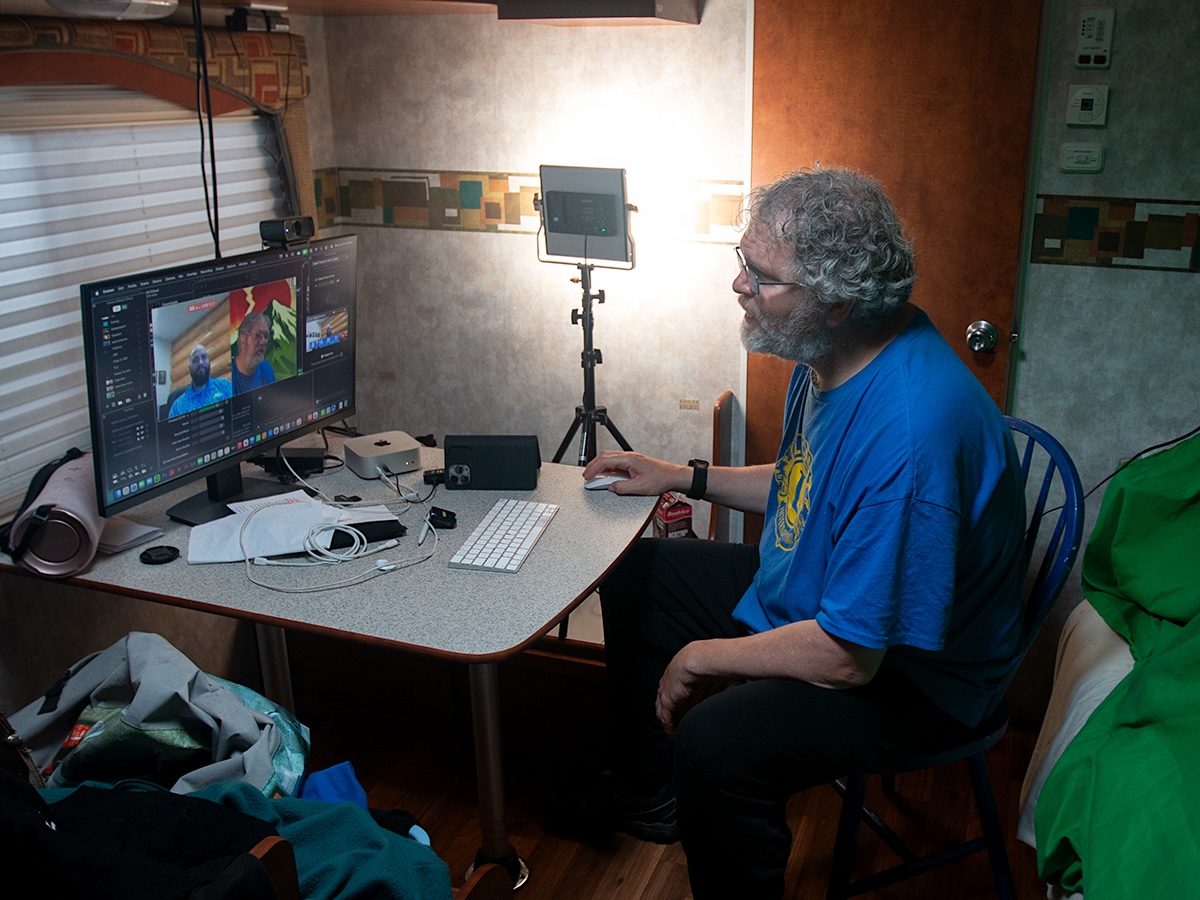
Trent Ernst sits in a dimly lit travel trailer and turns on his computer.
Outside, dappled morning light filters through aspen trees at the Flatbed Creek campground. Ernst has been up for hours. He has completed his morning chores, biked the three kilometres home to see his wife and ride with her to work, and then cycled back to this campground on the outskirts of town.
Now he takes a seat at a makeshift studio tucked at the end of the cramped camper and clicks “Go live” on his computer monitor. The screen plays a clip of newspapers rolling off a printing press. Then Ernst’s face appears.
“Good morning, everybody,” he begins. “This is your day in Tumbler Ridge.”
These morning dispatches have become a daily ritual since February, after a shooting at the local high school claimed the lives of nine community members, including five children. As the first news reporter to arrive at the scene, Ernst’s reporting became a vital source of information as the tragedy unfolded.
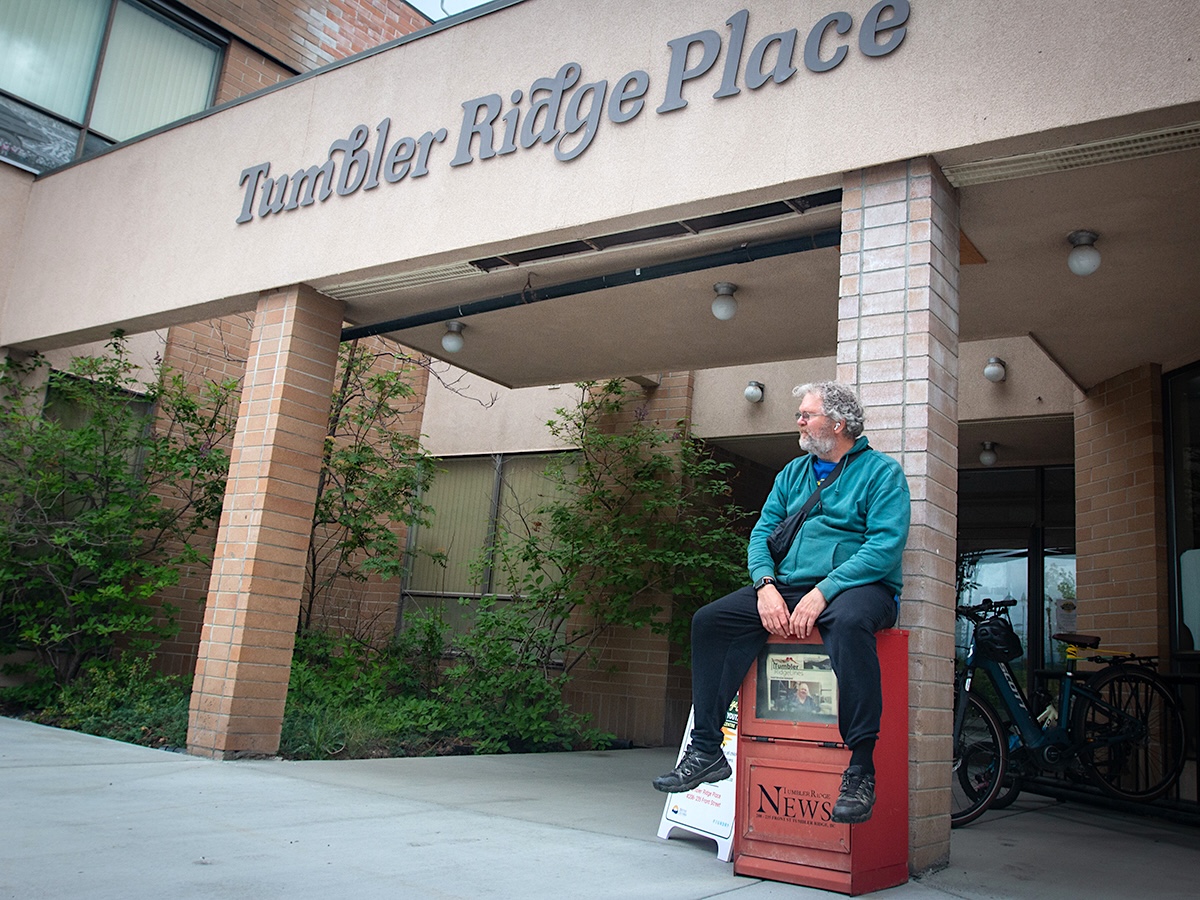
Ernst is the only reporter within 100 kilometres. He started Tumbler RidgeLines, which publishes online and in print every other week, after the town’s previous newspaper closed a decade ago. His morning updates have become a local news staple, and today’s broadcast quickly racks up hundreds of views — a significant reach in a town of just 2,400 people.
On any given day, the broadcasts can include everything from reminders about the upcoming fishing derby and drop-in ball hockey to updates on the high school demolition to an interview with Canada’s Governor General. Today, he reminds parents that the FIFA World Cup event will disrupt daycare parking before moving to an interview with a local town councillor.
Then, Ernst turns the camera to me. I’m here to better understand how a shrinking news media landscape is affecting small-town British Columbians. I’m especially interested in northeast B.C., a region that has been described as a “news desert” after losing a half-dozen community newspapers over the past decade.
In June, I spent time in Tumbler Ridge, Dawson Creek and Fort St. John, speaking with residents, government officials and journalists. Although the number of reporters in the region has shrunk considerably over the past decade, I discovered a close-knit community of journalists who are supporting one another to continue telling the stories that matter to their communities.
They include a rookie reporter in Fort St. John who bought the local newspaper after it shuttered in 2023; a trusted broadcast journalist whose reporting brought national attention to a wave of violent crime in Dawson Creek; and Ernst, whose coverage of the devastating shooting in Tumbler Ridge earlier this year reached audiences around the world.
But reporters like Ernst are becoming increasingly rare.
According to the last census, B.C. lost 185 reporter and columnist positions between 2016 and 2021. The losses are especially acute in rural areas, which have been hardest hit by newsroom closures, according to the Local News Research Project.
The project’s founder and co-director, April Lindgren, says anyone delivering independent, verified news reporting focused on a defined geographic region is providing an important service to rural residents. But they face challenges that have plagued the news industry for decades.
“If a community is lucky enough to have a former journalist whose local paper shuts down and then they start a newsletter, they’re really lucky to have it,” Lindgren says. “The truth is, often people start these very laudable projects, but after a while they just burn out.”
Local news decline: How did we get here?
Over the past century, local news evolved from a mom-and-pop cottage industry to a billion-dollar business.
The early 1900s saw the rise of locally owned community newspapers. But an “orgy of consolidation” in the latter half of the century resulted in many publications being gobbled up by corporate media, says Dwayne Winseck, a professor at Carleton University’s school of journalism and communication.
That transition wasn’t entirely a bad thing. Corporate ownership allowed small news outlets to lower their costs and access resources such as journalism training and editing support. But the transition from community service to corporate asset came at a cost.
“The ownership of these publications became detached from the communities that they’re serving,” Southern Alberta Institute of Technology journalism professor Tyler Nagel says. “Of course, that’s not in the community’s best interest.”
The 1981 Kent Commission report found that media consolidation was “clearly and directly contrary to the public interest” and resulted in less revenue being directed to news reporting. But the commission’s recommendations — which included breaking up regional monopolies and implementing restrictions on the sale and closure of newspapers — were panned by industry and largely ignored by government.
By the turn of the millennium, Canada’s major media companies had loaded themselves with unsustainable debt coupled with unrealistic profit expectations. Newspaper revenues began to soften in the early 2000s as people began choosing Craigslist over their local classifieds. As a result, newspaper chains increasingly traded, consolidated and closed small-town news outlets to maximize profits.
Many experts point to 2008 as a turning point for local journalism. It was the year of the financial crisis. The advent of the iPhone a year earlier offered free news at your fingertips. Facebook was gaining traction, and tech companies, which could provide inexpensive, targeted online ads, were increasingly siphoning the advertising dollars that had sustained the news industry for more than a century.
According to data from News Media Canada, an organization representing the country’s media companies, community newspapers collectively earned more than $1.2 billion from ad revenue in 2008. By 2022, the last year for which it published financial information, community newspapers collectively brought in $385 million — just 30 per cent of what they were earning a decade earlier. Included in the amount was online advertising, which hadn’t come close to making up for declines in print advertising and still represented less than 20 per cent of total revenue.
Winseck’s research shows that, today, three-quarters of Canadian advertising dollars are spent online. Most of that — nearly 90 per cent — goes to just three U.S. tech giants: Meta, Amazon and Google. Canadian media companies collectively account for less than four per cent.
News media that rely on ad revenue are being “deprived of oxygen,” Winseck writes. “By consolidating their grip on advertising in the last decade [tech companies] have driven the nail into the coffin of traditional commercial media and journalism.”
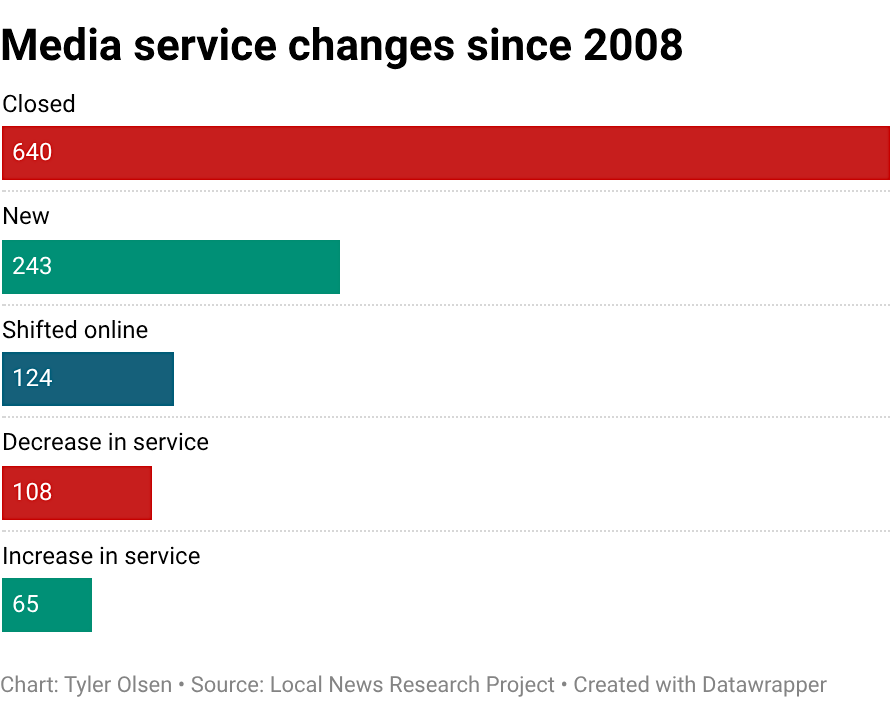
Community newspapers have been hit particularly hard. Lindgren’s Local News Research Project shows that, since 2008, 640 local news outlets have closed across Canada, including 95 in B.C. Nearly three-quarters were community newspapers.
While 453 local news outlets launched over the same period, more than one-third of those have subsequently closed.
There’s been little political will to address the issue, Winseck says, despite inquiries like the Kent Commission sounding the alarm for decades. “They’re swapping these papers and dividing up regions into these mutually exclusive operations, and they’re getting away with it,” he says.
Throughout the 2010s, B.C.’s two largest community newspaper chains, Black Press and Glacier Media, sought to avoid competition by trading dozens of local newspapers. After acquiring both newspapers in a community, the companies would then shutter one of the outlets. In 2012, the two companies owned a combined 107 titles in B.C. A decade later, the number had fallen to 85, according to News Media Canada.
Even where newspaper titles have survived, their newsroom capacity has frequently suffered. Community newspapers that boasted a fully staffed newsroom two decades ago now frequently share a regional editor and operate on a skeleton staff. In Haida Gwaii, Black Press maintains a website for its now defunct newspaper, despite it having no physical presence or locally based reporting on the northern archipelago.
It’s an example of what U.S. local journalism expert Margaret Sullivan describes in her book Ghosting the News: Local Journalism and the Crisis of American Democracy as a “ghost” newspaper.
Not just bake sales and bylaw amendments
The result is fewer news reporters sitting through small-town council meetings and court hearings or being present at local events.
In 2018, when Dawson Creek Mirror editor Rob Brown spotted members of the far-right anti-immigrant group Soldiers of Odin marching in a local parade, he reported on it. The story later reached a national audience when it was picked up by CBC.
But with fewer community news reporters on the ground, important information — such as the presence of a white supremacist group in your town — is less likely to make it to the public.
“Things get missed because reporters don’t write as much,” says Brown, who launched his own daily email newsletter and biweekly newspaper after Glacier closed the Mirror in 2023. “They don’t sit in city council. They’ll watch the video highlights at triple speed.”
Sullivan writes in her book that it’s not just “watchdog journalism” that is lost when local news disappears. The community loses a sense of itself.
“It’s the way a local columnist can express a community’s frustration or triumph,” she says, adding that feature stories, restaurant reviews, obituaries and letters to the editor all contribute to a sense of identity. “The newspaper ties a region together, helps it make sense of itself, fosters a sense of community, serves as a village square whose boundaries transcend Facebook’s filter bubble.”
Lindgren says that residents who experience a decline in news “feel a lack of connection, they feel a little bit lost, they feel like they’re missing out on important community events.” It also makes local government less effective by feeding mistrust in politicians and making candidates less likely to run for office.
“I used to joke that as news organizations started to fold, there was more than one local politician who said, ‘Great, no more of those pesky reporters asking me questions,’” Lindgren says. “But now they’re operating in a vacuum where there is no local news and... residents get really angry when they feel like they’ve been blindsided by a decision.”
Nagel says he hears from local news reporters that they are “stretched thin.”
“They feel that their positions are precarious. They feel that they’re being asked to do more with less. They feel that the publications that they work for are hanging by a thread, in some cases,” he says. “At the same time, I see just an incredible amount of passion in terms of serving that community.”
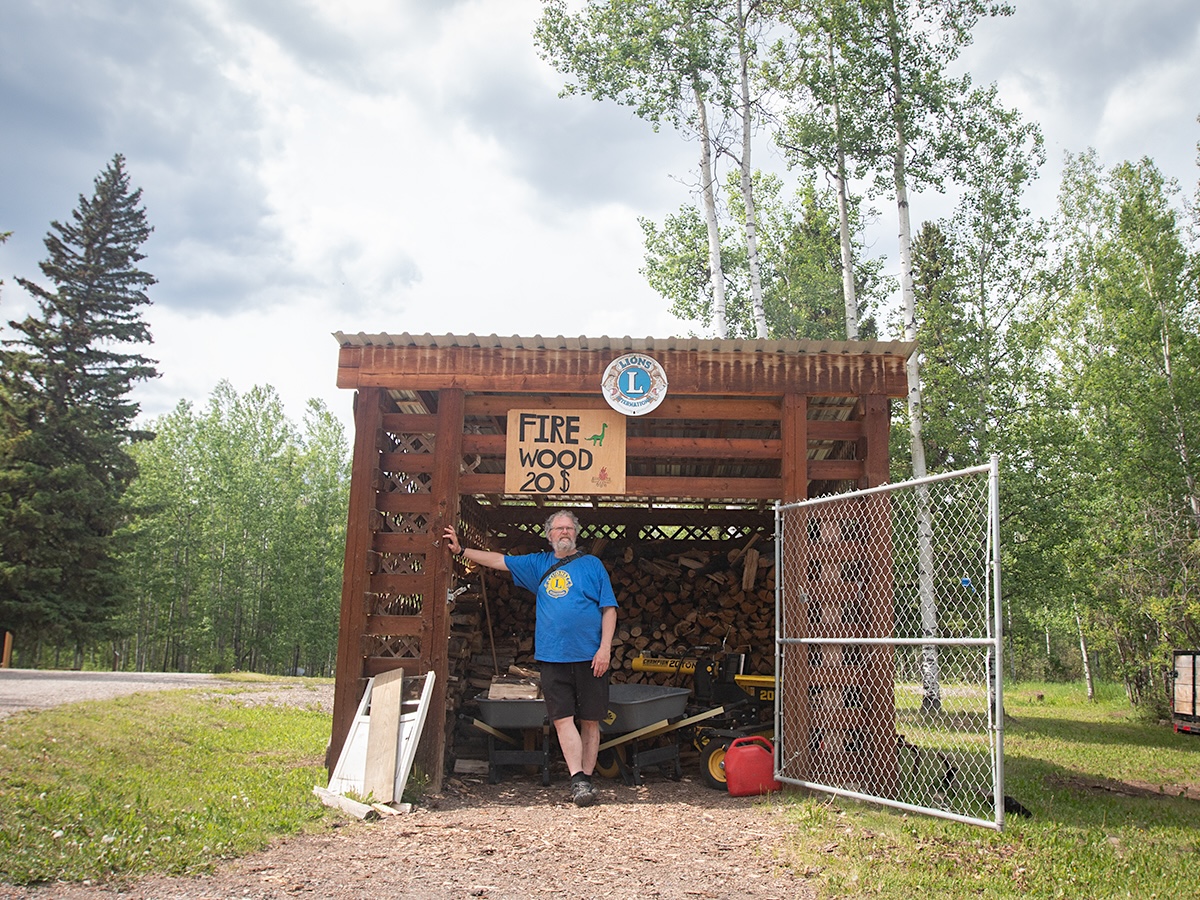
In Tumbler Ridge, Ernst subsidizes the newspaper by working other jobs. This summer, he worked as the attendant at the local campground. Between greeting guests, cleaning bathrooms and doling out wheelbarrow loads of firewood, he diligently continued to report the news.
Ernst says his wife, Colette, is lukewarm to the arrangement. She wanted to spend the summer camping, he says with a hint of irony.
It’s an enormous effort to keep the newspaper going. “We have had weeks where the discussion has degenerated to ‘I’m not sure that the paper will survive the year,’” Ernst says. “It’s definitely more a passion project than it is a revenue generator.”
But locals throughout the region told me that those efforts are appreciated.
In June, I travelled to northeast B.C. to report on news deserts. Instead, I found what Lindgren prefers to call local news poverty — local media struggling to keep up with the information needs of their communities.
I found a small but dedicated network of reporters that continue to serve their communities despite the challenges. Ernst’s work following the Tumbler Ridge shooting highlights the importance of local news sources, and in each community, residents pointed to their local journalists as critical sources of information. But their appreciation was often followed by a lament: What if they, too, were to disappear?
I also heard stories of hope. Media experts and professionals shared perspectives on what is working as the news industry navigates these shifting sands. We’ll conclude by considering the path forward for local journalism, exploring solutions that could ensure residents remain informed about their communities, their neighbours and their governments.
This series was produced through the support of the Government House Foundation and Jack Webster Foundation through the Lieutenant Governor’s BC Journalism Fellowship. The funders did not provide any editorial oversight. 
Read more: Media












Tyee Commenting Guidelines
Please note that email notifications for replies are not currently working due to a software issue which may be resolved in a future update.
Comments that violate guidelines risk being deleted, and violations may result in a temporary or permanent user ban. Maintain the spirit of good conversation to stay in the discussion and be patient with moderators. Comments are reviewed regularly but not in real time.
Do:
Do not: