


 SHARE:

When QuadrigaCX co-founder Gerald Cotten died from complications related to Crohn’s disease while on his honeymoon in India in 2018, he left behind a fraudulent cryptocurrency exchange that owed more than 76,000 Canadians roughly $215 million.
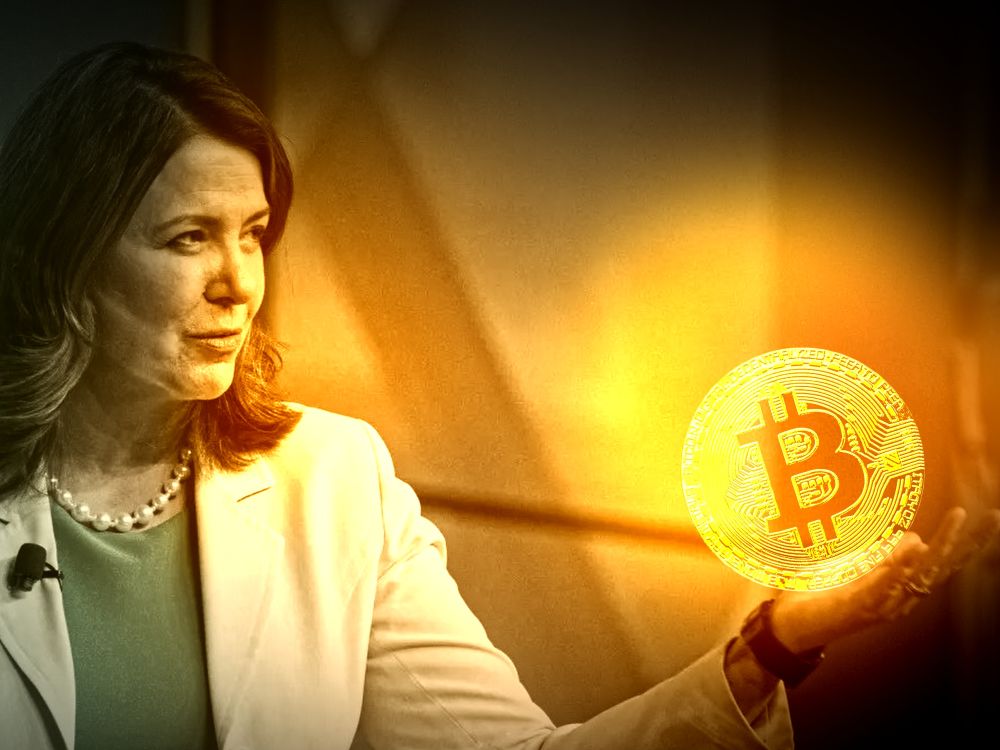
Among those who publicly admitted to losing money in the collapse was Alberta Premier Danielle Smith.
Despite being a victim of cryptocurrency fraud, Smith has continued to champion the industry. Before returning to politics, Smith occasionally hosted a radio show. In a 2022 episode for the Western Standard, she called cryptocurrency a “spiritual philosophy” and credited the bitcoin community with starting “the war on woke capitalism.”
An investigation by The Tyee found that since Smith became United Conservative Party premier in October 2022, her government has developed extensive ties with, and actively courted, the cryptocurrency industry, despite its history of massive investor losses due to extreme volatility, fraud and security breaches.
Smith’s UCP ministers and staff have consistently travelled abroad — with industry representatives — to solicit business from cryptocurrency enterprises. Ministers, and even the province’s regulators, have participated in private policy consultations with industry groups. Dale Nally, the minister responsible for the industry, appointed the country’s most prominent cryptocurrency lobbyist to the board of the provincial iGaming regulator, an appointment one ethics expert called a clear conflict of interest.
At the same time, MLA financial disclosures show that Smith and Nally hold cryptocurrency or investments tied to its value.
Experts say these relationships and financial interests raise ethical concerns. University of British Columbia economics professor Werner Antweiler warned that politicians promoting the industry are disregarding its financial risks and potentially exposing ordinary Albertans to harm.
“These politicians are doing a disservice to their constituents and to the population at large by promoting something that is clearly extremely problematic,” he said.
A speculative and volatile asset
Cryptocurrencies are a type of digital money that uses blockchain technology, a shared digital ledger maintained by a network of computers that verifies and records transactions. Some, such as central bank digital currencies, tie their value to another tangible asset, and Antweiler said those can be seen as a relatively stable investment.
Bitcoin, however, is not issued or backed by a government, nor does it represent ownership of a business that produces goods or provides a revenue-generating service. Instead, the market price reflects what people are willing to pay, and it will almost certainly fail at some point when the cost of producing more bitcoins no longer matches their perceived value.
Antweiler said this makes bitcoin an especially speculative and volatile asset. “If today they think one bitcoin is worth US$100,000, there is absolutely no guarantee that anyone will give you any money for it tomorrow.
“It is completely without basis because governments do not back it. It is not backed by anything except the value that people are willing to attribute to this token.”
In July, the Alberta Securities Commission barred the Calgary-based crypto-asset trading platform Catalyx from Canadian markets, following the initial collapse of the platform over a US$14-million shortfall and a fraud investigation of the company’s co-founder Jae Ho Lee.
Antweiler compares bitcoin's economics to a Ponzi scheme, arguing that early investors and industry executives profit as demand grows and prices rise, while later-stage investors face significant losses when that demand evaporates.
“It is exactly like any Ponzi scheme, but it is the most successful and slowest-burning Ponzi scheme ever,” he said.
Alberta’s busy blockchain lobbyists
Founded in 2018 by longtime cryptocurrency investor Koleya Karringten, the Canadian Bitcoin Consortium, formerly known as the Canadian Blockchain Consortium, is the primary group advocating for the industry in Alberta. The organization's website says its mission is to establish Canada as one of the top 10 global jurisdictions for bitcoin, develop a national bitcoin reserve and secure more than 20 per cent of the world’s bitcoin mining capacity.
The consortium’s membership packages range from $5,000 to $40,000 annually and promise members opportunities to “directly influence policymakers and advocate for the interests” of their business.
Its membership includes some of the world’s most infamous cryptocurrency companies, including CoinFlip. The attorney general of Iowa is suing the company, alleging it knowingly facilitated and profited from fraudulent transactions at its cryptocurrency ATMs. (A similar Missouri suit was dismissed last week.)
Antweiler said that insufficient regulatory oversight creates ample opportunities for fraud, leaving consumers vulnerable to financial losses. The industry provides the infrastructure for fraudulent investment schemes, while promoters market cryptocurrency in ways that make it seem more legitimate.
“The industry enables the fraudsters and the fraudsters enable the industry,” he said.
Alberta’s efforts to attract cryptocurrency businesses date back to Jason Kenney's premiership. During his tenure as UCP leader, he attended the Canadian Bitcoin Consortium’s first-ever trade mission in Calgary. Karringten, in multiple interviews, called the experience “an orange pill session,” in which someone is persuaded to believe in bitcoin and its value as sound money.
Under Kenney, the government created a dedicated concierge service, with Invest Alberta, to help financial technology companies navigate Alberta’s regulatory requirements. They also passed the Financial Innovation Act. It allows companies to apply for a temporary exemption from certain legislative and regulatory requirements, such as the Consumer Protection Act and the Personal Information Protection Act.
Antweiler said this kind of deregulation can create risks for consumers.
“Deregulation that takes away oversight where oversight is needed harms consumers, precisely when it comes to banking and money,” he said. “I think governments do have a duty to their constituents to keep them safe from harm.”
Greasing the wheels for crypto
The province’s support for cryptocurrency continued after Smith became premier. In April 2022, Smith discussed her return to politics at a consortium event, highlighting the need for politicians to understand cryptocurrency and the regulatory barriers facing the industry to better support it.
Karringten, the bitcoin lobbyist, later contributed $800 to Smith’s UCP leadership campaign. Between 2022 and 2026, Karringten donated another more than $6,100 to the party, according to Elections Alberta records. She also donated $2,250 to the Alberta NDP between 2018 and 2019.
On an episode of pro-cryptocurrency YouTuber Sunny Ray’s podcast last year, Karringten described asking Smith to appoint a minister to promote the industry actively, saying it would help the industry gain credibility and attract cryptocurrency businesses to Alberta.
“When she got elected, I was like, ‘My ask would be, help me create legitimacy in this space. And we need ministers to be mandated specifically to work with our organization to attract business to this province,’” she said. “‘If you can get me ministers mandated, I can attract you billions of dollars of investment through bitcoin mining.’”
Smith appointed Dale Nally as minister of Service Alberta and red tape reduction and Nate Glubish as minister of technology and innovation. She directed both to reduce the regulatory burden on blockchain-based technologies. Since then, the province has routinely taken publicly funded trips across North America with the cryptocurrency lobby group to pitch itself to international cryptocurrency companies.
While moderating a panel for the Canadian Bitcoin Consortium in 2023, Nally focused his message on reducing regulation for these companies, framing reduced government interference as a priority for both the industry and government.
“What I hear from this industry is really that the government’s job is to get out of your way,” Nally said. “I want to get rid of regulation, not all of it, but I want to get rid of lots of it and make it easier for you to do business.”
While he acknowledged that Alberta already has independent bodies overseeing many of these companies' utility and regulatory needs, he offered to organize discussions between these regulators and cryptocurrency companies.
Since 2023, the consortium has increasingly documented meetings between industry representatives and senior officials, which are said to address cryptocurrency mining, Alberta’s energy infrastructure and investment opportunities. Karringten has described the expansion of these relationships as a measure of the organization’s success.
“We have regulators leading our roundtables and coming to all of our events,” she said in her 2025 interview with Blockchain North.
She also described the organization as having multiple working groups being led by provincial regulators, with one being led by four cabinet ministers.
Ministerial involvement was evident during Nally and Glubish’s speech at a cryptocurrency conference in Texas last fall, when Glubish described the province’s data centre concierge service as a “one-stop shop” for developing cryptocurrency mines.
“You come to us. You tell us what you are looking to do, what is the vision for your project. We will help you find the optimal sites,” Glubish said, adding that the service could help developers identify available water, natural gas and electricity infrastructure, as well as municipalities supportive of their projects.
“If there is a permit you need from the department of energy, we will bring the right people from energy. And if there is a permit for the environment that you need, we will bring the people from our environment department.”
Toward an ‘Alberta Bitcoin Act’
In its 2025 annual report, the consortium identified an “Alberta Bitcoin Act” and a bitcoin mining and digital-asset road map as priorities for its government relations work. The group reported that it contributed draft language and background materials to the proposed road map, which aims to address issues including cryptocurrency mining, energy infrastructure and regulatory requirements.
Earlier this year, the consortium held invitation-only policy consultations for the “Alberta Bitcoin Act,” hosted by Nally. According to the event listing on the organization's website, the meetings aimed to explore what companies wanted included in the legislation and how the province could become more competitive in attracting bitcoin-related businesses.
That explanation aligns with an interview Nally gave to Blockchain North in 2025, in which he said he and Smith were enthusiastic about legislation that specifically supports the cryptocurrency sector and that they would let the industry lead on its contents.
“What does the industry want the Alberta Bitcoin Act to say that is going to enable this industry to supercharge it, to get it to the next level?” he said.
In the same interview, Nally said the government felt inspired by El Salvador's approach to cryptocurrency.
“We look at El Salvador; we love what they have done,” Nally said.
El Salvador became the first country to adopt bitcoin as legal tender in 2021, encouraging its use for everyday purchases. Public adoption of the technology was limited, and in January 2025 the country had to make bitcoin acceptance voluntary as part of a US$1.4-billion loan agreement with the International Monetary Fund, intended to mitigate macroeconomic risks from its aggressive adoption of cryptocurrency.
Conflict of interest concerns
Duff Conacher, co-founder of the government accountability organization Democracy Watch, said consultation with industry representatives is not inherently inappropriate. Still, governments should give people with competing interests meaningful opportunities to participate in policy development.
“Whenever you see an imbalance in terms of more access given to one stakeholder or a few stakeholders and certain other stakeholders ignored or not given as much access or opportunities to make their voice heard, then the public is quite justified in concluding that it is a process that favours one interest over the public interest,” Conacher said.
In February, Nally appointed Karringten, the cryptocurrency lobbyist, to the board of the Alberta iGaming Corp., the Crown corporation that oversees the province’s online gambling market. Karringten has continued to serve as executive director of the Canadian Bitcoin Consortium while holding the board seat.
In July, the Alberta iGaming Corp. was listed as a sponsor of the consortium’s annual Calgary Stampede Hootenanny. The group holds this social event each year as part of its Alberta trade mission, which was “held in honour of Minister Dale Nally” this year.
One month later, the consortium announced that Karringten had helped organize a three-day visit to Alberta for Nigel Feetham, Gibraltar’s minister for justice, trade and industry. The visit included meetings with Nally, the Alberta Gaming, Liquor and Cannabis Commission, the Alberta iGaming Corp. and the Alberta Securities Commission. Discussions focused on regulatory co-operation between Alberta and Gibraltar, including the use of digital assets in online gambling and prediction markets.
Alberta’s Lobbyists Act includes an exemption that allows registered lobbyists to receive compensation for serving on certain government boards. However, the Alberta iGaming Corp.’s code of conduct imposes separate obligations on board members to act impartially, avoid conflicts involving private interest and disclose real or apparent conflicts.
The Tyee asked the Alberta iGaming Corp. how Karringten, a cryptocurrency industry lobbyist, was allowed to be appointed to the board, how her presence aligns with its code of conduct and how many decisions Karringten has recused herself from.
A spokesperson did not directly answer any of those questions but said it “has processes in place to manage disclosed conflicts.”
Karringten told The Tyee she has fully disclosed any potential conflicts to the board and does not “engage in any board activities that would create a conflict.” She declined to say to whom she disclosed her conflicts, what those conflicts were and how they were addressed.
Conacher said it would be impossible for Karringten to avoid being in a conflict.
“[For her] to say that she steps aside when there is a conflict, there is always a conflict.”
Smith’s public disclosure statement of Dec. 31, 2025, filed with Alberta’s ethics commissioner, lists bitcoin among her other assets. Nally’s disclosure lists a cryptocurrency exchange-traded fund through an investment firm.
Dale Nally, Danielle Smith and Nate Glubish did not respond to The Tyee’s interview requests.
‘A gigantic loophole’
Conacher said the investments raise concerns about the effectiveness of Alberta’s conflict-of-interest rules, especially when politicians make decisions that affect industries in which they have personal financial interests.
“It seems to be legal because of huge loopholes in the ethics and lobbying ethics rules in Alberta, but it is still clearly unethical,” he said.
Alberta’s Conflicts of Interest Act excludes decisions of broad or general application from qualifying as furthering private interests, which means that if a government decision affects an entire industry, it likely won’t constitute a prohibited conflict, even when a politician owns investments whose value could be affected.
“They are allowed, under the Conflicts of Interest Act, to participate in decisions that they can profit from as long as those decisions apply generally, which 99 per cent of decisions that cabinet ministers make do,” Conacher said.
“So it is a gigantic loophole. It really means that the law should be called the almost impossible to be in a conflict of interest act.”
In November 2025, the Alberta NDP brought forward legislation to strengthen the provincial conflict-of-interest law. Bill 202 proposed expanded rules addressing perceived conflicts, limits on gifts from lobbyists and a lower disclosure threshold for gifts. Both Glubish and Nally were among the 45 UCP MLAs who voted against the legislation.
Conacher said these loopholes should be closed, but they often stay open because politicians write the rules that regulate their conduct.
“Politicians get to write the rules, so they write weaker rules for themselves and their staff than they do for everybody else.”
But, legal or not, the public can see when something is amiss, Conacher said.
“The public can recognize something smelly and unethical, pretty much every time. And so there is a political cost to trying to hide behind a loophole-filled law.”
On cryptocurrency, Antweiler said governments should address the financial insecurity that drives people toward promises of easy money, instead of encouraging investment in speculative schemes that are bound to crash.
“There is now every reason to think this is a particularly problematic avenue, and we should educate people to stay away from it as much as they can,” he said.
“This is basically an attitude that is not particularly caring about the fallout it will have for families whose fortunes get destroyed when people invest in this, and the money just disappears.”
If you have any information for this story, or information for another story, please contact Madalyn Beach in confidence via email.
Tomorrow: Experts raise alarms about deepening cryptocurrency-related investments by AIMCo, the Alberta Crown corporation that manages pension plans among $194.7 billion in assets for the government.
This investigation was supported by the Tom Barrett Investigative Journalism Fund, established by The Tyee to honour the late journalist’s legacy of in-depth reporting in the public interest. 
Read more: Alberta












Tyee Commenting Guidelines
Please note that email notifications for replies are not currently working due to a software issue which may be resolved in a future update.
Comments that violate guidelines risk being deleted, and violations may result in a temporary or permanent user ban. Maintain the spirit of good conversation to stay in the discussion and be patient with moderators. Comments are reviewed regularly but not in real time.
Do:
Do not: