

 SHARE:

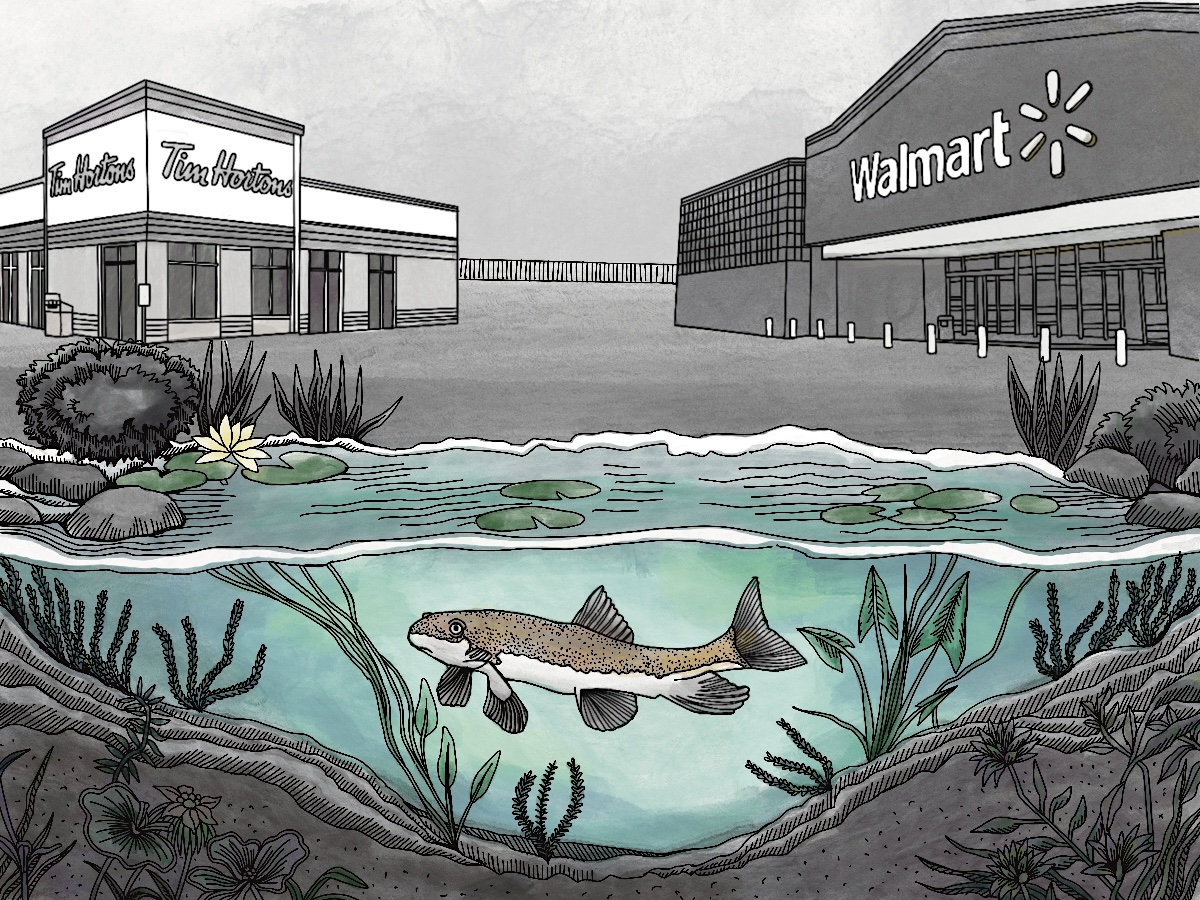
Fifteen years ago, a summer intern was catching fish in a Surrey stream for a wildlife survey. She netted a slender fish with fan-shaped fins she didn’t recognize, and tipped it into an oxygenated bucket to show her colleagues at A Rocha Canada, a Christian environmental stewardship organization.
“We got pretty excited when we saw what we thought was a Salish sucker,” David Anderson, B.C. co-director for A Rocha, told The Tyee. The fish had been considered locally extinct for several decades, he said.
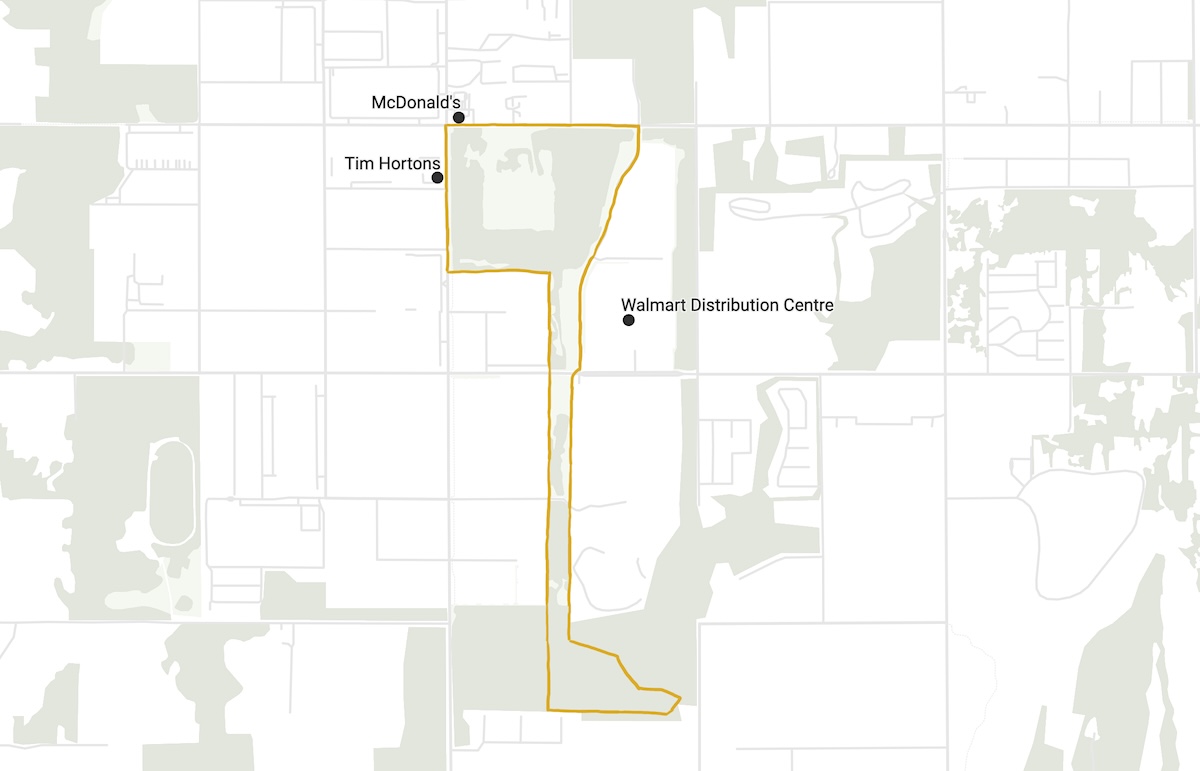
Staff and volunteers at A Rocha subsequently helped document hundreds of endangered Salish suckers in the stream, an unnamed tributary of the Little Campbell River in Surrey, which is sandwiched between two industrial parks and is metres away from a Walmart distribution centre parking lot.
This week, the deep-watered stream — along with a small, adjoining municipal park and an even smaller splotch of a city greenway — became Canada’s newest key biodiversity area.
The newly minted Campbell Heights key biodiversity area also sits next to a McDonald’s, a Tim Hortons and a facility producing heavy concrete segments for the Lower Mainland’s SkyTrain expansion project.
Steps away from the industrial and commercial hubbub, Salish suckers glide along the stream bed, foraging for midge fly larvae and other insects at dawn and dusk.
Western painted turtles also sun on the fringe of tiny ponds, barn owls listen for the rustle of a mouse or vole, and western toads and red-legged frogs nab ants and flies.
“You can grab a Tim Hortons and walk through the key biodiversity area,” Peter Soroye, the key biodiversity areas assessment and outreach co-ordinator for Wildlife Conservation Society Canada, told The Tyee.
Key biodiversity areas — usually known by their acronym, KBA — are places of exceptional importance for wildlife and ecosystems. They’re designated around the world according to strict scientific criteria.
They can be as small as the 14-hectare Christmas Hill KBA in Greater Victoria, which protects an urban pocket of the endangered Garry oak ecosystem, or as large as the 68,700-hectare Fraser River estuary KBA, a vital nursery for Pacific salmon that also supports vast populations of migratory and wintering birds.
B.C. has 80 of Canada’s 450 key biodiversity areas. There are more than 16,000 KBAs worldwide.
Soroye said key biodiversity areas are “bright spots in a world where biodiversity is under threat and species are declining.”
Despite its proximity to the Walmart and other commercial activity, the Campbell Heights site qualified to be a key biodiversity area because the stream is home to one per cent of Canada’s Salish suckers.
That might not sound like a lot, Soroye said, but biologists estimate Salish sucker populations have declined by up to 46 per cent over the past decade, meaning the site’s estimated 70 suckers are “significant.”
“Despite being surrounded by all sorts of development, and despite being in what most people would think is the most inhospitable area for an endangered species,” Soroye said, it’s encouraging to see Campbell Heights and other urban natural areas “hanging on.”
An ice age relic
Salish suckers, a genetically distinct dwarf form of the longnose sucker, are a relic from the last ice age. They’re about as long as a toothbrush, with mottled dark green or grey backs and lighter bellies. Males develop a bright red stripe down their flanks during spawning season.
The Salish suckers are of great interest to scientists because they’re a living example of how new species form when they are geographically isolated.
“It’s up there with Darwin’s finches,” fisheries biologist Mike Pearson told The Tyee, referring to finch studies on the Galápagos Islands that helped inspire Charles Darwin’s theory of evolution, showing how environmental conditions can cause species to adapt and change over time.
Ten thousand years ago, as thick ice sheets blanketed North America, a population of longnose suckers became trapped in the ice-free Chehalis River valley in Washington state. Cut off from other populations, they developed smaller bodies, larger scales, shorter snouts and narrower mouths.
As the ice sheets retreated, the Salish suckers used temporary, interconnected networks of lakes and streams to move north to B.C.’s lower Fraser River valley.
Today, Salish suckers live only in the lower Fraser Valley — in small lowland streams and sloughs, especially headwater marshes and beaver ponds — and in six watersheds in western Washington state.
Pearson, who wrote his PhD on Salish suckers, said the suckers are almost always found with salmon unless water quality is poor, as it “often is now in streams in the Fraser Valley, because of pollution.” The suckers are generally more tolerant of higher water temperatures, lower oxygen and other indicators of poor water quality.
“By the time the suckers are in trouble, the salmon are already gone,” he said.
‘Abundant ecosystem with beautiful species’
Declining water quality, largely because of nutrient pollution from agricultural runoff, poses a major threat to remaining Salish sucker populations in B.C., while Pearson said “a close second” is drought associated with climate change.
In the lower Little Campbell River, streams dry up altogether in the late summer and fall, “so they obviously don’t survive,” he said.
Rains also sweep airborne pollution, including nitrous oxide from car exhaust, into waterways with Salish suckers, Pearson added.
He said most of the Little Campbell River and its tributaries no longer have enough oxygen year-round to support Salish suckers, so the stream in the key biodiversity area is an important refuge and spawning area.
The Campbell Heights KBA designation recognizes that the stream is threatened by ongoing development of the surrounding lands, which is removing forest cover and increasing impervious surfaces. New developments, combined with rising vehicle traffic, are expected to increase contaminants in the Little Campbell River and its tributaries.
Land surrounding the Campbell Heights area is also undergoing a rezoning process from rural to light industrial land use, “which could further threaten the persistence of biodiversity at this site,” the designation notes.
Anderson, from A Rocha, said the area around Campbell Heights was heavily forested and “incredibly beautiful” a few decades ago when he was growing up in Surrey. Mature, second-growth Douglas fir and red cedar trees used to shade little streams, he said.
“I don’t want to lament too much about the loss,” Anderson said.
A Rocha is working to preserve what’s left of the natural world in the Campbell Heights area.
The group surveys for species at risk of extinction and removes invasive species such as Himalayan blackberry and reed canary grass from private properties and public lands and parks. Members also plant trees and create new wetlands for at-risk species such as red-legged frogs.
Anderson said the KBA designation “names what those of us who have been at this for a while already know.”
“It’s just a really abundant ecosystem with beautiful species.”
While key biodiversity areas don’t automatically bring legal protections, Soroye said the designation puts them in the national and global spotlight.
“It becomes a piece of information and a tool that people can use to support conservation and stewardship work across the country.” 
Read more: Environment







Tyee Commenting Guidelines
Please note that email notifications for replies are not currently working due to a software issue which may be resolved in a future update.
Comments that violate guidelines risk being deleted, and violations may result in a temporary or permanent user ban. Maintain the spirit of good conversation to stay in the discussion and be patient with moderators. Comments are reviewed regularly but not in real time.
Do:
Do not: