
 SHARE:

When one looks at a lot of art, an odd feeling can come creeping in alongside a bevy of questions. What is this? How did the artist do this? And principal among these, why did they do this?
Why do we humans feel the need, nay, the compulsion, to obsessively make paintings, sculptures, art installations? What foundational force lurks at the bottom of our nature that demands we put paint and pencil to paper and canvas?
Bring me into being, puny human, art demands! And we do.
Over the last few months as I visited different galleries in Vancouver, another question kept twining around my ankles like a stray cat. That question is how much? Yes, I’m talking money.
What happens when the market devours the creative impulse and turns it into product? I don’t really have any answers, just more questions and a curious form of unease with the metrics of the market.
That money and art have a twisted relationship isn’t a revelation. Even geniuses have had to fight to get paid. Think about Michelangelo di Lodovico Buonarroti Simoni’s famously tumultuous professional relationship with Pope Julius II, who commissioned him to paint the ceiling of the Sistine Chapel.
A number of recent local exhibitions offered a riposte to the insidious, invidious forces of capitalism, offering work that was personal, visceral and most importantly, political. The experience of seeing these shows reaffirmed the idea, at least for me, that the making of things, the very process itself, can and should have a higher purpose. Not to get too lofty, but maybe art can heal souls and create different futures.
At Kasko Gallery, extraordinary new work by youth in Haiti
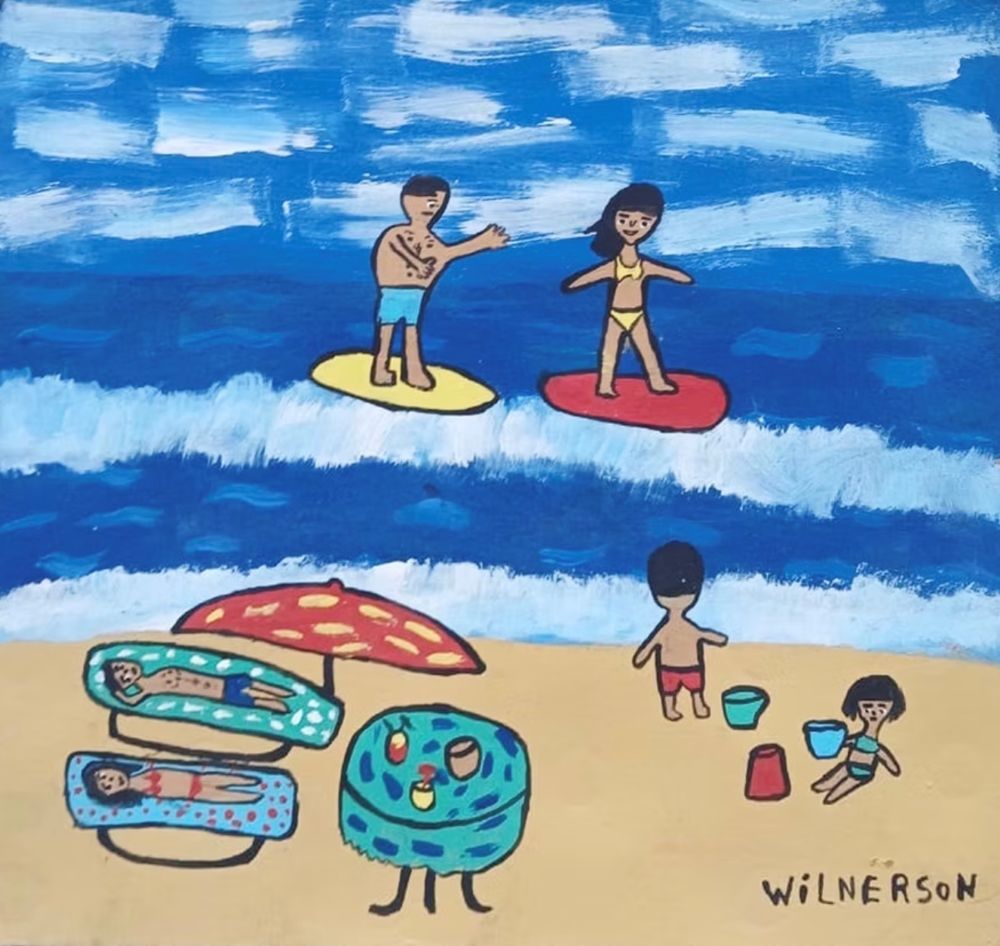
The Kasko Gallery, located on Clark Drive, recently presented a collection of work from the New Vision Art School, a free art school located in Port-au-Prince, Haiti.
Earlier in the fall, I visited the gallery on the show’s opening day and spoke with curator Dan Siney, who explained how the exhibition came about. Although the show closed in October, the work is still accessible to view online and, given the continuing challenges that Haitian people face, it feels important to note that positive things are still happening there.
Siney met the school’s founder, Lesly Pierre-Paul, in 2022. The two worked together to bring more than 40 drawings and paintings from the students for the first-ever presentation in Vancouver.
In an interview with the school’s founder posted on the Kasko Gallery’s social media, Pierre-Paul explained how the impetus for the school arose out of his own experiences.
“I was 18 in 2009. The neighbourhood I grew up in wasn’t an easy place to raise a kid because there are horrible things happening almost every day. People who live in that neighborhood don’t really have a monthly salary. Living in a poor community and growing up to become an honest person isn’t easy. Art changes negative minds into positive minds, especially for people who are living in the ghetto. Looking at the artists working in my community made me want to become an artist.”
In amongst the things that kids like to draw, there was other subject matter that no child should have to contend with represented in the bright and colourful work on display. The collection proved that it’s often the people who have the very least materially making the most extraordinary work, with whatever is at hand.
In the case of the children and youth who participated in New Vision’s program, drawing, painting and sculpture offered a place and a means to deal with the realities of daily life, but also to expand into other imagined worlds.
It’s been a number of weeks since I saw the show at the Kasko Gallery, but many of the images linger, sometimes uncomfortably. And that’s how it should be.
That’s the other thing about great art: it means something, it has a purpose, a function and sometimes a message.
At the Burnaby Art Gallery, vital work on resistance and solidarity
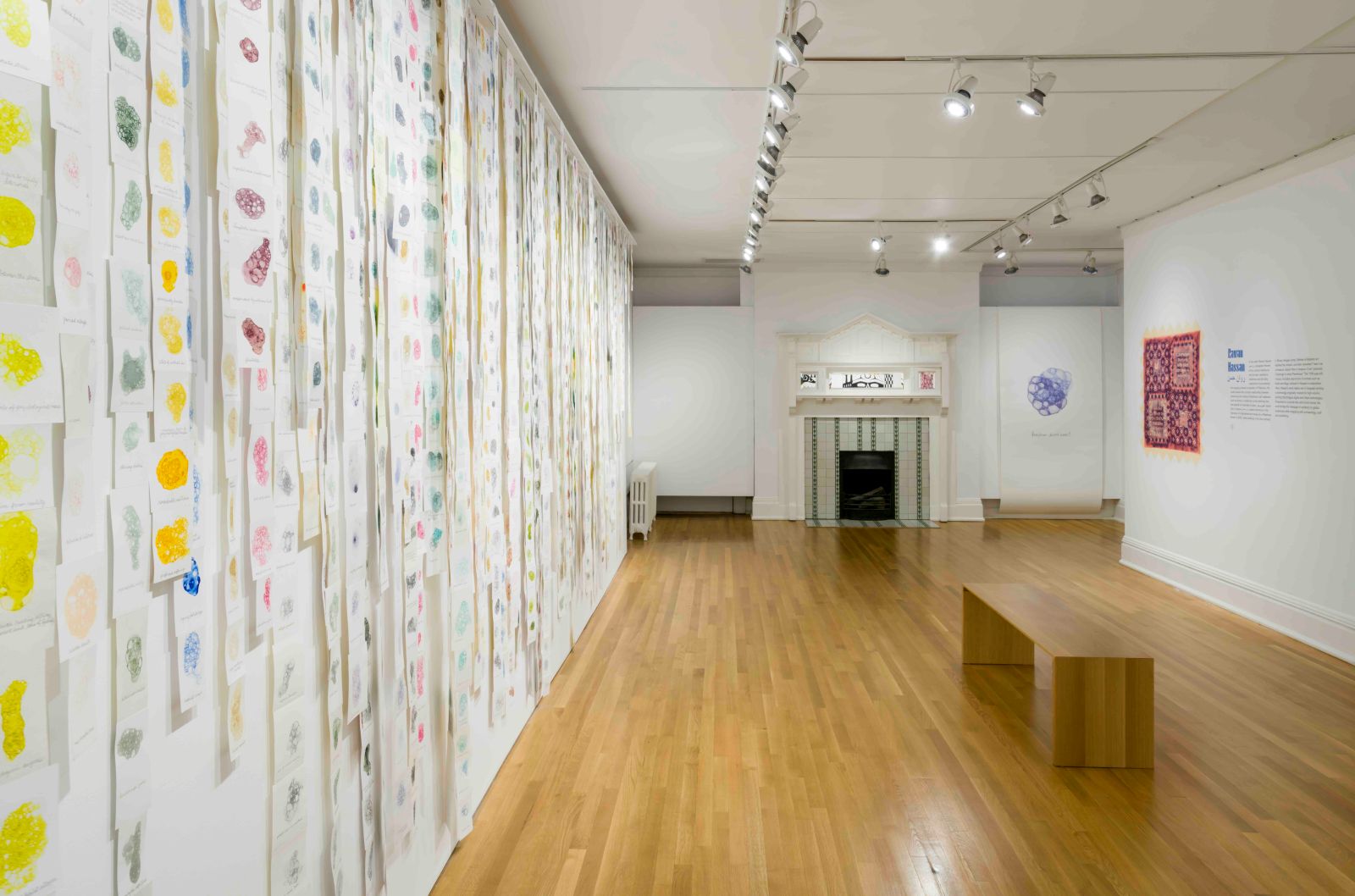
This is very much the case with RESIST!, a group show at the Burnaby Art Gallery. The show closes Nov. 15, but is very much worth junking all other plans and seeing the exhibition on its final weekend.
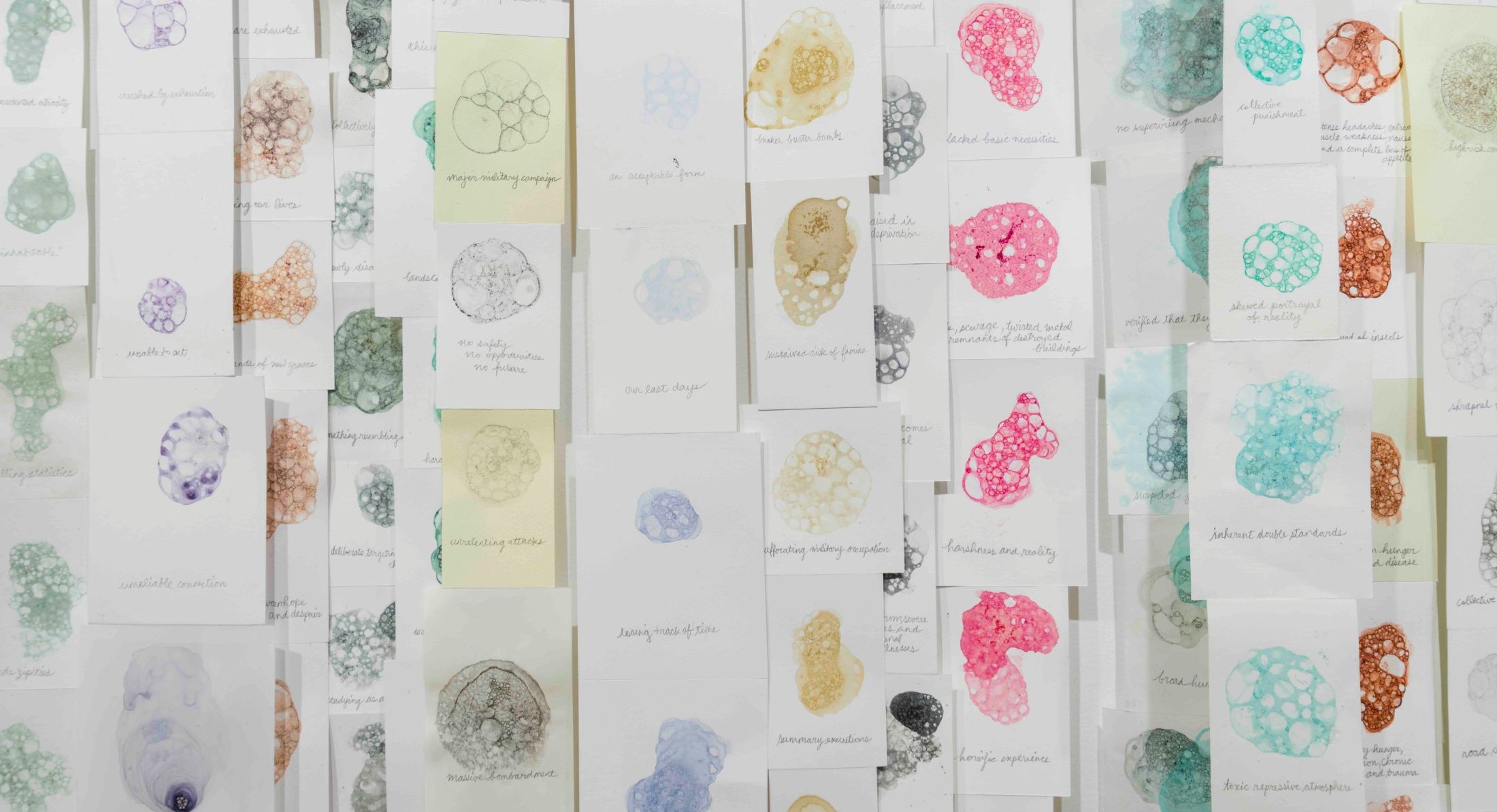
In addition to works from Rawan Hassan روان حسن, Gord Hill and Laurence Hyde, Elizabeth MacKenzie’s extraordinary installation Cleave walks the razored edge between beauty and horror.
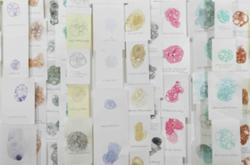
A number of years in creation, MacKenzie’s exquisite bubble drawings, created through the act of breathing, are layered in a dense hanging that invites closer inspection. The delicacy of the work — line, shape and colour — are so beautiful that that they sink deep into heart and mind.
There is much more than just beauty here, although aesthetics can act as a kind of backdoor to not only to consciousness, but also to conscience.
As a way to take in the unfathomable number of civilians casualties in Gaza, where at least 74,000 Palestinians have been killed, the act of making Cleave was not only a personal reaction for the artist, but a way for viewers to take in the scale of suffering without falling into despair.
In her artist’s statement, MacKenzie lays out not only the process of bringing the more than 2,000 drawings into being, but also how it has enabled her to bear the unbearable. She states it is “both a refuge from and engagement with the feelings of horror this catastrophe evokes.”
The genocide in Gaza isn’t over, and neither is MacKenzie’s work, which began in 2023 and continues.
At the Belkin Art Gallery, Jana Sterbak is brilliant
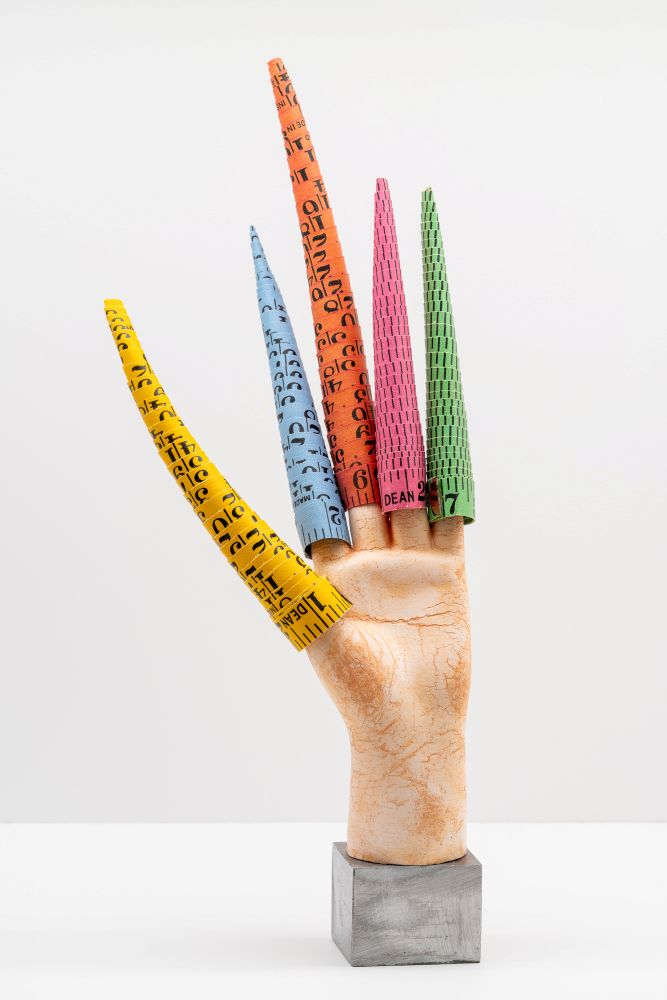
Elsewhere in Vancouver, a number of other terrific shows also challenge the idea that art is rarified and inaccessible, none more engaging than Jana Sterbak: Dimensions of Intimacy at the University of British Columbia’s Belkin Gallery.
When I was doing my undergrad in my twenties at the SFU’s School for the Contemporary Arts, Sterbak came to talk to our class of would-be artists. I remember her explaining the accidental origins of Generic Man, a photograph of a punk-looking dude with a bar code tattooed on the back of his neck. The idea came after the artist noticed a man, with the tag flipped up on the back of his shirt, which she initially mistook for a tattoo.
The fact that I can still recall some of what she talked about more than 35 years later is a testimony to the immediacy and brilliance of her work.
In conversation with curator Naomi Potter before the opening of the Belkin exhibition, Sterbak was blunt, funny and absolutely no bullshit. Based in Montreal, she has maintained a wildly diverse practice from sculpture to performance and back again.
Dimensions of Intimacy resurrects some of the artist’s spectacular works, from a manifesto touting the need for artists to be embedded in every level of society to a bed with a mattress made from an enormous loaf of baked bread, the appropriately titled Bread Bed (1996/2026).
Much of the earlier work, drawn from the artist’s own collection, maintains the poke-you-in-the-eye prankishness of youth, leavened with a good portion of intellectual rigour, humour and social critique.
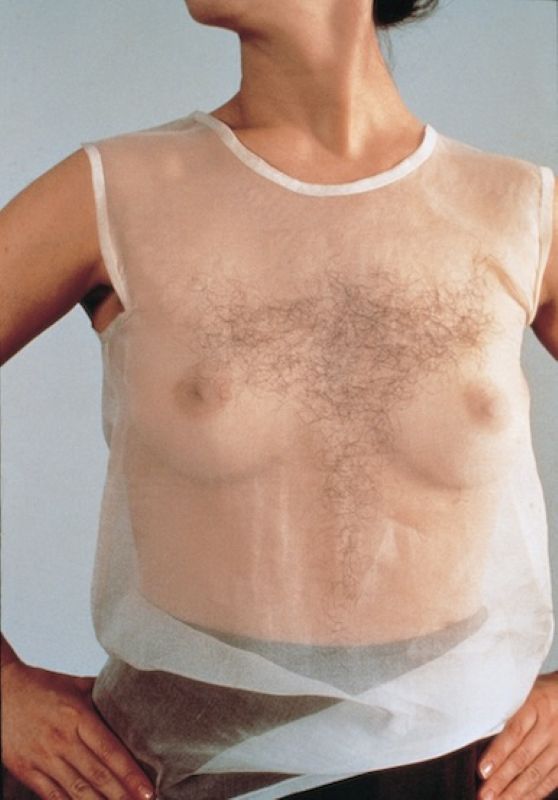
Born in Prague, Czechoslovakia, Sterbak and her family moved to Canada to escape the Soviet invasion. In addition to working with unlikely materials like ice, chocolate and gunpowder, Sterbak has also engaged in performance.
Her work is often small. As she explained in her talk, anything bigger than human scale is more about power than art, illustrating her point with a story about a sculpture in a Montreal park that causes dogs to bark, in reaction to the perceived aggressive size and scope of the figure.
“I prefer to call my work ‘objects’ or ‘situations,’ rather than ‘sculpture,” Sterbak said in her artist’s statement. “To relegate an object to the rarefied world of art negates its power to disturb and the potential for discovery. A really successful work of art has the ability to make us reconsider our perceptions — not only inside the museum, but also out in the world.”
At the Gibson Art Museum, a celebration of Martin Bartlett
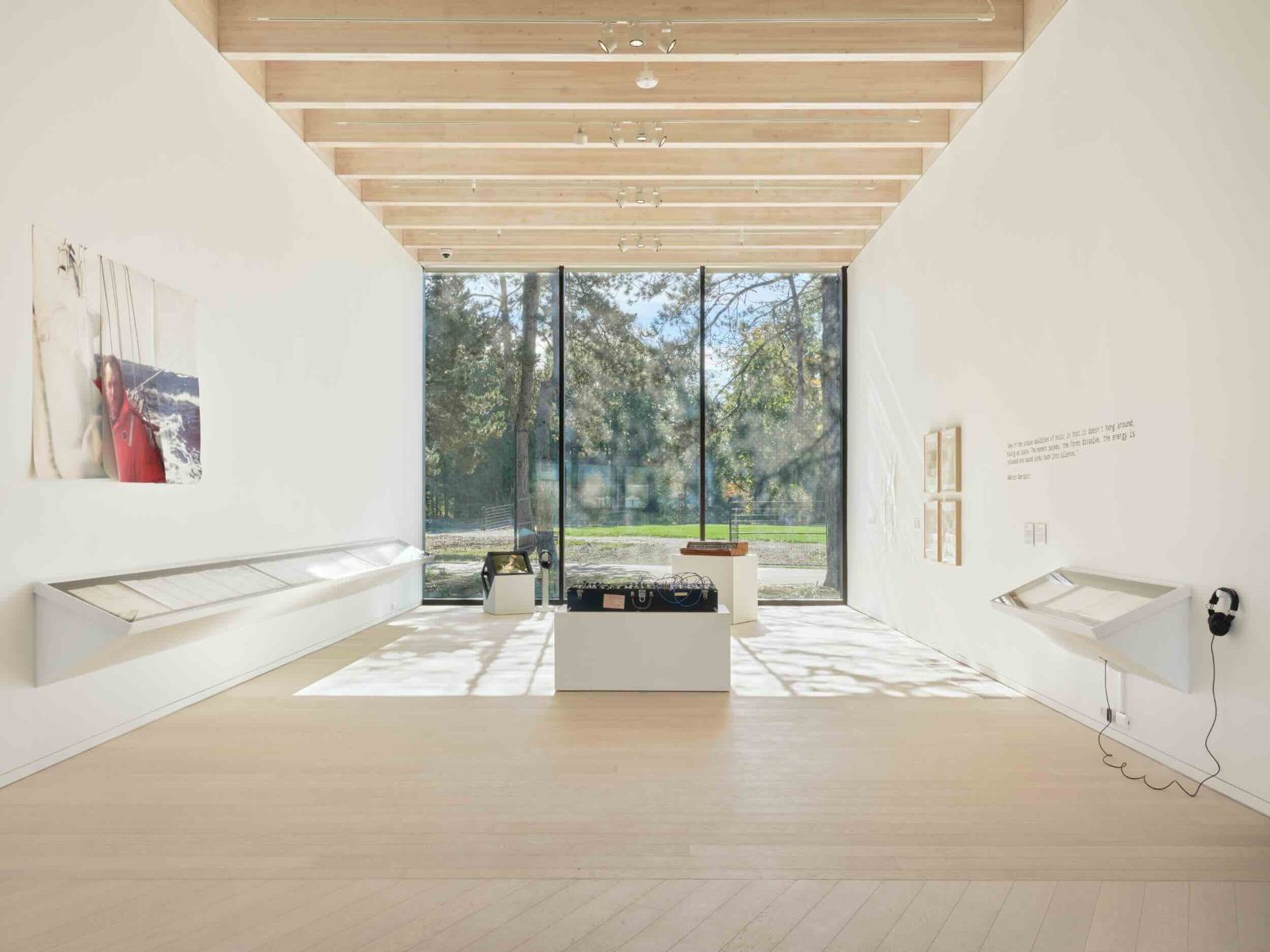
That idea also informs the work of the late Martin Bartlett, the subject of a new exhibition at SFU’s Gibson Art Museum.
On the site of original site of the School for the Contemporary Arts, the Gibson has arisen like a glorious phoenix. Martin Bartlett’s Begin Anywhere summons the late composer and SFU professor through an expansive exploration of his work. A co-founder of the Western Front artist-run centre in Mount Pleasant, Bartlett was a mover and shaker in Vancouver’s cultural community. He helped shape the arts curriculum at SFU, as well as the broader scope of cross-disciplinary collaboration in the city.
Curated by Charles Colbourne, María Estrada Piñera and Blqees Zuhair, with support and guidance from David MacWilliam, the show is a dizzying compilation of Bartlett’s investigations in the fields of music, performance and computer-performer interactivity. Openly gay, his many talents and interests including sailing, cooking and Indonesian Gamelan music. The title of the show sums up both its spirit and Bartlett’s approach: democratic, collaborative and open to the elemental forces at play in the universe.
All of these very different shows and experiences are a reminder that art is more than a way to park money. It’s more than a decorative bauble for the wealthy, or as the lyrics to Chicks on Speed’s song “Art Rules,” “Art is a playground for people who have everything.”
Fittingly enough, a major September 2026 biography of critic John Berger from author Tom Overton brings many of the current questions around the greater function of art into crystalline focus.
A paragraph from a recent New Yorker essay about Berger and his legacy leapt out at me.
“The visual arts had originated as a form of magic, of divine revelation. Then their authority became inseparable from wealth, from the palaces, museums, and fine homes where art works were displayed. Now, Berger explained, images of art had become ‘ephemeral, ubiquitous, insubstantial, available, valueless, free.’ What was needed was a corresponding change in how images could be used to connect ‘a people or class’ to its past.”
There is no single answer as to why we make art, but there is a bounty of different manifestations, as variegated and glorious as a meadow filled with flowers.
But the simplest answer may be this: making art makes us human.
‘RESIST’ at the Burnaby Art Gallery closes Nov. 15. That day, Elizabeth MacKenzie and fellow artist Rawan Hassan will be in conversation on Nov. 15 at 2 p.m. at the Burnaby Art Gallery. The event is free, but registration is required.
Jana Sterbak: Dimensions of Intimacy is on view at the Belkin Art Gallery at the University of British Columbia until Dec. 6.
Martin Bartlett’s Begin Anywhere is on view at the Gibson Art Museum at Simon Fraser University until Feb. 14, 2027. 
Read more: Art

Tyee Commenting Guidelines
Please note that email notifications for replies are not currently working due to a software issue which may be resolved in a future update.
Comments that violate guidelines risk being deleted, and violations may result in a temporary or permanent user ban. Maintain the spirit of good conversation to stay in the discussion and be patient with moderators. Comments are reviewed regularly but not in real time.
Do:
Do not: