



 SHARE:


April Lindgren could be considered Canada’s local news guru.
Lindgren spent the first half of her career working as a journalist before moving to Toronto Metropolitan University’s school of journalism, where she launched the Local News Research Project nearly 20 years ago. She is currently compiling a national local news directory — the first of its kind in Canada.
If anyone knows a thing or two about community news, it’s her. So I ask the pressing question: How do you build a successful local news outlet in today’s media landscape?
The industry has been in precipitous decline for decades. Over the past 20 years, tech companies have been siphoning advertising away from traditional news outlets, leading corporate media owners to consolidate news outlets and reduce editorial staff. Rural and remote areas have been hardest hit, leaving the remaining small-town reporters to do more work with fewer resources and reducing the volume of local news coverage.
When it comes to solutions, Lindgren doesn’t hesitate: the key to survival is doing good journalism.
“I would have a laser-focused commitment to producing journalism that will matter to people in the community,” she says. “There’s a whole range of coverage that you want to write about so that people see themselves in the news that you’re generating and it builds a sense of community.”
It sounds simple. But the challenges facing Canada’s news media are more complicated.
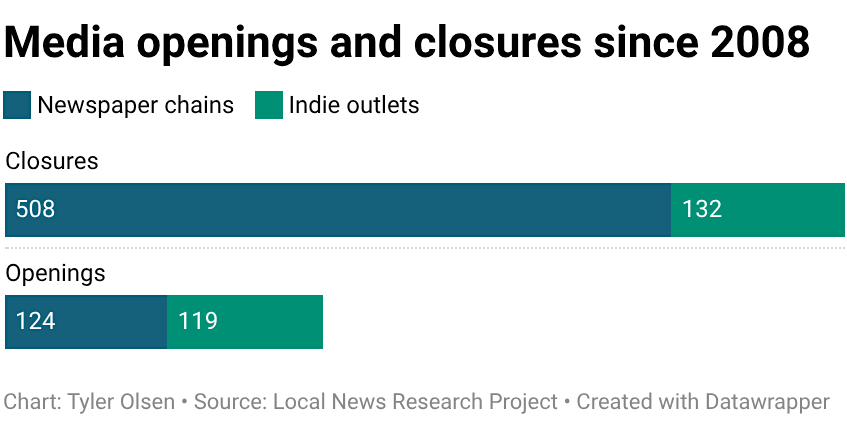
Lindgren’s research shows that of 640 local news outlets that closed in Canada since 2008, nearly three-quarters were community newspapers publishing fewer than five days a week. Of the closures, nearly 100 were located in B.C.
The losses amount to fewer journalists sitting in small-town council meetings, alerting communities to violent offenders or missing persons and covering local events. As a result, reporters are stretched thin and residents are less informed about their communities. Many are turning to social media for news, with the result that misinformation and conspiracies are replacing verified, on-the-ground reporting.
In many cases, the effects of declining news capacity may be unknown.
“We don’t know what we miss,” Canadian Association of Journalists president Brent Jolly says. “That’s the problem.”
The Tyee spent several months speaking with media professionals, experts and community members about the decline in local news capacity. We interviewed a junior reporter who bought the historic Alaska Highway News after it closed three years ago; we looked at how a local broadcast journalist covered a wave of violent crime in his community; and we profiled Trent Ernst, the only news reporter within 100 kilometres when the deadly Tumbler Ridge shooting occurred earlier this year.
While our reporting focused on northeast B.C., a region that has lost a half-dozen newspapers over the past decade, the challenges of declining local news capacity are ubiquitous across B.C. and Canada.
So, how can we save local news? It starts with good journalism. But news outlets need to be supported to do that work. Here’s a summary of what we heard in conversations with more than two dozen experts, journalists and community members about what the future might look like for a healthy news ecosystem in smaller communities.
Put community news reporters back in the community
The challenges in local news date back to last century.
Large media chains gobbled up small-town newspapers through the 1980s and ’90s and then, as profits began to soften in the early 2000s, began to gradually cut local reporters and replace them with content shared among multiple publications.
Then came the internet. By the early 2010s, advertisers were increasingly moving their business online and local news revenues were in free fall. Today, Canadian media companies collectively receive less than four per cent of the country’s online advertising spending. The vast majority — nearly 90 per cent — goes to three U.S. tech giants: Meta, Amazon and Google.
This year, for the first time ever, Canadians identified social media as their leading source of news — a concerning development given Meta’s ban on posting news articles in Canada. AI also appeared in the Reuters Institute’s rankings for the first time, with eight per cent of Canadians citing chatbots as a news source.
At the same time, everyone The Tyee spoke with — from laid-off news reporters to local government officials — expressed appreciation for their local news outlets. But how can we get people to care enough about community news to support it?
Make yourself indispensable, Lindgren says.
“The ideal is to be able to produce the kind of journalism that people really count on and therefore are willing to support,” Lindgren says. “It has to be seen to be serving the public interest to such an extent that people are willing to open up their wallets.”
That starts with ditching the desk.
“It’s just like a teenager,” says CJDC-TV news director Michael Popove, who mentors young reporters at the Dawson Creek television station. “You need to kick them out the door and say, ‘Get outside and play, and get involved in your community.’”
As newsrooms are increasingly virtual, Jolly says nothing beats personal connection for building trust and relationships. He points to Haida Gwaii News, an independent, family-owned publication where the owners connect with residents while doing deliveries.
In the United States, the Midcoast Villager’s newspaper office doubles as a café, which in turn hosts community events such as author readings, live music and political discussions. Here in Canada, Calgary’s the Sprawl has experimented with pop-up newsrooms at local libraries. In Valemount, B.C., the Rocky Mountain Goat’s office also functions as a bookstore and photo studio.
“It’s about being present,” Jolly says. “If you’re reflecting the community back to itself, I think it’s important to be there.”
Lindgren says that organizing community events such as all-candidates debates and panel discussions serves the dual purpose of creating connection while also generating news. “You would be facilitating conversations and then reporting on them,” she says.
Community events can offer another benefit: they can generate revenue.
Diversifying revenue streams
When it comes to producing good journalism, you may be asking, “But who’s going to pay for all this?”
Matt Blair found himself asking the same question in 2020, just as the COVID-19 pandemic hit and newspaper advertising took a nosedive. The situation threatened to sink Glacier Media’s Delta Optimist, where Blair was publisher at the time.
“Advertising revenue dried up incredibly quickly, literally overnight,” he says. So, Blair turned to his community. He put a publisher’s note on the front page asking for financial support in exchange for acknowledgment in the newspaper the following week.
He expected a few dozen donations. Instead, he got hundreds.
“We ended up getting so many names that we had to publish them across two different issues,” he says. “It ultimately gave us enough foundational funding that we were able to weather that particular point in time.”
The outlet returned to its traditional advertising model. But Blair, who has since moved to Glacier-owned Vancouver Is Awesome and is also president of the BC & Yukon Community News Media Association, wonders if he shouldn’t have continued to push the reader-funded model. “We’d probably be in a much different space in that market than we are today,” he says.
Asking readers who appreciate your journalism to support it is just one way that small news outlets are diversifying their revenue streams. (About half The Tyee’s revenue comes from the roughly 10,000 readers who support us.) News outlets are also leveraging related skills — like online marketing and event co-ordination — to supplement income. Some television and radio stations, such as CHET TV in Chetwynd, fund their operations through weekly bingo.
“We need to recognize that we cannot rely on advertising revenue solely going forward,” says Peter Kvarnstrom, senior vice-president of Glacier Media and government relations chair with the BC & Yukon Community News Media Association.
While relying on a single revenue stream leaves news outlets vulnerable to economic fluctuations, having three or four income sources can help increase an outlet’s sustainability while also fostering community connection.
“I can’t rely on just one source of revenue,” says Adam Reaburn, owner-publisher of Energeticcity.ca in Fort St. John. “Advertising is still the base, but it’s these other things that have also helped us to continue or grow over time.”

In addition to accepting donations, Energeticcity.ca offers digital marketing management and community event organization. Events such as job fairs, block parties and movies in the park are sponsored by local businesses and are free for the community.
“As an extra bonus, a local non-profit gets paid to hand out popcorn,” Reaburn says about movie nights. “They get a donation and everybody else gets free popcorn.”
The role of government: ‘this or death’
The news media have a complicated relationship with government.
Journalists are responsible for holding power to account. So, when powerful institutions provide support for struggling news outlets, there can be a perception of undue influence or that outlets will be reticent to report critically on the government of the day.
But it’s increasingly apparent that news outlets need government support to survive.
“It’s either this or death, frankly,” Jolly says.
“It’s not about local news editors getting their marching orders from the Prime Minister's Office like some conspiracy theorists want you to think,” Jolly adds. “It’s about infrastructure.”
Tyler Nagel, a journalism instructor at the Southern Alberta Institute of Technology, compares it to supporting the local fire department. While the fire department’s day-to-day functioning might appear mundane — getting a stuck cat out of a tree or servicing a smoke alarm — it is essential in an emergency.
“A fire department can’t be spun up overnight to respond to a fire,” he says. “That, for me, really highlights the importance of having journalism in place before a crisis happens.”
In B.C., changes to provincial legislation several years ago led many municipalities — including Fort St. John, Dawson Creek and Tumbler Ridge — to create their own bylaws allowing them to bypass newspapers and instead give public notice for things like community hearings on websites and social media platforms.
But other local governments have found creative ways to support their community news outlets. In High Level, Alberta, the municipality included newspaper subscriptions for every household in its annual budget.
On Vancouver Island, the Nuu-chah-nulth Tribal Council started Ha-Shilth-Sa in 1974. Its member nations provide financial support to the newspaper in exchange for advertising space and news reporting that’s relevant to the community — although the newspaper maintains control over editorial decisions, editor Eric Plummer says.
The paper is delivered for free to every nation member and also sells subscriptions to non-nation members. It gets about 10 per cent of its revenue from ads that come from outside the nation.
More than 50 years after it started, Ha-Shilth-Sa is Canada’s oldest First Nations newspaper — and it’s growing.
“I have more staff than I did when I started,” says Plummer, who has been editing Ha-Shilth-Sa for nearly a decade. “There’s no signs of it leaving any time soon.”
Ha-Shilth-Sa has grown, in part, due to the Local Journalism Initiative. Launched by the federal government in 2019, the program has expanded local news coverage by funding more than 400 reporting positions across the country in communities underserved by news media.
The LJI, as it’s known, allowed the Crowsnest Pass Herald in southern Alberta to extend coverage across the border to Sparwood, B.C. The small mining town had previously been without local news coverage, and community members were quick to snap up subscriptions and advertising, says Herald publisher Lisa Sygutek.
“We went from a 16-page paper to a 24-page paper,” says Sygutek, who is also president of the Alberta Weekly Newspapers Association. “They were hungry for news.”
But the LJI has its limitations. It’s available only to news outlets with at least two editorial staff, and publications need to reapply each new funding period, making the positions precarious. The program was set to expire in the spring, and it was unclear if the federal government would continue the funding.
But in Thursday’s federal budget, the government renewed the program and expanded the available funds.
Jolly, who is the director of the LJI program in addition to his role with the Canadian Association of Journalists, says governments need to think big picture about supporting news media infrastructure rather than applying “band-aid solutions.”
“I’m puzzled at a policy level what the holdback is for government advertising, for example, in community newspapers,” Jolly says. “I’m really befuddled that this isn’t such a slam dunk.”
One simple way governments can support local journalism is through where they direct their ad dollars.
“We’re not asking for handouts,” Sygutek says. “We’re asking for the government to spend money in newspapers.”
Ontario recently mandated that provincial government agencies and Crown corporations spend at least 25 per cent of their advertising budgets with federally designated qualified Canadian journalism organizations. Manitoba followed suit earlier this year, and News Media Canada has called on the federal government to do the same.
The B.C. government is not considering a similar policy, a spokesperson with the province’s communications branch told The Tyee prior to the recent election.
B.C.’s Government Communications and Public Engagement says it directs more than 50 per cent of its roughly $13-million annual advertising budget to “local media outlets.” But that figure includes non-news media, such as signage and billboards. The spokesperson couldn’t say exactly how much the province spends at outlets that produce journalism.
The federal government has also passed legislation intended to force big tech companies to pay for the news shared on their platforms. The Online News Act is either a financial windfall or a spectacular backfire, depending on whom you ask.
While Meta responded by blocking news links in Canada — driving a proliferation of misinformation on its platforms Facebook and Instagram and dealing a further blow to struggling news outlets that had come to rely on the platforms to disseminate articles — Google agreed to provide $100 million annually over five years to Canadian news outlets.
Those payments, colloquially known as the “Google money,” have become an important funding stream. The CBC, which receives seven per cent of the Google money, used its portion to expand coverage into regions underserved by news media.
Over the past two years, the national broadcaster has added 63 new reporting positions, most of them in Western Canada. It implemented more new positions in B.C. than in any other province, says Alison Broddle, senior managing director for CBC British Columbia. Two new journalists in Fort St. John have allowed the CBC to create a new bureau in the region.
While the Google money may not be permanent, the positions are, Broddle says.
“We’re committed to this in the long term,” she says. “These are permanent staff jobs. They weren’t just contracts. They weren’t pop-up bureaus.”
Return community news outlets to communities
There are signs that the age of corporate media ownership has peaked and that we’ll return to the days of mom-and-pop community news outlets.
Data from the Local News Research Project shows that nearly half of the more than 200 news outlets that have successfully launched since 2008 are independently owned. By comparison, independent owners represented only 20 per cent of newsroom closures over the same period.
Some corporate owners are looking to return outlets to more local ownership. Last year, Bell Media sold 45 radio stations to smaller, regional broadcasters. The sale affected 21 stations in B.C., including four in the northeast, which were bought by Courtenay-based Vista Radio.
Kvarnstrom believes that the days of corporate-owned newspaper chains are on the decline.
He says Glacier Media, which once owned 100 newspapers across Western Canada along with a number of business-oriented publications and information services, is moving away from community news. The company’s media assets make up just 15 per cent of the business compared with 60 per cent a decade ago.
“What we’re trying to do is to recognize that these papers and these media operations have a much better chance of success with local ownership,” Kvarnstrom says. “There’s a much stronger level of support from the community when they know the owner.”
In addition to the Alaska Highway News in Fort St. John, which Glacier sold to local journalist Todd Buck three years ago, the company has transferred newspapers in Prince George, Sechelt and Powell River to independent owners with roots in the community.
In Manitoba, Glacier sold the Flin Flon Reminder to the son of the man who had started it 80 years earlier.
“[He] came out of the blue and said, ‘Would your paper be available?’” Kvarnstrom says. “He’s never going to make a mass of money, but he’s going to pay his wages, he’s going to keep those journalists employed and he’s going to continue to serve his community with important information.”
Kvarnstrom believes it’s the way forward for local news. But running a community news outlet in today’s media landscape is not for the faint of heart.
The job requires long days, covering sometimes difficult topics while also being part of the community that you report on. Many undertake the work on a shoestring budget, and several described their outlets as a “passion project” or a “labour of love.”
But the work they do is invaluable. At a time when political division and online disinformation threaten to tear at the fabric of Canadian small towns, local journalism provides a virtual village square where residents can gather information and share ideas.
If Lindgren were to start a local news outlet today, it would be a not-for-profit outlet registered with the federal government and able to take advantage of funding, donations and tax breaks. It would incorporate multiple revenue streams to buffer it from economic shifts. Its reporters would be out in the community, reporting the news and rebuilding the relationships and trust that eroded as corporate news media gradually reduced the coverage and quality of local news.
Then, it would produce important local journalism — covering everything from small-town governments to the local knitting guild.
“You have to really be engaged with the community,” she says. “For so long we’ve had detachment.”
This is the fifth story in a five-part series produced through the support of the Government House Foundation and Jack Webster Foundation through the Lieutenant Governor’s BC Journalism Fellowship. The funders did not provide any editorial direction. 
Read more: Media











Tyee Commenting Guidelines
Please note that email notifications for replies are not currently working due to a software issue which may be resolved in a future update.
Comments that violate guidelines risk being deleted, and violations may result in a temporary or permanent user ban. Maintain the spirit of good conversation to stay in the discussion and be patient with moderators. Comments are reviewed regularly but not in real time.
Do:
Do not: