
 SHARE:

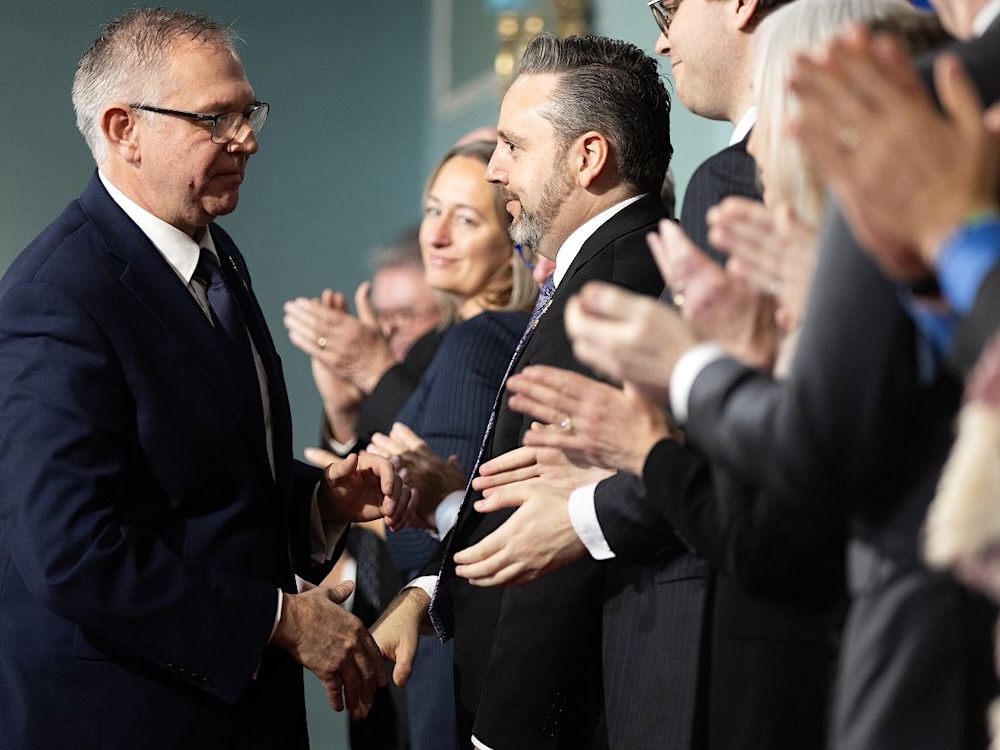
British Columbia Premier Lorne Doerkson appointed a streamlined cabinet Friday that includes some rookie MLAs in key roles.
West Vancouver-Capilano MLA Caroline Elliott, who came second in the Conservative Party of BC leadership race earlier this year, is the attorney general, and Ryan Peterson, the MLA for Coquitlam-Burke Mountain, is the health minister.
“I’m convinced we need someone with Ryan’s background, which is business, at that ministry,” Doerkson told reporters outside Government House in Victoria after the ceremony. “This is a massive ministry with $40 billion of expense and I’m convinced that Ryan’s the fellow for the job.”
Peterson, who was chair of the Business Council of British Columbia ahead of the election, is a co-founder of Finger Food Studios, a technology company that grew to some 200 employees before its sale to Unity Technologies for about $47 million.
Longtime finance critic Peter Milobar, the Kamloops Centre MLA who also ran to lead the Conservatives, is the new finance minister.
Asked about the Conservative campaign promise to launch an independent review of the province’s financial situation, Milobar said details of the timing and who will do it are coming soon.
“It’s meant to be an independent, full encompassing review of where exactly we’re at fiscally in the province so we have a good understanding of just the mess we need to clean up.”
As of September’s fiscal update, the province forecasts a record deficit of $13.8 billion in the current year. The Conservatives campaigned on a plan that would add $1.4 billion a year in operating spending while shrinking the deficit in three years to $10.8 billion.
Lt.-Gov. Wendy Cocchia swore in Doerkson and the new cabinet at a well-attended ceremony. Former BC Liberal premier Christy Clark sat in the front row alongside B.C. Supreme Court Chief Justice Ronald Skolrood and former lieutenant-governors Janet Austin and Steven Point.
Doerkson thanked his wife, Shelley, leaving the stage to embrace and kiss her, and delivered flowers to his mother and to his mentor Donna Barnett, former MLA for Cariboo-Chilcotin.
“Honesty is the foundation of trust, and without trust you cannot lead,” he said, adding that how you carry yourself is very important and promising the government would be accountable not just for its commitments, but also for its results.
He promised to work collaboratively with local governments and First Nations and to strive to make the province better for everyone.
“As of late, too many British Columbians are finding it harder to get ahead. The cost of everyday life has risen, businesses are struggling, health care isn’t always there when people need it, and too many young people are leaving to find opportunity elsewhere.”
The government will work to change that, he said.
Besides Doerkson, the cabinet includes 18 full cabinet ministers and six ministers of state. The BC NDP’s last cabinet included 24 ministers and three ministers of state.
Significant changes include joining post-secondary education and labour into one ministry, bringing energy and mining back together into a Ministry of Energy, Mines and Petroleum Resources and combining housing with local government, sport and culture.
Emergency management is now under a minister of state, and none of the ministries have “climate” in their names.
Doerkson said responsibility for climate will be in the Environment Ministry and he knows the new minister, Chilliwack-Cultus Lake MLA Á’a:líya Warbus, is committed to act on the issue.
“So am I,” said Doerkson, who lives in Williams Lake and represents Cariboo-Chilcotin. He noted the significant fires and extreme drought the region and the province have had in recent years. “I live in an area that frankly has been a war zone for a decade.”
As the minister of Indigenous relations and reconciliation, Columbia River-Revelstoke MLA Scott McInnis will be at the forefront of following through on the campaign promise to repeal the Declaration on the Rights of Indigenous Peoples Act, or DRIPA.
“The reality is we’ve had lots of wonderful agreements that have been beneficial to British Columbians before DRIPA existed,” said McInnis, who spent two years as the Conservatives’ Indigenous relations and reconciliation critic and briefly left the party over concerns about former leader Kerry-Lynne Findlay.
“We’re going to continue to engage with First Nations around this province, all 204, to look at prosperity opportunities, economic and social development opportunities, with First Nations to create a better province for all of us.”
The minister of social development will be Skeena MLA Claire Rattée, who will also serve as deputy premier.
Rattée, who has been a strong critic of the NDP government on drug and social policy since being elected two years ago, has spoken publicly about her own struggles with addiction and homelessness.
“For me it shows that anybody who is struggling can get to where I am today, and I hope that is something that resonates with people who are struggling right now,” she said. “I hope that’s something that resonates with other young women that I want to set a good example for.”
Becoming a cabinet minister and deputy premier is an honour and overwhelming, Rattée said.
“If you told me 10 or 20 years ago I’d be standing here today, I would not have believed you,” she said. “I hope this just reminds anyone who is struggling, anybody who might feel like they aren’t qualified for a position like this but wants to try to make a difference, that if you put your mind to it, anything is possible.”
Doerkson said he was “more than proud” to appoint Rattée. “The reality is she’s an inspiring young woman and I think she’s an amazing human being. She has lived certainly a full life.”
Other notable appointments include: Ian Paton in Agriculture; Kristina Loewen in Children and Family Development; Bruce Banman in Citizens’ Services and Technology; Larry Neufeld in Energy, Mines and Petroleum Resources; Kiel Giddens in Forests; Jessy Sahota in Public Safety and Solicitor General; Korky Neufeld in Post-Secondary Education and Labour; Donegal Wilson in Water, Land and Natural Resource Operations; and Trevor Halford in Transportation and Infrastructure.
The appointments largely leave out MLAs who had supported former leader Kerry-Lynne Findlay and those seen as being among the harder-right members.
Five-term MLA Teresa Wat, the MLA for Richmond-Bridgeport, will be the party’s nominee for Speaker.
The first order of business will be a cabinet meeting that should result in some directives, Doerkson said, adding there will be announcements soon about removing sexual orientation and gender identity resources from schools, strengthening the economy and improving permitting for projects.
Mandate letters to cabinet ministers are expected to be publicly released next week.
With all the personnel changes, would Doerkson commit to putting the government’s staff directory, declared secret by the former government in August, back online?
“Gosh, I didn’t expect that question today,” he said. “I will put that on the first order of business to talk about, because I have wanted that as well, so I will find out why the heck it’s not online and I’ll be back to you on that.”
The BC NDP congratulated Doerkson and the cabinet in a statement from interim leader Jennifer Whiteside that also said it was “deeply disappointing” to see the Housing Ministry eliminated.
“British Columbians also deserve a government that reflects our province’s diversity,” she said. “It is shocking that women make up just one-third of cabinet. And for the first time in three decades, B.C.’s Chinese-Canadian community, the province’s largest visible minority group with nearly 600,000 people, has no representation at the cabinet table.”
BC Green Party leader and Saanich North and the Islands MLA Emily Lowan criticized the government for failing to make climate a priority or to dedicate a minister for mental health and addictions to address the toxic drug crisis.
“Cabinet appointments tell you what a government plans to do,” Lowan said in a statement. “British Columbians are struggling in an impossible affordability crisis, and in the worst housing crisis in a generation, this government has downgraded the housing portfolio alongside labour.”
The full cabinet is:
- Premier — Lorne Doerkson
- Minister of Agriculture — Ian Paton
- Attorney General — Caroline Elliott
- Minister of Children and Family Development — Kristina Loewen
- Minister of Citizens' Services and Technology — Bruce Banman
- Minister of Economic Development and Tourism — Gavin Dew
- Minister of Education and Child Care — Lynne Block
- Minister of Energy, Mines and Petroleum Resources — Larry Neufeld
- Minister of Environment — Áʼa:líya Warbus
- Minister of Finance — Peter Milobar
- Minister of Forests — Kiel Giddens
- Minister of Health — Ryan Peterson
- Minister of Indigenous Relations and Reconciliation — Scott McInnis
- Minister of Local Government, Housing, Sport and Culture — Cathie Ounsted
- Minister of Post-Secondary Education and Labour — Korky Neufeld
- Minister of Public Safety and Solicitor General — Jessy Sahota
- Minister of Social Development and Deputy Premier — Claire Rattée
- Minister of Transportation and Infrastructure — Trevor Halford
- Minister of Water, Land and Natural Resource Operations — Donegal Wilson
- Minister of State for Red Tape Reduction — Carson Binda
- Minister of State for Rural Development — Anna Kindy
- Minister of State for Mining — Pete Davis
- Minister of State for Housing — Zeeshan Wahla
- Minister of State for Labour — Harman Bhangu
- Minister of State for Emergency Management — Ward Stamer

Read more: BC Politics





Tyee Commenting Guidelines
Please note that email notifications for replies are not currently working due to a software issue which may be resolved in a future update.
Comments that violate guidelines risk being deleted, and violations may result in a temporary or permanent user ban. Maintain the spirit of good conversation to stay in the discussion and be patient with moderators. Comments are reviewed regularly but not in real time.
Do:
Do not: