


 SHARE:

Tofino and Ucluelet might have been built on fish and timber, but a good part of today’s economy is supported by neoprene and foam.
The synthetic materials clothe surfers — from newbies to those nationally ranked — and form the base of all boards. The region supports about 20 surf shops or schools, and a recent Tourism Tofino survey of 3,047 people put a number on that outdoor enthusiasm: a quarter of respondents tried surfing or stand-up paddle boarding while visiting Tofino in 2024.
With most customers needing a wetsuit and schools offering multiple classes a day, there’s a lot of rubber constantly churning through the two communities. Some shops do their own simple repairs to keep the suits in circulation for as long as possible. But once it becomes unfixable, the suit is hard to rent or sell second-hand, meaning most end up mouldering in the landfill.
A non-profit is offering a way to avoid that fate.
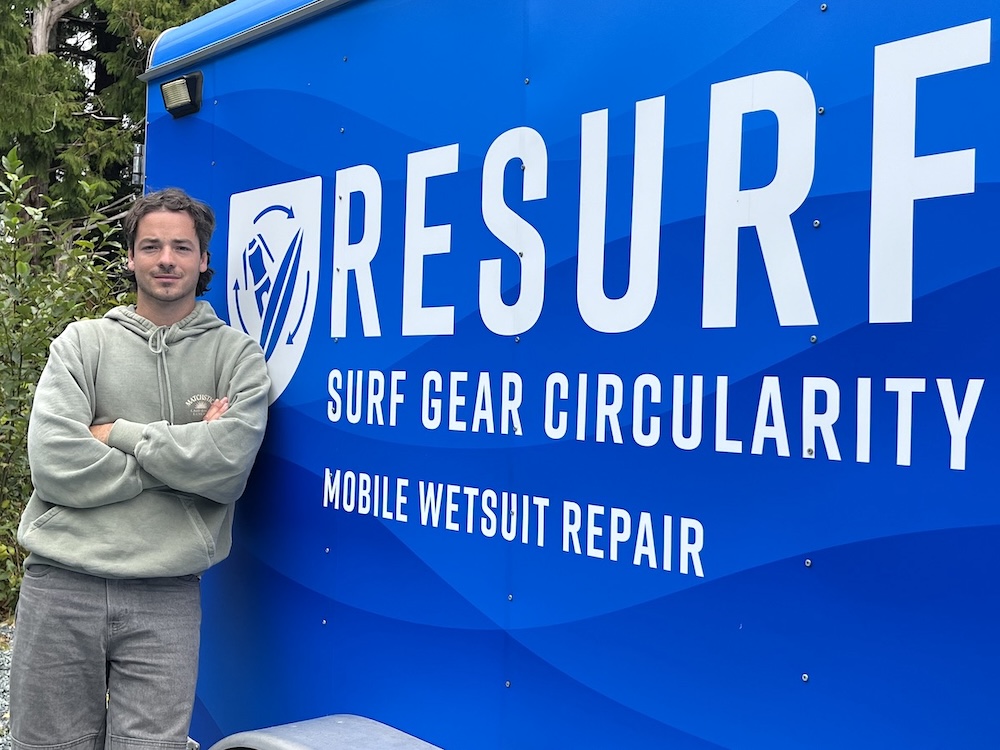
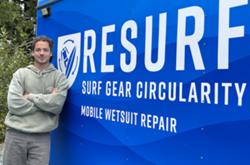
Since May 2025, Surfrider Foundation Canada has run a program called ReSurf, which has diverted about 4.5 tonnes of neoprene and over 200 foam boards from the dump. ReSurf operates out of a 2,500-square-foot, bright blue Quonset hut in downtown Ucluelet.
Its vision is to repair, upcycle and recycle waste from the surf industry.
Neoprene, a stretchy, synthetic rubber that insulates and forms the base of wetsuits, is made of toxic chemicals and doesn’t fully go away. It takes decades, if not centuries, for the material to disintegrate, resulting in microplastic and chemical pollution.
This fall, Surfrider’s advocacy led the Alberni-Clayoquot Regional District to adopt a bylaw prohibiting the disposal of wetsuits in the regional landfill. The ban is the first of its kind in Canada.
Surfrider has nine chapters across Canada — mostly in B.C. and Atlantic Canada — with eight staff and an active network of volunteers who serve “as the first response to local threats in coastal communities across Canada.”
Their work focuses mostly on reducing plastic in the environment: getting it off the beaches with regular cleanups, recycling cigarette butts and reducing single-use plastics. They also advocate for shoreline protection and beach access.
ReSurf is Surfrider Foundation Canada’s attempt to get a beloved sport paddling in the right direction.
“There was zero management for any sort of equipment attached to the surfing industry in Canada,” says Daniel Raab, ReSurf program manager. “Everything went to the landfill.”
The program was launched by a $546,632 grant from the CleanBC Plastics Action Fund, which helped the non-profit renovate the Ucluelet warehouse that now serves as its home base. The grant was followed in early 2026 by a $150,000 investment from the Island Coastal Economic Trust.
A global issue
Waste generated by surfing isn’t unique to Canada, of course, and extending the life of neoprene is a global challenge.
Most neoprene recycling efforts to date use mechanical solutions — either repurposing pieces of fabric into new items or granulating it into shredded bits that are extruded into new sheets like yoga mats. It can also be used for moulded parts such as gaskets or O-rings.
A company based in the United Kingdom, Circular Flow, is working with multiple partners in Europe to research and develop neoprene recycling technology. They already offer products like change mats, beach bags and car seat covers made out of recycled neoprene. Elsewhere, the Australian surfing giant Rip Curl also has a wetsuit recycling program in the United States, France and Australia.
For Surfrider, ReSurf isn’t its first foray into recycling and upcycling wetsuits.
Back in 2017, Surfrider started the Wetsuit Reincarnation program. People dropped off their old wetsuits at three local surf shops. The suits were then shipped to a California company, Suga, to be ground and processed into yoga mats.
But the storage and shipping of wetsuits — which weigh about one to two kilograms — eventually made the program impractical. The project was also strained when businesses started to dump their wetsuits on the team, overwhelming an initiative meant for individuals.
Karen Hendry, a volunteer with Wetsuit Reincarnation, wasn’t quite done with the idea, though. In 2020, Hendry launched her own initiative, Shred Neoprene, to see if she could find end-of-life solutions for neoprene closer to home.
The first step was finding a way to get the weight and volume of the wetsuits down.
“Grinding is one of the biggest hurdles,” Hendry says.
She eventually found a company with a tire granulator to grind a test shipment of neoprene and compress it into a sample mat. Hendry’s plan was to make interlocking tiles that could be used for workout or playground spaces, even tents or boats.
When the initial partner fell through — the fluffy neoprene clogged their machines — she found a mattress recycler in Hope willing to tackle neoprene, only to have that stall with the Fraser Valley floods in 2021.
Although her business ultimately became too much for one person, Hendry’s R&D made her a natural fit for ReSurf, and she was brought on to help shape the wetsuit recycling stream of the program.
‘Bring us all your wetsuits’
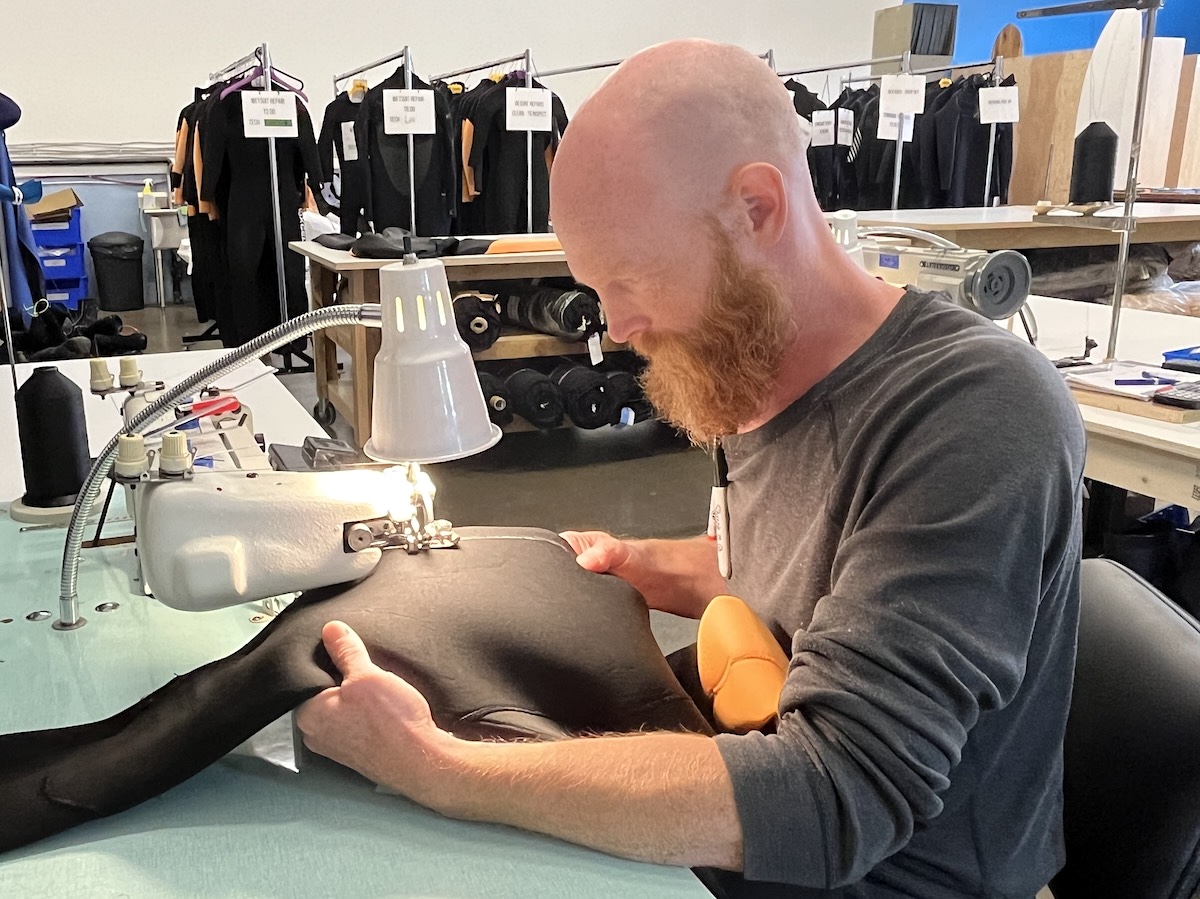
Most of ReSurf’s income comes from repairing suits. The program currently has three repair technicians, with plans to add a fourth. The small team — which includes sailmaker Lou Hamel and Adam-Edwin Dibb, who worked in the past with Arc’teryx — has done extensive research, experimenting with sewing techniques, glues and patches, says Raab.
Since opening, he says, they have kept more than 600 wetsuits out of the landfill.
The technicians repair suits for individuals and do “batch repairs” for the industry, where surf shops can bring in up to 15 suits at a time.
“ReSurf has been a game-changer,” says Zach Decorso, manager of Relic Surf Shop in Ucluelet. “Getting our suits professionally repaired at ReSurf gives them a year or two more life in our rental fleet.”
ReSurf’s goal is to create a hub for every solution — repairing, recycling, upcycling — to extend the life of surf gear under one roof.
This, according to Raab, will separate ReSurf from others. “There are some programs or companies that recycle wetsuits, there are people repairing wetsuits, and there are others that are doing surfboard collection,” says Raab, “but we’re doing all of it.”
There’s demand for it too.
When ReSurf first launched, it received a few hundred wetsuits per week at its Ucluelet location.
“We opened the doors and said, ‘Bring us all your wetsuits,’” Raab says.
Now, ReSurf also invites people to mail in suits or drop them off at one of its 24 collection locations, including at MEC stores in Vancouver and Nanaimo. A new Surfrider travel trailer, with room for two sewing machines, hit the road in 2026. Surfrider staff travelled to events to collect and repair wetsuits and spread the word about the program.
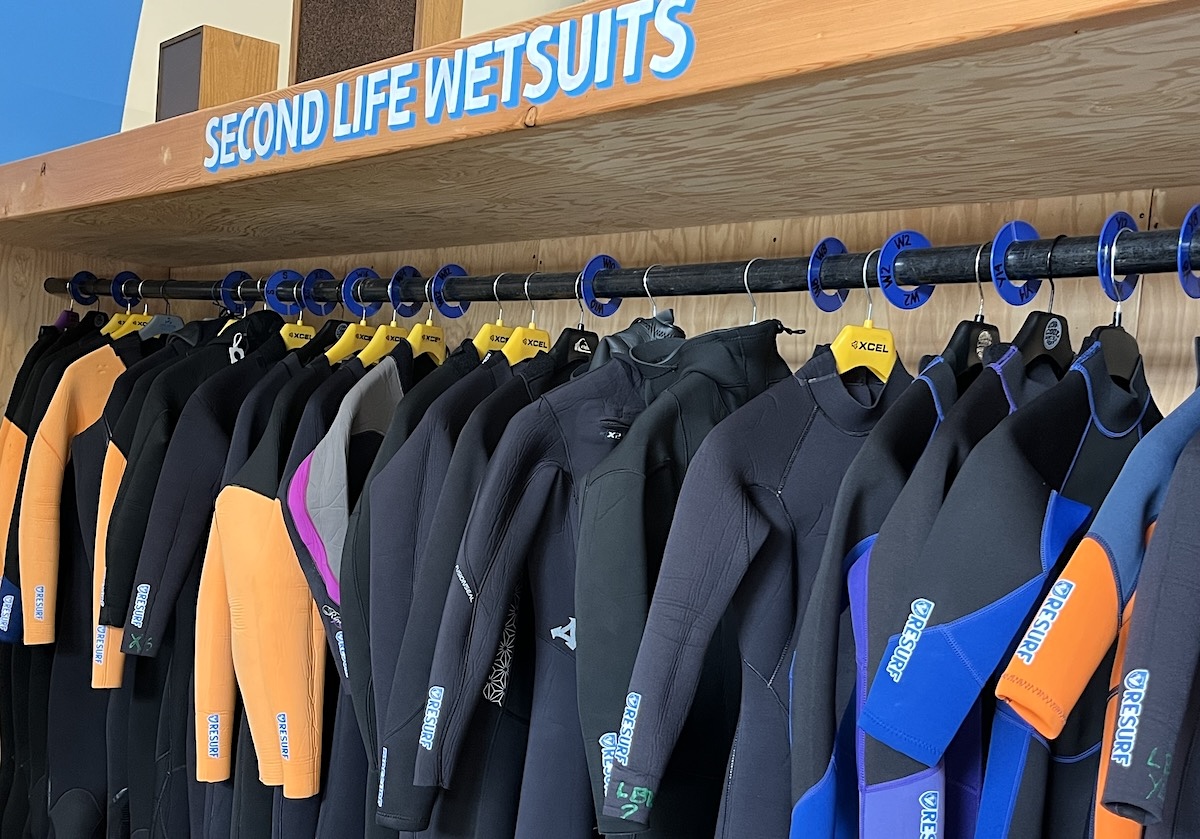
No matter the source, once in the shop, the suits are inspected by technicians to assess the level of damage. About 30 per cent can be repaired and are then resold in the small retail space, with proceeds funnelled back into ReSurf.
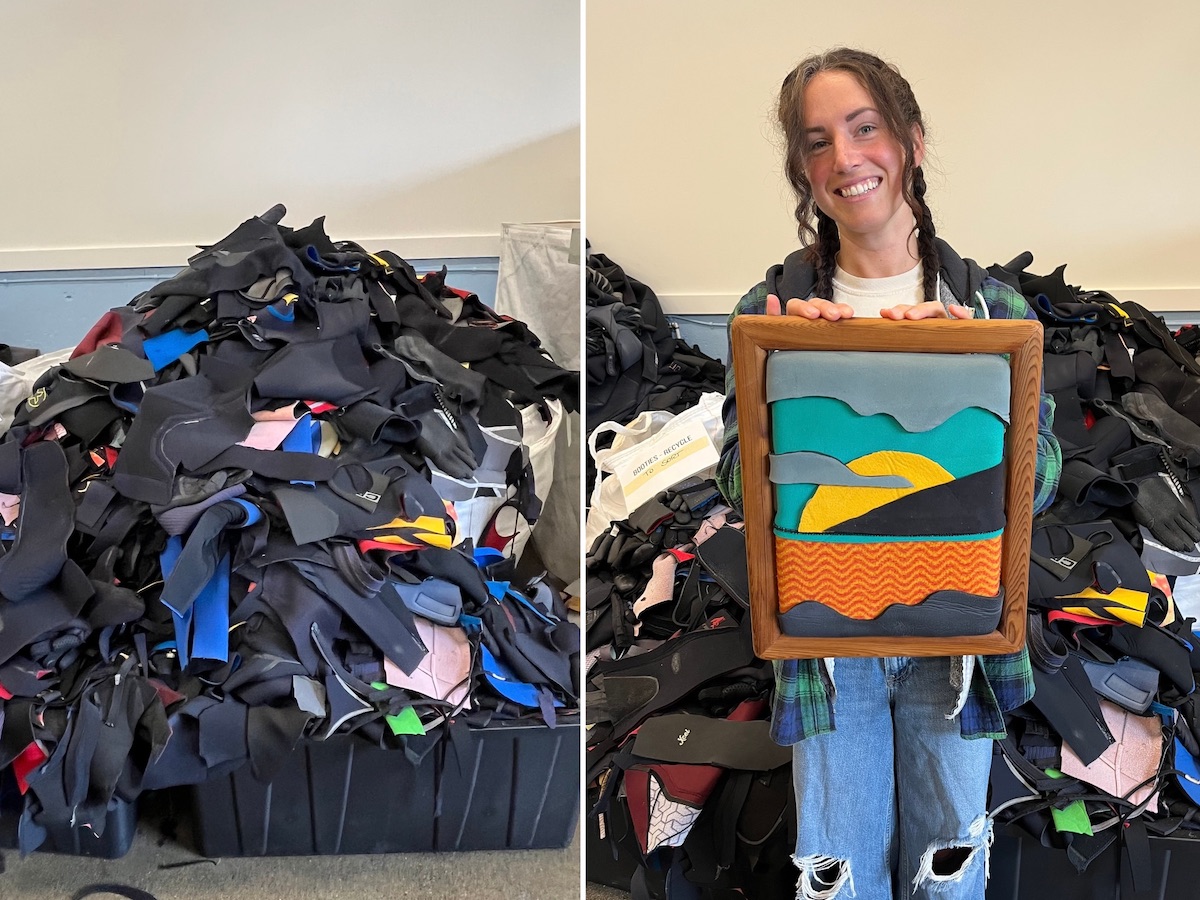
About five per cent are set aside for consignors, who can purchase a suit for $10. Their neoprene wares — water bottle slings, tote bags, dog accessories and such — are on display in the retail space. The latest addition is framed neoprene artwork by Ucluelet artist Kim Leckey, made from the most colourful parts of the wetsuits.
Two-thirds of the donated suits are beyond repair and destined for recycling.
The zippers, buckles and other plastic hardware are removed and sent to Reclaim Plastics in Burnaby, where they’re turned into concrete, according to Raab. The rest of each suit is cut into small sheets about the size of a paperback and then put through ReSurf’s on-site granulator — a supersized shredder for grinding tires — and held in “super sacks” to await shipment to partners who will take it to the next stage.
Raab says ReSurf is working with industry partners and materials engineers to test products that could be created from the shredded neoprene. They “could be hard like a brick or bendy like a yoga mat,” he says. He’s not ready to disclose the details but insists that contracts are in the works.
While British Columbia’s surf industry is strongest in Tofino and Ucluelet, there’s also a strong surfing economy around Lawrencetown, Nova Scotia, where Surfrider’s Atlantic Canada chapter collects wetsuits too.
They deliver the suits to the Ark, a non-profit organization that helps adults with diverse abilities in Bridgewater, Nova Scotia, where the neoprene is shredded and used as stuffing in floor cushions and punching bags. ReSurf carries the Ark’s neoprene drink “koozies,” card holders and sunglasses straps.
While the bulk of effort has been on wetsuits, ReSurf also collects and deconstructs soft-top surfboards into their component parts — the plastic wrap and foam core — and recycles them through the Richmond-based Ocean Legacy Foundation or Reclaim Plastics.
In recent months, they’ve added a new revenue stream: warranty repairs.
Since January, five companies, including Xcel, Billabong and Manera, have enlisted ReSurf as the Canadian hub for any warranty work.
Previously, warranty repairs had to be sent to facilities in California.
“It would take as long as 10 weeks for the suit to come back,” says Relic Surf Shop’s Decorso. “Now I can just walk the suit down the street to ReSurf and it’s back within the week.”
Raab is particularly excited by the new opportunity warranty work brings. The support from the industry, he says, shows that their skills and proof of concept are airtight. Eventually, he adds, the model could be replicated to other water sports that use neoprene.
“I think we’ve shown that ReSurf can bring a positive impact to the [surf] community,” he says.
The program is still dependent on grants, but with revenue streams growing, the vision is to be self-sustaining so that “Ucluelet can support the entirety of the surf industry right here,” he says.
For Raab, surfers offer inspiration in the way they care for their gear and appreciate the natural world.
“We need the surf industry to divert this material,” Raab says. “We need to be smart as surfers.”
This article runs in a section of The Tyee called ‘What Works: The Business of a Healthy Bioregion,’ where you’ll find profiles of people creating the low-carbon, regenerative economy we need from Alaska to central California. Find out more about this project and its funders, Magic Canoe and the Salmon Nation Trust. 
Read more: Environment






Tyee Commenting Guidelines
Please note that email notifications for replies are not currently working due to a software issue which may be resolved in a future update.
Comments that violate guidelines risk being deleted, and violations may result in a temporary or permanent user ban. Maintain the spirit of good conversation to stay in the discussion and be patient with moderators. Comments are reviewed regularly but not in real time.
Do:
Do not: