


 SHARE:

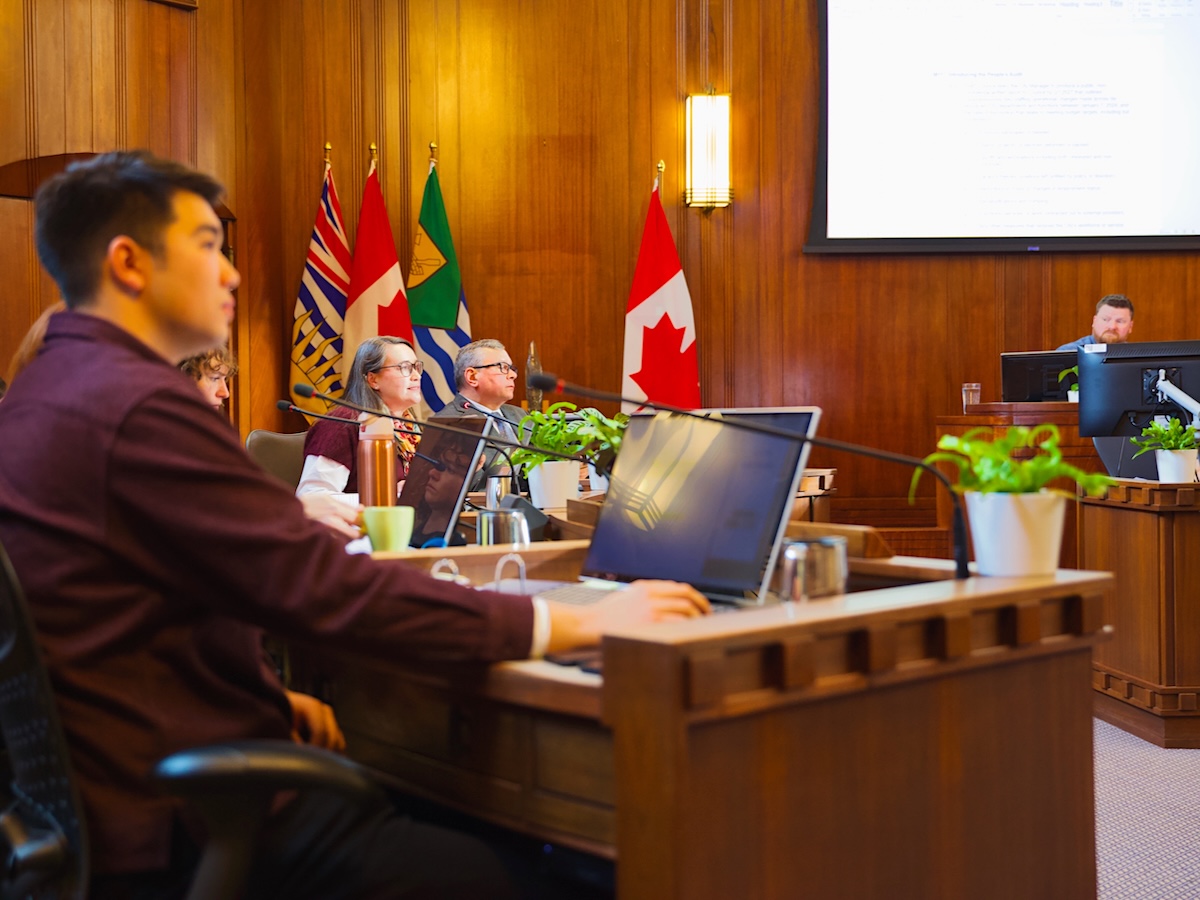
The new Vancouver city council’s second-ever meeting was stacked with motions working on election promises from the Coalition of Progressive Electors, or COPE, OneCity and Vancouver Green municipal parties who form the majority of council.
The motions included stopgap funding for the school board’s lunch program, a proposal to strengthen tenants’ rights, ending a two-year pause on support for most new supportive housing and becoming a living-wage employer again.
Many of the motions aimed to reverse policies pursued by the previous council during their four years in office, when ABC Vancouver held a majority on council.
Only one ABC councillor, Mike Klassen, was re-elected to the current council.
But two motions in particular sum up the breadth of change the current parties on council promised to bring.
They are COPE Coun. Sean Orr’s motion for a “People’s Audit” of the city to find out what was affected by the $120 million in cuts from the 2026 budget.
As well, OneCity Coun. Lucy Maloney presented an omnibus motion titled “Restoring Vancouver’s Leadership as an Inclusive, Compassionate and Resilient City,” which aimed to reverse past council changes and decisions that she says did not reflect council’s duty to provide residents with “fair treatment, dignity and respect from their local government.”
Both motions were passed by council, with only Klassen opposed.
The people’s 2026 budget audit
It has been almost a year since the controversial 2026 budget passed, despite the opposition of over 600 speakers and four sitting non-ABC city councillors. The budget cut or froze funding to all city departments except for police and fire in order to fund a zero per cent property tax increase for property owners.
Unlike prior budgets, the “zero means zero” budget did not provide extensive detail on what was being funded and what was cut.
Enter the People’s Audit, an election promise made by COPE in last month’s municipal election.
Orr’s motion instructs city staff to report back publicly in the first quarter of 2027 on the cuts, job eliminations and vacancies, layoffs, project pauses and cancellations, work hours cut, employees bumped and other changes that reduced city services’ delivery and outcomes, dating back to 2024.
“Since at least Jan. 1, 2024, the City has undertaken staffing and operational changes in anticipation of, or in response to, 2026 budget pressures,” Orr’s motion read.
Line-by-line detailed budgets were a campaign pledge for ABC Vancouver during the 2022 election. But so was achieving a zero per cent property tax increase.
And up until the 2026 budget, the ABC-majority council had increased property taxes every year they were in office.
In their final budget before the 2026 election, the mayor and all but the four non-ABC councillors prioritized freezing property taxes over providing a detailed budget.
Compared with the 373-page 2025 budget and the 506-page 2024 budget, the 2026 budget released publicly last November was just 23 pages.
Estimated to cost the city at least $120 million due to frozen property tax rates not keeping up with inflation, the budget did not make clear exactly what would be cut.
These details would only come out publicly in a piecemeal fashion from news articles over the past year.
But it was clear that the police and fire were the only city services receiving close to the funding they requested. The Vancouver Police Department received an additional 10 per cent or $46.2 million in funding, and the Vancouver fire department received an additional six per cent or $12.2 million.
“Ultimately this isn’t a blame game. This is just a way to be more transparent. And the public deserves to know what was lost and how we can fix it,” Orr said of his People’s Audit motion.
Green Coun. Stephanie Smith introduced an amendment to delete the word “comprehensively,” saying she was concerned about the amount of work staff would do to meet the definition. Orr agreed and the amendment passed.
But Klassen introduced a “strike and replace,” essentially rewriting most of the motion.
Klassen said that while he believes in looking into staff capacities and potential service gaps, ultimately council was not supposed to be involved in the city staff’s “operational decisions” and should be providing staff a longer timeline.
“Getting into a fact-finding exercise, some would call it an inquisition, going back into previous decisions, I think it just creates more concerns around potential privacy concerns,” Klassen said, adding he was also concerned about the workload for staff.
Klassen, unlike Orr, Mayor Pete Fry and Maloney, had voted to pass the 2026 budget.
“I’m very focused on moving forward and making sure that this council can succeed in its objectives and support our staff team and leadership to make sure that they can do that,” he said.
But the rest of the council disagreed.
COPE Coun. Solomon Yi-Kieran and Green councillors Annette Reilly and Smith all spoke in favour of keeping Orr’s motion as is.
“It isn’t a witch hunt, it isn’t trying to dig up dirt, it isn’t trying to drum up any bad blood. But I think that this motion is very useful for actually making sure that we don’t make those mistakes again,” Yi-Kieran said.
Except for Klassen, who voted against the motion, the People’s Audit passed with the rest of council and Mayor Fry in favour.
‘Restoring Vancouver’s Leadership’ motion
Maloney’s motion called on staff to rescind their work on three ABC-supported motions related to:
- a robot food delivery pilot program;
- combining the two protected bike lanes outside Vancouver General Hospital on West 10th Avenue into a bidirectional lane on the street’s north side; and
- halting staff’s work on a previous motion that paused some climate-focused bylaws and allowed natural gas for heating in new homes.
In their stead, Maloney’s motion calls for staff to instead work on:
- implementing staff’s June report on eliminating traffic-related injuries and deaths, including a recommendation to begin implementing 30- or 40-kilometre-per-hour driving speeds on major city streets;
- reinstating the community benefit agreements policy requiring “an appropriate level” of local procurement, sourcing and employment for development of megaprojects;
- reinstating the Parking Bylaw’s transportation demand management plan requirements that any new developments advance the city’s transit goals; and
- using business licence fees to encourage gas station and large commercial parking lot owners to install electric vehicle charging stations.
“As one of the four non-majority councillors last term, I witnessed decision-making that I view as inconsistent with our city’s values, and disconnected from research and evidence,” Maloney said.
“I firmly believe that Vancouver thrives when everyone has a place here, when we protect people who are most at risk, and when we proactively prepare our city for future challenges.”
The driving speed motion is unfortunately timely: three pedestrians have died and two were injured in Vancouver since late October after being hit by vehicles. That includes an 87-year-old woman whose death was announced by the Vancouver Police Department on Wednesday morning.
As well, on Nov. 15, Maloney delivered a city proclamation that the date be recognized in Vancouver as the World Day of Remembrance for Road Traffic Victims.
The 17 speakers addressing the motion were divided. Eight advocated for the motion, while nine spoke against it.
Many of those opposed to the gas water heater ban — citing consumer choice affordability and the B.C. Conservative government’s election promise to undo municipal bans — were from industry groups such as the Hearth, Patio & Barbecue Association of Canada, the BC Coalition for Affordable Dependable Energy and the Canadian Institute of Plumbing & Heating.
Vignesh Ram, vice-president of public policy at Serve Robotics, the company behind the food delivery robots, spoke to keeping the pilot, which had not yet started.
“We’re not asking Vancouver to make a permanent commitment. A pilot allows the city to establish conditions, captures public feedback and evaluates outcomes, creating smart, evidence-based policy,” he said, adding that they have already hired local employees.
However, speakers from both the Canadian National Institute for the Blind and Vision Zero Vancouver criticized the robot delivery pilot for its potential impact on people with disabilities.
“Individuals that are blind, deaf-blind or have low vision need clear and predictable sidewalks to be able to navigate, to be able to get around,” said Ana Booth, executive director of the B.C.-Yukon branch of the Canadian National Institute for the Blind.
Two representatives from Vancouver Coastal Health, the local health authority that operates Vancouver General Hospital, spoke against the cancelling of a bidirectional bike lane on West 10th Avenue.
“We believe that we can address the 10th Avenue bike lane corridor and potentially come up with a different solution,” said Shelly Fleck, chief clinical planning officer of major redevelopment and expansion projects with the health authority.
City staff later clarified that a review of Vancouver Coastal Health’s data on access to the hospital complex and safety concerns around the West 10th Avenue bike lane was ongoing. Passing Maloney’s motion would not affect the review or city staff’s ability to bring forward future recommended changes, they added.
Following the speakers, several amendments were made to the motion, including delaying implementation of the gas water heater ban until Jan. 1, 2028, and enforcement of the city’s annual carbon and greenhouse gas emission limits; asking staff to work with residents and developers to ease the permitting process for electric homes and utilities; eliminating the wording around local procurement, instead calling for an update to the community benefit agreements policy based on expert input; and asking staff to report back on the West 10th Avenue bike lane data review.
Klassen, who abstained from the amendment votes, said there were some elements of the motion he thought had merit.
But ultimately Klassen spoke against it, saying council owed it to residents, staff and businesses to review reversals of the past council’s work on an individual basis, including cost-based analyses.
Klassen, who had introduced the robot delivery pilot motion earlier this year, also criticized its cancellation.
“Our unwillingness to not even pilot a program sends, I think, a very concerning message to our tech innovation sector,” he said.
“It sends a signal that Vancouver isn’t a city where their ideas can be embraced, even on a trial basis. And I think in a time of fast-moving change and new technology, that’s not a great signal for us to be sending.”
Maloney’s motion passed, with only Klassen voting against it. 
Read more: Municipal Politics







Tyee Commenting Guidelines
Please note that email notifications for replies are not currently working due to a software issue which may be resolved in a future update.
Comments that violate guidelines risk being deleted, and violations may result in a temporary or permanent user ban. Maintain the spirit of good conversation to stay in the discussion and be patient with moderators. Comments are reviewed regularly but not in real time.
Do:
Do not: