


 SHARE:

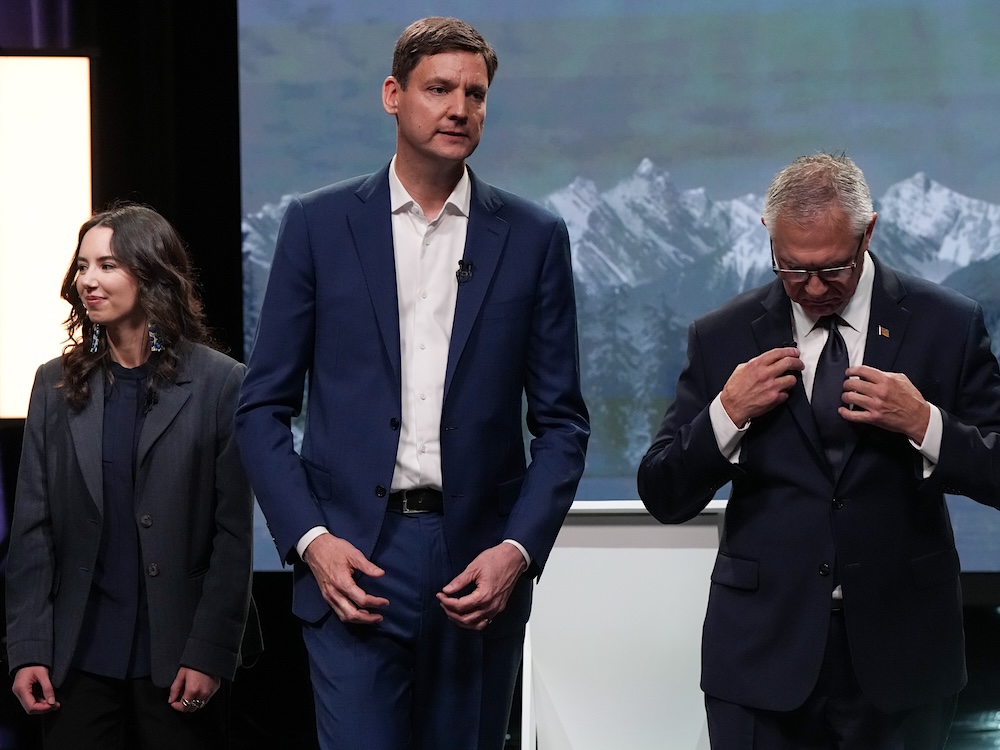
Experts agree neither of British Columbia’s two main provincial parties has presented a realistic fiscal plan ahead of Saturday’s provincial election.
Both the governing BC NDP and the Conservative Party of BC are offering plans that depend on “magical thinking,” said Marc Lee, a senior economist with the Canadian Centre for Policy Alternatives.
“Everyone wants to reduce the deficit,” Lee said, “but reducing the deficit is not popular politically apart from just saying it. If they actually have to reduce the deficit by cutting spending or increasing taxes, then it’s a different ball game.”
The parties avoid making those hard choices that may not be politically popular, he said, and instead, “both the NDP and the Conservatives just pad their revenues.”
The current year’s shortfall, according to the quarterly report released in September, is $13.8 billion and projected to shrink by about $1 billion in each of the next two years, which is the starting point for all of the parties. (Though Lee argues it’s fair to deduct the $5 billion budgeted for contingencies from the deficit: “Any time governments add extra padding like that, whether they call it a forecast allowance or contingencies, I tend to dismiss it because the game has always been to table a bigger deficit and then beat it by the year-end.”)
The NDP says that if it is re-elected, the government would end the year with a deficit about that same size, followed by slightly smaller deficits in each of the next two years.
It’s a plan that adds revenue from an increase in income tax on people earning more than $190,000 a year and from new major projects, including Phase 2 of the LNG Canada facility in Kitimat.
At the same time, it gives up hundreds of millions in potential revenue by suspending the gas tax until the end of March and backing off a plan to extend the provincial sales tax to professional services.
In the next two years the increased revenue would be spent on various NDP priorities, including $400 million for housing, $315 million for child care, $323 million for seniors care and $100 million for home energy retrofits.
The Conservatives say their plan would result in smaller deficits despite adding $1.4 billion a year in operating spending. They still project a $10.8-billion deficit in 2029-30 after three years of whittling it down.
It’s a plan predicated on reducing the $5 billion for contingencies in the budget to $4 billion this year and $3 billion in each of the following years. The Conservatives say they will also save money through a hiring freeze, a core review of ministry spending and cutting the amount spent on consultants.
Premier David Eby has argued that cutting contingencies amounts to a cut to health care, since that is where the money usually ends up being spent.
According to the first quarterly report on government finances released last month, “the Contingencies Vote helps fund unexpected costs that are difficult to forecast such as climate-related events, increased demands for government services, and emerging priorities.”
While the contingency may be used to pay for wildfire fighting, the update added $614 million for fire management but did not draw down on the contingency amount.
The Conservatives, having characterized the contingencies vote as a “slush fund,” also expect to take in an extra $1.7 billion over three years through quicker economic growth, $547 million from increased royalties on natural gas and other liquids, and $351 million from the stumpage fees from increased logging on Crown land.
Conservative Party of BC Leader Lorne Doerkson was questioned about counting on revenue from growth faster than independent agencies are predicting. “I think we are predicting about one per cent more optimism in the province than the NDP, and frankly I think it's completely achievable.”
The party’s most expensive promises include cutting income tax on the first $32,000 of earnings, which will cost $2.9 billion once it is fully implemented. A PST exemption on productive capital such as machinery, tools and software would cost another $500 million a year.
The idea that the Conservatives can “supercharge” the economy to increase revenue is unlikely to come true, Lee said. “It’s complete fantasy right there.”
While the Conservative projections are unrealistic, the NDP also makes dubious assumptions, he said. “The NDP’s rationale is a little more believable in that it’s going to come from natural resource royalties, but I also think that if you actually look at natural resource royalties over the last 20 years, they have been in the toilet.”
Even with the first phase of LNG Canada coming online, the bump to revenue has been small, so it’s unlikely natural resource revenues will return to where they were 20 years ago.
Lee’s bottom line? “Both parties are fudging the revenue side.”
He said it was good that the NDP had put tax increases on high incomes on the table and that it was a better plan than the Conservatives’ irresponsible promise of a big tax cut for all payers. People with the lowest incomes pay little tax in the first place, and the Conservative cut would go to everyone, including top earners.
It would be much better to target the support to people who need it instead of squandering it on high earners who won’t notice the extra $1,000 at the end of the year, he said.
Other experts have also suggested voters should be skeptical about both parties’ projections.
University of British Columbia Sauder School of Business economics professor Werner Antweiler was quoted in the Vancouver Sun saying more transparency is needed from both the NDP and the Conservatives about the likelihood of painful budget adjustments.
“Both parties get a failing grade from me for fiscal stewardship,” he said. “Those plans are fiscally unsound because they do not take fully into account that you need either heroic assumptions about economic growth to shrink the deficit, or you actually have to go and either raise revenue or cut expenditures.”
And Nicolas Schmitt, a professor emeritus at Simon Fraser University’s department of economics, told CBC the numbers will be difficult for voters to assess, given the current high level of economic volatility.
“It’s difficult to put credence into these, especially given the level of uncertainty in which we are currently living, given the relationship between the U.S. and Canada,” he said. “We don’t know how things will unfold in the next six months, let alone in three years.”
The BC Green Party’s costing rests on $22 billion from a one-time tax on wealth over $50 million, plus ongoing taxes on wealth and oil and gas extraction.
The party’s big-ticket spending plans include billions to bring income and disability assistance rates up to the poverty line and for housing, transportation, education, child care and mental health. 
Read more: BC Election 2026, BC Politics




Tyee Commenting Guidelines
Please note that email notifications for replies are not currently working due to a software issue which may be resolved in a future update.
Comments that violate guidelines risk being deleted, and violations may result in a temporary or permanent user ban. Maintain the spirit of good conversation to stay in the discussion and be patient with moderators. Comments are reviewed regularly but not in real time.
Do:
Do not: