


 SHARE:


When British Columbia’s NDP government rushed through housing bills 44, 46 and 47 in late 2023, it did so with a clear imbalance in who got heard. Mayors across Metro Vancouver later complained of “limited co-ordination and consultation.”
Bill 44 required small-scale multi-unit housing (three to six units) on most single-family lots in municipalities over 5,000 people. Bill 47 set minimum densities near transit. Bill 46 changed how development fees work. The official aim was faster supply to lower housing costs. In practice it rewrote local land-use rules from Victoria. Towers sprouted as grassroots enthusiasm wilted.
One of the mayors leading the resistance was Burnaby’s Mike Hurley. Last week he minced no words in waving goodbye to the David Eby government, saying that as “costly and time-consuming consequences of the failed one-size-fits-all approach to housing became clearer,” his city joined with others to “call for the legislation to be paused and reconsidered.”
Hurley may have been expressing the frustration and relief felt by many voters. It seems a critical mass of citizens failed to see how the NDP government’s top-down boosting of housing supply was helping priced-out renters and buyers. Even as costs have dropped in a slumping, condo-glutted market, the incomes of service workers, teachers and other mainstays of local economies still can’t match the going rate for basic housing in Metro Vancouver and beyond.
Polling during Eby’s failed campaign for re-election showed voters rated the need for affordable housing high on their lists of concerns and most did not approve of the NDP’s approach.
A survey sponsored by the advocacy group Housing Central surfaced deep anxieties among renters worried the upheaval in their neighbourhoods might lead to them being evicted and unable to find similarly priced shelter.
The same poll showed dissatisfaction with depending on standard market units to solve affordability. More than eight out of 10 agreed that non-profit and co-op housing was needed to fill the gap.
So, who was Eby listening to as he imposed his legislation that nearly four years later failed to earn voters’ trust? Freedom of information or FOI requests reveal he had steady contact with people linked to Abundant Housing Vancouver and other supply-side groups that had pushed for provincewide upzoning, the end of public hearings on compliant projects and less local control over planning.
CityHallWatch’s reporting on those FOI releases named a group of “external experts” that included Daniel Oleksiuk and Peter Waldkirch of Abundant Housing Vancouver, along with industry voices. A December 2025 letter to Premier Eby, signed by Hurley and 15 other mayors, said what local governments already knew: the laws were largely written without them.
Why increasing supply isn’t enough
If the idea held that simply building more units must bring costs down, Vancouver would already be North America’s most affordable centre city. It is not.
As I’ve pointed out before in these pages, since the 1960s the city has more than tripled its housing stock inside fixed boundaries through infill, secondary suites, laneway houses, mid-rise corridors and highrises on old industrial land. No other North American centre city has densified its existing area at a comparable rate.
Yet today the median home now costs more than 12 times the median household income — the highest ratio on the continent. Vancouver has the highest home prices relative to incomes of any major North American city, and among the highest in the world.
Why is simply building more not a panacea? Why, for example, did densification along the Cambie Street corridor drive rapid land-price inflation rather than cheaper homes? The supply narrative has little to say about suppressing land-price speculation and inflation, or about how to deliver low-cost housing the market isn’t geared to produce.
Now the voters have rendered their verdict. It’s time for B.C.’s next government to take a more sophisticated approach to the wicked problem of home affordability in Metro Vancouver.
What the Conservatives get right and wrong
Start with the basic fact that most of the assessed value of Vancouver housing now sits in the land, not the buildings on it. This is not how the city has always worked. Land-value inflation relative to building values accelerated around 2015 as global capital, low interest rates and policy-driven upzoning came together. Between roughly 2006 and 2022, real land values in the city rose far faster than building values, as the graph below shows.
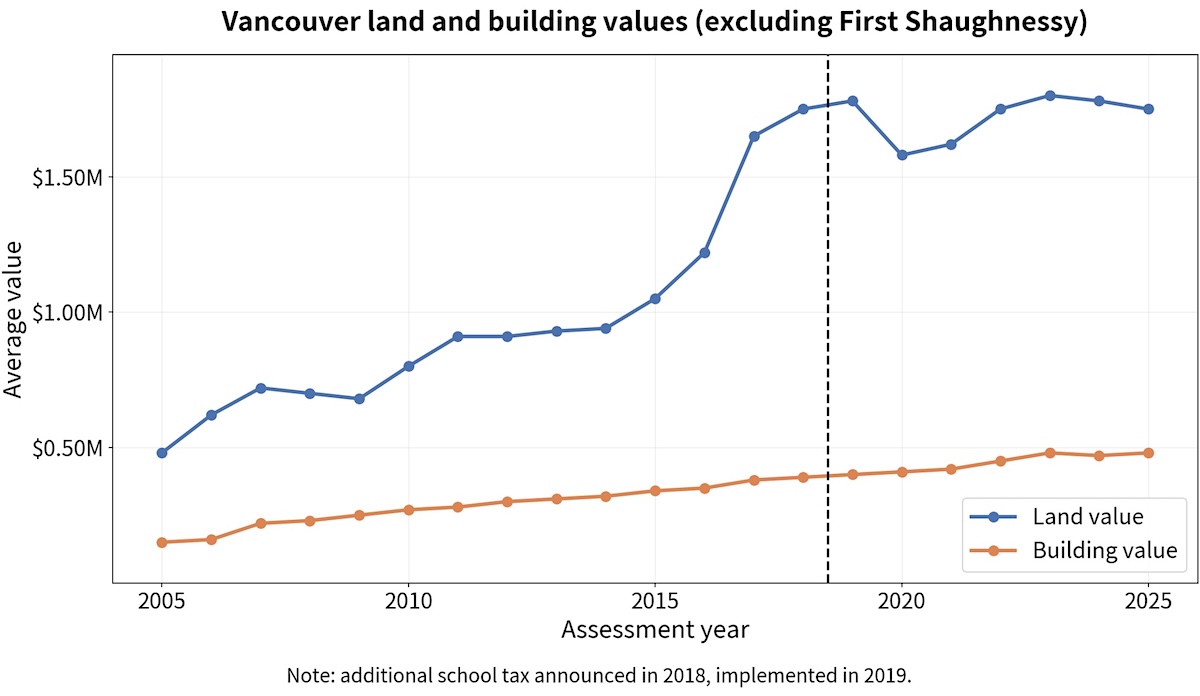
Today, new homes in Metro Vancouver sell for multiples of their construction costs that dwarf those in other Canadian cities. Recent Fraser Institute work put the Vancouver gap at roughly 4.7 times construction value, versus about two times in Toronto and 1.9 in Calgary.
When land is upzoned, the first effect is not cheaper housing. It is a higher “residual land value” that the next buyer or developer must pay. The new units are then priced to cover that higher land cost. This is why land-price inflation shows up in global cities everywhere, not just as a local problem of “red tape.”
But it’s not at all clear the new Conservative government under premier-designate Lorne Doerkson understands this driver of housing costs.
Doerkson is right to say bills 44 and 47 (and the related housing-target powers under Bill 43) should be repealed or substantially changed, and that planning decisions should return to localities.
As the 16 Metro Vancouver mayors argued in their letter, local elected officials are better placed to match density to services and to local official community plans.
Sadly, the Conservatives still misdiagnose the main problem. Their platform and commentary continue to treat the core barrier as municipal red tape and process. That view is incomplete.
Process delays matter at the margin. They do not explain why land now makes up the dominant share of housing cost in Vancouver, Toronto, San Francisco, London or Sydney. Cutting approval times or mandating more as-of-right density without tools to capture or restrain land-value inflation simply hands the windfall to landowners. The market then prices the new development rights into higher land values, and the cycle continues.
A to-do list for the new government
In August a group of experienced Vancouver urbanists, planners, architects and academics — including me — issued an open letter under the name “Housing Reset.”
Addressed to the City of Vancouver, the province and the federal government, it rejected the claim that there is a general housing supply shortage.
The real shortage, we wrote, is of affordable housing for middle-income wage earners. Private-market development alone cannot deliver secure, affordable units at the needed scale because land costs, speculation and shifting market conditions keep breaking the economics.
The letter’s 14 directions stress sustained public-private collaboration rather than one-time upzonings. Key parts include:
- tri-government land banking reserved for secure affordable housing and community infrastructure;
- expanded community land trusts that keep land ownership separate from the housing so units can stay at use value rather than investment value;
- a pause on further blanket upzoning of existing affordable stock except through citizen-based community planning;
- deliberate capture of land-value lifts through zoning tools so density serves affordability rather than speculation;
- neighbourhood-scale planning that brings forward suitable infill only as demand appears;
- support for non-profit developers; and
- financing changes that improve access to capital for modest-scale, secure tenures.
These recommendations do not deny the need for more housing. They insist that what gets built must be secured as affordable for primary residences of working households, not left as whatever remains after land costs are paid. They treat land-price inflation as the central obstacle rather than a side issue.
Vancouver’s own record — more infill units relative to its base than any other North American centre city, paired with the continent’s highest price-to-income ratios — remains the clearest demonstration that “supply, supply, supply” is not a sufficient policy.
Mike Hurley and his fellow mayors are right. Returning planning authority to localities is a necessary correction.
But there is an even more important one: treating land-price inflation as the core problem and using the practical tools already outlined by experienced local practitioners. 
Read more: BC Politics, Housing











Tyee Commenting Guidelines
Please note that email notifications for replies are not currently working due to a software issue which may be resolved in a future update.
Comments that violate guidelines risk being deleted, and violations may result in a temporary or permanent user ban. Maintain the spirit of good conversation to stay in the discussion and be patient with moderators. Comments are reviewed regularly but not in real time.
Do:
Do not: