
 SHARE:

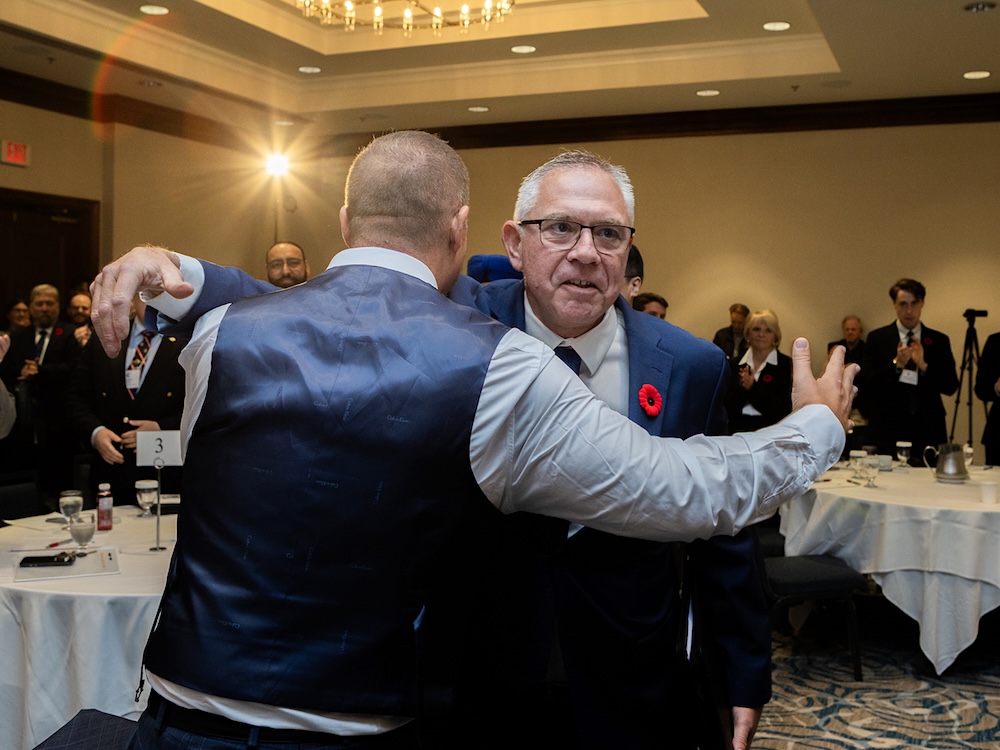
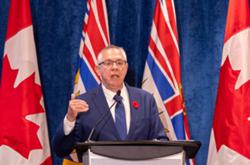
Fifteen. That, give or take, is how many of his own MLAs premier-designate Lorne Doerkson can afford to banish or alienate before his ability to govern is compromised.
The Conservatives’ recent overwhelming victory gives Doerkson a significant legislative cushion — and the ability to cast off politically toxic members of caucus. But Doerkson might not have as much breathing room as those numbers suggest, given his party’s very recent turmoil and public schisms.
Doerkson’s ability to drive a hard bargain with his party’s populist right wing might come down to the unpredictable behaviour of a new crop of untested MLAs who don’t have established political track records.
A Tyee analysis of the new Conservative caucus suggests that Doerkson is likely to have a solid core of allies and supporters. But it also reveals the fragility that could afflict his government if yet another intra-party civil war breaks out.
To maintain power, Doerkson needs the support of 47 MLAs. He easily has that now. But can he keep it for four years?
The core
Doerkson’s unexpected ascent to the Conservative leadership rapidly shifted British Columbia’s centre of power from the Lower Mainland to the Thompson-Cariboo region.
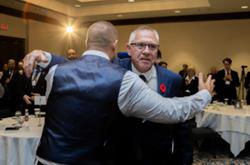
Doerkson’s elevation came shortly after Peter Milobar and a cadre of others left the party and took over the fledgling CentreBC. Doerkson had previously endorsed Milobar’s leadership campaign in the spring, and the two represent neighbouring ridings. Caucus members saw him, correctly, as a figure who could reunite the right. As soon as Kerry-Lynne Findlay stepped down and Doerkson was anointed, Milobar and the others returned.
Since becoming leader, Doerkson has been applauded for his “normie” conservatism that hearkens back to the fiscally focused BC Liberals, at the expense of culture-war clashes favoured by Findlay and her supporters. At the same time, he maintained his party’s previous promises to repeal the Declaration on the Rights of Indigenous Peoples Act and “repeal” SOGI, a set of teaching materials to support education about sexuality and gender identity.
Doerkson, who was first elected in 2020 as a BC Liberal, is certainly cut from that cloth. So too are many other re-elected Conservative MLAs in nearby ridings. All over the B.C. Interior, Doerkson has moderate friends and allies, many of whom also supported Milobar’s leadership campaign or left the party during Findlay’s final month. Many seem likely to lend their support to Doerkson, a politician with less polish and ambition than Milobar but, now, actual power.
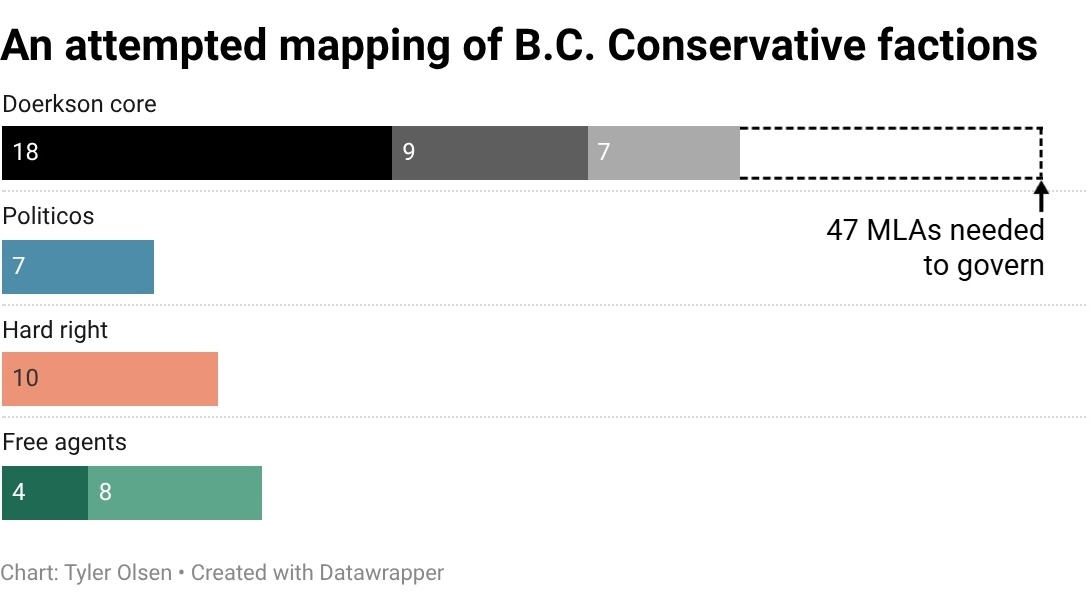
The Tyee has counted 18 returning Conservative MLAs whose past allegiances and positions suggest they are likely to support Doerkson’s focus on economic development. Of those MLAs, 11 represent ridings in the B.C. Interior. They include Milobar, Kamloops-North Thompson MLA Ward Stamer, Prince George-Mackenzie MLA Kiel Giddens, Fraser-Nicola MLA Tony Luck, Kelowna-Mission MLA Gavin Dew and Columbia River-Revelstoke MLA Scott McInnis.
The behaviour of newly elected MLAs is harder to predict. But nine new MLAs have extensive business resumés that fit the mould of previous fiscally focused BC Liberals. Both history and their campaign literature suggest that MLAs such as Abbotsford aerospace exec Darryl Kropp, BC Sports Hall of Fame CEO Nicholas Cartmell and Penticton Division of Family Practice executive director Tracy St. Claire will avoid positions that will bring them into disrepute or create excess turmoil. Others include Nicola Valley Institute of Technology finance VP Diane Black, non-profit exec Jaime Stein and Maple Ridge business consultant Doug Morneau.
Although prominent new MLAs can sometimes feel aggrieved if left on the backbenches for a lengthy time, there is no current prospect that the NDP will have the leverage to lure them away from Doerkson’s side.
In addition to the business class, seven new MLAs are moving to provincial politics from locally elected positions. Most also have the profile of moderates, and five are from the Lower Mainland, where councillors and mayors must play to diverse constituencies and avoid controversy. The local representatives have spent years working as part of council teams and learning to hold their tongue. They are also likely to provide a stable base for Doerkson. These MLAs include former White Rock mayor Megan Knight, longtime Lumby Mayor Kevin Acton, Central Saanich Coun. Cathie Ounsted and now-former Anmore mayor John McEwen.
The Tyee’s analysis is imperfect; it’s important to acknowledge that each MLA has their own personal ambitions and causes and that political positions and relationships can shift over time. Some MLAs will also be hard to pin down even in this group. Mike Hicks, a former Capital Regional District director, focused his campaign on local issues and his personal governance background. He also made news during the campaign for a garbled quote in which he spoke about First Nations being “conquered.” Hicks sought to clarify the quote, saying it “inartfully” conveyed the need for treaties. Inevitably, contradictory statements and behaviour by MLAs can make it difficult for observers and party strategists to put candidates into boxes.
Those disclaimers aside, The Tyee’s count of likely Doerkson loyalists comes to 34. That is 13 shy of the 47 MLAs Doerkson will need to survive four years.
Twenty-nine MLAs remain. From this group, Doerkson will need to be able to keep at least a baker’s dozen loyal to him. He might be able to afford to lose as many as 17, though that may change if apparent allies go rogue.
The hard right
After establishing the party’s moderate wing, it’s easiest to next pencil in the party’s populist right — the MLAs that appear most likely to break from Doerkson’s direction and reanimate recent party turmoil.
The core of this group was helpfully defined by former MLA Dallas Brodie’s initial vow to avoid running OneBC candidates against eight MLAs she identified as “principled conservatives”: Sheldon Clare, Sharon Hartwell, Anna Kindy, Kristina Loewen, Heather Maahs, Macklin McCall, Lawrence Mok and David Williams.
Those eight are among the most likely to break from Doerkson as individuals or en masse. Given past rhetoric, they also seem most likely to make controversial statements that could incite banishment from a Conservative party focused on moderation.
Of the remaining MLAs, The Tyee identified two more whose track records clearly suggest a fondness for populist conservatism. They include Larry Neufeld, who once donated to the People’s Party of Canada and its leader, and Steve Kooner, who endorsed Findlay’s leadership campaign alongside five of Brodie’s favoured candidates.
The free agents
The remaining 19 MLAs might be considered wild cards.
For these, the question will be not only what they believe, but how they prioritize party and stability and personal power over advancing ideological goals.
Among the political actors and our list of free agents are MLAs who have shown a preference for socially conservative policies — but also, sometimes, a willingness to adapt to political realities or desires. MLA Korky Neufeld, for instance, has called for the repealing of SOGI but also, as the chair of the Abbotsford school board, struck compromises with more progressive colleagues and avoided the controversies surrounding socially conservative counterparts in Chilliwack.
Recent leadership candidate Caroline Elliott, meanwhile, has shifted her stance on SOGI over the past decade to match the tone of conservative politics. She once publicly backed the introduction of SOGI under the BC Liberals, only to reverse course in more recent years as it became a target of the populist right.
Elliott is one of seven MLAs whose clear political ambition and ties with the Conservative party base may influence their future decisions and behaviour. Elliott has pledged her loyalty to Doerkson and seems likely to bide her time and prove herself as a cabinet minister — at least for now.
Harman Bhangu is another staunch conservative who, as the party’s vice-president, is credited with helping reinvigorate and reshape the organization as it surpassed BC United in the polls prior to the 2024 election. Like Elliott, whose leadership bid he supported, Bhangu has shown himself to be a calculating political actor.
Other names in this category are new MLAs, including former lobbyists Carson Binda and Margareta Dovgal, and former party vice-president Pavneet Singh. This group seems likely to work towards consolidating the Conservatives’ internal stability and power in the short term. In the long term, or if trouble emerges, history suggests that party activists may take on a more active role than other new MLAs.
But this isn’t 2024 anymore and political activists bred in the often nasty world of online politics could pose a challenge for Doerkson as the winds of conservatism shift. In the lead-up to the election, far-right operative Othman Mekhloufi, whose social media posts split OneBC in 2025, shared a group photo that included Dovgal. As the right faces a reckoning south of the border, will those who made a name in hard-edged conservative politics adapt or double down?
That leaves us with 12 free agents, whose future behaviour is particularly unclear to The Tyee — though perhaps not to party insiders or Doerkson’s leadership team. They include four returning MLAs and eight newly elected representatives.
Of the returning MLAs, two endorsed leadership candidates: Bryan Tepper supported Elliott, while Korky Neufeld favoured former BC Liberal cabinet minister Iain Black. Others include Jody Toor, who has taken few public positions as an MLA but spearheaded a successful private member’s bill on postnatal mental health care, and Surrey North MLA Mandeep Dhaliwal.
Finally, we have eight new MLAs with short political track records and limited public statements. They include Peace River oil and gas manager Curtis Whitford, Delta lawyer Monica Mohan and Surrey engineer Zeeshan Wahla.
Ten of these 12 free agents represent Lower Mainland ridings, and five are based in Surrey. Many of the candidates in that area focused on the party’s promise to remove SOGI materials from schools. Beyond SOGI, most of the Surrey MLAs focused on promises to bolster local infrastructure.
Although it’s difficult to make informed guesses about the future behaviour of new MLAs, the Conservatives’ campaign seems to have favoured the nomination of candidates less aligned with the party’s hard right. That was most obvious in the riding of Abbotsford-Mission, where the party chose the aerospace exec Darryl Kropp to run for the party instead of Reann Gasper, who had recently resigned her seat to enable Findlay to run in a byelection. (That byelection was aborted after the NDP triggered October’s snap election.)
Uncertainty remains
The Tyee’s analysis is imperfect and has obvious weaknesses. It’s based largely on the public campaign pages and public history of the 63 Conservative MLAs. Conservative insiders and some local constituents will be more familiar with their political dispositions and behaviour and statements beyond the gaze of the media. Recent history has shown that seemingly reliable and loyal politicians can veer off course based on shifting events, personal circumstances, policy disagreements or factional allegiances. From Darryl Plecas’s abandonment of the BC Liberals to become Speaker in 2017 to the resignation of NDP cabinet minister Selina Robinson in 2024, unpredictable events and personal interactions can turn reliable caucus colleagues into public opponents.
Other observers, and Conservative insiders with personal familiarity with each MLA, may also identify more or fewer MLAs in each broad grouping. But our analysis hints at the challenges and opportunities for Doerkson and his government as they prepare to govern British Columbia for, they hope, four years.
Here’s what our breakdown looks like.
Beyond the group of established, seemingly moderate MLAs, many of whom have personal connections as Interior caucus members under former leader John Rustad, the ties between many members of the current Conservative caucus appear to be relatively tenuous. As The Tyee recently reported, just six MLAs have three or more years of legislative experience.
Our breakdown suggests that while Doerkson may well be able to afford to ostracize the most strident conservatives among his caucus, doing so will leave him dependent upon retaining the loyalty of ambitious party colleagues and 10 Lower Mainland political newcomers. That means that, like many leaders, Doerkson and his new chief of staff will find themselves in constant, sometimes silent negotiations with potential caucus malcontents. And each side will seek to determine how far the other is willing to compromise before taking a leap into the unknown.
Will the populists’ numerical strength empower them to demand socially conservative, or more far-right, stances on issues like First Nations land rights and LGBTQ2S(IA)+ rights? Or will Doerkson call their bluff and assume they are unlikely to side with the NDP Opposition to bring down his government?
Will an accidental premier have the energy to rule his party with an iron fist? Or will he avoid making hard decisions, allowing himself to be pulled between his party’s disparate wings?
Doerkson will need a deliberate plan to retain control. But enforcing discipline is easier said than done in a party increasingly notorious for antipathy towards its own leaders. 
Read more: BC Politics


Tyee Commenting Guidelines
Please note that email notifications for replies are not currently working due to a software issue which may be resolved in a future update.
Comments that violate guidelines risk being deleted, and violations may result in a temporary or permanent user ban. Maintain the spirit of good conversation to stay in the discussion and be patient with moderators. Comments are reviewed regularly but not in real time.
Do:
Do not: