
 SHARE:

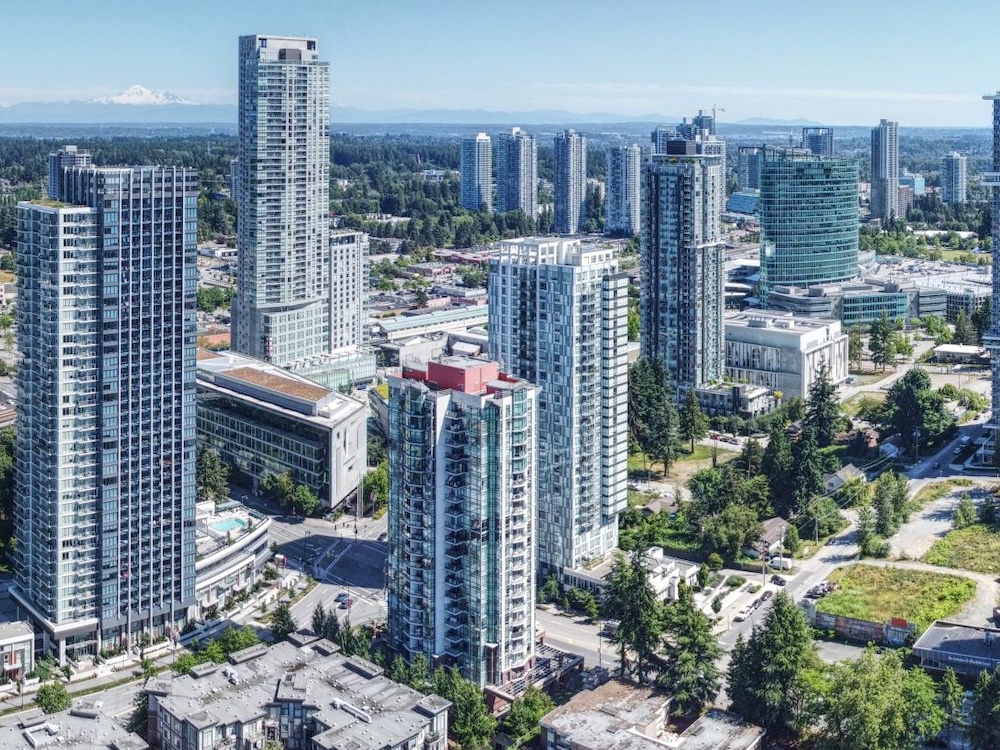
On a mid-campaign Wednesday morning, the leaders of British Columbia’s two main political parties held events a few blocks apart in Surrey.
BC NDP Leader David Eby stopped in at the Buy N Save South Indian Grocery on 72nd Avenue just west of King George Boulevard in the Surrey-Newton constituency to talk about supports for businesses and youth employment.
His main challenger, Conservative Party of BC Leader Lorne Doerkson, appeared a few blocks away at Crown Building Supplies on 76th Avenue, also in Surrey-Newton, talking about building the economy.
It was almost guaranteed the two leaders would cross paths in Surrey. Eby’s first event after calling the snap election was in the city, and in the campaign’s first weeks both he and Doerkson have been return visitors.
Asked about the electoral importance of Surrey, Eby declined to talk strategy.
“Surrey is generally important for the province right now,” he said. “It’s the fastest-growing city in the province, there’s a lot of energy here in Surrey, and because of the growth, because of the significant impact that Surrey has on the provincial economy and on the province’s fortunes, we put about $12 billion of investments into Surrey. New SkyTrain, new medical school, new hospital.”
The discussions in the election about health care and affordability are key issues in Surrey, Eby added. “It is crucial not just in the election but generally to the future of the province.”
The path to victory for either party goes through Surrey. Ten of the province’s 93 constituencies are in Surrey, and almost all are battlegrounds. The city was key to the NDP’s 2020 majority, but in the last election the Conservatives made gains and won six seats in the city to the NDP’s four.
In Surrey-Newton, where Eby and Doerkson both campaigned on Oct. 7, more than 15,000 people voted in 2024 and Jessie Sunner won for the NDP by just 1,266 votes.
That’s close, but by Surrey standards it was a wide margin.
Eight of the Lower Mainland city’s 10 constituencies were even closer. Six were decided by fewer than 800 ballots. The closest, Surrey-Guildford, was won by the NDP’s Garry Begg by just 22 votes.
Shinder Purewal teaches political science at Kwantlen Polytechnic University in Surrey. The city’s large number of voters of South Asian descent have traditionally supported the NDP provincially and the Liberals federally, but that’s changing, he said.
Almost 40 per cent of Surrey’s 760,000 residents have South Asian roots, and about 70 per cent are part of what Statistics Canada calls “visible minorities.”
Decades ago, many in the riding connected with the NDP through the unions at the mills where they worked, Purewal said. “The NDP through their unions and through their activists, they did a lot of recruitment.”
Now, however, fewer people are working in the mills and there’s a growing middle class of professionals and business people whose economic interests are more in line with the Conservatives, he said.
“I think Surrey is more probably leaning towards the Conservatives,” he said, adding there’s disappointment with Eby’s NDP government. “He chose to fight an election against Trump. That’s not going well with people I guess.”
The big issues in the city are housing, affordability, health care and inflation, all of which Eby already had a mandate to address before he sent the province to an early election, Purewal said.
Homes are expensive, mortgage rates are high, and a large number of developers and construction workers are underemployed, he said. “Basically their economy is dead. There’s no new housing, no new projects coming up.”
And then there are the long-term grievances. Aside from teaching in Surrey, Purewal has lived in the city for five decades. “We only have one hospital. Vancouver with a similar population, they have six,” he said. “I’ve always been hearing about the second hospital, but it’s still not ready. So, health care is a major issue.”
The long-promised second hospital and cancer centre broke ground in 2023 and is expected to be open in 2030.
Education is also a big issue in the city, Purewal said. “Surrey has more portables than any constituencies or city in B.C. Basically half of B.C.’s portables in schools are in Surrey.”
Young families are moving to Surrey because it’s affordable compared with Vancouver, but spending on new schools has failed to keep pace, he said.
People see the size of the provincial deficit, which was $13.8 billion according to the most recent update, but they don’t know where the money is being spent since they feel Surrey isn’t getting any of it, he said.
Purewal predicted that on election day the Conservatives will make gains in Surrey, adding that former NDP cabinet minister Jinny Sims will fail to get back to the legislature. “She lost last time and she’s going to lose again.”
The executive director of Surrey Women’s Centre, Shahnaz Rahman, said that when talking with people, she stresses the value of their vote and the importance of researching the candidates and participating in the process. But she does hear from people who lack the will to vote.
“There are many people like that,” she said. “They have just lost confidence in the democratic process or are not satisfied with any of the parties or any of the candidates, so they’ve concluded not to vote is an option.”
In 2024, the turnout of registered voters was below the provincial average of 58.4 per cent in nine of Surrey’s 10 constituencies. At 44.8 per cent, Surrey City Centre had the lowest turnout in the province.
Rahman said she would like to hear more from all the parties on their plans to support the kinds of programs and services the women’s centre provides. “Violence against women and intimate partner violence is not a partisan issue,” she said. “It is a community safety issue, it’s a public health issue, it’s of course a housing issue, a human rights issue.”
The issue needs to remain visible during elections, Rahman said. “When I hear from different politicians, they often focus on public safety, housing affordability, economic pressures, health care and stuff, which are all important pieces, but it’s really important to remember that intimate partner violence intersects with all of these issues.”
The current government has a gender-based action plan and recognizes the issue, and she would like whoever forms the next government to listen to people with experience in the sector, build on the work done over the last few decades and be committed to moving forward.
“What we would expect is a level of curiosity from them to understand these issues that are affecting public safety and all the other platforms that they may have on the agenda,” she said.
Norman Stowe, the riding president for the Conservatives in Surrey-Cloverdale, moved to Surrey in 1987 and has been involved in centre-right political parties going back to when the Social Credit party was in government.
“You can’t become premier in British Columbia without winning in Surrey,” Stowe said. “It’s definitely a big prize.”
Along with affordability and housing, top issues include public safety, he said, noting the city is coming out of an extortion crisis targeting South Asian business owners and residents that had many people on edge.
Transportation and transit are also key in a city where people spend twice as much time in their cars than the provincial average, Stowe said. The Surrey SkyTrain, which is extending the line from King George to Langley, is the first big investment since 1986, he said.
Even once it’s open, there will still be a need for service running north-south down King George or other arteries, he said, adding that the city has a lot of catching up to do compared with Vancouver or Burnaby.
Acknowledging his partisan bias, he said his feeling is the Conservatives have an edge in the city. “Door to door I think the Conservatives have momentum, and that’s a good thing.”
The NDP is, however, also able to turn out support in the city. An Oct. 15 event held in a Surrey gas station parking lot included residents speaking about why they like the NDP’s record.
One of them, Simran Khosla, is the owner of a trucking company with a fleet of 100 vehicles. He said he would save thousands of dollars thanks to the promised freeze on insurance rates and efforts to lower the cost of fuel.
Another, Karamjit Atwal, a cab driver whose household runs four cars, said the gas cut and insurance freeze will save him money. He also welcomed the government’s efforts to protect cab drivers as Uber has entered the market, and he thanked the government for removing bridge tolls, replacing the Pattullo Bridge, overseeing Surrey’s transition from the RCMP to a local police force and building a new hospital.
While competitive constituencies are concentrated in Surrey, several other tight races in 2024 will likely be close again.
Along with success in Surrey to win the stronger majority Eby is seeking, the NDP will be hoping to hold all the seats it won last time and pick up Kelowna Centre, Courtenay-Comox, Maple Ridge East, Penticton-Summerland and North Island from the Conservatives.
Meanwhile the Conservatives will see opportunities in the NDP-held constituencies of Juan de Fuca-Malahat, Coquitlam-Burke Mountain, Vernon-Lumby, Richmond-Steveston and Vancouver-Langara.
The Conservatives may also hope to take West Vancouver-Sea to Sky from the Greens; Jeremy Valeriote won that riding in 2024 by just 676 votes.
The Greens will hope to hold Valeriote’s seat and elect leader Emily Lowan in Saanich North and the Islands, which Rob Botterell held for the party before stepping down. The party aims to win more seats, though it’s unclear where that’s likely. In 2024 the party came a distant second in a couple of Victoria-area ridings and trailed everywhere else.
Polling so far suggests two parties that splintered from the Conservatives, OneBC and CentreBC, are unlikely to receive significant support, though the small number of votes they receive may make a difference in some tight races.
If one of the main parties opens a gap over the other in the popular vote, the list of constituencies they can win will grow. But if the result is close, as polls suggest it will be, who forms government will depend on a small number of seats where either could triumph.
Advance voting is open, and final voting day is Saturday. 
Read more: BC Election 2026, BC Politics



Tyee Commenting Guidelines
Please note that email notifications for replies are not currently working due to a software issue which may be resolved in a future update.
Comments that violate guidelines risk being deleted, and violations may result in a temporary or permanent user ban. Maintain the spirit of good conversation to stay in the discussion and be patient with moderators. Comments are reviewed regularly but not in real time.
Do:
Do not: