


 SHARE:

Here at the tail end of November, it’s still eerily warm in Vancouver. I have yet to turn on the heat in my apartment, and often find I’m actively sweating while out and about in the city.
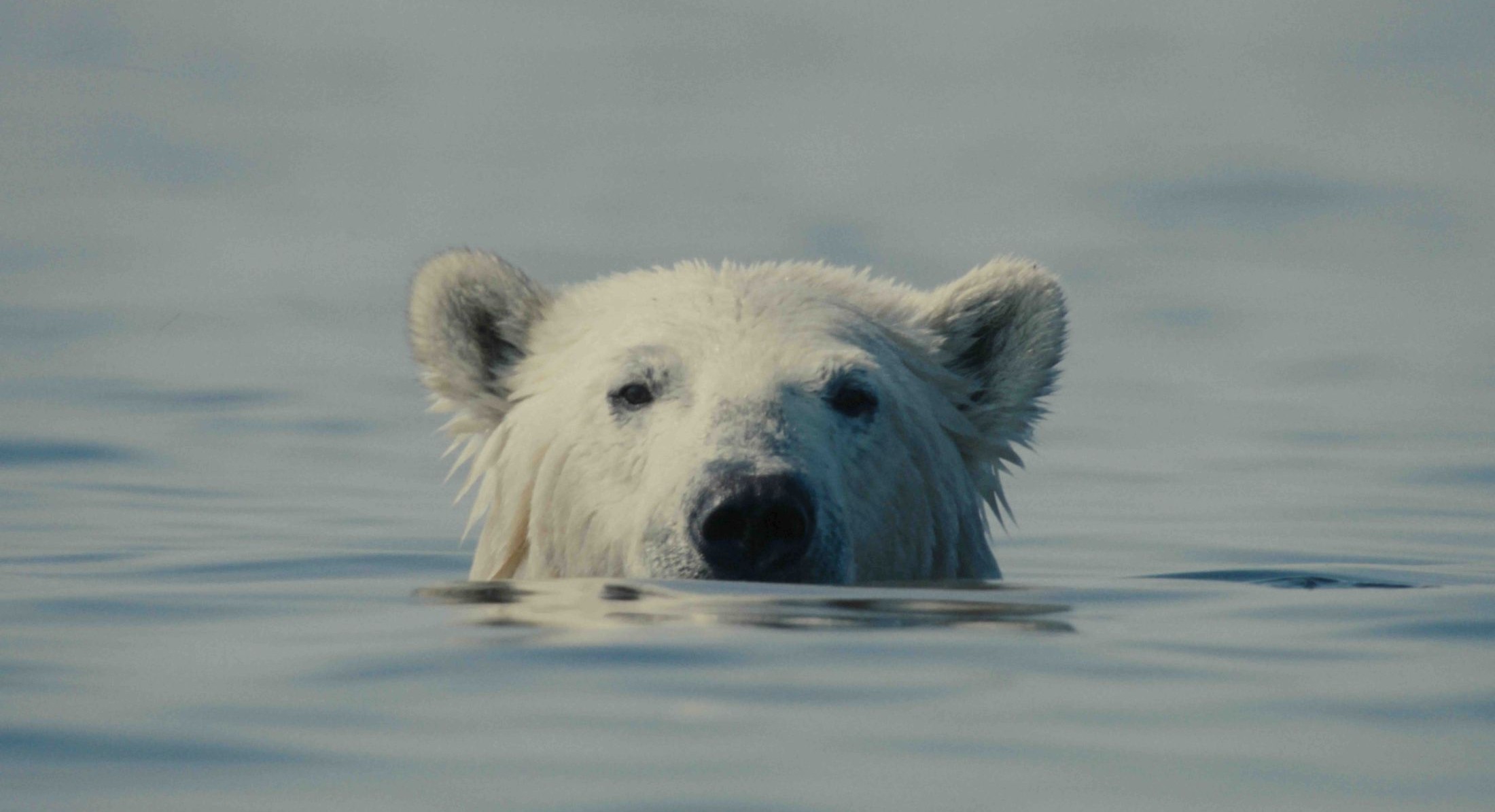
If I’m this warm, I can only imagine how bears must be feeling right now.
The unseasonal temperatures have not only affected humans and other animals. They’re also wreaking havoc on entire industries.
The Whistler Film Festival launches next week, Dec. 2, with a screening of Brad Bird’s animated noir opus Ray Gunn.
In years prior when I attended the festival, the snow was up to midthigh, and it was cold enough that I regretted not bringing warmer socks.
As of this writing on the week before opening night, major snowfall has yet to arrive in Whistler. Both Whistler Mountain and Blackcomb Mountain have opened recently for the ski season, but a lack of snow means not all the runs are open. Film festival attendees customarily squeeze in some skiing in amongst films and meetings. This year, there may be fewer options to choose from.
A place like Whistler arguably survives on winter culture. What does it mean when the cold fails to materialize?
It’s a question at the centre of the documentary Nuisance Bear, also playing at the Whistler Film Festival this year.
Coming off a banner year on the international festival circuit, Canadian filmmakers Gabriela Osio Vanden and Jack Weisman’s debut feature has won 17 awards and received 18 nominations. The extensive recognition for the documentary includes the prestigious 2026 Grand Jury Prize for Documentary at the Sundance Film Festival, the 2026 Best Cinematography Award at the Woodstock Film Festival, and the Werner Herzog Film Award 2026.

It’s not hard to see why. Bear is an up close and personal look at the humans and bears who call Churchill, Man., home.
It is fascinating, often ridiculously beautiful and filled with details about the place and its people.
But there is a dark heart at the centre of the story.
A journey to the ‘polar bear capital of the world’
The film’s interlocutor is Inuk elder Mike Tunalaaq Gibbons. He explains that every year when the sea ice forms later in the season, polar bears are forced to remain on land for longer periods of time. This is when trouble arises.
Bears and humans used to give each other a wide berth, Gibbons explains. But in the warming world, this is no longer possible.
Churchill, dubbed the “polar bear capital of the world,” provides an entry to the story with its industries of tourism and bear-watching. As attendant herds of tourists bundled in Canada Goose parkas are trundled out into the countryside to search for bears, the scope of the business becomes clear.
The bear-watching vehicles, oversized buses with exterior platforms allow for interactions between bears and humans, are themselves impressive in scale.
As the tourists take photos, twittering like a flock of excitable birds, the bears mosey about, sniffing the air. They seem to be taking a look to see if there’s an easy way to eat these noisy interlopers.
The look of curiosity and arguably, confusion, on the bears’ faces makes for an interesting introduction. But as the story progresses, even more complex elements emerge. This is clear from the film’s opening scene.
In what looks to be a pure and unsullied moment, a wild mother bear shepherds her two young cubs. Then the camera draws back, and a veritable scrum of photographers comes into view, the relentless click of their telephoto lenses capturing images of the trio.
Certainly, the sight of a mother bear and her adorable babies is hard to resist. The harder truth of these encounters is that they’re orchestrated and managed.
Wild bears are a resource, one that attracts both profit and potentially exploitation.
Gibbons notes that the healthy respect for boundaries that formerly typified interactions between the humans and bears was marked by care for territory. In other words, the two species did their best to avoid each other. But that has changed.
The directors expanded Nuisance Bear from a short film, made while they were both in film school, into a feature. They tell the story with little interpolation and plenty of amazing footage.
This is truly a cinematographers’ film, and the narrative is carried by a wealth of staggering images. Principal among these is the titular bear, born aloft in a sling, being moved to a more remote location via helicopter. In mid-flight, the heavily tranquilized bear appears to wake up, and one can only wonder what the animal makes of its predicament.
Even in the most incongruent of situations, such as dangling on a longline beneath a helicopter, the film affords the bears a degree of dignity and respect.
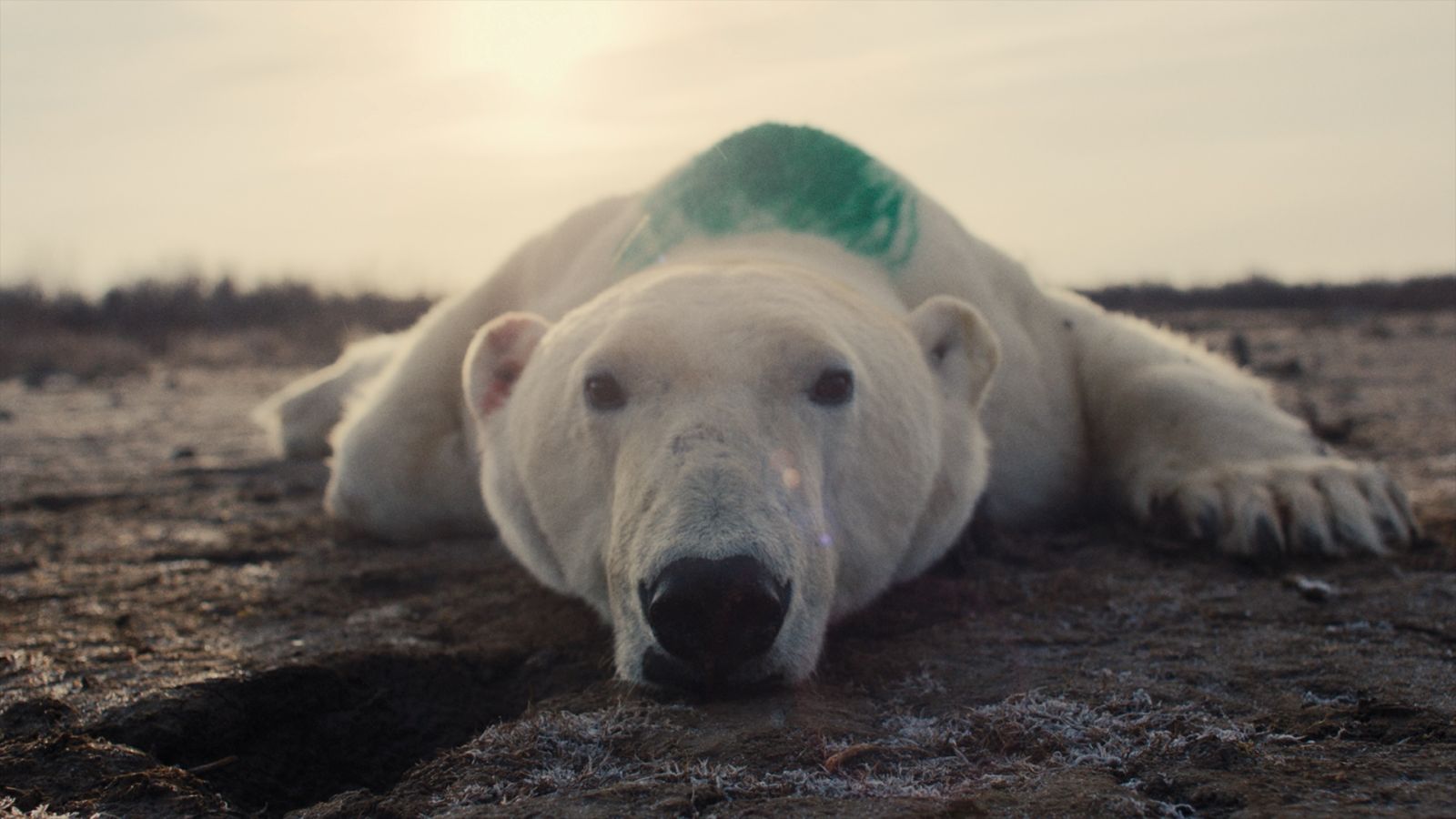
Once deposited back on the ground, the animal is tagged and given a bright green spot of spray paint to denote its status. A conservation officer stands astride the bear’s neck. They’re charged with the task of putting a transmitting chip in the bear’s ear. It’s hard not to hold one’s breath, hoping no one is harmed in the encounter.
A fine balance, and tipping scales
In the smaller community of Arviat, 260 kilometres north of Churchill in Nunavut, locals have been forced to directly contend with the changing behavior of polar bears. Patrols make their rounds on quads, checking in over the radio about kids playing pickup hockey and watching out for bears making their way into town.
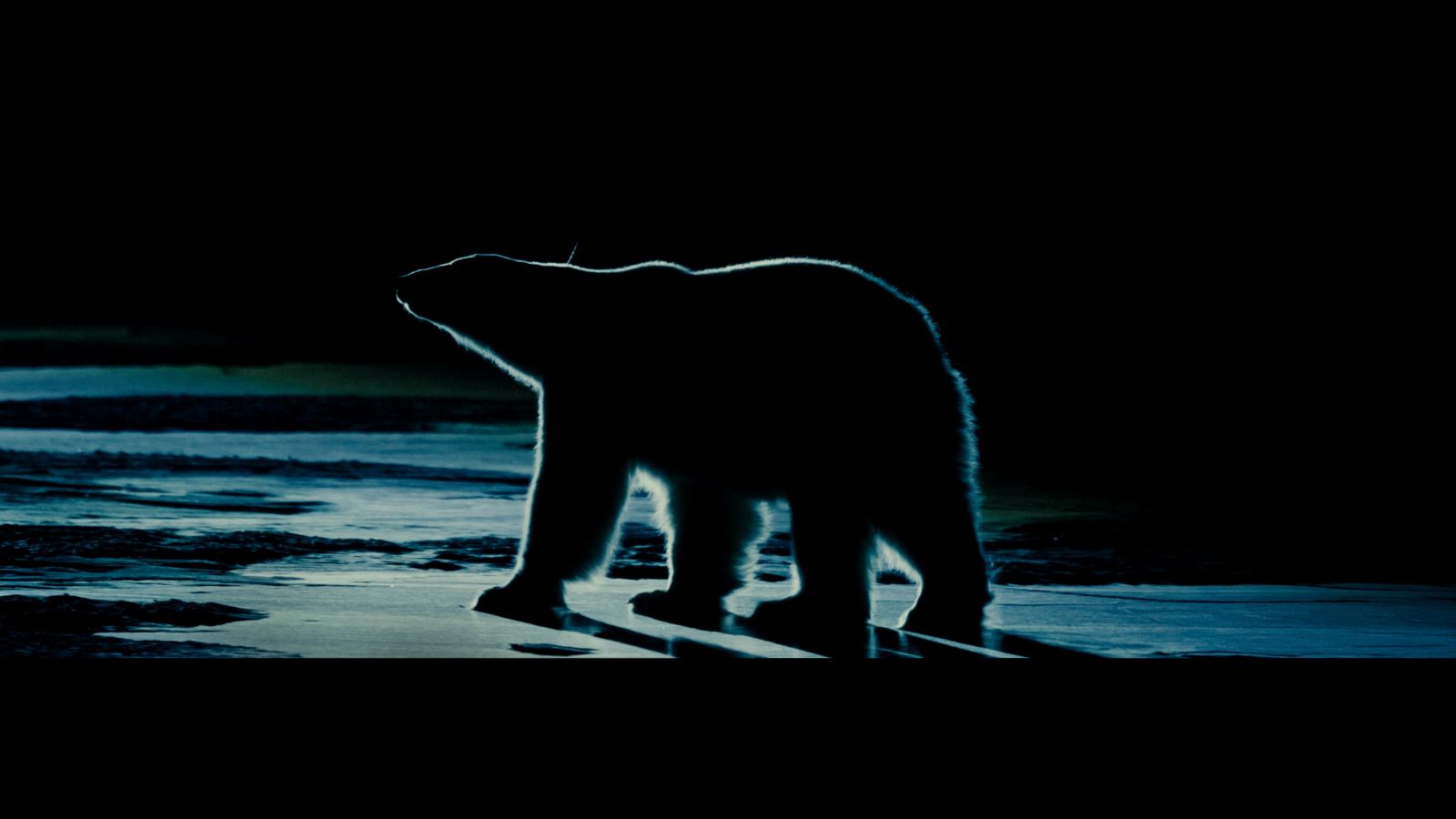
These scenes, largely filmed at night, are among the most riveting and arguably the most nerve-wracking. In the wavering light of the vehicle’s headlights, community members track the bear’s progress, doing their best to warn off the animals before anything more dire takes place.
The directors’ original short film largely eschewed language. In the Nuisance Bear feature documentary, there are numerous conversations taking place.
The audience sits in on community meetings where residents contend that far from being a population under threat, the number of bears is actually increasing. The sense that bear tourism has supported this growth is inferred if not stated outright. Underscoring this are scenes of multiple bears rooting through the local dump.
The description of the film in the Whistler festival guide makes a salient point about the context of the festival screening alongside larger forces at work.
“For Whistler audiences familiar with the delicate balance between bears, tourism and mountain communities, this extraordinary film strikes particularly close to home.”
‘Not harmony but chaos’
As winter tourism in places like Whistler stutter, what happens to the industries and infrastructure designed to support them? That remains the larger, far more destabilizing, question. Not just in ski resorts, but also arguably places like Churchill that have made use of bears as a tourist attraction. Even more difficult questions arise as bears and humans are in increasingly close proximity.
The recent grizzly attack that resulted in the death of a mother and daughter near Bella Coola, B.C. this fall resurfaced the darker and more horrific encounters between bears and humans.
Here’s where things get more intractable.
There’s an infamous quote from the acclaimed film director Werner Herzog’s 2005 documentary Grizzly Man. The film followed the life and death of bear enthusiast and advocate Timothy Treadwell, whose sentimental ideas about peaceful human-animal co-existence were, as Herzog states frankly, just that: sentimental and potentially destructive to everyone involved.
“I believe the common denominator of the universe is not harmony but chaos, hostility and murder,” Herzog said in the film.
What Herzog saw as only the “overwhelming indifference of nature” is certainly a part of the story of Nuisance Bear, but anyone who has ever spent a great deal of time with animals knows that there is something deeper taking place. Namely a struggle for dominion.
Voyeurism with a colonialist bent is another frequent aspect of many nature documentaries. To its credit, Nuisance Bear lets Indigenous people tell their own stories in their own language. In Inuktitut, interlocutor Gibbons talks about his experiences with residential school. He also shares his regrets, and feels he failed to pass on Indigenous knowledge to his own children.
In another scene, as the Arviat community gathers to participate in a lottery for the annual hunt of polar bears, the sense that Indigenous people are still forced to contend with the environmental changes largely brought about by more southern-situated populations is hard to escape.
Even documentary itself comes in for closer examination. As the film’s opening scene makes clear, documentary and media are often extractive industries, with filmmakers parachuting into different places in the world to take what they want and fashion a story out of it.
As an immersion in northern culture and Inuit communities, Nuisance Bear is a fascinating experience.
But an underlying grief eats at the edges of the film, making it an uneasy watch.
“No story is ever simple,” Gibbons states at the outset.
“Stories are like mazes. They lead us where we least expect.”
This is especially true of Nuisance Bear. It leaves you adrift with unresolved feelings about the state of the warming world and all its inhabitants.
‘Nuisance Bear’ screens at the Whistler Film Festival on Dec. 5. The festival runs Dec. 2 to 6. ‘Nuisance Bear’ also has several Vancouver screenings at the VIFF Centre starting Dec. 4. 
Read more: Indigenous, Media, Film, Environment







Tyee Commenting Guidelines
Please note that email notifications for replies are not currently working due to a software issue which may be resolved in a future update.
Comments that violate guidelines risk being deleted, and violations may result in a temporary or permanent user ban. Maintain the spirit of good conversation to stay in the discussion and be patient with moderators. Comments are reviewed regularly but not in real time.
Do:
Do not: