
 SHARE:
[Editor’s note: This article contains discussion of residential schools and residential school denialism. It may be triggering to some readers.]
In mid‑August, city council candidate Marc Emery stood in the street near the Sechelt Farmers’ and Artisans’ Market wearing a blue jersey that bore the Canadian coat of arms. He held a large white sign reading “No More Land Acknowledgments.”
In a recent email to The Tyee, Emery said his goal was to end land acknowledgments in all taxpayer-funded facilities. “It’s an insult to me and many who feel as me,” he wrote.
Opposing land acknowledgments is only one part of Emery’s self‑described “anti‑woke” campaign. He told The Tyee he’s running because of an array of issues including high property taxes and drag queen story hour. Over the past few years, he has also posted statements denying evidence of residential school harms and suggesting violence against Indigenous people.
Emery’s candidacy comes just over two years after the Union of British Columbia Indian Chiefs called on five municipalities, including Sechelt, to address residential school denialism and reject “racist misinformation” in their cities.
With civic elections approaching in October, The Tyee revisited those communities as familiar figures such as Emery, some involved in previous controversies, hit the campaign trail.
SOME RELEVANT RECENT HISTORY
‘Grave Error,’ residential school denialism, land acknowledgments
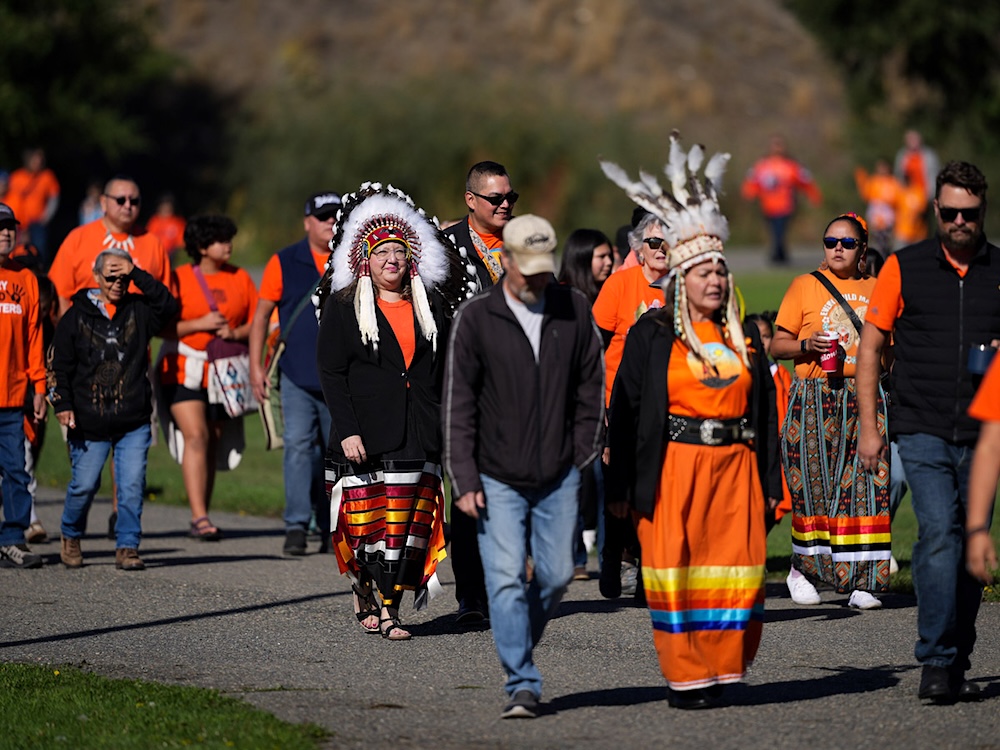
In August 2024, the Union of British Columbia Indian Chiefs called on Sechelt, Powell River, Quesnel, Kamloops and West Vancouver to formally reject residential school denialism, uphold survivor testimony, implement the Truth and Reconciliation Commission’s Calls to Action and “categorically reject” misinformation promoted by the book Grave Error: How the Media Misled Us, a compilation of essays the UBCIC linked to “residential school denialism,” as it claims “genocide did not occur at residential schools.”
Earlier in 2024, Quesnel had become a flashpoint after Mayor Ron Paull’s wife, Pat Morton, was accused of distributing the book. Councillors denounced the book and Paull’s wife’s actions. Paull voted with council in favour of the motion.
Frances Widdowson — one of the book’s contributors and someone APTN said in 2025 was “emerging as denialism’s public face” — also travelled to Quesnel to speak to council. The UBCIC as well as the Lhtako Dene, Nazko and Lhoosk’uz Dené First Nations called for Paull’s resignation and said they would no longer work with him.
The Tyee contacted Widdowson for comment on her appearances in Quesnel and other municipalities, and the fact that these appearances, and the book Grave Error, were often cited when discussing residential school denialism, but did not hear back by press time.
“We are concerned that this is just the tip of the iceberg,” Grand Chief Stewart Phillip was quoted saying in an April 2024 news release. He added that it could represent a “broader network of individuals connected to municipalities peddling hateful denialism and eroding trust in local government.”
Following the controversies, Quesnel council voted unanimously to censure Paull, remove him from committees and suspend his travel budget. Paull later won a lawsuit on the matter and the council resolutions were quashed.
Pat Morton also sued the UBCIC, saying their letter was defamatory and caused “severe reputational damage, emotional distress and fear.” The B.C. Supreme Court dismissed that lawsuit.
Although the UBCIC did not address the other municipalities individually prior to the August 2024 letter, each had had its own controversies. The Tyee reached out to the UBCIC for clarification and comment but did not receive a response by the time of publication.
In Sechelt, Mayor John Henderson had also discussed Grave Error with senior staff. He declined to support the UBCIC resolution. Both shíshálh Nation and the UBCIC Chiefs‑in‑Assembly called for his resignation. Henderson argued the issue was about freedom to read, but acting mayor Brenda Rowe disagreed, telling APTN News: “This is not about freedom of speech or the right to read. This is not about book banning. This is about being in a position of leadership in our community where our neighbour that we are one kilometre away from is shíshálh Nation, and we just don’t see that as part of a leadership role,” Rowe said. Council passed the resolution without Henderson’s support.
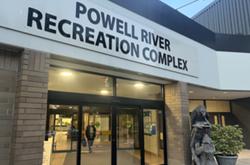
In Powell River, the dust-up began in 2021 when the Tla’amin Nation requested that the town consider changing its name. Powell River is named after Israel Wood Powell, B.C.’s first superintendent of Indian affairs. Powell was an advocate of establishing residential schools and was also instrumental in the development of legislation banning potlatches. (The regional district had also previously been renamed qathet, a named gifted by Tla’amin Nation Elders.) A group of residents, joining under the name the “Concerned Citizens of Powell River,” began to agitate against the name change. They invited Frances Widdowson to town to discuss the name change. Mayor Ron Woznow had attended another Widdowson event earlier that year in the city’s public library.
Jim Palm, a municipal councillor, “belittled and mocked” the Ayajuthem language, spoken by Tla’amin Nation members, at a committee-of-the-whole meeting, when discussing what the city’s name could be changed to.
In a written statement, Palm apologized for his comments, saying the fictitious name he used “was not intended as a mockery of the Tla’amin language.” He added: “However, it is now clear that the effect of this example was hurtful and had further-reaching consequences although there was no disrespect meant.” Palm was not associated with the Widdowson events and has not been accused of participating in residential school denialism.
Powell River council voted to support the UBCIC resolution. Woznow was not present at the vote. Palm brought forward a motion for a staff report with a legal opinion regarding the UBCIC resolution and chose not to vote on the motion in support of the UBCIC resolution.
The Tyee asked Woznow about how he would have voted on the UBCIC resolution, as well as whether he’d like to add context to why he attended the event with Widdowson. He listed positive relationships he has had with Indigenous people in his youth and his experience founding and raising money for the Verna J. Kirkness education program, which supports science, technology, engineering and mathematics education for Indigenous youth. “There is no yes or no answer to your questions,” Woznow wrote. He added that unless he was “offered 3,000 words,” any response he would give would result in a misunderstanding of his position.
In Kamloops, incidents of residential school denialism increased steeply after ground-penetrating radar discovered 215 potential burial sites on the site of the former residential school in 2021. The Tk̓emlúps te Secwépemc Nation has since updated that number to 200 and is using other technologies to do further research and analysis as the community grapples with whether or not to disturb potential remains. The final report of the Truth and Reconciliation Commission documented at least 3,200 deaths at residential schools across Canada. This is supported by family and survivor testimony collected by the commission. “The practice was not to send the bodies of students who died at schools to their home communities,” the commission said.
People have shown up to the site of the former residential school with shovels; Frances Widdowson has worn a “What Remains? 215” sandwich board at events; and most recently, masked men from the white supremacist group Second Sons Canada unfurled a “Got bones?” banner nearby.
Though Kamloops municipal council and district have worked hard to build a positive relationship with Tk̓emlúps te Secwépemc, Coun. Dale Bass said misinformation continues to fuel “racist emails” being sent to council. Kamloops filed the UBCIC letter with no reported response or public statements.
In West Vancouver in 2022, council removed the requirement for oral land acknowledgments at meetings for “efficiency.” The change was made without consulting the Squamish Nation. Though the mayor, Mark Sager, told Global News that the change was not intended to question or deny the need for further action and reflection on reconciliation, Sḵwx̱wú7mesh Úxwumixw Council chairperson Khelsilem said the move felt like “drifting backwards.” West Vancouver filed the UBCIC letter with no reported response or public statements.
WHERE THE MUNICIPALITIES ARE NOW
Quesnell: Ron Paull runs again
In Quesnel, incumbent Mayor Ron Paull is running again. He was quoted in My Cariboo Now saying that the controversy around Grave Error has put the city on a “path to good relations,” including having council-to-council meetings that were not happening previously. “There are so many economic and business opportunities at our disposal that will work so much better, in fact maybe they wouldn’t even work at all, if there wasn’t that business relationship between the Nations and the City and also the Regional District.”
Paull did not respond to The Tyee’s questions about his current relationship with the Lhtako Dene, Nazko and Lhoosk’uz Dené First Nations before publication. The Lhtako Dene, Nazko and Lhoosk’uz Dené First Nations also did not provide comment.
Powell River: Jim Palm, candidates with ties to Frances Widdowson
In qathet Living’s September issue, Tla’amin Hegus John Hackett described Powell River’s current council as “standoffish,” referring particularly to an unnamed couple of council members as “kind of falling into that anti-Indigenous atmosphere.”
“That kind of pours into the community,” he added.
Coun. Jim Palm is now running for mayor of Powell River. The Tyee reached out to Palm for comment and to understand more about his current relationship with the Tla’amin Nation but did not hear back before publication. His website lists working “with Tla’amin” as an economic priority.
Diane Sparks, running for Powell River council, was a leader of the Concerned Citizens for Powell River group. She invited Frances Widdowson to Powell River and spoke at a separate event in Powell River with Widdowson. An AI meme she posted, of a dinosaur holding a sign reading “It was my land first,” appears to mock land acknowledgments. In another social media post, she referred to the qathet Regional District as “Qwaket.”
Her campaign materials assert that one of her platform goals is a “stronger relationship with Tla’amin.” However, in another Facebook comment, she said “reconciliation will never be achieved” unless the nation votes in a different Hegus and council “that have common sense.”
The Tyee reached out to Sparks for comment but did not hear back before publication.
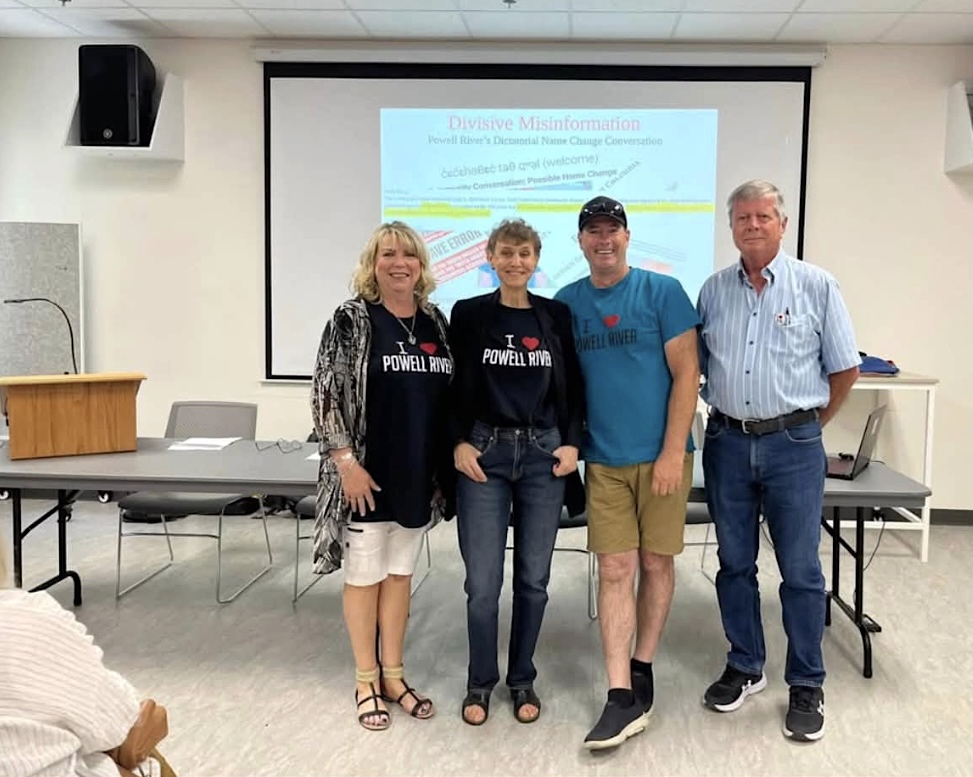
Ted Vizzutti, another council candidate, had been a paramedic in the town for many years before he “elected to retire early” during a BC Emergency Health Services union investigation into allegations that he had been “circulating racist, anti-Indigenous and defamatory content on social media and door to door” and “referring to Indigenous people as ‘Indians.’” These actions “impacted the Tla’amin Nation community wherein they do not feel safe to call 911,” a letter sent to Vizzutti by the union said. The letter containing these allegations was made public by Rebel News, which interviewed Vizzutti. Vizzutti has attended and spoken at talks with Widdowson and posed for photos with her. The Tyee reached out to Vizzutti for comment but did not hear back before publication.
Council candidate Cathy Korolek also spoke alongside Widdowson at the September 2024 event about Powell River’s name change. The Tyee reached out to Korolek for comment but did not hear back before publication.
Current Mayor Ron Woznow is not running for re-election.
Sechelt: Mayor goes for MLA seat, Emery runs for council
After throwing his hat into the ring initially, incumbent Mayor John Henderson withdrew from the municipal race, citing “division and frustration” as well as a need for “fresh faces.” Henderson did not respond to The Tyee’s request for comment on whether the division and frustration he was referring to had to do with his relationship with shíshálh Nation.
Henderson subsequently joined the Conservative Party of BC and will be challenging NDP MLA Randene Neill for the Powell River-Sunshine Coast seat in the provincial legislature.
Meanwhile, Marc Emery joined the race for council. A May 2026 petition, which has garnered over 2,000 signatures, requests that the RCMP investigate Emery for hate speech. One of the highlighted statements was a post from X in November 2025 in response to the announcement that the snpink’tn (Penticton) Indian Band closed a section of the former Kettle Valley railway due to heavy rainfall and unsafe conditions. Emery wrote: “Any indigenous band that blocks railroads or any infrastructure should be dealt with by truncheons cracking their skulls within 24 hours. When you seize railroads, you are going to war. Time to finish the job our ancestors didn’t.”
When The Tyee asked Emery about this statement, he said he hadn’t understood the context of the original post he was referring to. “I was under the understanding the railway was blocked for political reasons,” he said. “If it was based on a legitimate hazard due to weather, I recant.”
In response to The Tyee’s question about whether or not what he wrote was hate speech, he said that what he meant by “the job of our ancestors” was “conquest and clarity.” Emery told The Tyee that he believed neither treaties nor reserve lands should have been implemented. “Being held blackmail by these dozens/hundreds of bands is insane to any kind of nation building,” he said, adding that his platform was aligned with that of OneBC.
Emery told The Tyee that he believes the municipality’s relationship to shíshálh Nation is “very important.” This is Emery’s second time running for Sechelt’s municipal council.
Kamloops and West Vancouver
In Kamloops, the recent Second Sons Canada incident drew swift condemnation from Kamloops council, who said the move was an “act of racism.” No council hopefuls appear to share the views of the residential school denialists who frequently land their city in the news.
The Tyee analyzed news reports and platforms for council candidates in West Vancouver but did not find evidence of the types of perspectives or views that put that city in the spotlight in 2024. UBCIC did not respond by press time to questions sent by The Tyee asking the council to clarify which incidents had led to the inclusion of West Vancouver in the letter, or if they had any concerns about candidates currently running for office.
What will these elections tell us?
Daniel Heath Justice, a professor of critical Indigenous studies and English at the University of British Columbia, and Sean Carleton, an associate professor in the department of history and Indigenous studies at the University of Manitoba, define residential school denialism as “the rejection or misrepresentation of basic facts about residential schooling to undermine truth and reconciliation efforts.”
Carleton told The Tyee that the denialist movement has so far consisted of a small group of people who amplify one another’s thoughts and arguments in events, books and documentaries.
But, he said, it’s unclear if the public is leaning in.
“One of the arguments that I make is that residential school denialism is certainly getting louder, but how much it is growing is really hard to determine,” he told The Tyee.
“What they're actually doing is they're pushing division as a political wedge to gain political power and influence, and to continue to poison the relationship between Indigenous Peoples and Canadians.”
The Tyee approached other candidates running in Powell River, Kamloops and other municipalities. Many incumbents said their constituents were focused more on housing costs, homelessness and public safety than on narratives questioning the impacts and legacies of residential schools. They expected issues such as Powell River’s name change to take a back seat.
Rob Southcott, a current city councillor who is now running for mayor of Powell River, sees the rhetoric around the name change and reconciliation as evidence of deeper anxieties.
“There's been material wealth here all through its entire history until just recently, where now we're facing real fiscal challenges,” he told The Tyee, referring to the closure of the local pulp mill and the loss of its major industrial tax base. Change is “inherently scary,” Southcott added. He referenced land claims, including the Cowichan decision, as one particular uncertainty constituents are facing.
“People don't know what that means, and it's so easy to be exploited,” he said.
But Southcott also pointed to the opportunities created by working together and strengthening the city’s relationship with the Tla’amin Nation to pursue projects that are mutually and financially beneficial. He cited the nation’s recent tree farm acquisition as an example.
“The Tla’amin emerging and in a powerful way in their own culture, which is a beautiful thing,” Southcott said.
Back in Sechelt, a jester joins Emery
Emery wasn’t the only one to show up with a signboard at the Sechelt market.
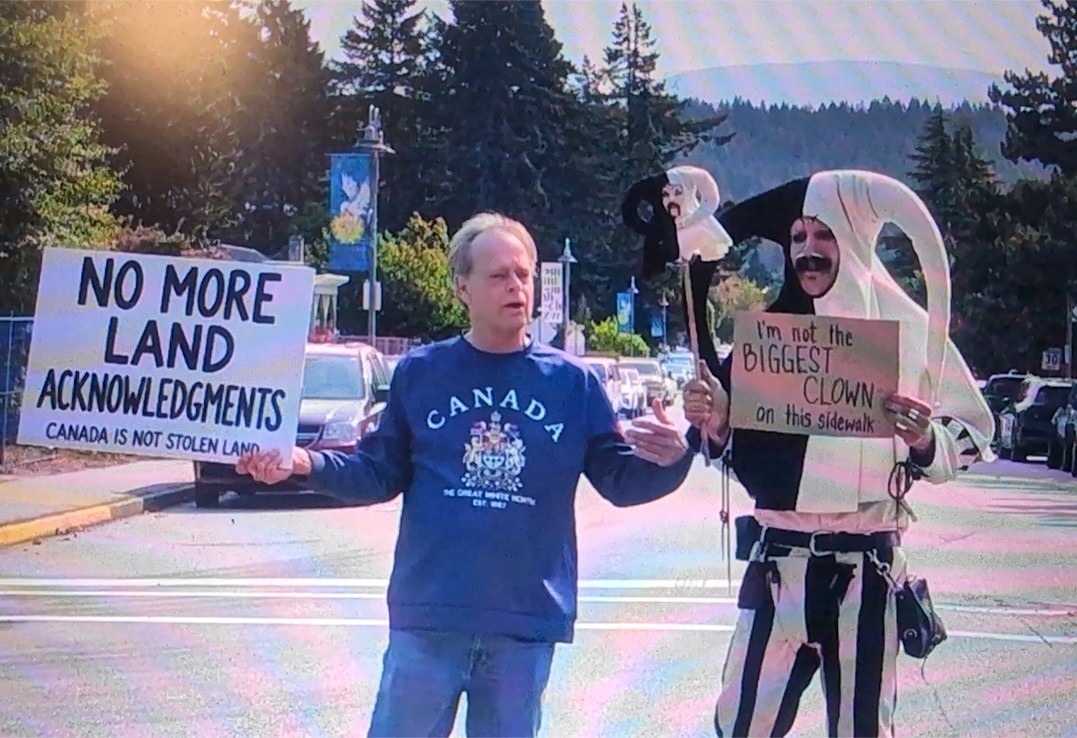
A musician and street performer who goes by the name Hog had recently received a grant to do street performances and decided to take his jester costume on a “maiden voyage” to “mock his atrocious views.”
Wearing a cream and black jester suit, Hog held a smaller marionette jester in one hand. In the other hand, he held a sign reading, “I am not the biggest clown on this sidewalk.”
For five hours, Hog stood beside Emery, occasionally blowing a bugle horn in his direction.
Emery told The Tyee by email that he felt Hog was “very intimidating.”
Sean Carleton told The Tyee that even though rhetoric around residential school denialism appears to be subsiding, it still requires work.
“Truth and reconciliation is not inevitable,” he said.
If people want the “arc of the moral universe” to “bend towards justice,” Carleton added, quoting Frederick Douglass, they need to get involved.
“They have to shape society towards peace and justice,” he said.
If you have tips related to campaigns in your community or believe there is more to add to this story, please email editor[at]thetyee.ca. ![[Tyee]](/design-article.thetyee.ca/ui/img/yellowblob.png)
Read more: Indigenous, Rights + Justice, Municipal Elections 2026, Municipal Politics




Tyee Commenting Guidelines
Please note that email notifications for replies are not currently working due to a software issue which may be resolved in a future update.
Comments that violate guidelines risk being deleted, and violations may result in a temporary or permanent user ban. Maintain the spirit of good conversation to stay in the discussion and be patient with moderators. Comments are reviewed regularly but not in real time.
Do:
Do not: