

 SHARE:
[Editor’s note: This article contains discussion of residential schools and residential school denialism.]
The B.C. Supreme Court has dismissed a defamation lawsuit launched by the wife of Quesnel’s mayor against the Union of BC Indian Chiefs, or UBCIC, ruling the group’s comments in a letter did “negligible (if any) harm” to her reputation.
The judgment also noted the importance of protecting the right to free expression.
In a decision released last week, Justice Jasmin Ahmad dismissed Pat Morton’s case against the First Nations advocacy organization. Morton is married to Quesnel Mayor Ron Paull.
Ahmad found there is “high public interest” in protecting UBCIC’s freedom of expression.
“The UBCIC has a long and established history of activism and advocacy in the public interest and has been vocal in challenging residential school denialism,” she found.
Ahmad dismissed Morton’s lawsuit under anti-SLAPP — or strategic lawsuits against public participation — legislation. The Protection of Public Participation Act, which passed in 2019, is meant to prevent lawsuits intended to silence critics.
Morton was suing over an April 2, 2024, letter to Quesnel council expressing concern about the promotion of a book advancing residential school denialism.
Ahmad found the letter was written with the goal of responding to what UBCIC viewed “as the dissemination of misinformation harmful to residential school survivors and their families.” The letter was meant to protect Indigenous people and particularly residential school survivors, whom she described as a “protected group in Canadian society.”
The judgment also means Morton is liable for UBCIC’s legal costs.
Morton filed her claim a year ago, saying that UBCIC’s letter, which was included in the city’s council package and shared on social media by people outside the organization, was defamatory and caused her reputational harm, emotional distress and business losses.
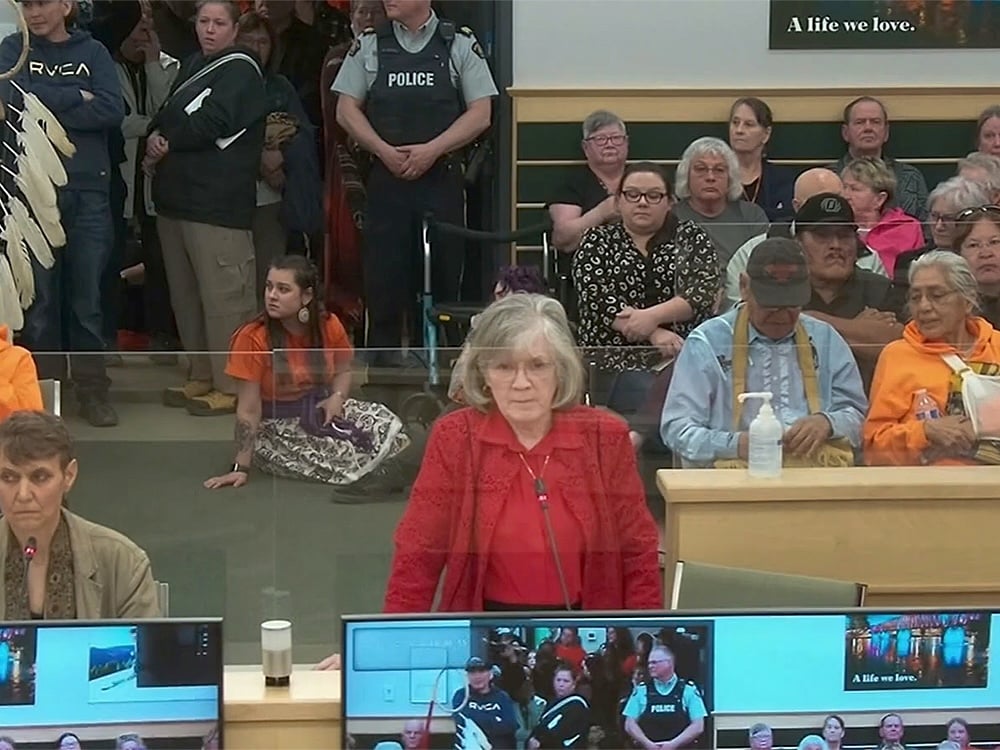
Controversy had erupted a year earlier in the B.C. Interior city of fewer than 10,000 people, when it came to light that Morton had been promoting the controversial book Grave Error: How the Media Misled Us (and the Truth About Residential Schools).
Grave Error, published by the right-wing news outlet True North, is a collection of essays that claim many of the documented harms inflicted by residential schools are “either totally false or grossly exaggerated.” The book has been criticized for spreading a false narrative about Indigenous history that is harmful to residential school survivors and reconciliation efforts.
While two city councillors have accused Paull of also sharing the book, the mayor has denied the allegations.
The allegations about the mayor’s connection to the book emerged at a March 19, 2024, council meeting and brought swift condemnation from other council members, First Nations leaders and the Quesnel board of education. The UBCIC, BC Assembly of First Nations and BC General Employees’ Union have all publicly criticized the mayor’s connection to the book.
In its April 2024 letter, UBCIC alleged that Morton had “bought cases” of Grave Error and given them out to clients at the Quesnel accounting business where she works, “in blatant disregard for the impact this would have on residential school survivors and their families.”
Morton’s son, Kevin Christieson, who owns the accounting business, filed a separate claim against UBCIC in May 2025 alleging that the letter brought him “severe reputational damage, emotional distress and fear.” Online court records show that Christieson’s lawsuit hasn’t been active since the parties last filed statements a month after it was opened.
According to the recent decision, Morton bought 13 copies of the book and provided one to a client at the business, asking her to “read the book and provide an opinion.” Morton also offered copies to the school district library and the local MLA, who returned it unread, according to the decision. She gave the remaining books to “close friends and family.”
Ahmad wrote in her decision that the case was not about Morton’s right to distribute the book or express her views about its content.
“This application is about whether the public interest in protecting the UBCIC’s right to publicly express its criticism of Ms. Morton for her distribution of the book outweighs any harm Ms. Morton may have incurred as a result of the UBCIC’s letter to Quesnel’s mayor and council,” she wrote.
She found that UBCIC’s letter was based on a matter of public interest and that its statement that Morton had acted with “blatant disregard for the impact” on residential school survivors was fair comment.
She added that similar views were expressed by others, including a Quesnel city councillor, Lhtako Dene Nation, Nazko First Nation, BC Assembly of First Nations, North Cariboo Métis Association, the superintendent and board of education of the local school district and social media commenters.
She also pointed to a public rally and residents who spoke at the council meeting, which were both held the same day that the letter was sent to council.
“In other words, the opinion expressed in the UBCIC Letter not only could be honestly held by a person, it was, in fact, held by the UBCIC and many others,” Ahmad found.
Based on the timing, she said, public criticism against Morton “started before the UBCIC letter was written or made public” and that there was no evidence that it meaningfully “exacerbated or heightened the level of public hostility.”
She also found that she could not link Morton’s claims of emotional distress — which included stress, anxiety and impacts on her health — to the UBCIC letter and that any business losses would have been incurred by Christieson.
While Ahmad agreed that social media comments were “decidedly critical” of Morton, she also determined that not all could be linked to the letter, which was posted to Facebook by Quesnel Coun. Laurey-Anne Roodenburg.
She found that Morton had “appended comments from different Facebook posts that contain negative comments about her” and incorrectly attributed them to Roodenburg’s post. Ahmad said she was unable to conclude whether Morton deliberately attempted to mislead the court with the misplaced comments.
“Ms. Morton provided no explanation for the inaccuracies,” Ahmad wrote.
B.C. court records show that Morton has filed more than a dozen civil claims in B.C. courts over the last several decades. In addition to the lawsuit against UBCIC, Morton is also suing Roodenburg, who serves as Quesnel city council’s Indigenous liaison, saying statements she made “contributed to a hostile environment” at council meetings.
In December, Roodenburg applied to have the action dismissed under the Protection of Public Participation Act. While a hearing in the case was scheduled for Monday, it was not included in the B.C. Supreme Court list circulated to media earlier this week.
The UBCIC celebrated last week’s decision in a statement, saying it “affirms the critical importance of protecting UBCIC’s advocacy supporting residential school Survivors and addresses harmful misinformation in the public sphere.”
“This decision reinforces that standing up for Survivors and speaking the truth about residential schools is not only necessary, it is protected,” UBCIC president Grand Chief Stewart Phillip said in the statement. “UBCIC has a responsibility to our member Nations and to Survivors to challenge misinformation that causes harm, and we will continue to do so without hesitation.”
Residential schools were federal institutions where Indigenous children were forcibly separated from their families, traditions and cultures in an effort to assimilate them. The institutions, which operated from 1883 to 1996, were rife with abuse, overcrowding, malnutrition and disease. Many children died as a result.
The 2015 final report of the Truth and Reconciliation Commission of Canada estimated that more than 4,000 children died at residential schools — a number that has since been estimated to be up to 50 per cent higher.
In an unrelated statement released Monday, B.C. human rights commissioner Kasari Govender took aim at mis- and disinformation — and its connection to colonialism — saying it undermines human rights and “poses the single biggest threat to our democracy.”
“Inside and outside the Legislature, it is becoming common to deny well proven facts and present false information in its place,” Govender wrote. “We need to get our facts straight.”
Govender said there is a well-documented history of how the Canadian government “tried to destroy Indigenous cultures, languages, laws, families and often bodies,” something she said has been established in statements from residential school survivors.
“The purpose of the residential school system was ‘to get rid of the Indian problem,’” she wrote. “These are facts that aren’t up for debate.” ![[Tyee]](/design-article.thetyee.ca/ui/img/yellowblob.png)
Read more: Indigenous, Rights + Justice, Municipal Politics









Tyee Commenting Guidelines
Please note that email notifications for replies are not currently working due to a software issue which may be resolved in a future update.
Comments that violate guidelines risk being deleted, and violations may result in a temporary or permanent user ban. Maintain the spirit of good conversation to stay in the discussion and be patient with moderators. Comments are reviewed regularly but not in real time.
Do:
Do not: