


 SHARE:
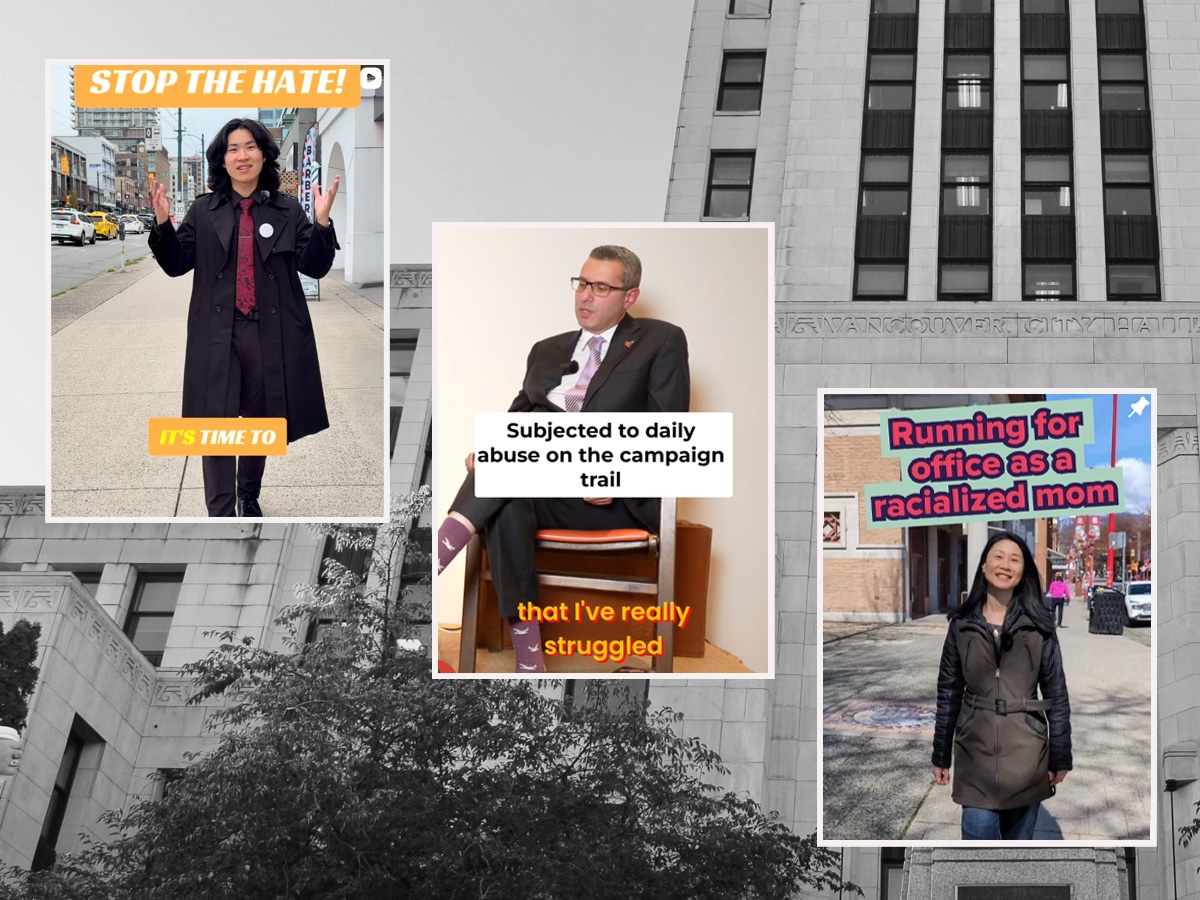
According to a 2025 CPAC poll, half of Canadians aged 18 to 29 turn to social media for news. This includes coverage of B.C.’s municipal elections set for Oct. 17 — not to mention the provincial election one week later on Oct. 24.
But not only are younger adults less likely to consume news from traditional news media outlets; they’re also less likely to vote in municipal elections.
So if candidates want to get their message across to the people least likely to vote, they have to be active on social media.
Social media participation comes with downsides, however.
The platforms provide users the opportunity to air their legitimate policy critiques. But they also let users leave anonymous harassing, hateful comments on a candidate’s race, body, accent, religion, gender, sexuality, mental health, past use of substances, income level or other characteristics.
Kareem Allam, who is running for mayor with the Vancouver Liberals, said he expected to face harassment on the campaign trail. A veteran political campaigner, helping everyone from current Vancouver Mayor Ken Sim to former Surrey mayor Dianne Watts and former BC United leader Kevin Falcon win their respective elections, Allam thought he had seen the worst online harassment could get.
There has been plenty of fair criticism online of his policies, or the fact that Allam is responsible for the successful ABC Vancouver majority win in the 2022 municipal election, including Sim’s successful mayoral run.
But Allam wasn’t expecting the level of hate he said has been aimed at him for being Muslim or having parents who are from Sudan and Egypt.
The harassment really ramped up, Allam told The Tyee, after the recent successes of famous Muslim American candidates such as New York City Mayor Zohran Mamdani and Michigan Democratic nominee for the U.S. Senate Abdul El-Sayed — and after Allam did his own campaign interview, shared on social media, with Muslim Stand for Rights, or MSFR.ca, a Vancouver-based Muslim non-profit foundation.
“It had a much more profound impact on me and my sense of belonging, of my standing in my community, my own sense of self-perception and agency,” Allam said of the hateful comments he received, which he said have included racist slurs.
“Someone who has been around as long as I have, you would have suspected I would have been more prepared. But the levels of harassment have escalated beyond anything I’ve seen.”
Allam is not alone. He said several Vancouver Liberals candidates, including two new mothers just a few months postpartum, have been harassed online for their appearance, gender, religion and race.
Allam has also heard from candidates in other parties who have been subjected to online harassment for similar reasons. He’s also seen the Islamophobic and racist comments left on campaign videos for Muhammad Ahmad, who is also Muslim and running for Vancouver mayor with the Bright Future Vancouver party.
It’s not a new issue in Canadian politics, nor is it limited to campaigns. Elected officials, particularly women, LGBTQ2S(IA)+ people and racialized people, have long reported the increasing levels of harassment they experience. And it’s not always coming from anonymous online accounts, either.
This past June, Vancouver’s integrity commissioner found Sim had harassed Coalition of Progressive Electors or COPE Coun. Sean Orr on two occasions in 2025. ABC councillors, who form the majority on city council, refused to sanction Sim, alleging the independent integrity commissioner’s investigation was biased.
Orr is currently suing Sim for a separate incident last February, in which Sim and ABC Coun. Lenny Zhou told Chinese-language news media that Orr had been photographed distributing illegal drugs.
Zhou later repeated these claims, which Orr said are totally false, in Mandarin in a video posted to WeChat, a social media platform popular with the Chinese diaspora community.
Both Sim and Zhou eventually apologized and claimed they had received misinformation.
Sim has also faced harassment while in office. In 2025 he alleged he and his family had received numerous death threats, and Sim was using a Vancouver police escort for his safety.
‘They might see some negative things about their mom’
This is not the first municipal election Iona Bonamis has run in as a candidate. The current OneCity candidate for Vancouver city council ran for the same position, with the same party, in 2022.
She’s also seen the numerous accounts of harassment experienced by women who have run for or were elected to a government office in Canada and across the world.
So Bonamis knew what to expect when she announced she was running again.
“I prepared myself mentally and emotionally for that. And I talked to the family about it,” said Bonamis, whose children are nine and 12 years old. “I wanted to prepare them so they know they might see some negative things about their mom.”
For Bonamis, whose ancestry is Chinese, the harassment has mainly taken the form of racist comments on her social media posts.
Particularly after she announced a provincial court challenge from her and six other candidates who wanted their names in both English and Chinese characters on the election ballot. It’s an issue that was heard by the B.C. courts in the 2022 election as well.
“Initial reaction is frustrated,” Bonamis said of reading harassing comments people leave on her posts.
“Then it kind of just makes me even more strong-willed to do even better work, and to continue showing up and prove people wrong.”
Shortly before our interview last week, Bonamis found out she and the other candidates won their court case.
“This court case has actually proven that it’s really important to continue fighting,” she said. “And good results can come out of that if people continue to show up for what we think is right.”
Turning the tables on the haters
Bonamis told The Tyee she ignores the hateful comments for the sake of her mental health. Andy Lin, who is running for Vancouver council with Bright Future Vancouver, has taken a different approach.
With shoulder-length hair and sporting a red mid-length trench coat in his videos, Lin is used to receiving harassment about his sex, gender and sexuality, as well as being accused of being a “communist spy” — despite having been born in Vancouver.
But Lin, who made a social media video calling on people to “stop the hate” and focus on the election issues, responds directly to the hateful comments.
“Getting bullied in high school is kind of good, because it just preps you for politics,” Lin said, adding that a person needs “tungsten skin” to run for office.
“You know you’re on the right track when people are insulting your physical appearance, how you talk, basically any physical attribute and not your policies.”
Increased attention for harassers also means increased traffic to his posts where he outlines his and Bright Future Vancouver’s campaign platform, he said.
Lin, Bonamis and Allam all agree that receiving online hate and harassment discourages others from entering politics.
“We want to have more representation in our elected officials, and our cities are getting more diverse. It’s really important to have all these different voices at all elected bodies,” said Bonamis. “And unfortunately these types of comments are discouraging people.”
Social media platforms need to change, say experts
“Trolled on the Campaign Trail: Online Incivility and Abuse in Canadian Politics,” a 2020 research paper from the University of British Columbia’s Centre for the Study of Democratic Institutions, found online harassment aimed at a person or political party can exacerbate societal divisions and a breakdown in democratic engagement in real life, too.
“A growing body of literature suggests that targeted harassment and incivility can have harmful ‘chilling effects’ on participation, which is particularly likely to make women unwilling to express their political views online,” the report says.
“Similarly, a 2016 survey in Canada found that women and racialized individuals were more likely to censor themselves out of fear of online harassment.”
Looking specifically at tweets sent to federal election candidates in 2019, the report found 40 per cent of messages were “uncivil,” while another 16 per cent were “abusive.” High-profile candidates, including party leaders, received the majority of these comments.
The researchers did not find that women and racialized people received more harassment than other candidates during this particular election.
But they acknowledged that women and racialized people are already receiving disproportionate threats, harassment and marginalization in the physical world. The impact of receiving hateful comments was “often amplified” by their life experiences, the report says.
The paper has a number of recommendations for political parties, social media platforms and policymakers to reduce harassment and its impact on people and our democratic process.
They include requiring social media platforms to moderate comments, which sites such as Facebook and X, formerly Twitter, have actually moved away from in recent years. They also call for platforms to root out bot accounts and mis- and disinformation.
Some of the report’s recommendations for political parties include training and guidance for candidates, not only in how to handle such comments but in the messages they send out. As well, they should promote healthy democratic engagement among the people who comment, including their own supporters who may engage in such behaviour with opposing candidates and parties.
“We do everything possible to wrap care around candidates who are experiencing online and in-person targeted hate,” said an emailed statement sent to The Tyee by Giovanna Orecchio, OneCity campaign director.
“OneCity's core team moderates social media comments if they cross the line into abuse, pay for legal counsel to defend candidates and electeds when necessary, and have a formalized support system that matches candidates with community leaders who share portions of their lived experiences so our spectacular candidates have someone on speed dial for trusted mental health supports.”
For politicians, who create the policies and laws that could make a difference in what social media companies are required to do, the report says they should work with other levels of government, provincially, federally and abroad, “to address this global problem.”
With a provincial election coming so closely on the heels of this municipal campaign, the timing to hold these discussions could not be better. ![[Tyee]](/design-article.thetyee.ca/ui/img/yellowblob.png)
Read more: Rights + Justice, Municipal Politics






Tyee Commenting Guidelines
Please note that email notifications for replies are not currently working due to a software issue which may be resolved in a future update.
Comments that violate guidelines risk being deleted, and violations may result in a temporary or permanent user ban. Maintain the spirit of good conversation to stay in the discussion and be patient with moderators. Comments are reviewed regularly but not in real time.
Do:
Do not: