


 SHARE:

There’s a sequence in You Can See Everything, the buzzy new documentary about Elizabeth Holmes, that has already become legendary meme material.
“Why would I deceive you?” Holmes says.
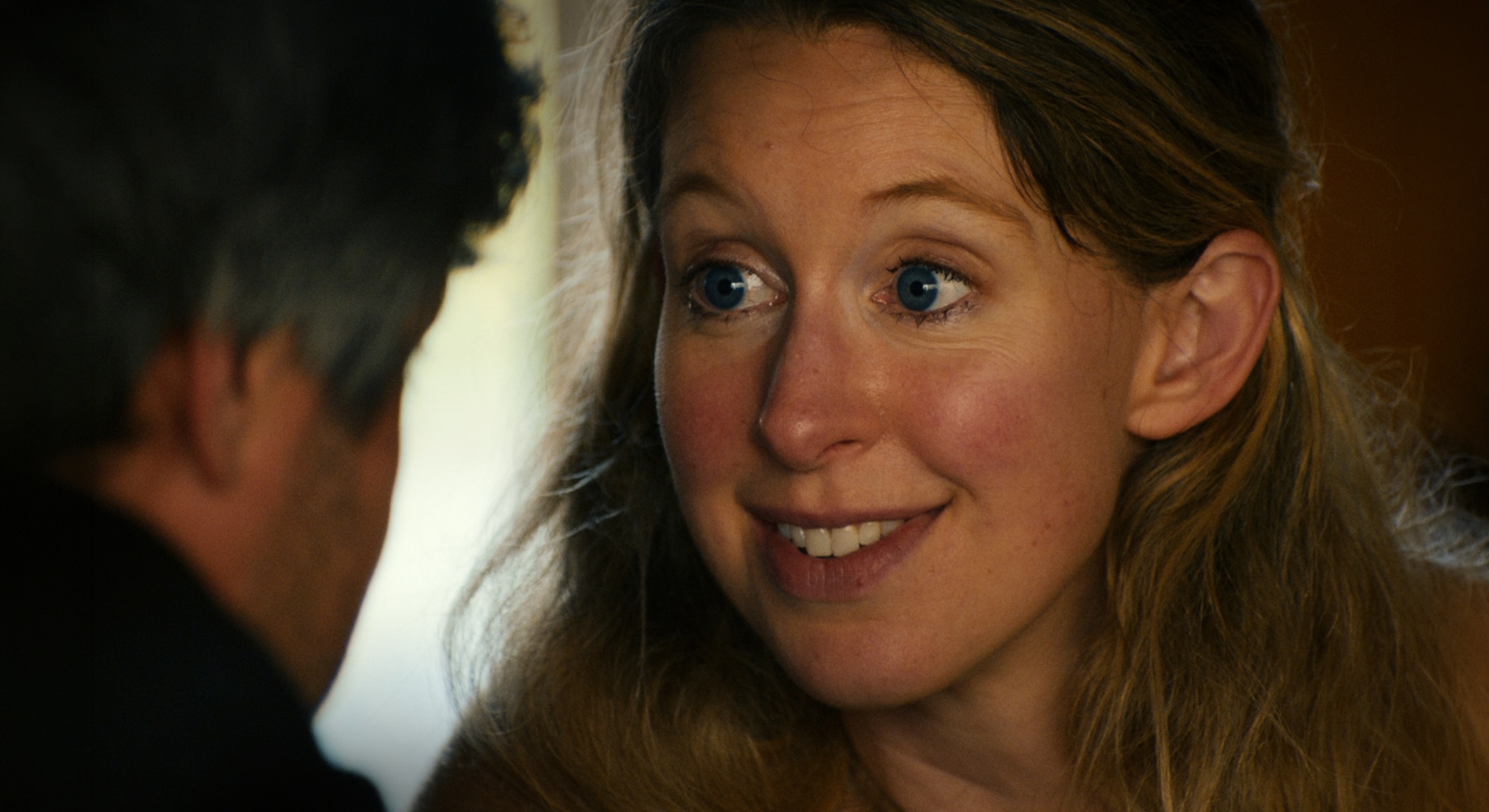
The disgraced Silicon Valley tech leader, mere days away from going to jail for defrauding investors, is framed in extreme close-up as she speaks with Nathan Fielder, the film’s interviewer and co-director. Her eyes are wide, blue, unblinking and glassy.
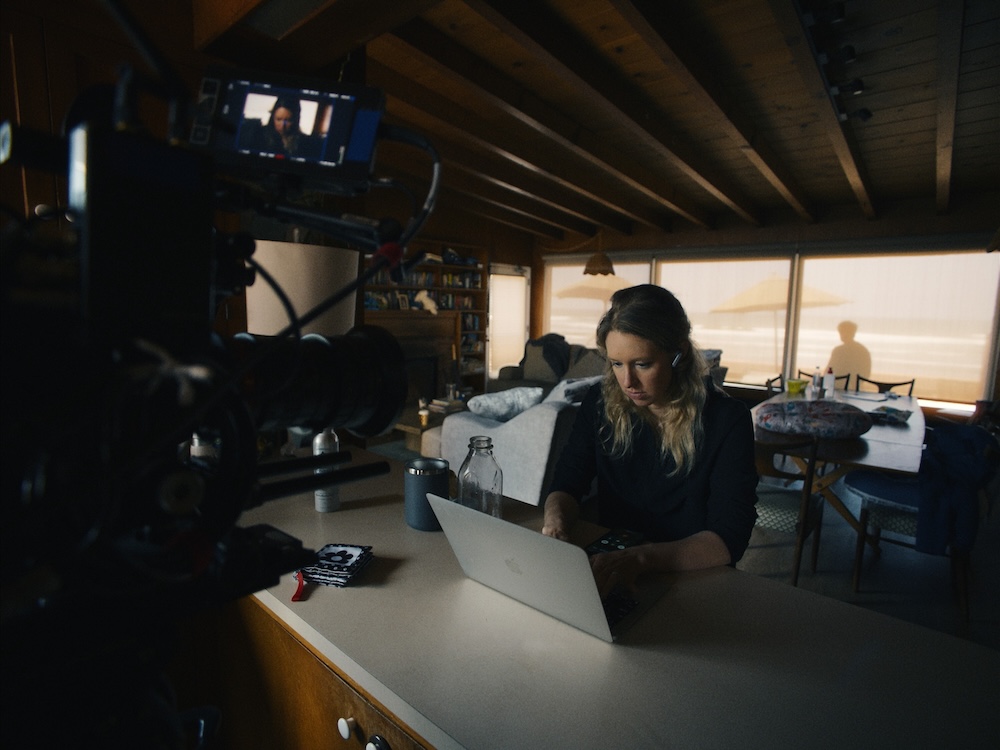
Holmes has invited Fielder and co-director Lance Oppenheim into the beachside rental where her family is staying to document her final days before prison in the spring of 2023. The reason she thought this was a good idea is opaque (at least to the audience), but one gets the sense that Holmes feels like she can prove some sort of truth about herself and her situation through the documentary.
To its credit, the film itself is not so worried about exactly what Holmes did and if she deserves her sentence.
It doesn’t dive into the legal definitions of investor fraud in some attempt to prove Holmes innocent.
It doesn’t particularly concern itself with the science of Theranos, the health technology company Holmes founded in 2003. Holmes claimed that Theranos had developed a revolutionary device that could run thousands of diagnostic tests using a single drop of blood, which proved inaccurate and unreliable.
Rather, Fielder and Oppenheim seem fundamentally concerned with the nature of truth and belief, and whether Holmes genuinely believes that she did nothing wrong.
In this particular conversation — shown in part in the film’s first teaser trailer that dropped following its surprise premiere at the Telluride Film Festival last month — Holmes has just told Fielder (and viewers) that she’s never told a lie, and genuinely doesn’t believe she did anything wrong in relation to Theranos.
When Fielder pushes back and asks if she’s messing with him, Holmes does not relent. She speaks plainly with a hint of a smile, locking eyes with Fielder in a stare that seems to dare him to see anything further.
“I’m not that person. I can promise you that. I don’t have anything to deceive you on. Of course I’m not deceiving you. I’m engaging with you as a human being,” Holmes says.
“Why would I deceive you? There’s no reason for me to do that.”
Holmes’s tone is equally dripping with earnestness and an almost smug defiance. It’s a brash challenge to Fielder (or the viewer) to press harder, because she knows she won’t break.
If anything, the challenge builds her conviction in what she is saying.
An uncanny similarity to the premier of Alberta
Holmes’ delivery and cadences might feel uncomfortably familiar to those who have followed Alberta politics over the past several years.
On the same night I saw You Can See Everything at Fifth Avenue Cinemas here in Vancouver, my home province of Alberta voted in a referendum about holding a referendum (I know, it’s confusing!).
The ballot included questions about the province separating from Canada and about provincial immigration policy. When I checked the results on my phone after leaving the theatre, I immediately saw that the separation question had failed horribly, with around 75 per cent of Albertans voting against the idea.
Yet Smith had spent months in the lead-up to the vote speaking earnestly to her constituents in eerily the same voice as Holmes.
Smith seemed to be willing people to believe she had their best interests at heart and that in calling the referendum, she was responding to some widespread demand and need for the province.
To be clear, this is all performance. There was no widespread demand for the referendum. It was panned as an idea from the start, and largely existed only to appease a tiny subsection of Smith’s United Conservative Party base.
But like Holmes, Smith speaks on this and other controversial issues as if she’s fully and wholly convinced herself that what she’s saying is true — even if it’s not.
I’m not the only one to make this connection. Writing on Bluesky, journalist (and Tyee contributor) Rachel Gilmore referred to the premier as having “that Elizabeth Holmes diction.”
But it extends beyond mannerisms and vocal tone. You Can See Everything explores what happens when a powerful person lies with such intensity they construct a new reality where the truth doesn’t seem to matter anymore.
And that is largely our political reality these days, particularly when it comes to figures like Smith, who are willing to commit wholly to the performance of a truth they construct.
In Alberta, a history of deceit
Dating back to her early days in the Wildrose Party of Alberta, one of Smith’s great talents as a politician has been convincing her audience that she genuinely believes what she is saying, even if what she’s saying is grounded in falsehood. It’s a talent crafted in her years as a talk radio host, and as premier we’ve seen it deployed to justify a host of regressive laws and policies, including the recent referendum, and Smith’s slate of anti-trans policies first introduced in 2023.
Take for example, a presser late last year where Smith repeatedly stressed that her government’s law banning most gender-affirming health care for young people in the province will help preserve teenagers’ fertility by stopping them from undergoing “sterilizing” surgical procedures.
When a reporter in attendance noted that there has not been a single reported instance of a youth under the age of 18 receiving gender-affirming lower surgery in Canada, Smith seemingly corrected them, arguing back that there have been many patients under 18 who underwent mastectomies.
To be clear, a mastectomy is not a “sterilizing procedure,” and it is a falsehood to describe it as such.
And while many of her critics may frame her as unintelligent, Danielle Smith is not stupid. She probably knows this is not true, just as she knew there was no widespread public desire in her province for a separation referendum.
But moral panic works in such a way that something as routine as a mastectomy can be cast as a dangerous sterilizing procedure and legislated by the government as such.
Thriving on the edge of rationality
In a piece about the film for New York Magazine, writer Sarah Jones reflects on Holmes’s performance of truth in You Can See Everything.
“If she’s lying, her opportunism is pathological, and her children are background actors in a production she’s staged,” Jones writes.
“There is, perhaps, a third option, which is that she is so delusional that she’s convinced herself that she never scammed anyone. She does come from an industry rank with unsupported claims about revolutionary tech or the end of civilization, so conceit may feel natural to her. The film allows us to wonder about her relationship to reality, which is one of its strengths.”
That third option is particularly helpful when considering politicians like Smith. For her critics, it is easy to get caught up in the fact-check when faced with this barrage of misinformation. It is tempting to hyperfocus on disproving the lies she spouts with a rational voice to justify deeply irrational actions.
There is a certain value to that approach — that reporter at the press conference last year was right to challenge Smith when she falsely claimed that a surgery does something it definitely does not.
But figures like Smith and Holmes thrive on the edge cases of rationality. Like Holmes daring Fielder to push further into her life because she has nothing to hide — literally giving the film its title when she tells him he “can see everything” — Smith doesn’t accept these fact checks because they don’t suit the reality she has built.
In the film, it’s clear that, when Holmes and her partner Billy Evans tell Fielder that she’s never ever told a lie, that is fundamentally impossible.
But as we see in several sequences where Fielder tries to unpack specific words with Holmes, she is a master at convincing us — and herself — that what she’s saying is technically true.
At one point, Holmes and Fielder debate the nature of the word “can.” Fielder argues that when Holmes previously said the Theranos device “can perform any test,” that was technically a lie.
Holmes resists, countering that with the right chemistry, the device could indeed perform any test — they just didn’t have the right chemistry. So she technically didn’t lie when she said they had a device that “can” perform any test.
Consider Smith’s justifications for banning trans women and girls from women’s sports teams in the province.
Sure, there is no documented real case of a trans woman disproportionately dominating a women’s sports competition. Yet Smith and other proponents of such policies have constructed a reality where this is a threat warranting immediate government action that even overrides the Charter rights of trans people.
To an extent, that threat is real to Smith, her supporters and anyone willing to believe in it enough. Just as Holmes is innocent in her own eyes, and works to make us feel the same way.
Why does someone powerful lie to us?
In You Can See Everything, Holmes claims that there is no reason for her to deceive Fielder. But of course there are reasons for her to lie to him. Her public image and future business prospects depend, to an extent, on the self she presents in the film.
The same goes for politicians like Smith. They have every reason to deceive us. They have every reason to lie and construct a new reality where immigrants are a threat to everyday people, where kids are getting dangerous gender surgery en masse. Where Alberta desperately needs a separation referendum. Where libraries can’t have certain books in them.
The more they lie, the more they will their deceit into existence.
Some politicians are better at this performance than others. Outgoing B.C. premier David Eby wasn’t good at it. His attempts to construct a reality where a snap election made sense in any sphere other than his government’s own ego failed horrendously. He couldn’t commit fully to the bit, and paid the price.
As for Smith, it remains to be seen how long she can keep up the performance and continue bending reality to her will.
For Holmes, no squirrelly evasion could actually keep her out of prison.
Perhaps a reckoning that can’t be spun into a new reality will come for Smith as well.
Until then, know that these people have every reason to deceive us.
'You Can See Everything' is now screening in major theatres. 







Tyee Commenting Guidelines
Please note that email notifications for replies are not currently working due to a software issue which may be resolved in a future update.
Comments that violate guidelines risk being deleted, and violations may result in a temporary or permanent user ban. Maintain the spirit of good conversation to stay in the discussion and be patient with moderators. Comments are reviewed regularly but not in real time.
Do:
Do not: