


 SHARE:

The last three years have been tumultuous for Alberta’s nascent renewable electricity industry. And deadly.
In early 2023 the industry was booming. Rystad Energy, a leading global energy intelligence firm, predicted Alberta would become Canada’s wind and solar power leader by 2025. Alberta’s grid manager said renewables were growing by “leaps and bounds.”
The United Conservative Party echoed these views in the 2023 election campaign. Alberta was “poised to lead the country in the development of renewable energy, working alongside our traditional energy resources.”
Then Premier Danielle Smith shattered this promise. Applications for new solar power plants have literally disappeared. Alberta has seen just two utility-scale solar applications and no wind applications since late September 2025. Rather than encourage renewables the UCP has done exactly the opposite. At the heart of its war on wind and solar power is blatant deception.
UCP politicians conjured a crisis in the availability of Alberta’s best agricultural lands. They then used this fearmongering illusion to identify renewables as a serious threat to agriculture.
“Agriculture first” was the mantra the government incorporated into its regulatory regime for renewable electricity. Smith’s government portrayed itself as the defender of farmers and ranchers. It generally prohibited solar development on high-quality agricultural lands. The only exception to this was if the company could demonstrate its solar plant could co-exist with agricultural activities. Co-existence means retaining 80 per cent of the land’s potential agricultural productivity.
Two deceptions drive this regulatory change. The first is that renewables threaten Alberta’s best agricultural lands. The second is that, when it comes to electricity development, natural gas power plants don’t gobble up high-quality agricultural land.
I have previously suggested in these page that ideological opposition to green energy drives her discriminatory regulatory treatment of wind and solar. We now have the regulatory record to back my case.
Do renewables threaten Alberta’s best agricultural lands? The short answer is “No.”
Between 2011 and 2025 Alberta lost 34,113 hectares of Class 2 agricultural land — Alberta’s best lands for crop production. This amounted to 0.8 per cent of the more than 4 million hectares of Class 2 land in Alberta.
The Alberta Utilities Commission or AUC observed through its 2023-24 inquiry into renewables that power plant development had “not historically been a primary driver of agricultural land loss in Alberta.” Urban sprawl, rural subdivisions and petroleum were the primary culprits for taking agricultural land out of production.
More importantly, what is likely to happen in the future? Here the AUC commissioners accepted the evidence they heard. Renewables would occupy very little high-quality agricultural land over the next several decades.
They accepted that Alberta only would lose a sliver of its best agricultural land even if Alberta went “all in” on aggressively licensing renewables to establish a net-zero electricity system by 2035. The solar plants needed to reach net-zero would occupy less than one per cent of this high-quality agricultural land by 2041.
Minister of Affordability and Utilities Nathan Neudorf ignored this AUC observation when he directed the commission to adopt his version of an “agriculture first” approach. Neudorf’s approach only applied to renewables applications. Renewables projects on Alberta’s best agricultural land couldn’t be approved unless they demonstrated that renewable energy and farming or ranching activities could live together on the site.
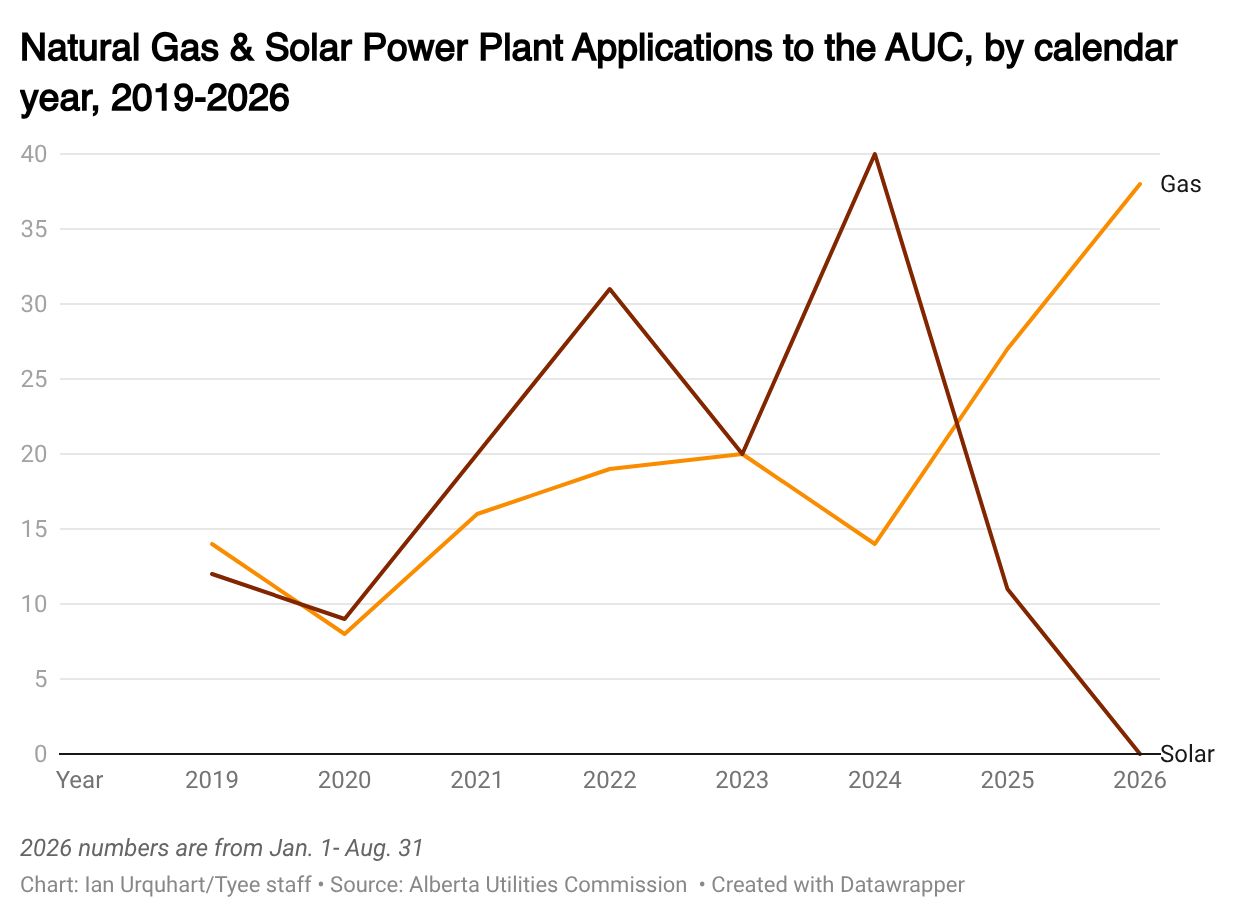
If the UCP government intended its “agriculture First” policy to damage the future of renewables in Alberta, mission accomplished. Recent years’ power plant applications charted below show the renewables boom died an early death.
A solar industry executive I spoke to believes Smith’s government, through handfuls of regulatory and policy changes, has a “death by a thousand cuts approach” to renewables.
The “agriculture first” policy is a major example of those cuts. Its mandatory agricultural assessments add costs; its agrivoltaics requirements, even when incorporated into applications, add uncertainty. A gauntlet now must be run by any solar project daring to lease property from the landowners and farmers who want to lease their property to renewables.
Meanwhile, the sun shines brightly on natural gas-fired electricity. The AUC received 55 natural gas-fired power plant applications in the past year. If all the gas projects now before the regulator are approved, they would generate just over six gigawatts of electricity. This would be enough to power millions of homes.
It’s over. This is what the post-2024 regulatory record tells us about the spectacular “leaps and bounds” growth renewables enjoyed just a few years ago. Alberta’s path now is one where fossil fuels will increase their prominence in the provincial electricity market.
A free pass for gas plants
Smith’s government wants Albertans to believe that renewables, and only renewables, seriously threaten the province’s agricultural fabric. Ignore what history tells us — that much, much more high-quality agricultural land has been sacrificed to well sites, pipelines, rural subdivisions and urban sprawl.
But what about natural gas-fired electricity power plants? Do they threaten to consume high-quality agricultural land?

If the Alberta government is committed genuinely to “agriculture first” shouldn’t AUC regulators also evaluate whether today’s boom in natural gas applications may threaten agriculture as much as, if not more than, renewables?
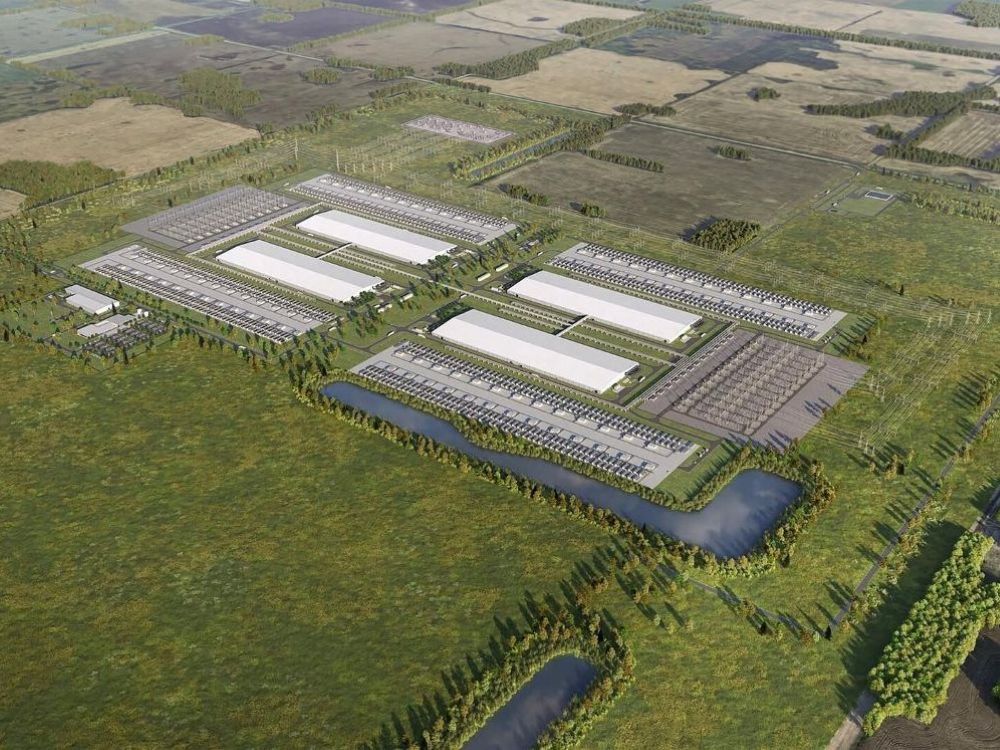
Not according to Minister Neudorf. I asked him repeatedly about this in the context of the Greenlight Electricity Centre project. Approved by the AUC in June 2026, Greenlight is huge. It will be Alberta’s second-largest natural gas power plant. Greenlight’s 1,864 megawatts of generating capacity will be more than the entire electrical demand of Edmonton. Its electricity will power Meta’s Sturgeon County AI data centre located next door.
Greenlight will have a significant impact on agriculture in Sturgeon County. It will be located on 242 acres of high-quality agricultural land; 89.3 per cent of those acres are Class 2. Why, I asked the Minister, wasn’t Greenlight required to follow the same informational and design requirements his government demands of a solar power plant on these lands? “Generally,” Neudorf replied, “natural gas plants do not have the same type of land-intensive agricultural or visual impacts as solar and wind developments.”
Greenlight expects to take five years to build its plant and then operate it for 30 years. The company’s application to the AUC is very clear that virtually all 98 hectares of high-quality agricultural land are dedicated to the power plant. Greenlight will take all of this prime agricultural land out of production for 35 years.
This truth simply can’t be squared with the minister’s statement that natural gas plants don’t have similar land-intensive agricultural impacts as solar. Without any co-existence requirement, Greenlight’s impact on the land will be much more severe than what would come from a solar plant on the same site.
The Agriculture department should have participated in the Greenlight process if the government was concerned sincerely about power plants and agriculture. Agriculture could have raised concerns about losing agricultural land; it could have questioned witnesses about whether this loss was in the public interest.
Greenlight is not a one-off. Two other large natural gas power plants now before the AUC will consume a significant amount of high-quality land. Beacon AI Centers has submitted two power plant applications to the AUC. The Heartland project is proposed for Sturgeon County, kitty corner to Greenlight. Its generating capacity is 920 megawatts and it will take 128.3 hectares of land out of agricultural production. Approximately 80 per cent of those hectares is Class 2 land.
Beacon has a second project, Indus, located just east of Calgary; Indus will generate a maximum of 1,494 megawatts. This power plant is part of a 253.8 hectare data centre “campus.” Most of the centre’s footprint is on Class 2 land.
The company’s environmental evaluation for the project notes these lands will be taken out of agricultural production for decades. But because the land will be reclaimed at the end of the project’s life, as would be required of any comparable solar power plant, the company’s environmental evaluation ranks this residual effect as “not significant.” Clearly a double standard is being applied.
In Alberta today it simply doesn’t matter if natural gas power plants and data centres take prime agricultural land out of production.
The provincial and municipal governments, as well as the boosters of these projects, likely will say these natural gas power plants conform with municipal land use plans. That’s true. But this defence misses the key point. Conforming to local land use planning wouldn’t save renewables proposals from having to try to jump over regulatory hurdles their cousin fossil fuel projects are excused from. Fossil fuel power plants clearly are favoured when it comes to locating on high-quality agriculture land.
If Premier Smith was genuinely concerned about protecting agricultural land from electricity power plants she would direct the AUC to apply the same rules to natural gas proposals as the regulator applies to renewables. 
Read more: Energy, Alberta, Environment










Tyee Commenting Guidelines
Please note that email notifications for replies are not currently working due to a software issue which may be resolved in a future update.
Comments that violate guidelines risk being deleted, and violations may result in a temporary or permanent user ban. Maintain the spirit of good conversation to stay in the discussion and be patient with moderators. Comments are reviewed regularly but not in real time.
Do:
Do not: