

 SHARE:

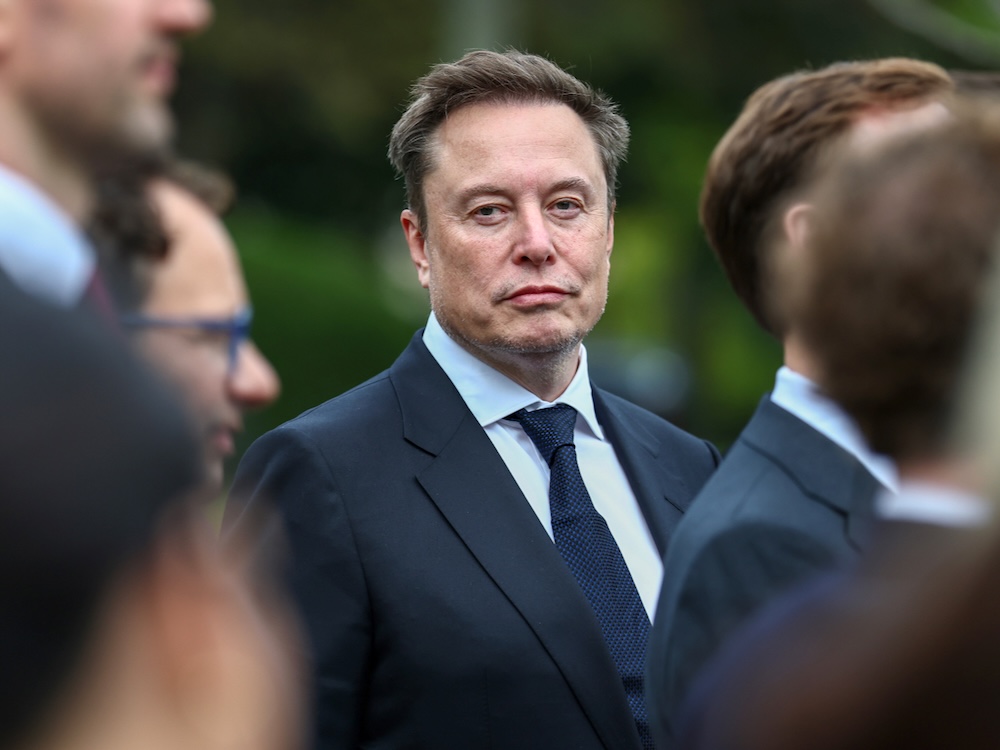
The federal government has a contract with Elon Musk’s SpaceX for Starlink satellite internet that has increased by more than 10 times since it was first awarded two and a half years ago.
And it's sticking with it.
The multi-year contract — which is posted on the federal government's procurement website and shared on the Investigative Journalism Foundation’s Paper Trail database — buys satellite connectivity for federal organizations through Starlink, SpaceX’s satellite internet service. It was initially for around $2.3 million when it was awarded in February 2024, but with amendments it has increased to nearly $29 million.
This comes as Prime Minister Mark Carney has said Canada will “diversify away from” Starlink amid a push for domestic sovereignty in the sector. Carney said he’s concerned after Ukraine recently suffered a slowdown of access to Starlink at the behest of Musk.
But with few to no alternatives for the specific needs of the Canadian government, particularly in remote and rural areas until viable alternatives are established, experts say Starlink is here to stay.
The federal government’s broad contract with Starlink
Shared Services Canada’s contract with Starlink is wide-ranging, but details are limited.
SSC spokesperson Ashlea Wells said it “provides satellite connectivity services to federal organizations for fixed, semi-permanent, mobile, drive-away, maritime, and aeronautical applications.” Starlink is used to “support operational requirements and communications, particularly in remote locations.”
The contract is for two years, from February 2024 to 2026, with up to three one-year extension options.
It currently has six amendments, among them an $8.8-million increase in January 2025 and a $17.2-million increase in January 2026, bringing the total contract cost up from $2.3 million to $28.9 million.
Asked about these amendments, Wells said the government has extended the contract until February, and that it is in the process of doing the same for the year after. She said the amendments were issued to “support ongoing service requirements” and that the contract operates “on an as-needed basis.”
Curtis McCord, a policy analyst with the Canadian Anti-Monopoly Project, said when a country is reliant on one company for services, it is vulnerable to price spikes.
“The vendor can charge whatever price because they know you have to buy it,” McCord said. “The lock-in to price-rise pipeline is kind of the big tech playbook.”
When SSC established the contract, Starlink was the only provider capable of meeting “specific operational requirements.” As of Sept. 30, 2026, SSC has paid SpaceX $15.7 million, excluding taxes, Wells told the IJF.
Starlink makes up a “relatively small portion” of SSC's satellite portfolio and “continues to provide a specific service that covers operational gaps where domestic alternatives are not yet available,” she said.
Canada needs an alternative before quitting Starlink, say experts
McCord isn’t surprised to see Canada is still reliant on Starlink even as Carney signals a major shift away from it.
“Even if you’re going to move into a new place, you have to keep paying your rent until the lease is up and you’ve signed a new one,” McCord said. “You can’t just stop paying. Well, you can, but you might find yourself between houses.”
McCord said one of the realities of a satellite internet monopoly is that governments have little choice if they want to switch providers.
Last month, Musk admitted to throttling Ukraine’s access to Starlink, which the country relies on for defence against attacks from Russia. The slowdown, which lasted for several days, demonstrates just how vulnerable countries that rely on one internet service provider can be.
“The reality is they can have their arm twisted,” McCord said, noting that even if what happened in Ukraine is unlikely in Canada, it is “possible.”
Carney has said he’s concerned about what happened in Ukraine.
"We as Canadians do not want to be caught in a situation where we are reliant on one provider that may change their view, or may be forced to change their view, by one nation state that puts Canadians at risk — or compromises our sovereignty, our ability to express our values and live our values,” Carney told reporters during a trip to Turkey last month.
Dwayne Winseck, a professor at Carleton University’s school of journalism and communication and director of the Global Media and Internet Concentration Project, said Canada is “absolutely” vulnerable.
“The lessons of Ukraine are just stunning,” Winseck said.
But Winseck said Canada has only itself to blame for falling so far behind in the satellite telecoms game. He said there hasn’t been enough government pressure on companies such as the heavily government-subsidized Telesat to deliver a comparable alternative to Starlink.
“We can look at vulnerability and we can say it’s been home-brewed,” he said.
Monique Scotti, a Telesat spokesperson, said Telesat has secured the rockets needed to deploy its initial 225-satellite constellation, with the first two satellites launching in the coming months. More will launch after “in-orbit testing” in mid-2027, with Lightspeed Telesat’s low-Earth orbit satellite constellation expected to “enter global service” in early 2028.
The Canadian government has already awarded the company a $2.3-billion contract to establish an Arctic satellite network for the military. The federal government also gave Telesat a $2.14-billion loan. 
Read more: Politics











Tyee Commenting Guidelines
Please note that email notifications for replies are not currently working due to a software issue which may be resolved in a future update.
Comments that violate guidelines risk being deleted, and violations may result in a temporary or permanent user ban. Maintain the spirit of good conversation to stay in the discussion and be patient with moderators. Comments are reviewed regularly but not in real time.
Do:
Do not: