


 SHARE:

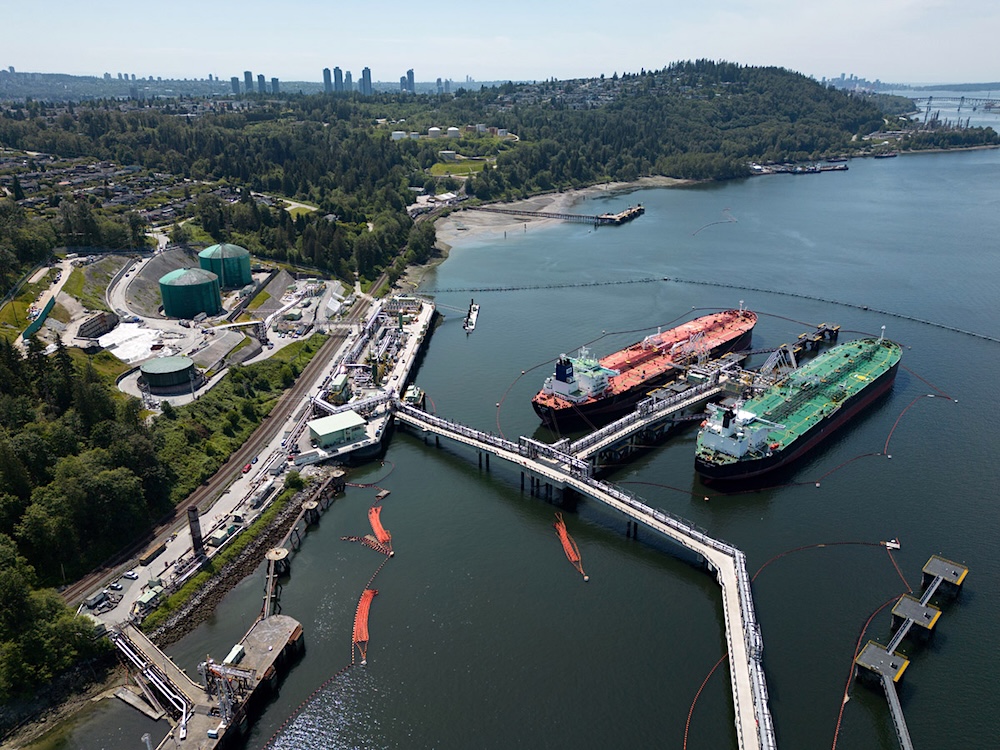
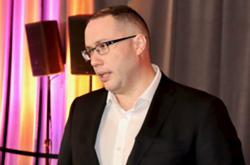
Brian Kirk, the manager of Washington state’s oil spill prevention program, spent two decades as a U.S. navy officer travelling around the world on destroyers, command ships, cruisers and aircraft carriers. He’s familiar with wily currents, storms, fog and unpredictable seas.
But these days, Kirk is focused on a choppy issue close to home: the increasing likelihood that oil supertankers will be navigating sharp turns and reef-dotted channels in the Salish Sea for the first time, as part of Canada’s new West Coast pipeline project.
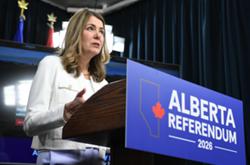
The project has the full backing of B.C. Conservative premier-elect Lorne Doerkson, who told reporters on Sunday that the first calls he plans to make in his new role are to Prime Minister Mark Carney and Alberta Premier Danielle Smith to express his support for the new pipeline.
Hazards in the Salish Sea make supertankers unsuitable, Kirk told The Tyee.
“With a larger ship like that, with just a tremendous amount of mass, if anything goes wrong you can find yourself in trouble pretty quickly,” he said.
Canada’s federal government has deemed the supertankers — also called very large crude carriers — too dangerous for B.C.’s North Coast waters, where Carney recently recommitted to a long-standing oil tanker ban that also includes smaller carriers.
Washington state banned oil supertankers in inland waters 50 years ago on the grounds that the risk of a catastrophic spill was too high.
Yet if the pipeline project receives final approval next year, as expected, a supertanker carrying two million barrels of diluted bitumen from Alberta’s oilsands could travel through the Salish Sea, one of the world’s most biodiverse inland seas, every other day.
“That’s a lot of very large crude carriers moving through these waters,” Kirk said.
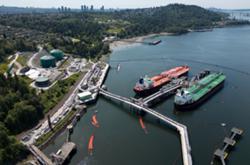
Supertankers hold two and a half times as much oil as the Aframax tankers — also banned on B.C.’s North Coast — that currently ship oil from the Trans Mountain pipeline terminus in Burnaby through the Salish Sea. But it’s often more economical to ship oil to foreign markets in supertankers. Until earlier this year, when oil prices climbed, some Aframax tankers with oil from the Trans Mountain pipeline travelled to a designated area off San Diego, California, to transfer their cargo to supertankers — a practice called lightering — before crossing the Pacific Ocean.
Carney says the new oil pipeline project, recently coined Pacific Link, is needed to diversify Canadian oil exports amid the escalating Canada-U.S. trade war. Earlier this month, Ottawa designated the Pacific Link pipeline a project of national interest, meaning it will be fast-tracked, sidestepping environmental safeguards in place for decades. Carney said he aims to finalize conditions by next September, “clearing the way to get shovels in the ground.”
But critics of Pacific Link — including Washington Gov. Bob Ferguson and non-profit organizations on both sides of the Canada-U.S. border working to protect the shared Salish Sea — say oil supertankers will put wildlife, ecosystems, coastal communities and the maritime economy at unacceptable risk.
Kirk, who now works for Washington state’s Department of Ecology, has recently been reviewing maps of the Salish Sea and examining the accident history of oil supertankers.
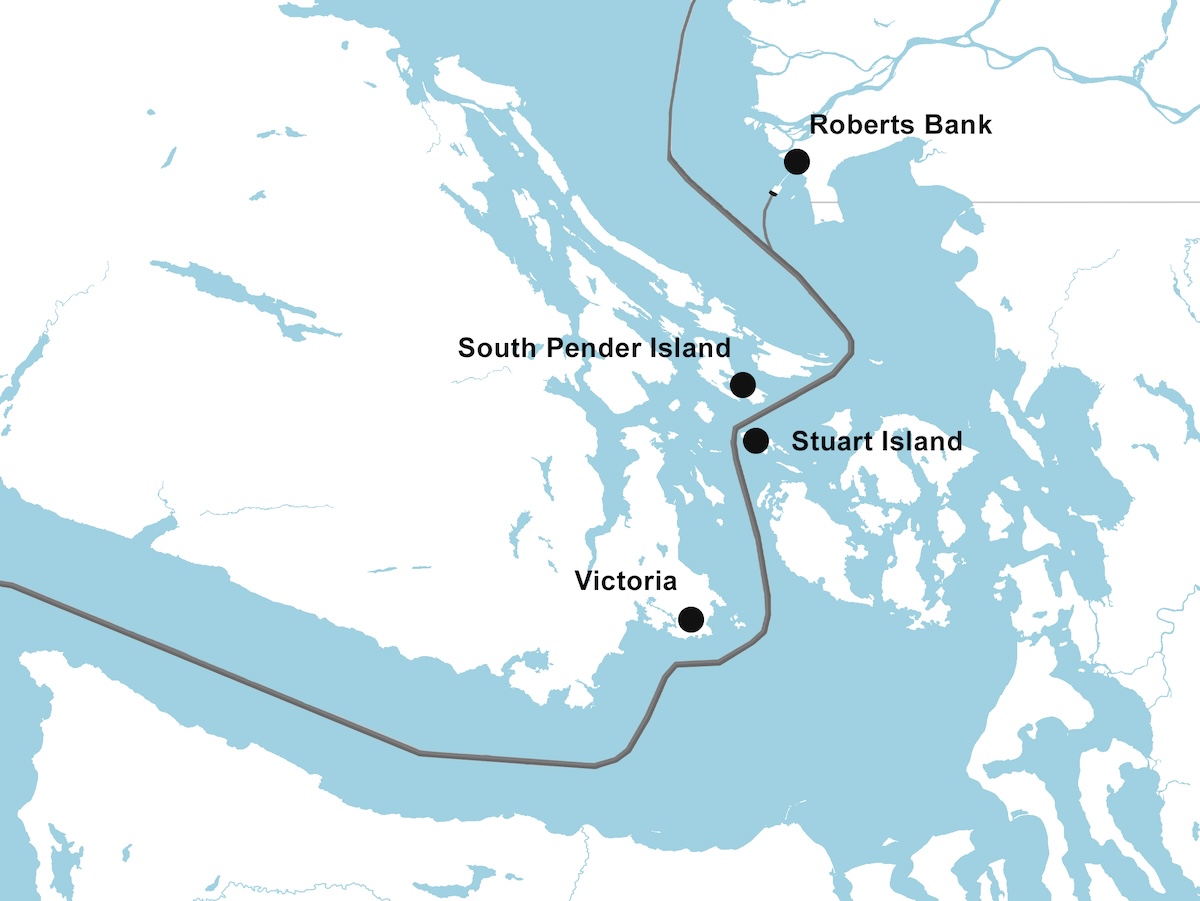
High among Kirk’s concerns is a turn of almost 90 degrees the oil supertankers would have to execute at the intersection of Boundary Pass and Haro Strait — a location aptly called Turn Point — in the two-way international shipping lane.
Inbound traffic generally stays on the U.S. side of the shipping lane, while outbound traffic usually stays on the Canadian side.
Starboard of Turn Point, heading towards the open Pacific Ocean, sits the south tip of Pender Island in British Columbia. On the port side, about three kilometres away, lies the west end of Stuart Island in Washington state.
“If something goes wrong, if you have a loss of power or if you have a steering malfunction, if you’re steaming along and then your rudder fails hard over to one side — two miles begins to feel not so big,” Kirk said.
“You can run out of room pretty quickly.”
He said Canada notes that “great caution and vigilance” are necessary in Haro Strait and Boundary Pass because of rocks, reefs and fast-moving and changing tidal streams.
“The current through those channels can be pretty strong, four knots or better, which is a good amount of current acting on a ship.”
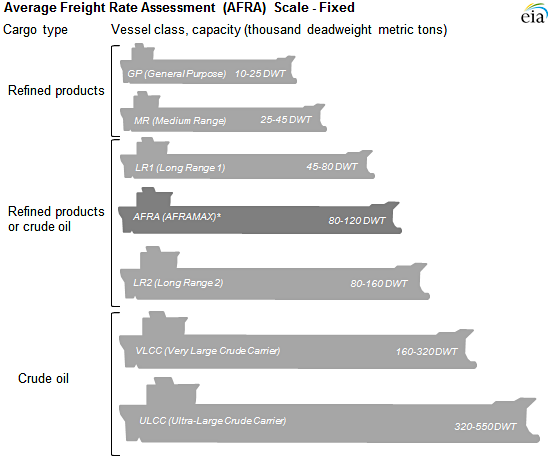
Kirk said supertankers sit farther down in the water than Aframax tankers, meaning “you can get into trouble faster.”
“You’ll run into things that a smaller ship would pass over,” he said, noting that Washington state currently has the capacity to respond to a spill from an Aframax tanker, but not from a supertanker.
“The bottom line is that if an accident does happen, the consequences could be that much more devastating.”
An ‘existential threat’ to southern resident killer whales
Diluted bitumen is difficult to clean up in the event of a spill. Chemical dilutants, used to send bitumen through pipelines, evaporate quickly. But bitumen, a form of crude oil with the consistency of peanut butter, sinks, so it can’t be cleaned up using skimmers and floating oil booms.
The diluted bitumen would be loaded at a new tanker terminal planned for Roberts Bank, south of Vancouver, close to the Canada-U.S. border. Roberts Bank is home to a globally important ecosystem that is a crucial stop on the Pacific flyway for migrating birds. It also supports one of the world’s largest salmon runs and the endangered southern resident killer whale population shared by Canada and the United States.

According to a project description the Alberta government submitted to Canada’s Major Projects Office, it appears the supertankers, each the length of three football fields, would transect major BC Ferries routes before they skirt the Gulf Islands and pass Victoria and other communities en route to the Strait of Juan de Fuca and markets in Asia.
The Tyee earlier reported that Casey Sixkiller, the director of Washington state’s Department of Ecology, the lead agency for oil spill prevention and response, wrote to Carney’s government saying shared waters are “too valuable” to fast-track a project that could lead to a catastrophic oil spill and harm ecosystems and the maritime economy.
The letter followed Carney and Alberta Premier Danielle Smith’s joint announcement in early July that the new oil pipeline route would terminate in the Lower Mainland, not on B.C.’s North Coast.
On Oct. 2, after Carney fast-tracked the pipeline as a project of national interest, Sixkiller and Ferguson, Washington state’s governor, issued a joint statement saying they were “disappointed” with the decision. They noted the project would bring a “massive expansion in both the volume of crude oil and the number of tankers transiting the Salish Sea.”
They also said supertankers pose an “existential threat” to southern resident killer whales, Salish Sea ecosystems and tribal and First Nations communities that depend on marine resources.
Kirk said that while supertanker accidents, collisions, groundings and large-volume oil spills at tanker terminals tend to be low-probability events, “they’re not impossible.”
“There’s nothing that says you can’t have a devastating accident with a very large crude carrier.”
In one 2007 accident Kirk examined, a very large crude carrier was anchored off the coast of Korea when a passing crane barge under tow broke free in bad weather. The barge struck the carrier, rupturing three of its cargo tanks and spilling 11,000 tonnes of heavy crude oil.
The spill fouled hundreds of kilometres of shoreline, including one of Asia’s largest wetland areas, an important stopover for migrating birds. It covered birds and oysters in sludge and led to more than $1 billion in claims, while up to 10,000 workers and 50,000 volunteers a day joined a four-month cleanup effort involving more than 100 spill response vessels and 1,500 private vessels.
While that oil supertanker had a single hull, which are prohibited in Canadian waters, Kirk said the accident is a sobering example of how a seemingly minor weather-related event can cause catastrophic damage.
Kirk also reviewed a 2015 accident where a very large crude carrier collided with a container ship off Jebel Ali port in the United Arab Emirates, splitting open the carrier’s bow. No cargo tanks were ruptured, which Kirk attributes to sheer luck in the collision angle.
“I’ve been in and out of Jebel Ali any number of times on ships,” he said. “What caused this accident was a pretty simple misunderstanding between the two ships as they were making their passing arrangements — as they were talking to each other about how they were going to pass.”
Steep increase in shipping traffic projected
Adding to Washington state’s worries is a projected jump in shipping traffic in the Salish Sea.
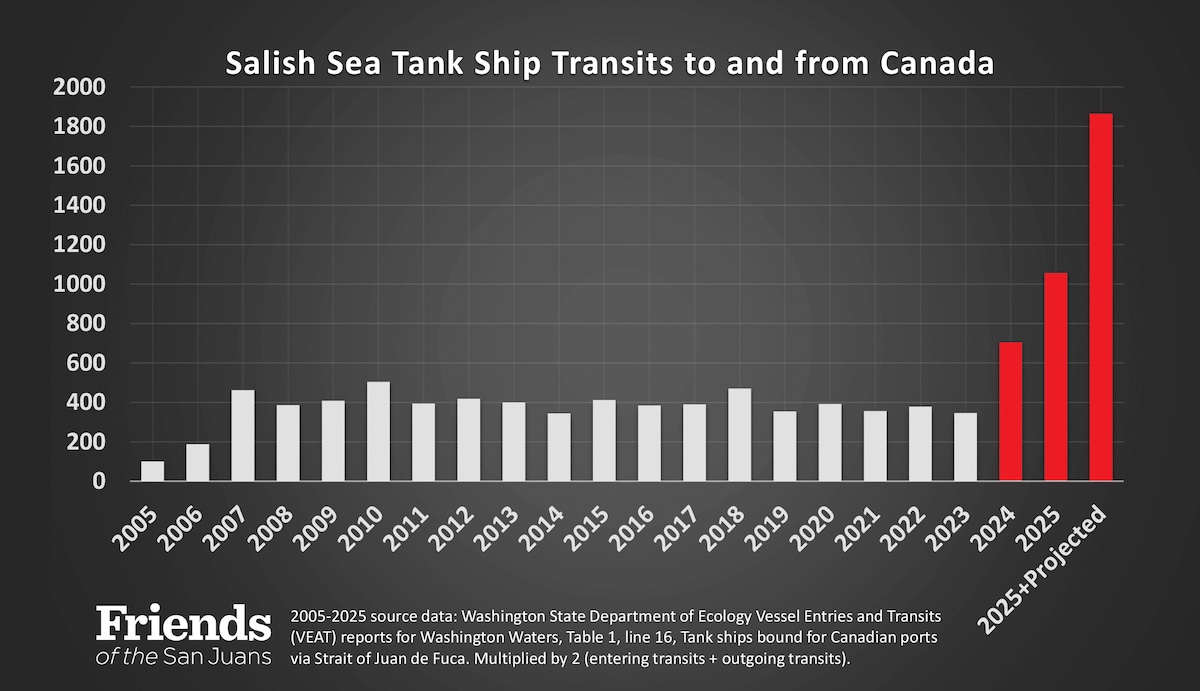
A new analysis by the U.S. non-profit group Friends of the San Juans shows ocean-going vessel traffic in the Salish Sea will increase by almost 2,000 transits annually from projects planned for B.C. and Washington and Oregon states.
Most worrying, according to the group, is the recent and projected rise in tanker traffic driven largely by an increase in Canadian fossil fuel exports.
Outbound traffic from the Trans Mountain pipeline project has slowly increased from two tankers a month to about 31, with 34 tankers a month anticipated. Once the Vancouver Fraser Port Authority finishes dredging Burrard Inlet, the tankers will also be able to fully load instead of operating at 70 to 80 per cent capacity.
The newly approved Tilbury LNG expansion is expected to generate up to 136 ship transits a year in the Salish Sea, while the Woodfibre LNG project under construction in Squamish, north of Vancouver, is expected to generate 80 annual transits.
Other projects will also boost shipping traffic in the Salish Sea. The Roberts Bank Terminal 2 project, which the Carney government is widely expected to designate a project of national interest, will bring an anticipated 520 ship transits a year.
In Washington state, a shipping terminal modernization in Bellingham could add 192 annual transits, while the NXTClean Fuels project in Port Westward, Oregon, could generate an additional 112 transits a year.
For tankers alone, that adds up to a projected total of over 1,800 transits a year.
Lovel Pratt, marine protection and policy director for Friends of the San Juans, told The Tyee a major oil spill would threaten the health of the Salish Sea, island communities and shorelines.
“A spill is not going to stop at the border,” she said, pointing to the long history of co-operation between Canada and the United States in stewarding the Salish Sea.
Even when oil supertankers are operating safely, the increase in ship traffic will hurt southern resident killer whales that live in the Salish Sea, Pratt said, voicing a concern shared by scientists and conservation groups in Canada.
“The presence of the ships disrupts their foraging and their ability to catch prey, especially the females that need to eat more if they’re pregnant or nursing,” she said. Ship noise also disrupts the whales’ ability to communicate with one another, and the overall increase in ship traffic in the Salish Sea will heighten the chances of whale collisions, she added.
“Even the death of one whale could have population consequences,” she said.
Friends of the San Juans, whose mission is to protect the San Juan Islands for people and nature, is circulating a petition urging Ferguson and state agencies to use all legal and regulatory actions possible to try to prevent oil supertankers from transiting the Salish Sea. If the Pacific Link project proceeds, they’re asking Ferguson to secure conditions to address risks.
Ferguson and Sixkiller have already called on the Carney government to make detailed commitments to safeguard shared marine waters and fill gaps in response commitments if the project receives final approval.
But it’s not clear if Canada would take any action to help Washington state in the event of a spill.
The Canadian government’s response
Mélany Gauvin, media relations spokesperson for the Privy Council Office, told The Tyee that Canada has a comprehensive marine liability and compensation regime for losses and damage from oil spills from ships. “Shipowners are held strictly liable for the damage that they cause,” Gauvin said.
She said claims for oil pollution damage in Canada can be submitted directly to the shipowner or their insurer, while the Ship and Rail Compensation Canada Ship Fund provides additional compensation for any type of oil spill from any kind of ship, beyond the shipowner’s limit of liability.
Gauvin also noted the Carney government’s recent announcement that it will invest $1.2 billion to better protect Canada’s oceans and the life they sustain, including $740 million to renew and expand oceans protections. Details about protection expansions are not yet available.
She said Washington state oil spill impacts would fall under the liability and compensation regime of the 1990 U.S. Oil Pollution Act.
The Tyee asked Transport Canada if the government will update its 2013 marine spill risk assessment, but the department didn’t answer the question directly.
Sau Sau Liu, Transport Canada’s senior communications adviser, said the department “continuously assesses risk through its marine safety oversight program.”
The department also conducts targeted assessments as required, including “navigation safety assessments” for projects involving marine terminal and transshipment sites, Liu said, adding that the assessments contribute to Canada’s overall understanding of marine safety risks and “help guide mitigation measures.”
Friends of the San Juans is calling on Canada to fund an emergency towing vessel that would be ready to respond to a ship in distress in Canadian waters around the clock on any day of the year.
The United States has an emergency rescue tug stationed at Neah Bay, west of Port Angeles on Washington state’s Olympic Peninsula, Pratt pointed out. When it responds to a vessel in distress, perhaps because it has lost steering or power, the ship in question pays for the service, she noted.
“We really need to have another emergency response towing vessel in Haro Strait or Boundary Bay,” Pratt said.
“That’s an area where there’s real concern that if there were a loss of steerage or power, it could be really devastating in terms of an accident or oil spill.” 
Read more: Energy, Environment







Tyee Commenting Guidelines
Please note that email notifications for replies are not currently working due to a software issue which may be resolved in a future update.
Comments that violate guidelines risk being deleted, and violations may result in a temporary or permanent user ban. Maintain the spirit of good conversation to stay in the discussion and be patient with moderators. Comments are reviewed regularly but not in real time.
Do:
Do not: