

 SHARE:

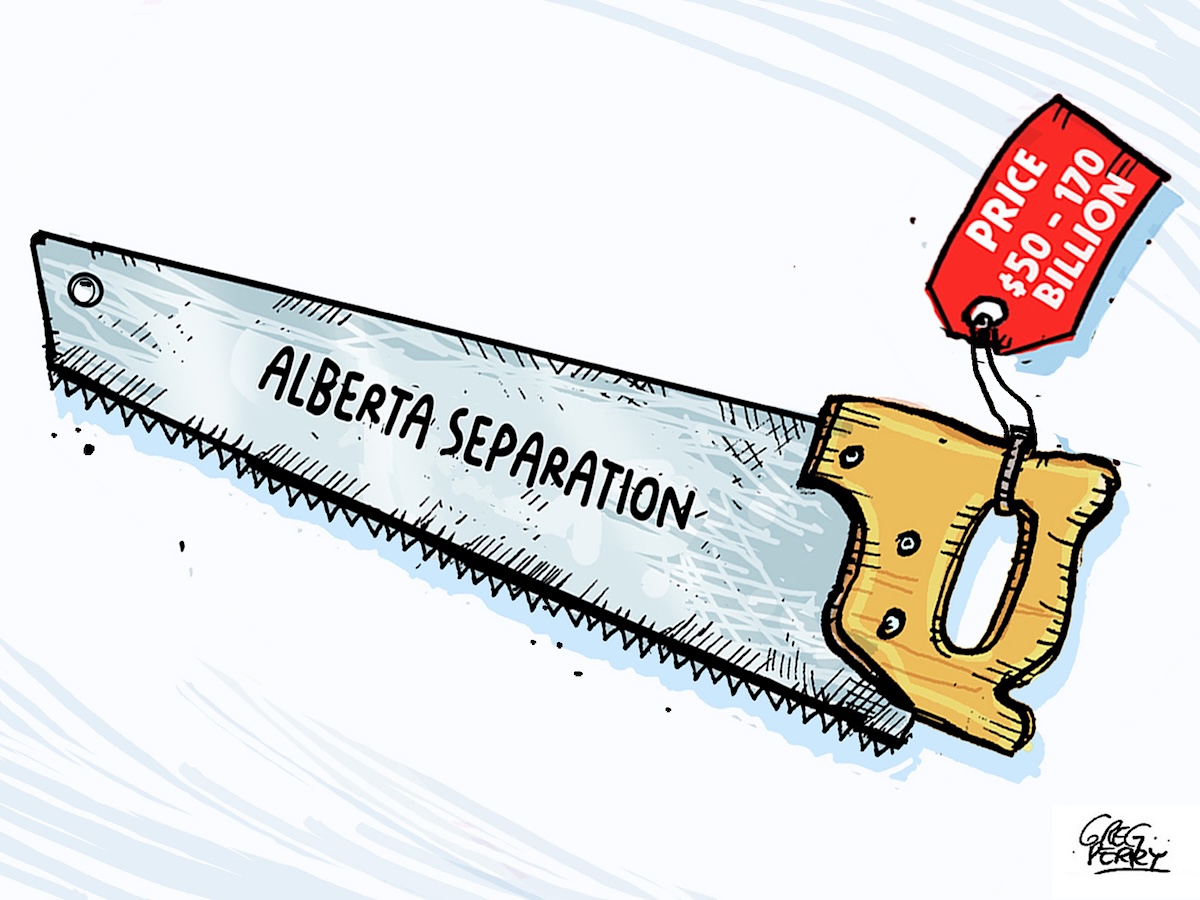
More than 75 per cent of Albertans voted not to begin the process of separating from Canada. And Alberta Premier Danielle Smith has pledged to honour the “remain” vote during her term.
So, are we done with the threat of Alberta breaking away from Canada?
Hardly, and here are five reasons why.
Reason 1: History
Western alienation has a long history in Canada. The National Policy of Sir John A. Macdonald, introduced in 1878 and 1879, launched the building of the transcontinental railway, encouraged immigration to populate farming regions and imposed protectionist tariffs to bolster internal markets for Canadian products.
All of this was designed to develop the West and bring it into the Canadian federation and to fend off annexation by the United States.
The tariffs forced western farmers to buy goods and equipment from eastern manufacturers instead of from less expensive manufacturers in the United States. The farmers understandably wanted free trade with their southern neighbour where they also sold their farm products. Farmers’ movements grew to press for control of grain shipping and marketing. So, battle lines were drawn early between the West and the federal government.
The provinces of Alberta and Saskatchewan were established in 1905, but they were not given control of their resources until 1930.
In the 1970s world oil prices spiked. Then-prime minister Pierre Trudeau’s national energy program was designed to increase Canadian ownership of the oil industry and up the share of oil profits going to the federal government.
The West believed this was fundamentally unfair. Resentment continued to build, finding political representation in the populist Reform party led by Preston Manning that within 10 years of founding became the official Opposition in Ottawa in 1997.
From Reform eventually grew the Conservative Party of Canada, which Stephen Harper wrangled into power from 2006 to 2015. To this day, the Conservative power base remains in the West.
Under Justin Trudeau, western alienation flared up again in reaction to federal environmental policies such as the carbon tax, equalization payments and COVID-19 vaccine mandates.
This cauldron of resentments energized — but now place at mortal risk — Premier Smith’s United Conservative Party leadership.
Recall that separatists kicked out the previous UCP leader, Jason Kenney. To keep her job, Smith struck a friendly posture towards Alberta separatists. The day after the 2025 federal election, Smith introduced legislation to make it easier to trigger a referendum, which led to the divisive Oct. 19 vote.
The price tag for the exercise may hit $130 million. But that hardly bought peace in the province.
Reason 2: The widening rural-urban divide
Alberta is Canada’s fastest-growing province, its population this year topping five million after adding 1.7 million people in the last couple of decades.
The traditional power structure in Alberta, dominated by grain growers and cattle producers, long has viewed eastern elites and the federal government as natural adversaries.
But this old order has been challenged by demographic growth in the large Alberta cities, where much of the new population has settled. Support for remaining in Canada was strongest in Edmonton and Calgary, as well as other major cities. By comparison, the separatists drew their support largely from rural areas where 40 per cent said yes to pursuing a binding separation vote.
Which is to say that Alberta is not a monolith. On the other hand, like flint against steel, the rise of urban influence is likely to sharpen a sense of alienation in rural parts.
Separatist supporters tend to be older, less formally educated, socially conservative and practising Christians. Some separatist meetings start with a prayer, and there is an almost evangelical zeal in the movement. U.S. pastors and churches have wielded an influence, holding out a vision of a new country run by Christians with traditional family values.
As Alberta’s cities become more diverse, a separate solitude entrenches in the province’s rural areas.
Reason 3: Anti-immigrant sentiment
Anti-immigrant feeling is a touchstone of right-wing movements and governments everywhere.
When Albertan Marcello Di Cintio and other journalists spent time among Alberta’s separatists leading up to the referendum vote, they were struck by how deeply racist feelings ran towards newcomers to Canada.
Such attitudes are like a flammable liquid soaking the movement. When Smith crafted five of her referendum questions to scapegoat immigrants for Alberta’s financial challenges, it was like waving a lit match.
Where does this go? In Europe, the British intelligence agency MI5 has found right-wing extremists are increasingly likely to consider terror attacks on immigration centres and asylum hotels.
We are a peaceful country and generally settle our differences democratically, but that finding is nevertheless disturbing.
Reason 4: US meddling
No one has exploited anti-immigrant attitudes more than the racist to the south of us, Donald Trump.
Trump has roiled his MAGA base by rounding up immigrants whom he routinely denigrates as rapists and murderers. If times get tougher in an economic downturn triggered by Trump’s tariffs and wars, expect that sentiment to strengthen on Alberta’s separatist fringe. As Andrew Nikiforuk has documented in The Tyee, a favourite Trumpist think tank eagerly expects chaos and division to weaken Canada until it is wholly vulnerable to U.S. annexation.
At an independence rally on the steps of the Alberta legislature two days before the separation vote, prominent separatist Keith Wilson pronounced: “When I look out at the crowd gathered today I see fighters. I see fighters who are going to fight for the future of our children.”
Wilson then introduced U.S. mixed martial arts fighter Sean Strickland to thunderous applause. Strickland, who has made homophobic, sexist and racist statements, told the crowd that the “Freedom Convoy” was an inspiration to every American. He claimed Alberta does not have a voice in Canada and is being “stepped on.” It was an obvious riff on Trump’s cage fight on the White House lawn in honour of the United States’ 250th birthday.
As has been documented, the “Freedom Convoy” was funded in large part by foreign money. Many of the same players have formed the base for the separation movement in Alberta. Some have strong links to MAGA-inspired Republicans. And separatist leaders have met with U.S. officials to seek loans and other support.
Reason 5: Too many are invested in separatism
Despite the overwhelming vote to remain in Canada, key separatists have vowed to carry on. Alberta Prosperity Project co-leader Jeffrey Rath said he and others “plan to roll up our sleeves and work harder.”
You might think he’d be preoccupied by lawsuits claiming he owes more than $100 million for alleged legal malfeasance. Instead, Rath is doubling down on promoting the separatist cause.
As is Mitch Sylvestre, another co-founder of the Alberta Prosperity Project. The sporting goods and gun shop owner plans to push the United Conservative Party to adopt a position on seceding from Canada at the party’s annual general meeting in November.
Sylvestre is also president of the Bonnyville-Cold Lake-St. Paul UCP constituency association. He vows to challenge Smith’s leadership if she won’t endorse separation.
Sylvestre plans to bring busloads of rural Albertans to the party meeting, when delegates vote on policy and elect their board members to take over the UCP board. Twenty-two UCP constituency associations are necessary to trigger a leadership vote to oust Smith. At least five UCP constituency associations have already voted for a review.
If grassroots radicals continue to agitate in Alberta, it is not unreasonable to believe that MAGA Republicans will back them by any means to destabilize and try to annex Canada. Manufactured dissent fuelled by artificial intelligence, misinformation and malignant bots is a factor to be reckoned with in the new world of techno-democracy.
It is chilling that a separatist government was elected in Quebec with just 27.9 per cent of the popular vote. Separatist leader Rath has noted that Alberta separatists could do the same in the future.
Rath’s opponent Thomas Lukaszuk, leader of the Forever Canadian group, urges a continuing dialogue with those who voted for separation. “We cannot go on like this,” he said. “Some of the issues they have raised are legitimate.”
Canadians should not go to sleep because of the results of the Alberta referendum. One out of four people in the province indicated they wanted to proceed with the separation process. Their concerns must be addressed.
Until then, this is far from over. 
Read more: Alberta










Tyee Commenting Guidelines
Please note that email notifications for replies are not currently working due to a software issue which may be resolved in a future update.
Comments that violate guidelines risk being deleted, and violations may result in a temporary or permanent user ban. Maintain the spirit of good conversation to stay in the discussion and be patient with moderators. Comments are reviewed regularly but not in real time.
Do:
Do not: