

 SHARE:
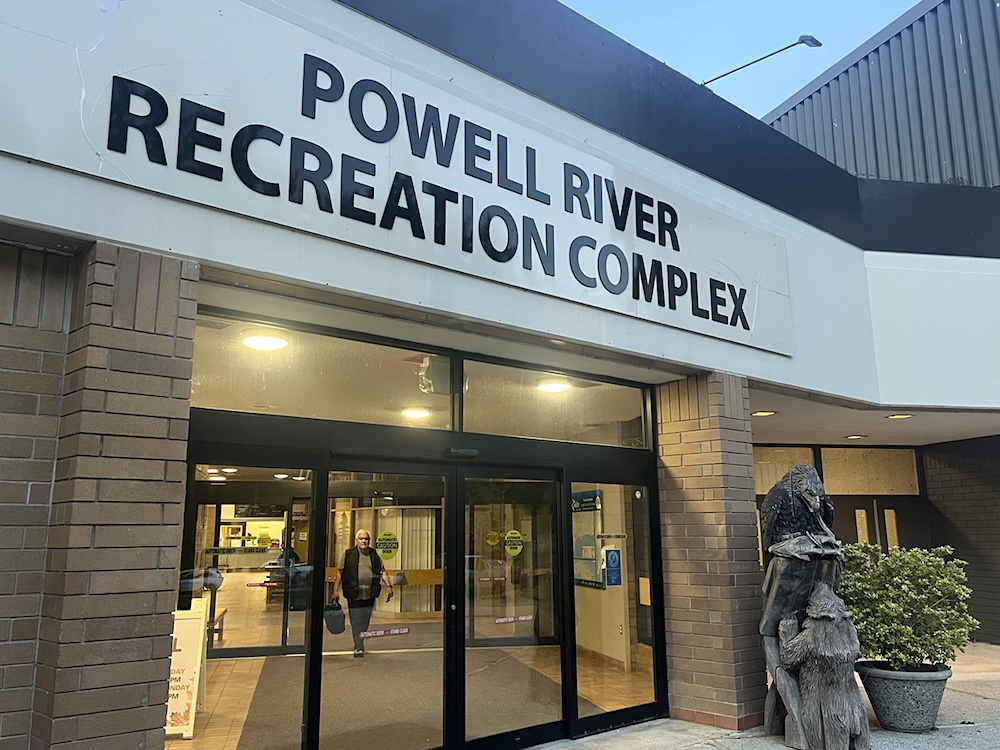
It’s a fresh fall morning in Powell River, and the city’s aquatic centre is open for swimming. Sunlight beams through hemisphere windows, across three shared wide lines. A lifeguard watches as swimmers work on their front crawl and breaststroke.
Then an airy chunk of the building’s ceiling detaches, floating down into the pool.
Pieces of the aquatic centre’s foam insulation have been raining down, intermittently, for years. The ceiling was first identified as a “top priority for replacement” by council in 2021.
The pool isn’t the only aging infrastructure the city has recently needed to address. It got a new wastewater treatment facility in 2023 and completed electrical upgrades at the recreation complex earlier this year.
But the upgrades present a challenge: despite the fact that Powell River’s population is growing, its industrial tax base has declined steeply after the 2023 closure of the local pulp and paper mill.
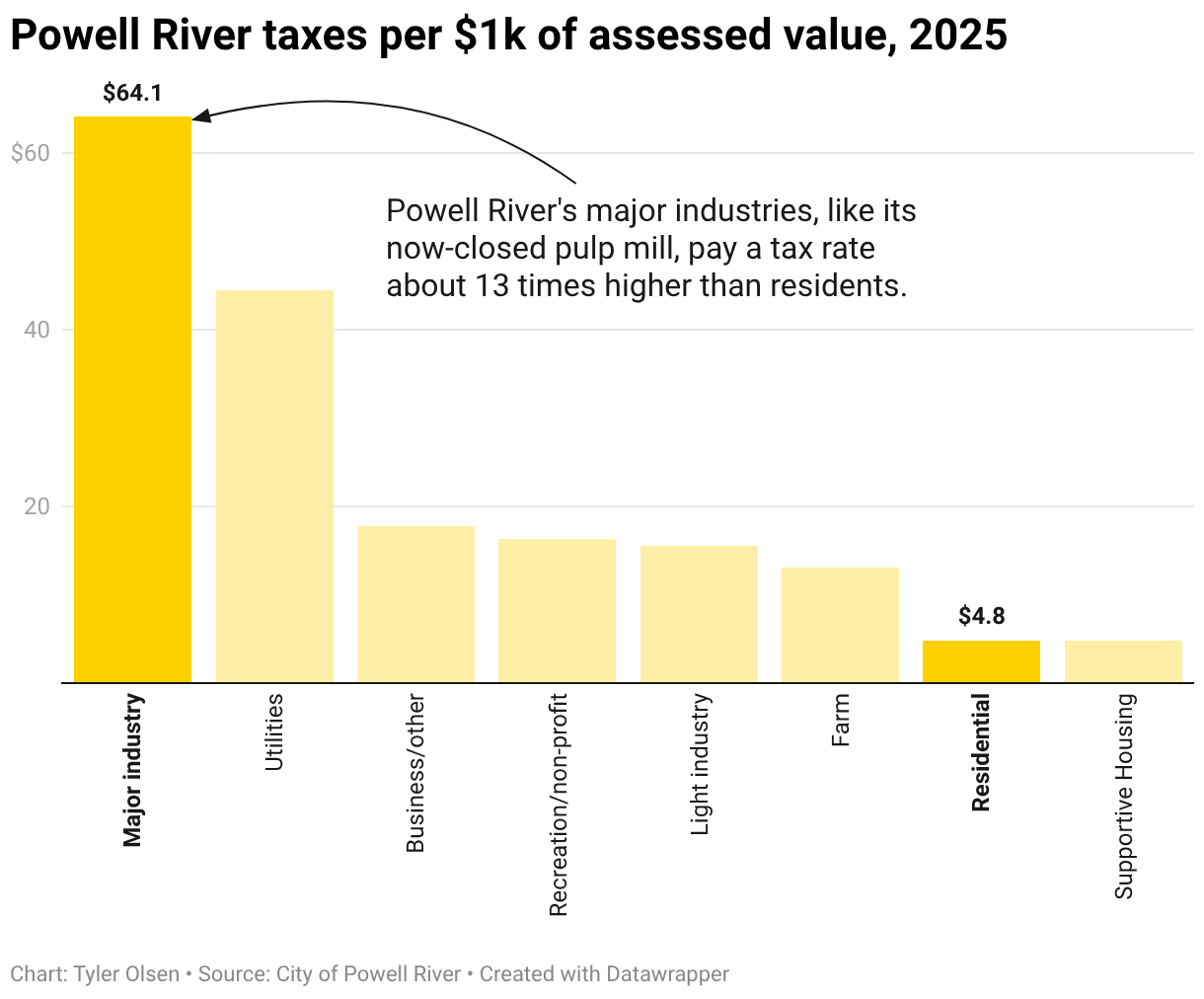
Industrial taxes have long been a cornerstone of municipal budgets in cities across the province. Tax rates for industry are much higher than residential and business taxes. In Powell River, for example, the tax rate on heavy industry is more than 10 times the residential tax rate and more than triple the business rate. Cities cannot run operating deficits in their budgets; when industrial taxes disappear, other taxes rise to account for the loss.
As council considered its last budget, it directed city staff to draft options for how the municipality could lessen the property tax increases needed to make up for disappearing industrial taxes.
The options included reducing transit hours, decreasing library hours, eliminating grants in kind, turning off some street lights and even closing the aquatic complex altogether. The suggested cuts proved unpopular.
To bridge the gap, the city is dipping into its reserves and raising property taxes by nearly six per cent, amounting to $337.39 per household, on average. While Powell River has much-discussed high tax rates, its comparatively lower home values mean the actual property taxes paid by homeowners are comparable to those paid in communities such as Revelstoke, Comox and Summerland.
Meanwhile, voters and local politicians are in the midst of a municipal election, in which many candidate platforms — in Powell River and elsewhere — cite the need to freeze or reduce property taxes, find “efficiencies” and “live within our means.”
Is it a reasonable promise?
Allison Habkirk, a registered planner and Capilano University instructor, laughs out loud at the question. Habkirk has 30 years of experience in municipal politics and previously served as mayor of Central Saanich.
Voters should understand that tax reductions will not happen “unless there are serious cuts to services,” Habkirk said.
Municipalities need to take a hard look at expenditures, Habkirk said. But “it is tough to reduce expenditures unless services are cut, and even that often won’t result in freezing or reducing taxes because as we all know, the cost of living increases by about three per cent each year.”
“There is no golden egg out there,” Habkirk said. “Reducing taxes is extremely hard to do in the current economy.”
How did we get here?
There’s “nothing unique” about Powell River’s situation, Habkirk said, pointing to Port Alberni, Cranbrook and Castlegar, three other cities that were all once reliant on “one big taxpayer for a big chunk of the taxes.”
“When that taxpayer goes away, you need to fill that gap, and most of the time there isn’t an easy industrial replacement,” Habkirk said.
Paul Horn, the outgoing mayor of Mission, said several other contributing factors have led to property tax increases for B.C.’s municipalities.
Mission raised property taxes by nearly six per cent in 2025 and by 7.4 per cent in 2026.
Inflationary pressures, labour costs and the need to hire new firefighters and RCMP staff prompted the increase, Horn said.
The same factors — COVID and wars in Ukraine and Iran — that have led to inflation for consumers have also affected municipalities, Horn said. That inflation has been magnified for costly city expenses such as building materials, snowplows and fire trucks, road salt and pool chemicals.
“In the last few years, the orders of magnitude for capital projects have gone in the neighbourhood of anywhere from 100 per cent to 200 per cent more than they used to be,” he said.
Some municipalities, such as Abbotsford, track a metric called the municipal cost index that measures the yearly inflation of goods and services that cities and towns buy. Abbotsford has projected the 2026 municipal cost index to be 3.95 per cent, more than double the consumer price index that measures overall inflation.
Rapidly escalating costs mean that municipal efforts to save money might look different than residents expect, Horn said.
“You want to spend your capital budget when it’s projected to be needed, because otherwise, your capital budget’s not going to keep up with the escalating costs,” he said.
Another key factor has been the downloading of responsibilities from the federal government to the provincial government, and from the provincial government to the municipal governments.
Housing is a perfect example, Horn said. “We are really in a crisis.”
The province has encouraged municipalities to reduce their development cost charges and amenity cost charges to lower the cost of building new housing. But that has affected the bottom lines of municipal budgets, Horn said.
“That only leaves one choice, which is to put the cost of that growth onto the taxpayer.”
Municipal costs are also increasing because of the inadequacy of social services that are supposed to be funded by the provincial government, Horn said.
Municipalities are seeing more marginalized people without adequate health care and mental health care living on the streets, he said. Not only is that an “undignified way to treat people,” but it increases policing costs, which are largely paid by municipalities, Horn said.
Habkirk told The Tyee that housing and social services have become “huge” burdens on municipalities.
“Twenty years ago, any municipality would have said that’s not our job,” Habkirk said.
“That is a wealth transfer service. That’s for the provincial and federal governments to look after. That’s not our job. And now it’s just assumed it’s local government’s job, but there’s been no accommodation for the cost of those things.”
Horn added that it’s been a common problem in municipalities to underfund the reserves that cities put aside to replace aging infrastructure.
“You get to this point where it’s crunch time, and people don’t want to borrow, but they also haven’t set aside enough money,” Horn said.
So what’s the fix?
Like many things in politics, solving the tax problem is more complex and less immediate than a campaign slogan. And every municipality is different. As CBC’s Justin McElroy outlined, many larger municipalities, such as Vancouver, Burnaby and Surrey, run significant budget surpluses.
When it comes to mill towns, relying on a single industry for a long time wasn’t “neglect,” Habkirk told The Tyee. “It was good fortune, really.”
Habkirk believes it is unlikely that another single big industry will arrive to replace the ones that have left communities such as Powell River, Port Alberni, Castlegar and Cranbrook.
In Powell River, Cranberry Business Park has purchased much of tiskʷət, the old mill site and a former key village site for the Tla’amin Nation. The company says it intends to turn the area into “a new hub for industrial, manufacturing and technology-related investment.” In an interview with qathet Living earlier this year, CEO Craig Austin said those industries could include wood waste methanol manufacturing, shipbuilding and an AI data centre.
As of May, Cranberry said it had secured two tenants for the site.
The Tla’amin Nation has also reacquired 120 acres of tiskʷət, which was illegally sold in 1878. The nation is building 30 affordable homes on the site.
In the absence of another big industrial player arriving to replace mills, the reasonable, and common, approach to the tax crunch is to “absorb the shock” over a long period of time, Habkirk said.
“It sounds like Powell River, as painful as it has been, has been making this transition — increasing residential tax rates, adjusting commercial tax rates and then using some of the reserves to cushion the blow.”
Habkirk turned to the rec centre.
“You’re a population of 15,000, and that begs the question: Can you afford an aquatic centre?
“I’m loath to say it’s a luxury, but you’re going to have to be prepared to pay for it because aquatic centres, ice rinks, they are expensive facilities,” Habkirk said. “They’re in another category from water, sewer, roads.”
Horn said Mission’s electorate has struggled to accept the recent tax hikes.
“We have faced pushback, and I wouldn’t say that we have necessarily got everybody on board,” he said.
While Mission’s next mayor has won by acclamation, Horn said city finances are one of the biggest issues in the race for the city’s council seats. But in Mission and elsewhere, Horn added, those challenges aren’t necessarily well understood by council hopefuls.
“When I speak to some of the candidates who are running, they don’t really understand the fiscal realities of a municipality. You have to set a service level,” he said.
Horn encouraged candidates running for municipal office to familiarize themselves with their city’s budget process, meet with the city’s chief administrative officer and learn how to ask good questions about the budget process.
Audits and reviews are now standard practice, and since the mid-1990s, “budgets have been slashed and rigour has been applied at all levels of government,” Horn said.
“People need to understand that we’re no longer cutting fat. There hasn’t been fat for a very long time. You’re not even cutting muscle anymore. I think you’re in the bone.”
‘Facilities we enjoy make this a good place’
Back in Powell River, the city is planning to begin fixing the aquatic centre ceiling as early as next spring. It secured a $3.6-million grant for the project, which is expected to cost $10.1 million.
After speculation arose about the pool’s potential closure, the city released a memo reassuring residents that the facility would remain open.
Coun. George Doubt told the Powell River Peak the community had spoken “loud and clear” that they wanted local facilities to remain open. But they will come at a cost.
“The recreation centre, the swimming pool — all the facilities that we enjoy and make this a good place to live, cost money,” Doubt said.
“Nobody likes to see higher taxes, but we all want the services and we depend on them.” ![[Tyee]](/design-article.thetyee.ca/ui/img/yellowblob.png)
Read more: Municipal Elections 2026, Municipal Politics









Tyee Commenting Guidelines
Please note that email notifications for replies are not currently working due to a software issue which may be resolved in a future update.
Comments that violate guidelines risk being deleted, and violations may result in a temporary or permanent user ban. Maintain the spirit of good conversation to stay in the discussion and be patient with moderators. Comments are reviewed regularly but not in real time.
Do:
Do not: