


 SHARE:
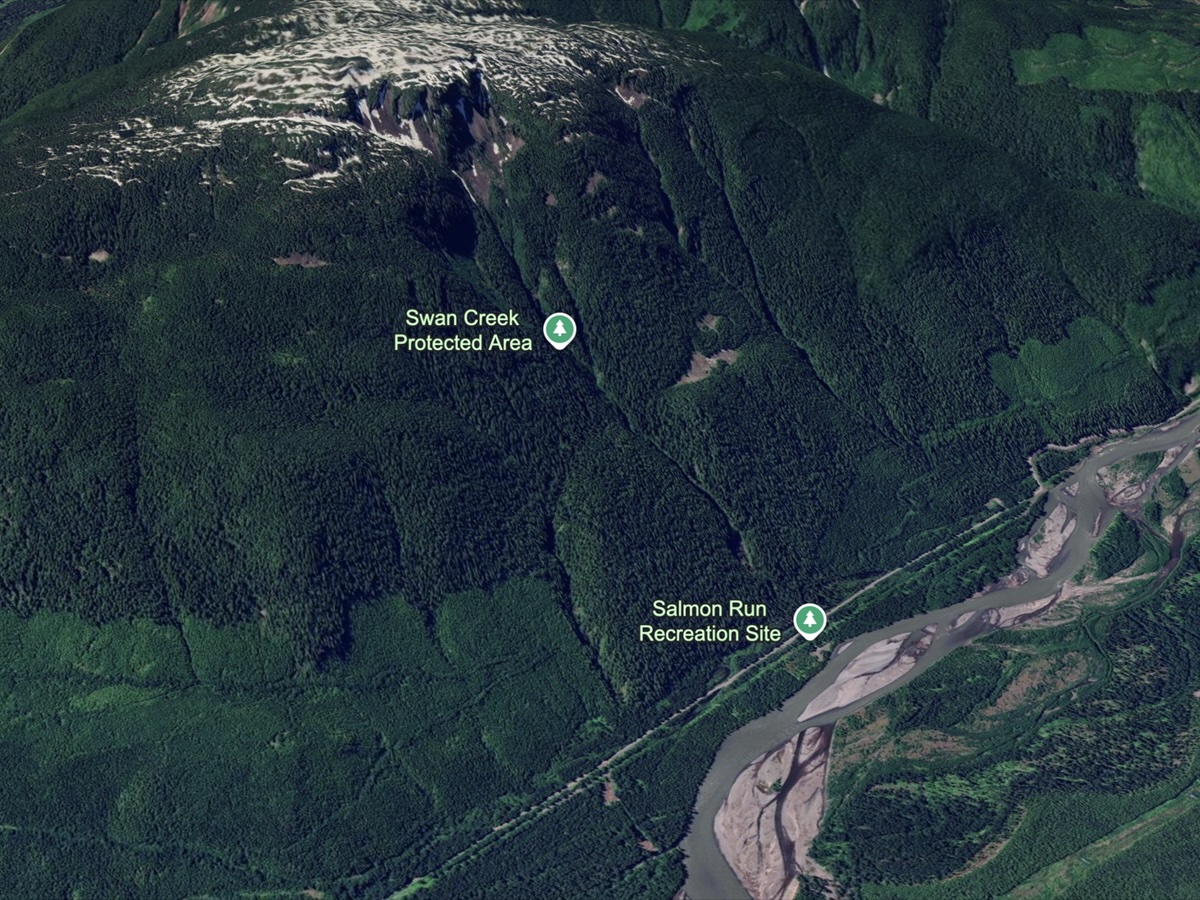
BC Hydro is seeking to remove part of a provincial protected area near Terrace, B.C., to make way for a transmission line that will power the liquefied natural gas and mining industries.
In a recently released environmental impact assessment, BC Hydro says its favoured route for the North Coast Transmission Line cuts through part of the Swan Creek Protected Area, an unlogged watershed bordering the Zymoetz River.
The Zymoetz, known locally as the Copper River, is a tributary of the Skeena River and has a recreational steelhead fishery and chinook spawning areas.
While the portion that BC Hydro aims to remove is relatively small — 12.4 hectares, or about five per cent of the protected area — it includes old-growth forest, winter habitat for moose, wetlands, fish-bearing tributaries of the Zymoetz River and habitat suitable for multiple species at risk of extinction.
It’s unclear how other parts of the protected area could be affected by the transmission line construction activities, such as building new access roads and removing “dangerous” trees within 100 metres of clearing areas.
Last year, the B.C. government announced it would exempt the transmission line from an environmental assessment carried out by the B.C. Environmental Assessment Office.
The B.C. government also exempted the line from review by the British Columbia Utilities Commission, meaning there will be no independent assessment of the need for the line or examination of alternatives.
Instead, the government passed legislation to allow the BC Energy Regulator to issue permits and authorizations for the line. That means little information about the transmission line’s environmental, social and health impacts will be available to the public.
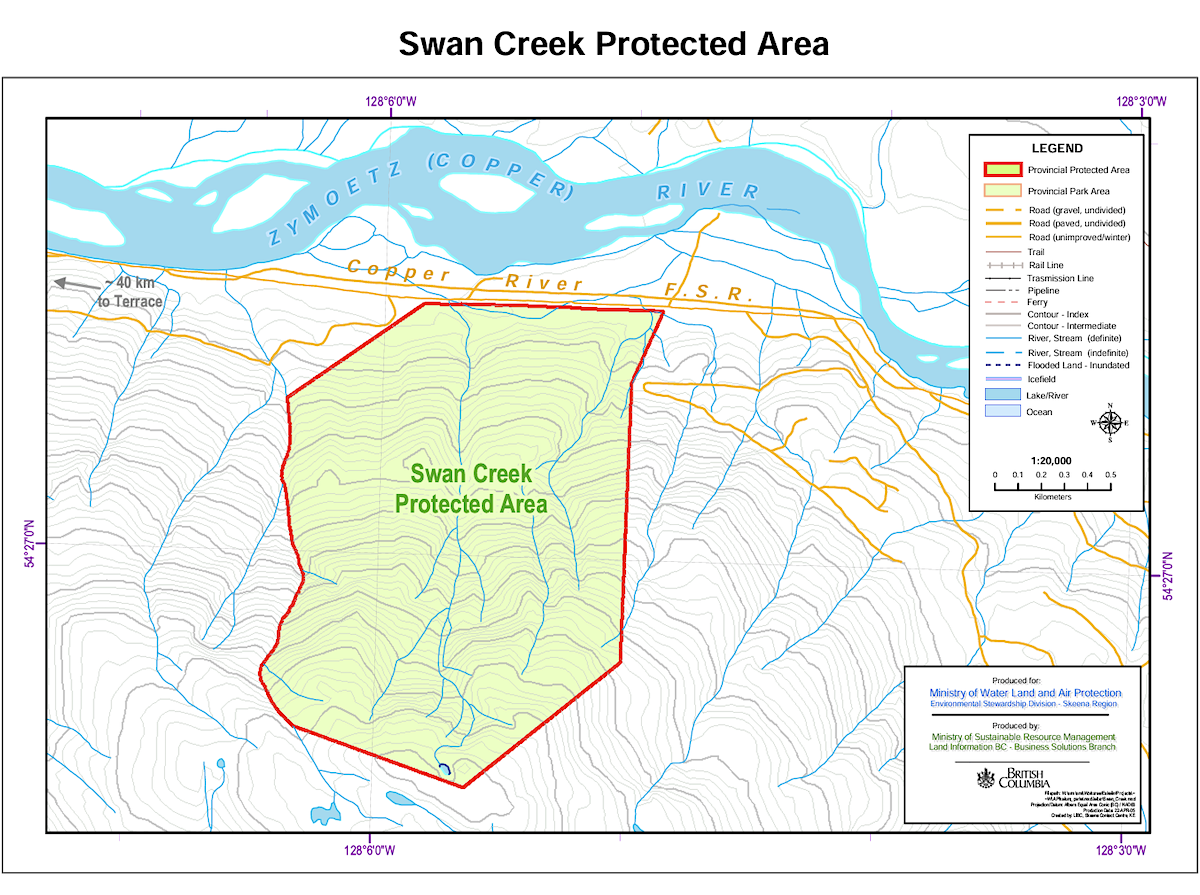
BC Parks requested the environmental assessment for the Swan Creek Protected Area after BC Hydro asked for a “boundary adjustment.”
In the assessment, BC Hydro says the transmission line route through the protected area will have less of an environmental impact than routing the line to the north, on the opposite side of the Zymoetz River. The favoured route passes by five archeological sites, but the report says local First Nations are supportive.
Public comment open until Labour Day
BC Hydro’s plan for Swan Creek, which is open for public comment until Sept. 7, is sparking concerns from researchers and parks and wilderness advocates, who say the public needs more information about the transmission line’s overall environmental impacts.
Kai Chan, a professor at the University of British Columbia’s Institute for Resources, Environment and Sustainability and a Canada Research Chair in rewilding and social-ecological transformation, said that while the area BC Hydro wants to remove is a “small drop in the bucket,” the plan is problematic for several reasons.
He pointed to the removal of what BC Hydro’s assessment calls “regionally important” old-growth forest, home to western hemlock, mountain hemlock, western red cedar and subalpine fir trees up to two metres in diameter.
“So much old growth has been lost that any further loss is of concern throughout the whole world,” Chan said, calling the continuing destruction of B.C.’s remaining old-growth forests “a dire situation.”
He also said it’s troubling to lose part of a protected area when B.C. and Canada are striving to add new protections so they can meet global commitments to halt and reverse unprecedented biodiversity loss.
B.C. shouldn’t be taking away from its protected areas network “without also putting back those specific habitats that are being lost,” Chan told The Tyee.
The Swan Creek Protected Area is one of more than 1,000 parks and protected areas managed by BC Parks, which together cover slightly more than 15 per cent of the province’s 944,735 square kilometres.
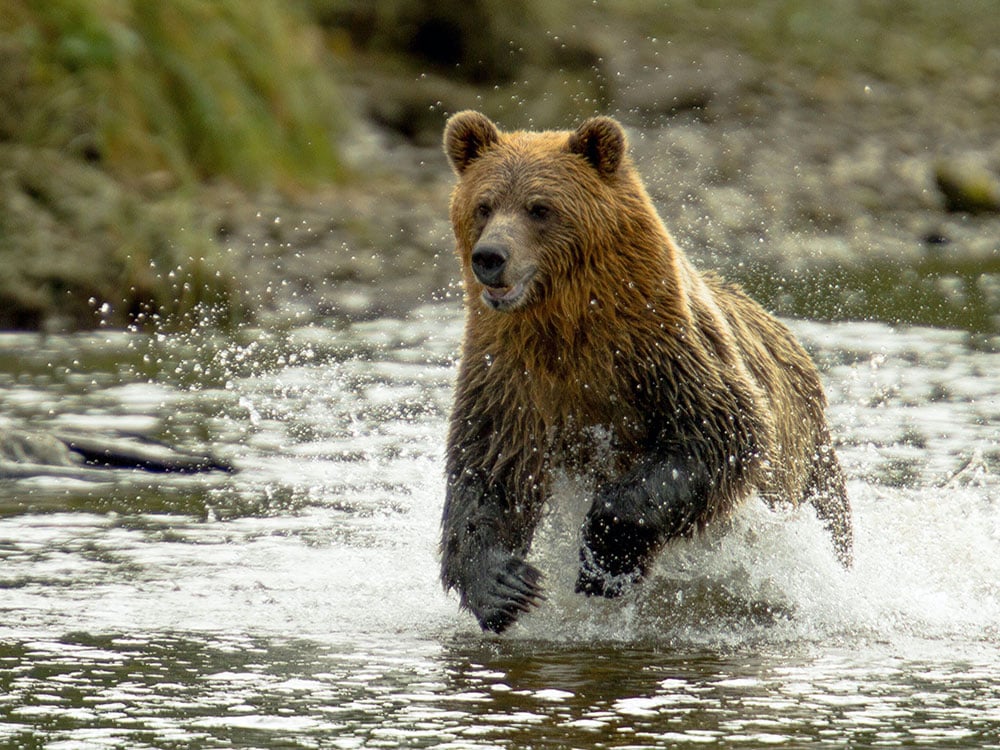
BC Hydro’s assessment says the Swan Creek Protected Area contains habitat suitable for grizzly bears and at-risk bats, as well as 16 bird species that are listed as at risk of extinction in B.C. or federally. These include the western screech owl, bank swallow, northern pygmy owl, black swift, American goshawk and rusty blackbird.
B.C.’s Ministry of Environment and Parks told The Tyee that the final decision about adjusting the boundary of the Swan Creek Protected Area is up to cabinet. The ministry said BC Hydro will propose compensation or mitigation measures during Stage 2 of its proposal, following the public comment period.
The final Stage 2 proposal will include the total area that BC Hydro is requesting to remove from Swan Creek, including all construction and tree removal areas, “because these activities are not allowable in the protected area,” the ministry said.
Joe Foy, protected areas campaigner for the Wilderness Committee, said the Swan Creek Protected Area sits in a “pretty hammered landscape,” with many logging cutblocks nearby. He described the protected area — which has a waterfall and is touted for its recreational value — as a largely intact “remnant” of old-growth forest.
“I would much rather see the province say that parks and protected areas are sacred and that planning will resolve to go around them,” Foy told The Tyee.
The 60-page Swan Creek environmental assessment report, which also has five appendixes, says the assessment was required by BC Parks to support BC Hydro’s request for a “boundary adjustment.”
Details about the transmission line’s overall environmental impacts remain scarce.
Foy said it saddened him to read the “huge” Swan Creek environmental assessment report and realize that it covers only 1.1 kilometres of the 450-kilometre transmission line.
Power lines and other corridors impact wildlife movement and riparian areas, and their upkeep can include chemical spraying and soil disturbances, which can affect salmon rivers, he said.
The public should be allowed the opportunity to be informed about the transmission line’s environmental impacts as a whole, Foy said, rather than being “only allowed to look at this tiny segment that goes through a small protected area.”
Foy said the fact the public can comment on only the Swan Creek Protected Area section is “a huge problem, and it’s made bigger by the lack of trust, by the growing list of endangered and now extinct species, and the federal government’s push to weaken even more environmental regulations.”
A 2023 BC Hydro presentation said the transmission line would affect up to 100 private properties, including agricultural land, overlap with designated winter habitat for moose and cross waterways that are home to white sturgeon, a species at risk of extinction.
Aleesha Switzer, acting conservation director for the Canadian Parks and Wilderness Society’s B.C. chapter, called the lack of a fulsome environmental assessment for the transmission line “concerning,” adding that the public may not understand the impacts of major projects such as transmission lines “until it’s too late.”
“There are some kinds of ecosystems and species at risk that we may never get back,” she said.
Projects of national importance
The federal government has designated the North Coast Transmission Line a project of national importance.
The transmission line will supply power to Ksi Lisims LNG, a floating gas liquefaction and export facility operated by Texas-based Western LNG in partnership with Nisg̱a'a Nation and Calgary-based Rockies LNG.
Federal taxpayers will contribute $3.9 billion to the transmission line’s $6-billion price tag, while BC Hydro ratepayers will pick up the rest of the tab.
The line’s electricity will come in part from the publicly funded $16-billion Site C dam — recently renamed the John Horgan Dam — on the Peace River in northeast B.C.
Chan from UBC said he’s concerned about the “invisible erosion” of protected areas and a dearth of meaningful mitigation measures and environmental restoration initiatives.
“In our push for nation-building projects, let’s treat nature as a nation-building project,” he said.
The Swan Creek Protected Area was not mentioned in a detailed news release that BC Hydro sent out yesterday to announce that transmission line construction has begun. ![[Tyee]](/design-article.thetyee.ca/ui/img/yellowblob.png)
Read more: Energy, Environment








Tyee Commenting Guidelines
Please note that email notifications for replies are not currently working due to a software issue which may be resolved in a future update.
Comments that violate guidelines risk being deleted, and violations may result in a temporary or permanent user ban. Maintain the spirit of good conversation to stay in the discussion and be patient with moderators. Comments are reviewed regularly but not in real time.
Do:
Do not: