


 SHARE:
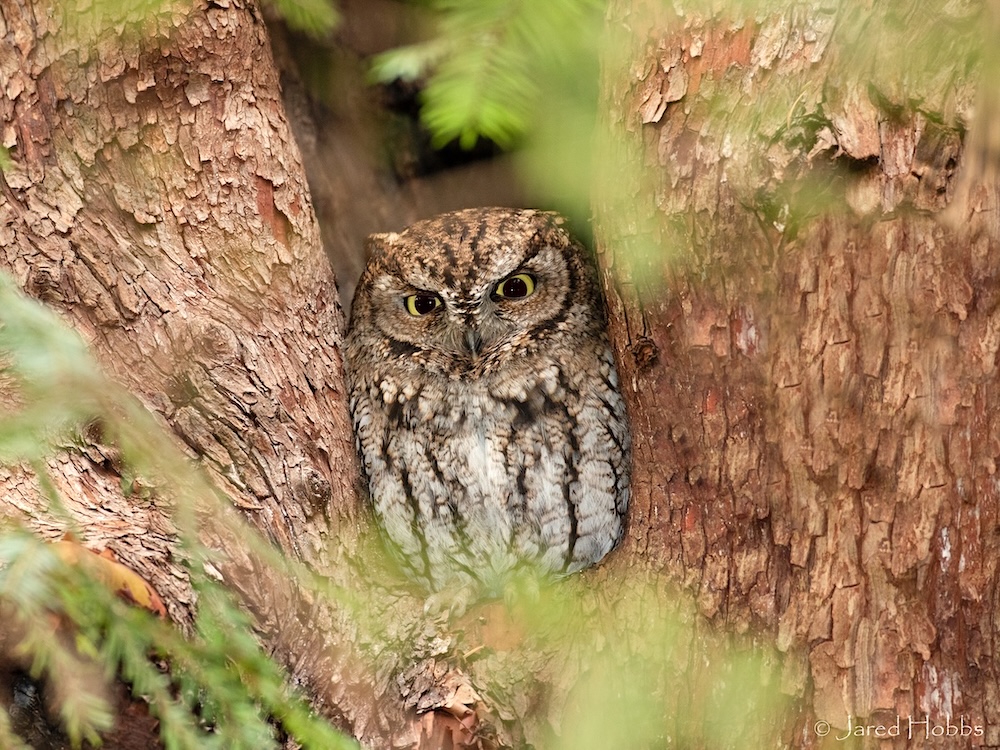
Megan Buers is dodging potholes on a labyrinth of logging roads on northern Vancouver Island, hoping for a late-night rendezvous with a western screech owl.
“He’s the Brad Pitt of the screech owl world,” says Buers, a wildlife biologist. In avian lingo, that means this particular owl is a muscular and meaty example of his species, with rakish plumage.
So far, Buers has seen the owl — but not yet managed to fit him with a transmitter for tracking.
En route to the spot where they last glimpsed Brad Pitt, Buers and her research technician Reese Embree stop and roll down the windows of their dusty Subaru Outback. They crank up a speaker and point it at a band of mature trees a logging company has left standing along the Memekay River in the Campbell River watershed.
A western screech owl call plays: Hooot hooot hooot hoot-hoot-hoot-hoot.
They listen intently to see if they get a response, and then hit play again. The rhythm and cadence of the call resembles a ping-pong ball bouncing to a stop. It’s definitely not a screech.
“Nothing,” Buers says, shaking her head.
The dashing owl in question is part of a mystery that Buers hopes to help solve. Western screech owls are disappearing from B.C.’s coast — and nobody is quite sure why.
Thirty years ago, screech owls hatched their fluffy white chicks in at least a dozen parks in the Lower Mainland, including Stanley Park and Pacific Spirit Park. If you grabbed binoculars and a flashlight and went owling in Greater Victoria, you’d be more likely to encounter a western screech owl than any other owl species.
“You used to get them in your backyard,” Buers says. “You’d hear anecdotal tales from folks in Nanaimo that they used to literally have them on their back porch.”
Today, it’s rare to find a screech owl in urban areas. In the mid-1990s, 10 screech owl pairs nested on the University of Victoria’s campus. Last year, birders found only “one lonely male, calling where a pair used to nest.”
Elsewhere on the coast, screech owl populations are in sharp decline, and the owl is now threatened with extinction in B.C.
“We know they like to nest in big trees,” Buers says. “Outside of that, we don’t really know what they need.”
Her research, for a PhD at the University of British Columbia Okanagan, aims to find out if western screech owls require old trees and mature forests for other reasons, including to find prey. Are screech owls more abundant in old-growth forests? And how does that compare to managed landscapes like replanted woods?
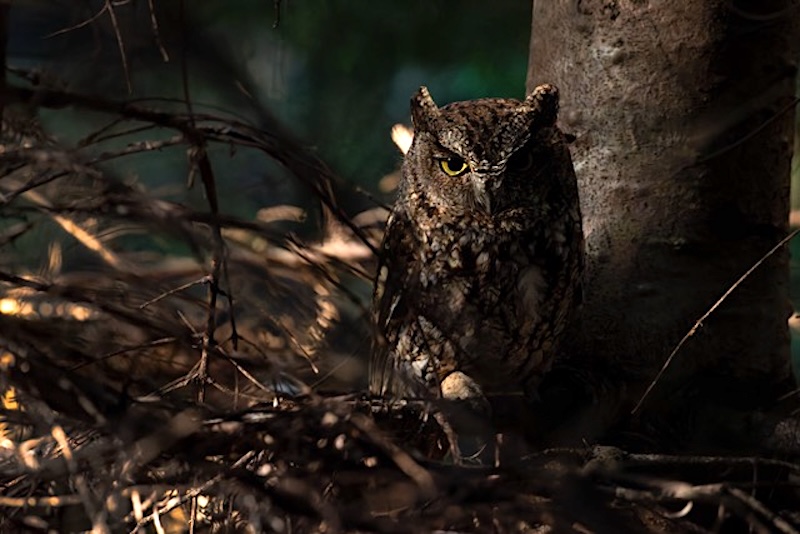
“What is it that they need? Something easy that’s not going to impact forestry too much, but would benefit biodiversity greatly?” Buers asks. “Right now, we don’t know.”
Tonight, Buers is hoping to catch Brad Pitt and outfit him in a “little pair of pants” attached to a transmitter the size of a small beetle, with two tiny antennas, that might provide some clues about how far he flies and where he roams.
A lot of personality
Catching a western screech owl is part reconnaissance, part luck and a lot of chicanery.
The idea is to trick Brad into thinking another male screech owl has invaded his territory. “He’ll come swooping in,” Buers says.
She parks near a weedy, disused logging road, close to the spot where she and Embree found Brad Pitt last night. She’s pretty sure he and a lady friend are nesting nearby, in a grove of old trees by a stream.
The sun is setting over the serrated peaks of the Vancouver Island mountain range as Buers and Embree pull on warm clothes — hats, down jackets and, for Buers, fleece pyjama bottoms under rain pants.
Buers grew up in the Okanagan, identifying spiders and frogs in her backyard. Intrigued by a northern saw-whet owl that ended up in her family’s chicken coop, she wanted to be an ecologist from an early age. Her LinkedIn profile says she favours the nocturnal; her Instagram account says she’s “owl-obsessed.” She’s been studying western screech owls for five years.
Embree, an early-career biologist hoping to pursue a graduate degree in conservation and wildlife management, retrieves a shopping bag with a net and a dummy owl nicknamed Screechika from the trunk. She’s painted the Styrofoam owl brown, gluing some feathers to it for good measure.
Joining the pair on this late April night are two Indigenous guardians, Riley Ross-Nelson and Scott Assu, from the We Wai Kai First Nation. The guardians are sharing their knowledge of their nation’s territory while they help Buers catch and tag owls — a partnership that B.C.’s Ministry of Water, Land and Resource Stewardship helped broker as part of its ongoing support for her research, which is also supported by the federal government.
“Our nation really cares about managing biodiversity, and all our species are extremely important to biodiversity,” Assu says. “We don’t want to watch any species go extinct on our territory.”
As Indigenous guardians, Ross-Nelson and Assu are the “eyes and the ears on the territory,” Ross-Nelson says.
Assu has just returned home for the summer from Vancouver, where he’s studying archeology at Simon Fraser University. Ross-Nelson, who previously worked in the logging industry, has helped Buers and Embree find and tag three owls over the last eight weeks.
He also helped them set up autonomous recording units that will track bird calls and help determine where western screech owls live.
The four carry several small bags of equipment about 20 metres up the old logging road. They hoist up the net in a little gully flanked by young fir trees, as stars begin to twinkle in the clear velvet purple sky. The net, strung between collapsible poles and anchored by ropes, will hopefully ensnare Brad Pitt in its silky black mesh, invisible against the night sky.
Embree places Screechika and the speaker on top of a bush directly in front of the net. Everyone moves away and sits down on the slope of a grassy knoll. It grows darker and colder. They wait.
Hoooot hoooot hoooot hoot-hoot-hoot, goes the birding app. Silence. Hooot hooot hooot hoot-hoot-hoot. Silence.
From the direction of the nest, a robin sounds the alarm with a frantic peek peek peek to warn of a predator.
And then, finally, a bouncing ping-pong ball hoot echoes back.
“It’s the female,” Buers says. Listening again, she identifies it as a “begging” call.
The female is waiting for Brad to bring her food, Buers explains: perhaps a chorus frog plucked from a drainage ditch, a beakful of caterpillars or an unlucky chickadee.
A dark shape swooshes across the logging road, as ephemeral as a ghost, and disappears.
Embree hits the hoot button one more time, and then everything happens very quickly, with a modicum of drama befitting a peeved movie star. Western screech owls are small — as tall as a robin, and weighing about as much as an apple — but they pack a lot of personality.
A ‘canary in a coal mine’
Western screech owls, Buers says, are a “canary in a coal mine.” If they’re not doing well, it indicates that other species sharing the same ecosystem — including their prey, such as at-risk northern red-legged frogs — are also struggling.
The decline of coastal western screech owls (Megascops kennicottii kennicottii) is particularly worrying. Unlike some other owl species, screech owls are known as generalists. Roughly translated, that means they aren’t picky eaters and can thrive in many places.
Spotted owls, which are functionally extinct in B.C.’s wild, have very specific needs. They nest only in old-growth forests and prey largely on flying squirrels and bushy-tailed woodrats, other denizens of mature forests. Burrowing owls, also virtually lost from B.C., nest only underground in treeless areas, occupying burrows dug by other critters such as ground squirrels.
But western screech owls, be they city slickers or country bumpkins, are much more adaptable.
They prefer to nest in the cavity of a large-diameter tree — generally one that’s been dug out by northern flickers or pileated woodpeckers in hot pursuit of insects and grubs. But if an appropriate tree cavity isn’t available, they’ll readily take up residence and hatch chicks in a nest box. And if one source of food isn’t available, they’ll switch to another.
Last summer, Buers watched screech owls on Vargas Island, off the west coast of Vancouver Island in Clayoquot Sound, forage for seafood in the intertidal zone. She’s also documented B.C. interior western screech owls — a different subspecies also in peril — fishing in streams. One determined pair flew a dozen fish, likely rainbow trout, to their nest.
Western screech owls face a bevy of threats. They’ve lost habitat to urbanization, agriculture and industrial forestry. In populated areas, rodenticides and collisions with vehicles take a toll. The large dead or dying trees that provide ideal nesting cavities are frequently removed from private land and city parks because they are considered hazardous.
And, as the adage goes, it’s better to be the hunter than to be the prey. Barred owls, a much larger and more aggressive owl, hopscotched across the continent and became established in B.C. in the 1990s. They compete with western screech owls for territory and food.
The barred owl dinner menu also includes their smaller kin.
Buers hypothesizes that rather than one single factor, it’s perhaps all of them together — “habitat change, development, barred owls, pollutants, car collisions.”
“There are many different things working synergistically to affect western screech owl populations,” she says.
Eggs in the nest
Before anyone else can rise to their feet, Buers dashes to the net, where a wriggling ball of feathers is fighting to be free.
“Hello, my lady, how are you tonight?” she asks in a soft voice as she deftly frees the owl.
Buers places the owl into a small cloth bag held out by Assu. They pull the bag’s drawstring shut. The bag sways and the owl hoots, quietly but in quick succession. “She is not happy,” Assu says.
Earlier, the team spread out the equipment for taking swabs and affixing the transmitter. Now, the grassy area resembles an operating theatre, with bright headlights adding to the clinical ambience.
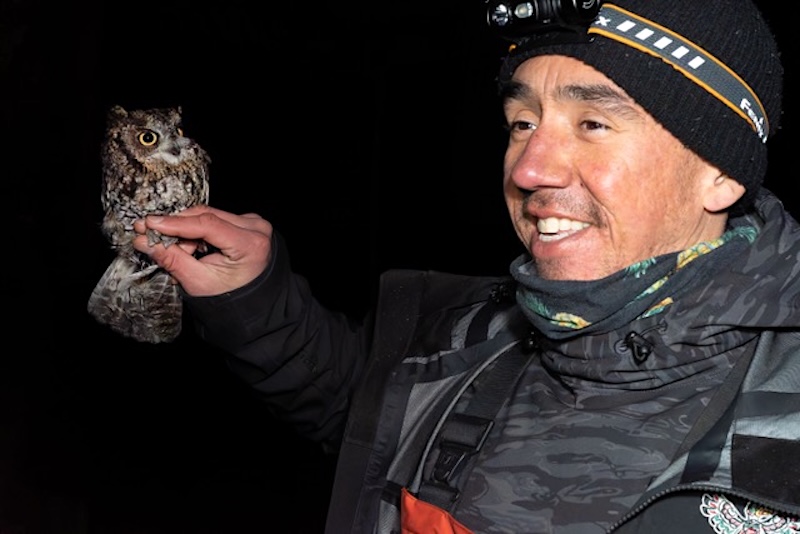
Freed from the bag, the owl clacks her bill furiously like a pair of castanets. She points her ear tufts and poufs out her brownish-grey feathers, which makes her seem to be regarding her captors sternly and with all the dignity she can muster. Buers grasps the owl’s talons, which have already bloodied her knuckles, and gently flips her onto her back.
She blows on belly feathers to reveal a featherless patch, which indicates the owl is keeping eggs warm.
“Where’s your boy?” she asks the owl.
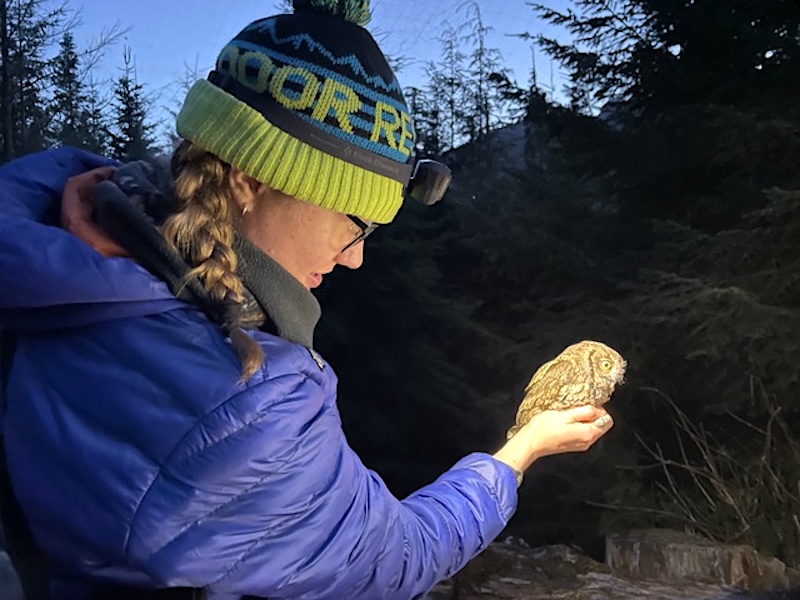
Buers and Embree measure the owl’s wingspan and bill, while Ross-Nelson takes notes. Everyone moves slowly, speaking in hushed voices. Embree swabs the owl’s cloaca, its single opening for urinary, digestive and reproduction tracts. They’ll send the swab to a lab, which will test its gut microbiome composition and may provide some indication of the owl’s health.
Like each of the 13 owls Buers will outfit with a transmitter in the Campbell River watershed from March to May, this owl will also get a tiny aluminum foot band with a number.
She’s gorgeous, Buers says. She’s bigger than Brad. Buers says she’s an Angelina Jolie.
Falling through safety nets
Thirteen years ago, B.C.’s auditor general warned that many species are falling through the gaps in safety nets created for species at risk of extinction — or, worse, they lack a safety net altogether.
Coastal western screech owls are among them.
The owls are automatically protected by Canada’s Species at Risk Act only if they’re on federal land — about one per cent of B.C. And they don’t migrate, so they’re not covered by the Migratory Birds Convention Act.
In theory, B.C.’s Wildlife Act provides protection against harm for at-risk species. But only four — the Vancouver Island marmot, burrowing owl, sea otter and American white pelican — have been listed under the act since it was created two decades ago.
The Forest and Range Practices Act also theoretically affords help for struggling species listed under the act. Under that act, B.C. could choose to establish wildlife habitat areas for western screech owls. (B.C. permits logging in some wildlife habitat areas but bans it in others.) The government could also set wildlife conservation objectives for forestry companies.
But western screech owls aren’t listed under that act, either. And the list of species covered by the act hasn’t been updated since 2006.
B.C. has been considering adding western screech owls to the act since at least 2024. A ministry spokesperson told The Tyee that consideration is still in progress.
But as of now, western screech owls have almost no protections. It’s illegal to kill any bird deliberately, or to destroy its eggs. And while a government permit is required to remove a tree where western screech owls nest, Buers points out that the nest cavities are easy to miss.
It’s also hard to spot a screech owl. With brownish-grey feathers the same colour as tree trunks and a shape-shifting ability to make themselves tall and point their ear tufts like a stick, they are the “king of camouflage,” Buers says.
Back to the nest
Working quickly, with pliers and cutters, Buers and Embree fit the flexible harness fitted with the transmitter over the owl’s legs and back.
Buers grasps the owl’s talons tightly as her wings open and close. She carries Angelina to a mound of grass and lets her go. Angelina spreads her wings wide — then topples over and rolls around. Buers gently picks her up and tries again. And again.
The owl does a face plant. Buers knows time is running out. Angelina can’t leave her eggs for too long. It’s decision time.
“The second I take this off, she’s gonna be gone,” Buers says. “Maybe they’re just geniuses. They’re like, ‘I know how to trick her. I’ll just pretend that I can’t fly, and she’ll take it off.’”
With visible disappointment, Buers brings Angelina back to the staging area and snips off the harness — and the transmitter. “We’ll take that net down,” Buers says, “because I don’t want to bother her anymore.”
It takes Angelina no time at all to soar, with one languorous flap of her wings, up into the darkening night. Sparkling moonlight illuminates her tiny body and broad, slightly rounded wings for an instant before she melts into the dark forest.
Soon, Buers hears the sound she’s been waiting for all night. A low hooot hooot hooot hoot-hoot-hoot-hoot from the direction of the nest. Brad is back from his nighttime wanderings. He’s just letting Buers know. ![[Tyee]](/design-article.thetyee.ca/ui/img/yellowblob.png)
Read more: Environment









Tyee Commenting Guidelines
Please note that email notifications for replies are not currently working due to a software issue which may be resolved in a future update.
Comments that violate guidelines risk being deleted, and violations may result in a temporary or permanent user ban. Maintain the spirit of good conversation to stay in the discussion and be patient with moderators. Comments are reviewed regularly but not in real time.
Do:
Do not: