


 SHARE:
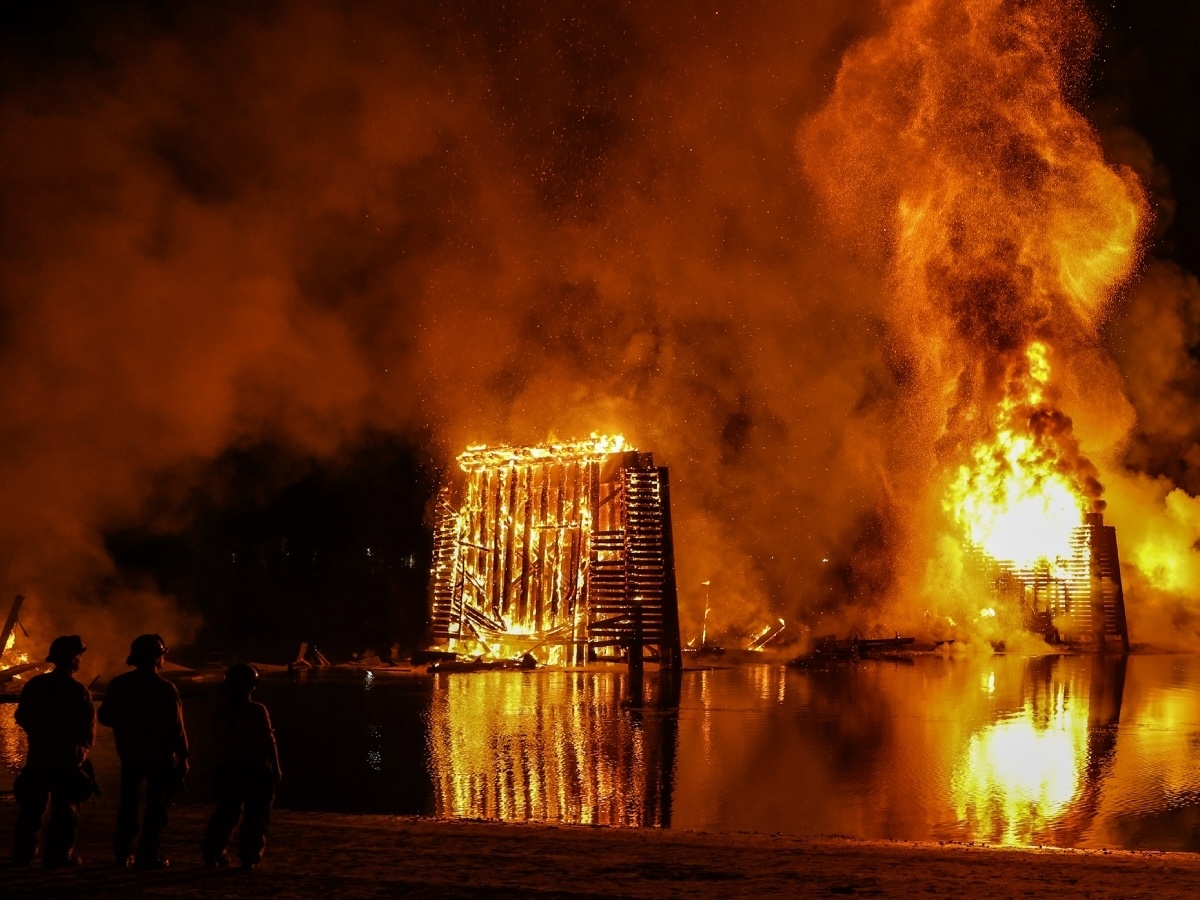
For nearly 90 years, Kamloops’ Red Bridge stretched across the South Thompson River, its weathered timber deck and distinctive, painted handrails and piers making it one of the city’s most recognizable landmarks.
Today, the approach to the bridge ends at a chain-link fence topped with barbed wire. For nearly two years now, an orange “Bridge Closed” sign has hung on the fence, marking not only the end of the road but the loss of a crossing that continues to affect life on both sides of the river.
With no clear timeline for its replacement and no firm commitment from the provincial government, which owned the bridge, locals say the crossing’s loss has brought consequences that extend far beyond transportation.
Losing ‘connection’
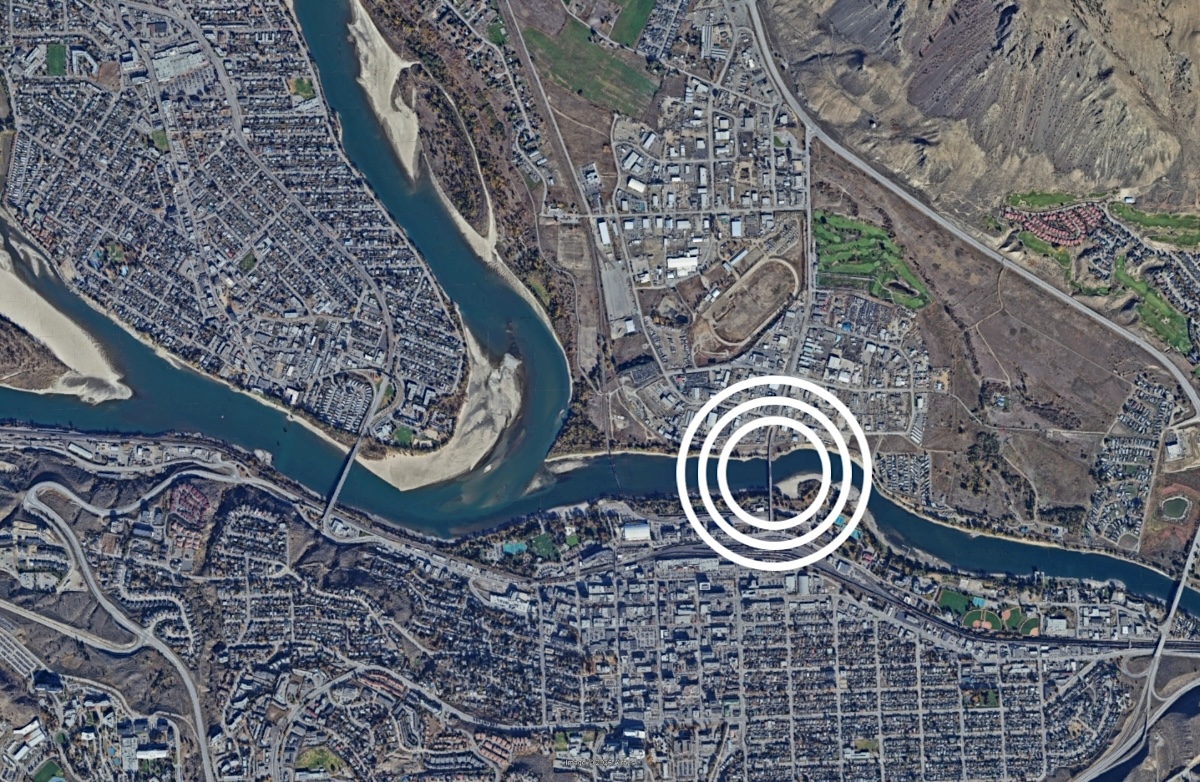
The Red Bridge linked downtown Kamloops with Tk̓emlúps te Secwépemc, an Indigenous government and First Nation with more than 1,600 members. It served as an important route for residents, commuters, cyclists and pedestrians until the early morning hours of Sept. 19, 2024, when an arson fire destroyed the bridge in a blaze that burned for nearly a week.
For many Tk̓emlúps residents, the bridge had provided the quickest route into the city for work, medical appointments, shopping and other essential services. It was also the primary link between downtown Kamloops and an industrial park on the reserve where retailers, home improvement stores, restaurants, a golf course and small businesses relied on the bridge for much of their daily customer traffic.
Kúkpi7 Rosanne Casimir, the Chief of Tk̓emlúps te Secwépemc, believes rebuilding the bridge is about far more than restoring a transportation route.
“This bridge, it’s not just movement; it’s connection,” Casimir told The Tyee.
“It’s that reciprocal relationship that our people have with the city and that the city also has with our community.”
Now that the bridge is gone, Casimir is concerned about the safety of people trying to get from one part of Kamloops to another. A Canadian National Railway bridge crosses the Thompson River close to the Red Bridge’s former location, and Casimir says some locals have used it to cross.
“That is so dangerous,” she said. “We know that crossway has taken lives.”
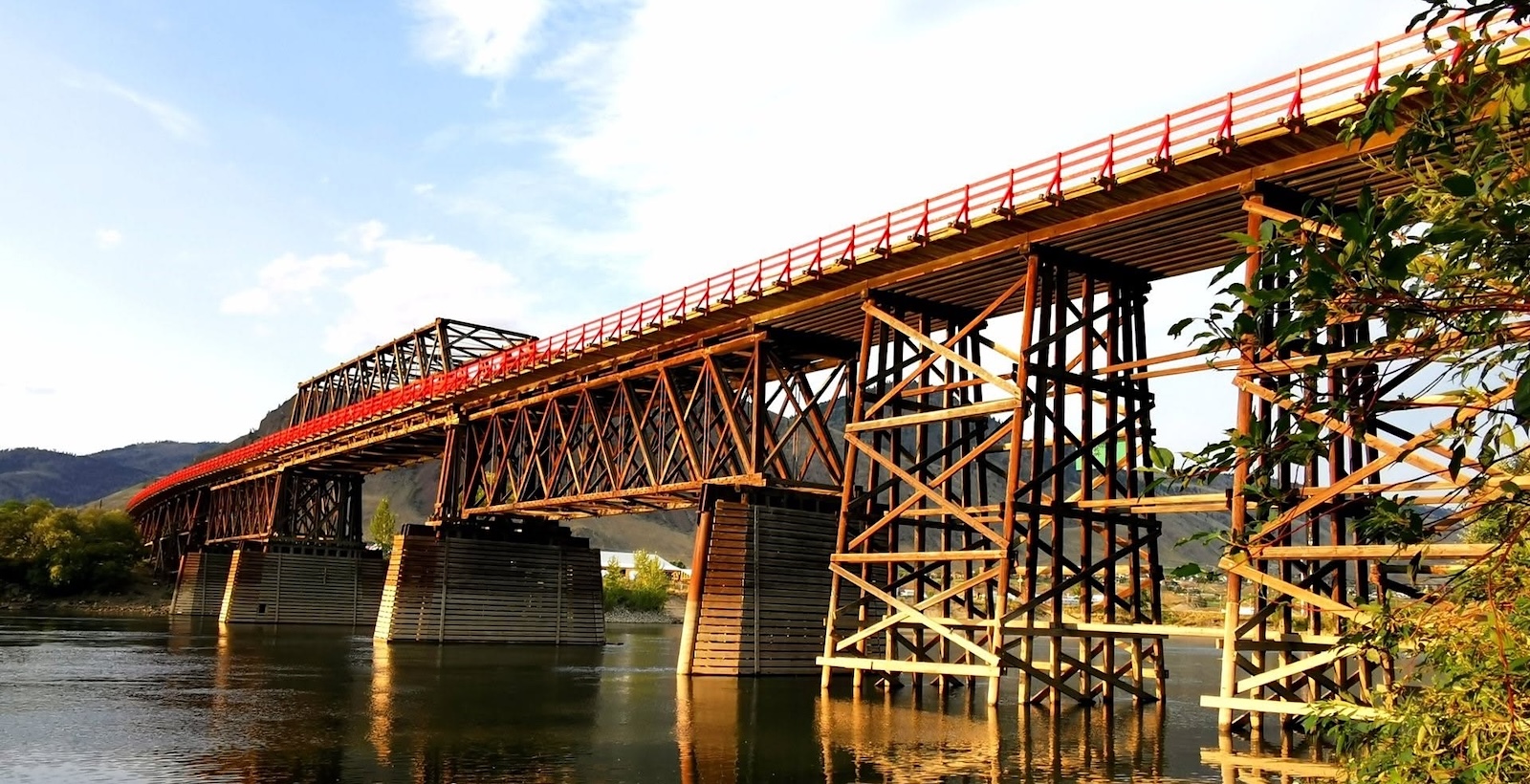
The Red Bridge’s wooden trusses were built out of Douglas fir milled from a local sawmill in Stump Lake along Highway 5. The narrow bridge had two lanes but was built to different standards, with lanes only 2.7 metres wide compared with the regular width of 3.5 metres. It wasn’t uncommon for drivers to clip mirrors, rub their tires or scratch their vehicles.
Although residents remember the bridge as impossibly narrow with a bumpy collage of asphalt and timber, it was also a Kamloops icon, featured in countless paintings and photographs.
"It was the bridge people loved to hate," Kamloops Coun. Stephen Karpuk said.
It’s where teenagers jumped from various heights into the South Thompson River. Whether people loved it or braced for the drive, the bridge had become woven into the city's identity.
“We loved it for what it represented and the visual view-scape that it presented and the history that we were reminded of, but we hated driving across it,” Karpuk said.
Like Casimir, Karpuk sees the bridge as more than a transportation corridor: it was an economic connection between communities and a symbol of the growing relationship between Tk̓emlúps te Secwépemc and Kamloops.
“The bridge is a linkage that joins two wonderful communities together,” Karpuk said. "I think every community has something that holds them together. I don't know if the Red Bridge was something that held us together but it was certainly symbolic."
Karpuk was less than two years into his first term as a city councillor when he received the call at the Union of BC Municipalities conference in Vancouver that the bridge was on fire and that it was also a crime scene.
At first Karpuk thought the call was about a fire on the bridge two days prior, also deemed suspicious, that had been subsequently extinguished.
“I was thinking, No, no, the fire was on Tuesday, we're fine,” he remembered. He learned of the scale of the new fire from a photo of the central part of the bridge dropping into the river below.
“It was a visceral experience because I've lived in the city almost 50 years and I thought, Wow, it's no longer there.”
The RCMP said the fire was deliberately set but no arrests have been made. An RCMP spokesperson would tell The Tyee only that the investigation is active and ongoing. Police have not shared any other specific updates.
A profound loss
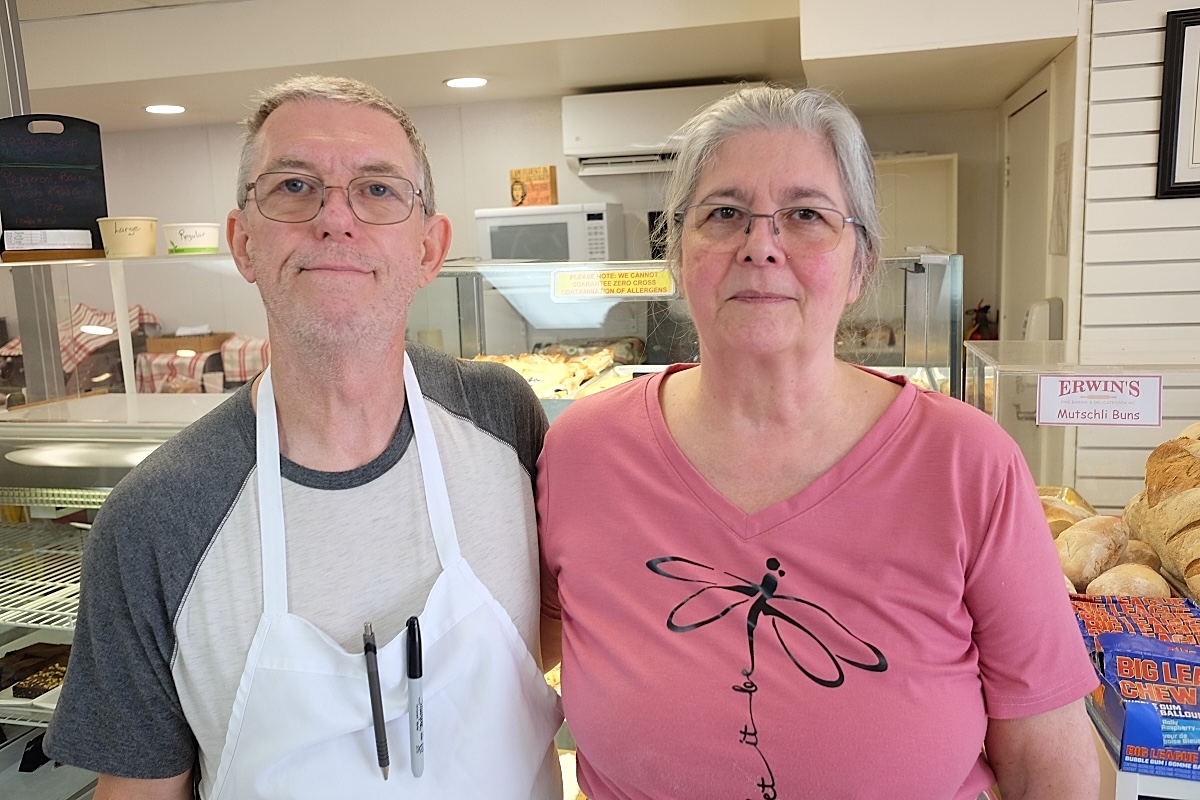
For Mount Paul Industrial Park businesses such as Erwin’s bakery, a fixture of Kamloops for more than 50 years, the destruction of the bridge had an immediate impact.
"The first few months I just cried," said Robyn Haley, who owns Erwin's with her husband, Shawn. “I cried while I was making sandwiches. I cried when I was making soups. I was afraid to order anything because I didn't know if the doors would be open in a week."
The fire came just as the bakery was beginning to recover from the economic strain of the COVID-19 pandemic, she said. The loss of the Red Bridge brought another crisis.
"My bookkeeper thinks I have PTSD," Haley said.
They were able to crawl their way to Christmas, their busy season.
To survive, the Haleys dramatically scaled back the business. Today, the bakery employs just three people: Robyn, Shawn and their night baker. Their product list has shrunk from 19 pages to four. Cakes and cupcakes were eliminated from the menu, and anything that hadn't been ordered in the previous six months came off the price list.
"We have completely lost our morning commuters. They're gone," Haley said.
Spend a few minutes inside Erwin's bakery and it quickly becomes clear what has kept the business alive. Haley greets customers by name. She remembers their regular orders, asks about their children and knows when they're coming off a shift at work. That loyalty, she said, has carried the bakery through.
Some customers now travel far out of their way to visit. They include one man who rides his mobility scooter along Highway 5 despite the lack of safe infrastructure.
“There's no lane, there's no sidewalk, there's no safety, but it's his only way over here,” Haley said. “What used to take him two kilometres now takes 10."
The bridge’s absence is just as apparent for drivers. Every weekday morning and afternoon, traffic that once crossed the Red Bridge backs up along Highway 5, turning what was a direct route into a daily bottleneck. Nearly two years after the fire, the congestion serves as another visible reminder of a crossing that has yet to be replaced.
Locals are questioning why rebuilding is taking so long.
“It doesn’t need to be made of fairy dust and unicorn fur — just put a flipping bridge up there,” Haley said. The sentiment is widespread. Comments to rebuild and rebuild immediately are echoed by Kamloops council, Tk̓emlúps te Secwépemc leadership and residents.
Casimir recalled hearing from one resident, “Red Bridge? Any colour.” She said people want to have the corridor rebuilt as soon as possible.
The province spent nearly $20 million to clean up the bridge after the fire. Premier David Eby promised the bridge would "absolutely" be rebuilt, yet nearly two years later there is still no timeline for construction — or any decision on the form a new bridge might take.
This past June, more than 6,000 residents participated in two public consultation sessions examining replacement options.
The province suggested several possibilities were on the table. One option included a modern replacement bridge with room for vehicles, pedestrians and cyclists. But locals were also asked their thoughts about constructing a bridge with space only for walkers and bikers or improving a Highway 5 bridge to the east — either in tandem with a new bridge or instead of a new crossing.
According to Karpuk, the message was unmistakable: people want the Red Bridge’s replacement to have two traffic lanes and space for pedestrians and cyclists.
He expects a new bridge to cost anywhere from $85 million to $220 million.
A spokesperson for the Ministry of Transportation and Transit wrote that the ministry is currently reviewing the feedback received and developing a summary report that will inform the recommended design of a new bridge.
Karpuk is hopeful. Speaking on behalf of the city, he highlighted the need for a rebuilt bridge during a recent presentation to a provincial budgeting committee.
"We'll hold the premier to his commentary that he has said this is needed and it will get rebuilt," Karpuk said. "What is not being said is when. So that's the one we're a little bit concerned about, is when. We need it now."
This past spring, the Haleys put their bakery on the market for $429,000.
“I'm tired. I am so tired,” Robyn Haley said. “We are one medical crisis away from having to close the doors. So that becomes very real once you hit a certain age.”
Despite the challenges of the past several years, Haley believes the business is finally positioned for growth. After the dramatic restructuring, the bakery is once again profitable.
Finding a buyer, however, is another matter.
Any prospective owner is being asked to invest in a business whose future customer traffic remains uncertain, given the lack of information on the restoration of the crossing.
“It does need the Red Bridge because without your morning and your afternoon commute, honestly, we could be open from 10 till 2,” Haley said.
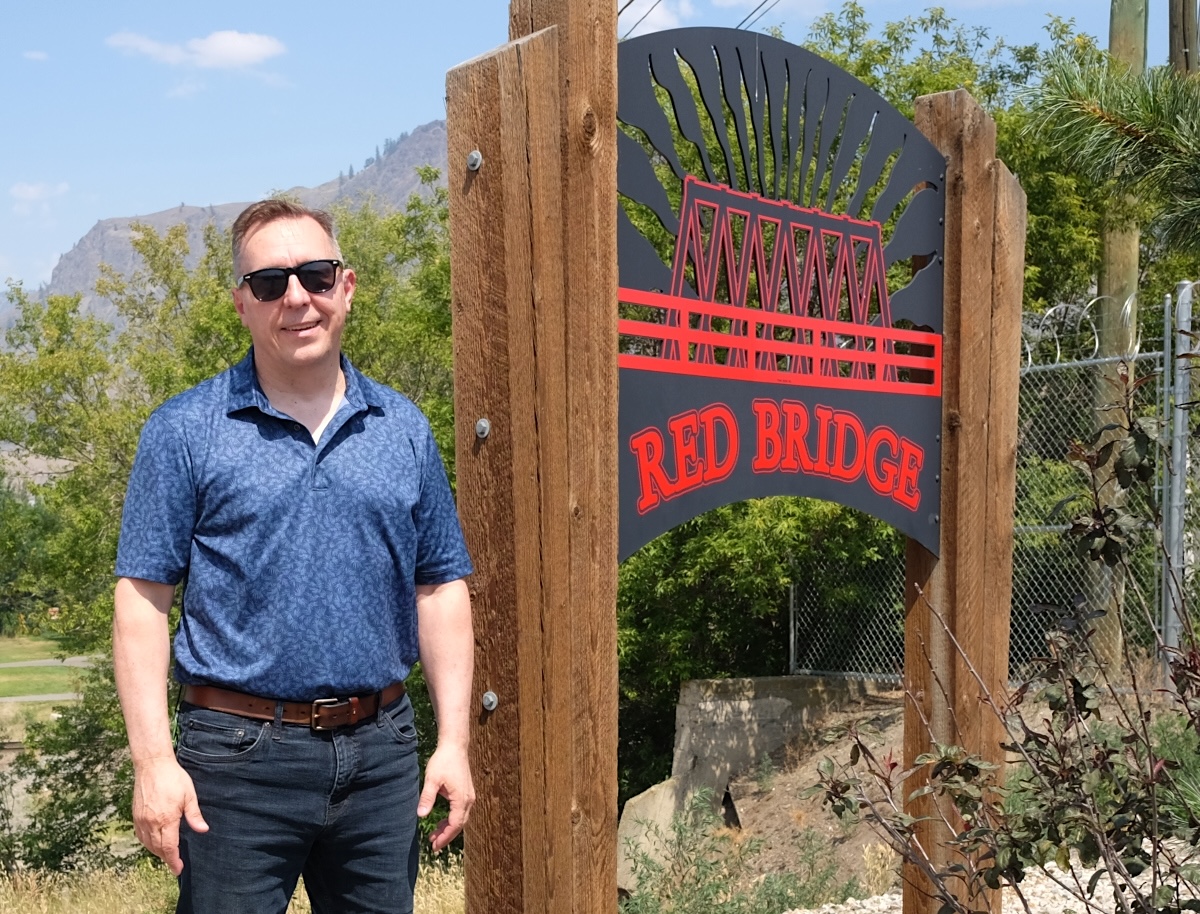
Nearly two years after the fire, visitors to the south entrance find two stories side by side: a heritage plaque celebrating more than a century of crossings at this point on the South Thompson River, and the graffiti-covered “Bridge Closed” sign marking the latest chapter in that history.
For Casimir, that unfinished chapter is about more than restoring a transportation route or improving safety and economic opportunities. It’s also about honouring commitments and continuing to strengthen the relationship between Tk̓emlúps te Secwépemc and Kamloops.
“When I look at reconciliation and the importance and significance of that Red Bridge and rebuilding, it's about the connection that we have between our respective communities and how we’re working together,” Casimir said.
“It's about relationship. It's about the connection. And rebuilding this bridge, it really is a tangible way to advance reconciliation in a nutshell.” ![[Tyee]](/design-article.thetyee.ca/ui/img/yellowblob.png)
Read more: Indigenous, Transportation








Tyee Commenting Guidelines
Please note that email notifications for replies are not currently working due to a software issue which may be resolved in a future update.
Comments that violate guidelines risk being deleted, and violations may result in a temporary or permanent user ban. Maintain the spirit of good conversation to stay in the discussion and be patient with moderators. Comments are reviewed regularly but not in real time.
Do:
Do not: