


 SHARE:

Vancouver’s new Mark V SkyTrain rolled into service last month, drawing buzz from commuters about the future of transit in the city.
Over the next four years, 47 trains made up of 235 Mark V cars will be introduced to Metro Vancouver’s Expo and Millennium lines. The new trains will replace the 40-year-old first iteration of SkyTrain, the Mark I cars.
“It feels like, for the first time, TransLink finally has rolling stock that feels like a proper big-city subway,” said Andrew Ferreira, a local Vancouver transit enthusiast and advocate.
The cars have new features like leaning pads and updated navigation displays commuters can use on the trains. They are being introduced to assist with the Broadway and Surrey-Langley extensions, TransLink explained in an email to The Tyee.
“We spend hours a day on these vehicles when we’re getting to school and to work, and they tend to be just a handful of different types of vehicles, and so the differences between them become so accentuated,” said Denis Agar, the executive director of Movement: Metro Vancouver Transit Riders.
“When we get this new addition to the fleet, it’s really exciting. It changes up the daily routine. It adds that newness and the new train smell.”
What is that new train smell?
Since the first announcement of the new trains, Vancouver transit advocates have awaited their arrival. In 2019, TransLink conducted public surveys to gauge commuter needs for the new fleet and heard there was a need for leaning rails, flex space and bike racks.
Then, in 2020, TransLink secured a contract with Bombardier to buy 205 trains at $723 million, with each individual train car costing $3.5 million.
In 2024, TransLink placed another order for trains with the manufacturer Alstom ahead of the Surrey-Langley extension. The 30 extra train cars cost $123 million at $4.1 million per car.
It is easy for Vancouverites to figure out if they’ve hitched a ride on one of the new trains.
Aside from that “new train smell,” the amount of room for standing has increased thanks to the wider aisles. There are also more handrails and leaning pads for commuters to ride comfortably while standing up.
“The fact that they’re five-car trains, that they have that much more capacity, means that we finally have some relief for overcrowding that a lot of people on the Sky Train experience,” said Agar.
In 2024, a TransLink report found the Expo and Millennium lines faced an average of over 348,000 daily boardings. The trains will increase passenger capacity by 25 per cent, according to TransLink.
“If you’ve taken the Expo Line downtown during rush hour in the mornings, you know it’s a sardine can,” said Ferreira. “So, I’m excited for more capacity.”
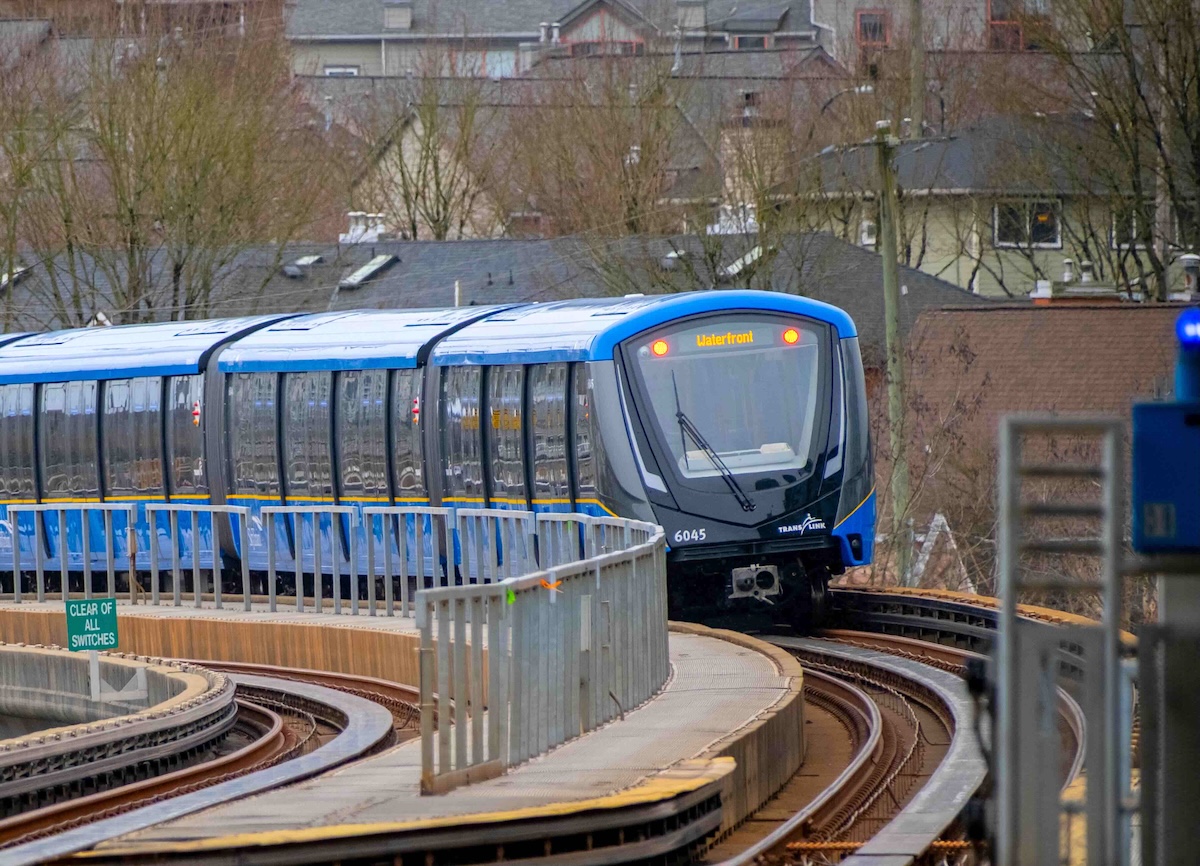
The wider aisles are also aimed at helping to increase accessibility for riders using mobility devices and bicycles. While this might not seem like a massive upgrade from recent versions of the SkyTrain cars, it is a considerable upgrade to the accessibility of the Mark I trains, which are the trains the Mark Vs will be replacing, said Agar.
The new LCD navigation display will make navigation easier for riders by showing them exactly where their train is on the line. The visual door indicators will also help riders by lighting up when the doors open at stops.
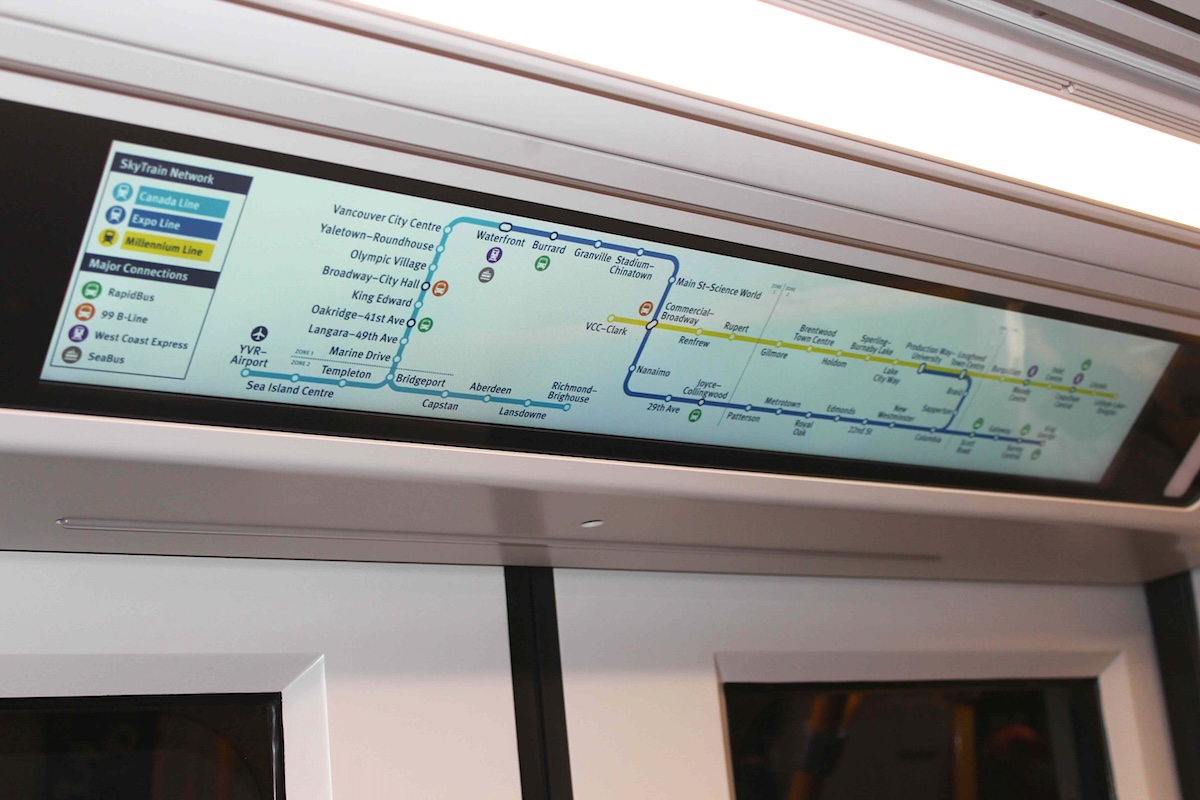
“TransLink has been slow on those, and they’re such an important path-finding tool,” said Ferreira. “It’s wonderful to see them start to roll out.”
The front-facing (or back-facing) window seats are also making a return. The solo seats come with a faux driving board and the best view of the tracks. The seat is a coveted spot for train enthusiasts, commuters who want some space and children riding the train to play train driver.
There are also some unique designs inside the train cars. The windscreens located in each car of the train are decorated by artwork designed by Rain Pierre of q̓ic̓əy̓ (Katzie), Atheana Picha of qw̓ɑ:nƛ̓ə̓n̓ (Kwantlen), Brandon Gabriel of qw̓ɑ:nƛ̓ə̓n̓, Darryl Blyth of xʷməθkʷəy̓əm (Musqueam) and Rose Williams of Sḵwx̱wú7mesh (Squamish) First Nations.
“I’m a big fan of the fact that even on the inside by the doors they have Indigenous art,” explained Ferreira. “It’s the little things like that, the digital displays, the Indigenous art, the increased use of the colour blue, they stand out more. They’re slightly more interesting to look at.”
A 40-year-old history
As Vancouver’s transit system keeps growing, it’s hard to imagine that the almost 40-year-old network was once much smaller.
SkyTrain opened in Vancouver in December 1985, just in time for Expo 86. The Expo Line ran from Waterfront Station to New Westminster.
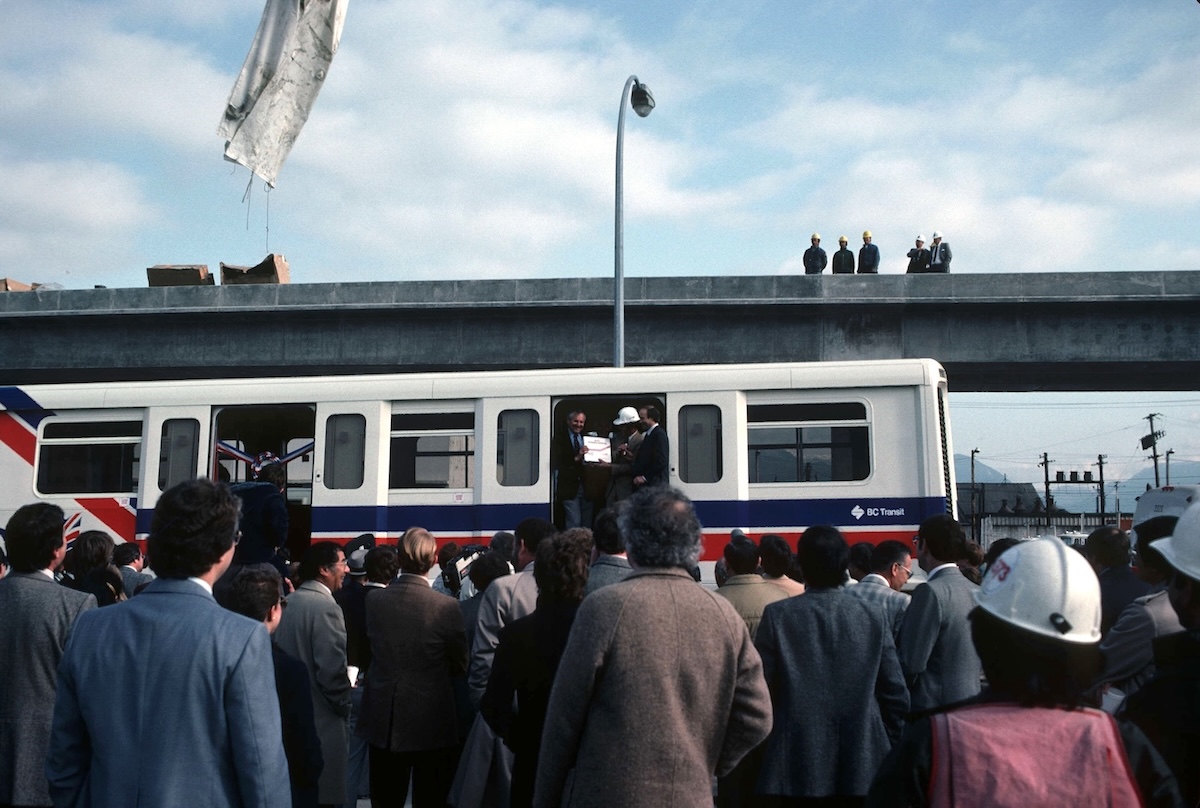
The first trains were also initially carpeted before they were replaced with new flooring in 1992 due to the challenge of the “grime and wet” of Vancouver.
In 2002, Vancouver got the Millennium Line, along with the Mark II cars.
Then, in 2009, the Canada Line was introduced in time for the 2010 Olympics, running from Vancouver International Airport or Richmond-Brighouse to Waterfront.
From there, the Evergreen Extension was added onto the Millennium Line. This pushed the length of the whole network to 79.6 kilometres.
The extension of the SkyTrain then saw another update to the SkyTrain cars, with the introduction of the Mark III cars, which offered the amenities we are now used to, like more space, quieter trains and additional space for bikes, strollers and wheelchairs.
Now, ahead of the completion of the Broadway and Surrey-Langley expansions, the new Mark V trains are being rolled out, increasing the capacity of the whole fleet.
“What has been pulled off in Vancouver is unprecedented in terms of a young, mostly suburban region, managing to get a ton of people on transit,” said Agar.
Why it’s important to keep investing in transit
The new Mark V cars have arrived in the wake of a severe funding crisis for TransLink.
In 2024, TransLink reported a funding gap of approximately $600 million each year. Its budget is about $2.5 billion.
TransLink listed a number of factors that had caused the shortfall. Fuel tax revenue was down because of drivers switching to electric cars and hybrids. Transit fares had been frozen below inflation as a pandemic relief measure. And the rapid inflation in the wake of the COVID-19 pandemic had pushed up costs for everything from labour to fuel.
Left unaddressed, the shortfall would have resulted in cutting bus service in half, reducing SkyTrain and SeaBus service by one-third and eliminating the West Coast Express, along with other cuts to transportation services. The threats motivated advocates to start a campaign called Save the Bus and encouraged commuters to contact their MLA to ask for more funding for transit.
Since then, TransLink has cut costs and gotten an injection of funds from the provincial government. The province will provide TransLink with $312 million in funding over the next three years, and the transit authority is also increasing its revenue with a 0.5 per cent raise on property taxes, a five per cent increase in parking lot sales tax, a fare increase in 2026 and a $1.50 increase to the extra fee paid by travellers at YVR-Airport Station.
The federal government also announced $1.5 billion in funding for TransLink over 10 years, in addition to $663 million over 10 years for capital projects.
The funding boost means that TransLink can finally offer more bus service. Starting this September, bus service will increase for the first time since 2018, with over 50 of Metro Vancouver’s most crowded routes getting expanded service.
But Movement says there’s still more work to do. While TransLink is now rolling out a five per cent increase in bus service, that won’t be enough for the long term. And although TransLink’s Access for Everyone plan aims to double bus service in 10 years, it isn’t funded yet.
Agar said one of the ways TransLink could receive more funding would be through a referendum, which would mean that people would vote on whether they would like to pay higher taxes for transit improvements.
The last time Metro Vancouver had a transit referendum, in 2015, the region voted no to the increase after a hard-fought campaign. Agar said that loss might make TransLink hesitant to try again.
Ferreira said he would be willing to pay more, be it increased fares or taxes, to support transit innovation.
“I don’t own a car; I can’t afford it. I live in a dual-income household, and we still cannot justify the costs of owning a vehicle. It’s tough,” said Ferreira. “We’re lucky that our jobs allow us to transit where we need to be. But if that situation changes, then we wouldn’t have much of a choice. But absolutely, I would pay more.”
Agar also highlighted the importance of transit for all members of the community, from business owners in helping them increase foot traffic in their shops, to motorists in transit, helping with traffic congestion.
For commuters, investing in transit also means investing in the experience.
“There are so many intangible benefits that come with using transit. You’re not isolated in your own little world,” said Ferreira. “The sense of community that you feel — even if you never speak to anyone on a bus — will do you some good, certainly more than cocooning yourself in your vehicle.”
Advocates continue to push for transit improvements
While the expansion of the fleet signals a continued investment in transit, there is still more that TransLink and Vancouver can do to advance the commuter experience further. Addressing issues like accessibility and fare fees are a part of that, Agar said.
Although the new fleet and SkyTrain stations are accessible, Agar said TransLink could invest more into HandyDart — a bus service for people with disabilities — and washrooms in each station.
“Places like Toronto have washrooms at certain subway stations, but we do not have any,” said Agar. “I know that’s something TransLink studied forever; it’s just a matter of getting the money to allow them to put in washrooms and maintain them.”
Agar also urged transit users not to forget about buses and bus infrastructure. It’s cheaper to invest in buses and bus lanes than to build more SkyTrain, Agar explained.
Another item on the list of desired advancements is a low-income transit pass, which is offered in cities like Toronto and Calgary.
“Our fares should be progressive,” said Agar. “If you can afford to pay full fare, you should, and if you can’t, then you should get a really steep discount.” ![[Tyee]](/design-article.thetyee.ca/ui/img/yellowblob.png)
Read more: Transportation, Urban Planning









Tyee Commenting Guidelines
Please note that email notifications for replies are not currently working due to a software issue which may be resolved in a future update.
Comments that violate guidelines risk being deleted, and violations may result in a temporary or permanent user ban. Maintain the spirit of good conversation to stay in the discussion and be patient with moderators. Comments are reviewed regularly but not in real time.
Do:
Do not: