


 SHARE:
Becoming: The Art of Gu Xiong traces the evolution of internationally recognized multidisciplinary artist Gu Xiong. On display at the Museum of Vancouver now through Feb. 7, 2027, Becoming is the most comprehensive display of his work and highlights landmark pieces from his 50-year career.
MOV: What will people see when they visit ‘Becoming: The Art of Gu Xiong’?
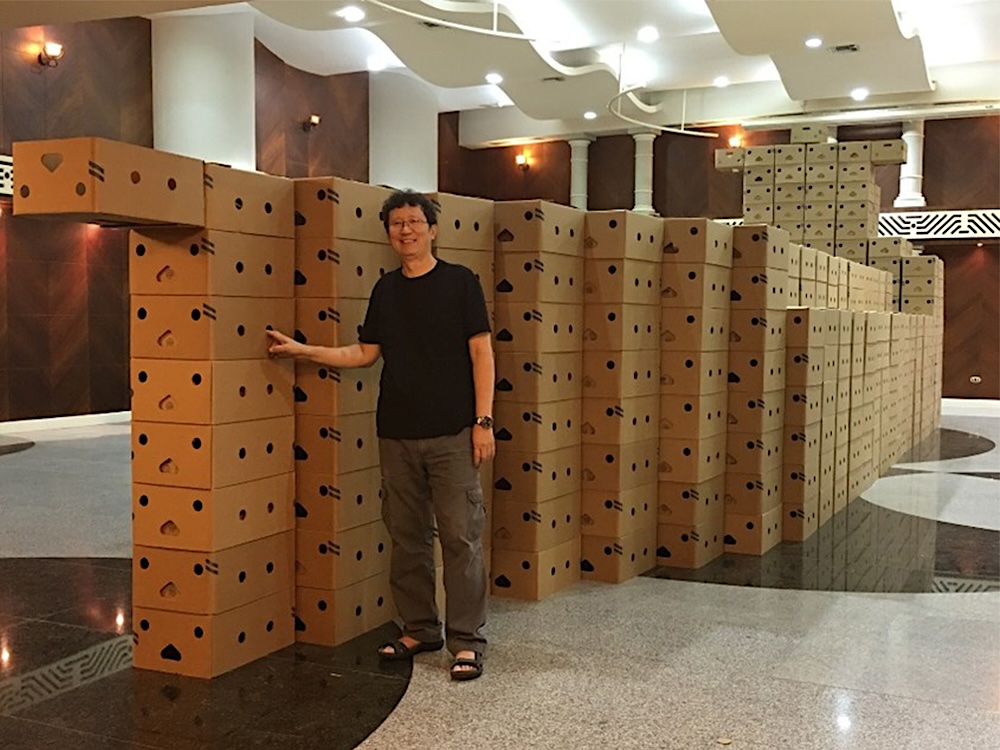
Gu Xiong: I like to work in multimedia formats, which gives me more diverse opportunities to explore my ideas. People will see A River of Migration, which is an installation formed by hundreds of plaster salmon fish and small white plastic boats flowing across the entire exhibition space. There will be paintings like Enclosures and charcoal drawings in Here, There, Everywhere. Illuminated Niagara Falls is made of hundreds of photographs, and its associated piece A Migrant Worker’s Crate is a re-creation of the crates Jamaican migrant workers send home to their families. Yellow Cargo is a sculpture made from cardboard boxes, produce labels and video projection. My favourite piece is Smile, three individual portraits of my family with a poem in English and Chinese. It explores our family’s resilience through humour.
Creating this exhibition has been a journey to retrace my artistic roots and the flow of my artistic development, through migration and global changes, like a river finding its way through treacherous landscapes. These renewed reflections shaped the spaces and themes of this exhibition, forming new meanings from past and recent work.
How did you start as an artist?
During the Cultural Revolution in China in the 1970s, I was sent to the countryside. I sketched every day, recording my daily life. In 1978, I applied to art school and was accepted by the Sichuan Fine Arts Institute, where I earned a bachelor’s and master’s degree in fine arts. I became an instructor and started to teach students in 1985. In 1986, I was the first Chinese artist to attend the artist-in-residence program at the Banff Centre for the Arts. I worked with contemporary artists from around the world, and we went to New York to visit art galleries and museums. This experience had a big impact. I saw the work of Andy Warhol, which had a huge influence on me. But I knew I had to find my own way for my art.
I returned to China, and in 1989, I participated in the groundbreaking exhibition China/Avant-Garde at the China national museum of fine arts in Beijing with Enclosures. In 1989 I had my second residency at the Banff Centre.
Tell us about moving to Canada.
I dreamed of going to Canada after seeing a review of a Group of Seven exhibition in 1975. At the Banff Centre, Alvin Balkind, the head of the visual art studio, was very supportive of my immigration. I moved to Vancouver in 1990, and my wife and my daughter came to join me.
In the initial years we were caught in a culture shock, losing everything we once had, feeling lost and disoriented in a new culture. The most challenging aspect was making a living and trying to make art at the same time. As a new immigrant, family was very important. Without their support, I couldn’t keep doing my artwork; they are part of me.
As an immigrant I wanted to explore the process of creating our new identities, to have our experiences and voices be heard and shared. We became a blend of two cultures, creating something new.
In the 1990s and early 2000s, your work shifted, partially because of your role as a professor at the University of British Columbia. Tell us about that.
In teaching at UBC, I encouraged my students to deepen their artistic voice and concepts through researching other artists’ work, art history and critical theory. This also inspired me to research and deepen my art. Through my research project, I was inspired by migrant workers on Canadian farmland. They came to earn money from physical labour to support their families. Their situation resonated with me.
What is next artistically for you?
Today, I see myself as a complex person whose cultural conflict has entered my life and work since coming to Canada, and I am in a state of constant evolution. When the vitality and hope of life emerges, I will follow and explore it.
‘Becoming: The Art of Gu Xiong’ is on display at the Museum of Vancouver now through February 2027. For more information on ‘Becoming’ and other exhibitions at the MOV, visit the museum’s website. ![[Tyee]](/design-article.thetyee.ca/ui/img/yellowblob.png)
Read more: Art
This article is part of a Tyee Presents initiative. Tyee Presents is the special sponsored content section within The Tyee where we highlight contests, events and other initiatives that are put on either by us or by our select partners. The Tyee does not and cannot vouch for or endorse products advertised on The Tyee. We choose our partners carefully and consciously, to fit with The Tyee’s reputation as B.C.’s Home for News, Culture and Solutions. Learn more about Tyee Presents.
Tyee Commenting Guidelines
Please note that email notifications for replies are not currently working due to a software issue which may be resolved in a future update.
Comments that violate guidelines risk being deleted, and violations may result in a temporary or permanent user ban. Maintain the spirit of good conversation to stay in the discussion and be patient with moderators. Comments are reviewed regularly but not in real time.
Do:
Do not: