


 SHARE:

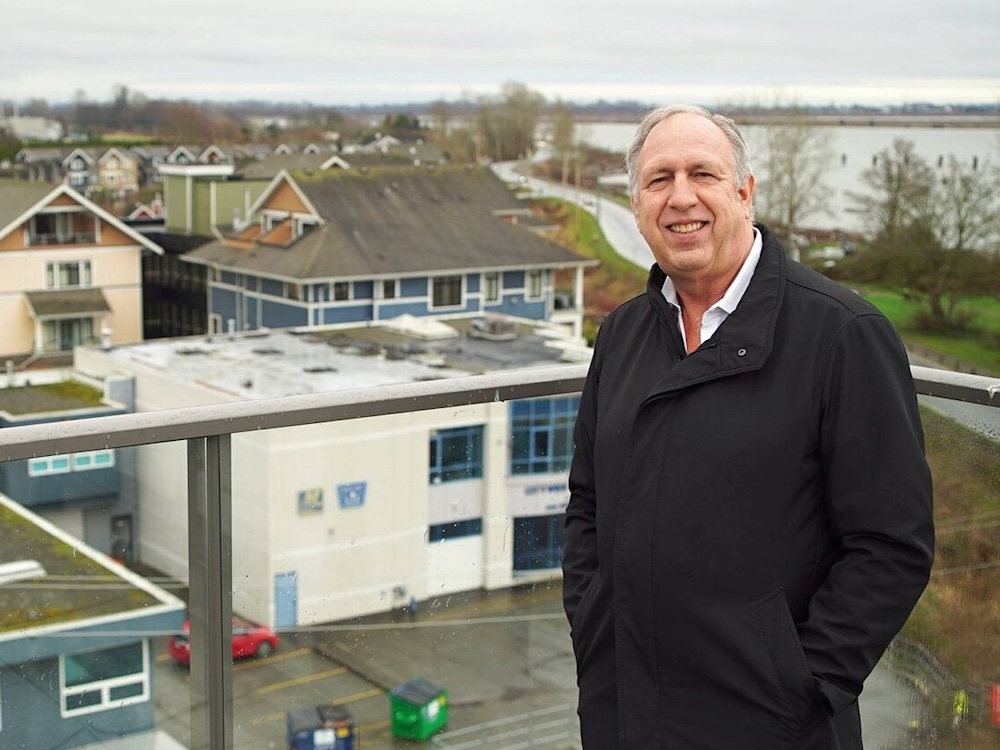
It’s a quiet, cloudy morning on the Alexandra Greenway, a tree-lined corridor in Richmond. Today the double-lane bike and walking path is empty, save for a songbird darting by and a bunny nibbling plants just off to the side.
Despite the tranquil scene, much of the energy for about 2,000 homes, an Islamic temple and a firehall comes from this otherwise unassuming patch of green space — that is, about 70 metres below ground. That’s where hundreds of buried pipes have circulated an infinite loop of fluid, on repeat, for over a decade, pulling heat from the earth into buildings across the neighbourhood and back again.
Owned by the City of Richmond, the Alexandra District Energy Utility is among the province’s first large-scale, networked energy systems to draw on heating and cooling from the shallow earth. Known to some as geoexchange or a ground-source heat pump, the technology is old, but its use in B.C. remains relatively uncommon. Unlike geothermal energy, which taps deep heat from the earth’s mantle and molten core, geoexchange targets earth-buffered radiation from the sun. Its heat isn’t hot, but it is stable, and for geoexchange users, that’s an asset, not a flaw.
“We hopped on this opportunity,” says Alen Postolka, director of district energy for Lulu Island Energy Co., the City of Richmond’s wholly owned energy utility, which launched the system with Oris Geo Energy, a local building developer specializing in geoexchange, in 2012.
At the time, Richmond faced a problem familiar to many municipalities seeking to develop in an era of climate change: the city wanted to decarbonize while continuing to grow. Its population had just grown by eight per cent in the last five years, totalling over 190,000 by 2011. Richmond, which also has the highest life expectancy rate in B.C., is now home to about 210,000 people.
Geoexchange appeared to present a solution.
The systems are a small but growing international market, led by regions such as the United States and the European Union, including Sweden, whose buildings have over 670,000 units hooked up to some form of geoexchange. The technology has a sleepier profile in B.C., getting little mention from the province as an option for addressing its energy needs.
Dana Westermark, developer at Oris, sees that as a missed opportunity to address some of B.C.’s gnarliest energy problems, including a coming shortage of once abundant hydro power and the infrastructure to transport it.
“It's really looking at trying to solve some problems that you know haven't really bitten yet but are likely going to bite in the foreseeable future,” he says.
‘It’s basically a battery’
Back in the early 2000s, when the Alexandra Greenway was still an undisturbed patch of grass, Westermark, a longtime Richmond developer, was busy helping his friend build a house. “I don't normally do single-family homes, but this person was a friend of mine,” Westermark says.
Westermark’s friend, an “avid environmentalist,” wanted a house heated by geoexchange, something neither Westermark nor many other Vancouver developers knew about at the time. “It was very leading-edge to be looking at doing geo back then,” Westermark says.
There’s nothing new about the earth’s heat. Recent evidence suggests some humans may have survived through the last ice age in part thanks to the insulated heat of underground caves. Cave dwellers benefited from the same fundamental facts used in geoexchange: despite vast fluctuations above ground, ambient temperatures in the shallow underground remain relatively stable, generally ranging between a chilly but habitable 10 to 12 C.
“That's not warm enough for us to feel comfortable. But it can be used as a source of heat,” says Jeff Quibell, an engineer specializing in geoexchange with Falcon Engineering in Kelowna.
To raise that modest heat, geoexchange systems employ a reverse refrigeration technology developed in the late 1800s.
Common geoexchange systems use networks of underground vertical or horizontal pipes that push and pull a conductive liquid in a loop. Above ground, a machine called a ground-source heat pump pulls that liquid across a pipe carrying another liquid, a refrigerant, which boils at very low temperatures. Once boiling, the refrigerant turns into a vapour, which is then squeezed in a compressor, increasing its temperature and pressure. That superheated vapour is piped past another liquid, which then becomes the heating conduit for buildings, passing by air shafts and water heaters inside hot coils. In the summer, the system works in the opposite direction, absorbing heat from indoor air and depositing it underground.
“It’s basically a battery,” Leighton Gall says. Gall, a member of the Métis Nation, is a researcher and directional driller working on geothermal and geoexchange energy systems.

Geoexchange requires some electricity to move heated water and air around, but unlike systems that use electricity to produce heat energy, geoexchange moves and concentrates already existing heat from underground.
“It reduces your electricity by one hell of a lot,” says Gall. Electricity is still required to run the compressors and to pump air and water through the system, but the demand is relatively small. Whereas electric systems use one unit of electricity to produce one unit of heating and cooling energy, a geoexchange system uses one unit of electricity to produce up to five units of energy. Geoexchange systems also have an advantage in cold regions. Unlike regular air-source heat pumps, which begin to lose their efficiency advantage over electric baseboard heaters in very low temperatures, geoexchange maintains its edge.
Geoexchange’s reverse refrigeration approach was first developed in the 1940s, but it remained uncommon in Vancouver around the 2000s, when Westermark set out to build his friend’s house. He remembers observing a contractor building the geoexchange system inside the home.
“I thought, holy Dinah, this is way too complicated,” he says, remembering the cumbersome setup. “You can do this a lot easier.”
Westermark worked with a mechanical contractor and an engineer to devise a streamlined geoexchange system that became his specialty as a developer and utility owner. “I was really quite impressed by the simplicity of a good geo-system,” he says.
Westermark began having conversations with a friend, Richmond’s late engineering manager, Robert Gonzales. “He and I worked quite closely together and developed the business case for the city to do a geoexchange utility,” Westermark says.
Prior to their project, the Vancouver airport’s networked, or “district energy,” geoexchange system was the only comparable case study, though it used a different, open-loop approach that uses heat from water flowing underground. By relying on closed-loop technology that would just target the earth’s ambient heat, they decided to build the province’s first networked geoexchange system of its kind.
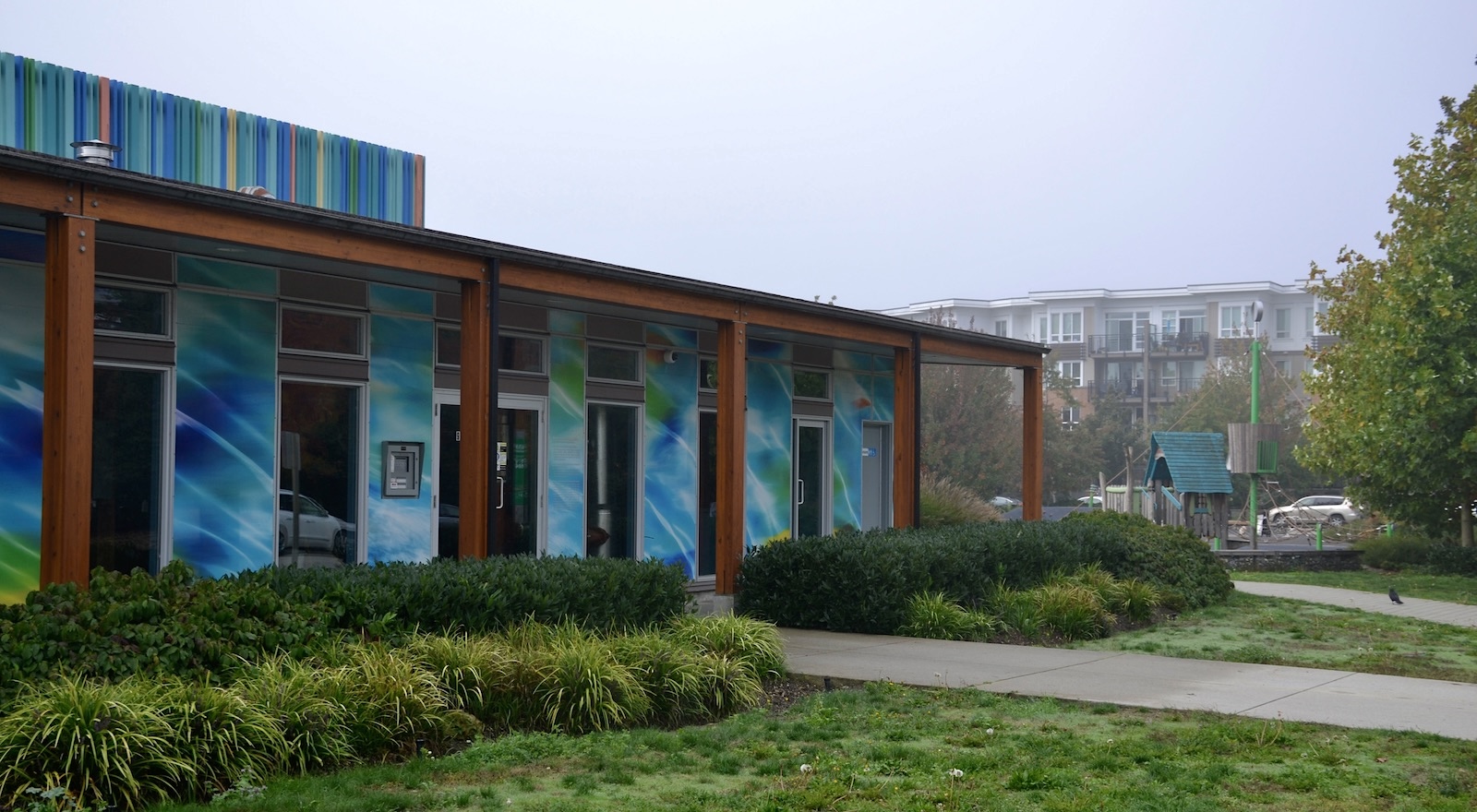
They began with 250 vertical pipes installed in the greenway and expanded to 700 pipes a few years later. Besides a few gas boilers installed to top up the system on the coldest days, the neighbourhood gets almost all its hot water, heating and air conditioning from the geoexchange system. Westermark and Postolka differ on the necessity of those gas boilers: Westermark argues they’re redundant and drive up costs, whereas Postolka says they’re needed for backup in case the system needs maintenance.
Since then, geoexchange systems have expanded across the province. That includes Hazelton Secondary School, where ground heat has substantially curbed the need for propane, and Summerland Secondary, which expects to cut about 220 tonnes of greenhouse gas emissions per year using the system. In Vancouver, Oakridge Park’s residential area and shopping centre are building a geoexchange district energy system for about 2,600 homes, retail spaces and community buildings.
Over a decade into its operation, Postolka describes Richmond’s Alexandra geoexchange system as “perfect.”
“I would love it if I could implement it everywhere,” he says. “But we couldn’t.”
The limits of geoexchange
Like many energy technologies, geoexchange has limits.
It requires underground space, and while some apartment buildings can now establish systems beneath parking stalls, large networked systems like Richmond’s need larger areas to access enough underground heat, though new advances in drilling technology are beginning to reduce those space demands.
In dense urban regions, the undisturbed space needed for geoexchange can be scarce. Richmond is a case in point: Postolka says the city has built two more district energy networks but opted for other technologies, including waste heat and gas boilers, in part because they lacked the room to build and transport more geoexchange energy. Those projects are slightly closer to the heart of the city and currently serve thousands of residential units across more than five million square feet.
Geological conditions matter too: geoexchange works best in loose, alluvial soils, whereas drilling into bedrock can increase costs.
Broadly, the upfront costs of geoexchange development remain one of the technology’s biggest barriers, says Falcon Engineering’s Quibell. Whether on bedrock or not, drilling holes underground is expensive, as are the heat pump systems required to harness the heat. Even the Alexandra utility cost $24 million to install.
Meanwhile, gas power in B.C. remains relatively cheap. Geoexchange can easily undercut the cost of installing electric baseboard heaters in large buildings, says Quibell, but gas is a more formidable competitor. “If we're comparing against gas, it's much harder,” he says. Advances in fracking technology in recent decades have made gas easier and cheaper to extract, stacking the deck against geoexchange.
Recent policy changes haven’t helped things either.
B.C.’s decision to scrap the consumer-facing carbon tax removed a vital price signal.
“The geoexchange industry took a real significant kick in the pants with the loss of the carbon tax,” says Quibell. “The way in which it was proposed to escalate, by 2030 we would have been in a very competitive position.”
“That was really, really, really, really hard on us.”
And for developers like Westermark, the regulatory picture has recently transformed. Until last year, private utilities building and selling the energy from district geoexchange energy systems were exempted from the kinds of administrative work required of major utilities such as BC Hydro and FortisBC. But that has now ended. Though exemptions for small geoexchange systems continue, Westermark says regulatory costs for new systems like the ones he was developing are now too prohibitive to consider.
“It’s basically choked the life out of the business,” he says.
In an email to The Tyee, the British Columbia Utilities Commission said the recent change sought in part to “improve transparency” and “support efficient regulatory processes, while balancing the public interest.”
BC’s future energy crunch
B.C. may be facing a turbulent energy landscape in the years ahead. That includes rapidly growing power demand to support proposed industries such as liquefied natural gas and data centres, finding the energy to sustain its expected population growth and electrifying its still-fossil-fuel-dominated economy.
Higher energy demand will require major transmission and substation upgrades, adding to BC Hydro’s mounting future expenses. The utility recently announced hundreds of millions of dollars in coming investments to keep its system up to par.
The prospect of an electricity deficit has already triggered some calls to increase support for fossil fuels such as gas, including potentially building new gas power plants.
Westermark sees geoexchange as an opportunity to avoid the coming energy crunch and the fallback solution of fossil fuels. The systems require less upkeep than gas boilers and even air-source heat pumps, which often have to be fixed or replaced. And because geoexchange provides a stable, year-round energy source, it can align well with more variable energy options such as solar panels.
As battery storage systems improve, Westermark sees opportunities to support regional energy communities, eschewing the need for expensive transmission upgrades altogether. “You could solve a lot of problems by having these site-specific energy systems that weren't dependent on a grid,” he says.
“I have to admit, we're not there yet,” Westermark adds. He’s still waiting for advances in things like battery storage technology to help geoexchange stand on its own with help from renewables like solar. Until then, he says, “we’ve got a ways to go.”
This article runs in a section of The Tyee called ‘What Works: The Business of a Healthy Bioregion,’ where you’ll find profiles of people creating the low-carbon, regenerative economy we need from Alaska to central California. Find out more about this project and its funders, Magic Canoe and the Salmon Nation Trust. 
Read more: Energy, Environment










Tyee Commenting Guidelines
Please note that email notifications for replies are not currently working due to a software issue which may be resolved in a future update.
Comments that violate guidelines risk being deleted, and violations may result in a temporary or permanent user ban. Maintain the spirit of good conversation to stay in the discussion and be patient with moderators. Comments are reviewed regularly but not in real time.
Do:
Do not: