

 SHARE:
Two decades ago, Mike Anderson took on a construction project that laid the foundation for a new career with a larger goal — tackling one of the biggest needs in many First Nations communities.
The forester by trade agreed to build a powwow arbour in under four months for the Skeetchestn Indian Band. Under his direction, a journeyman carpenter and half a dozen of the community’s youth got the job done, completing a 12,000-square foot structure for a large community gathering on Skeetchestn traditional territory.
Anderson was grateful to see the pride the kids took in the construction process. They learned valuable skills while turning raw logs into a significant place for their community. And that served as inspiration for Anderson’s latest passion project: Skeetchestn Dodeca-Homes.
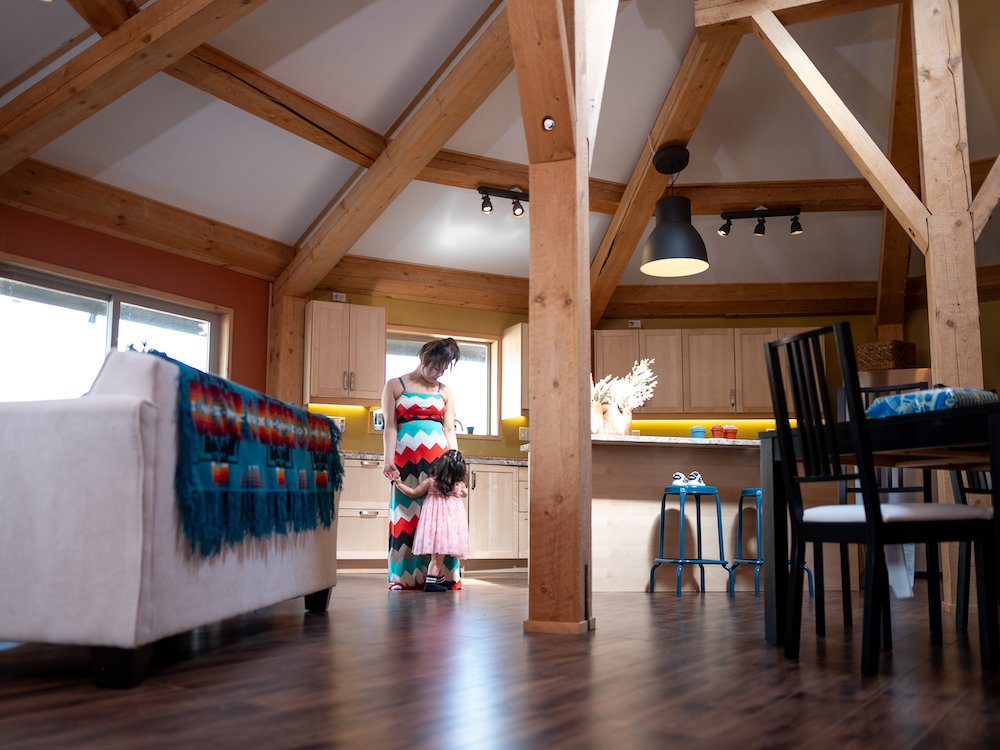
Developed by the Skeetchestn Natural Resources Corporation, Dodeca-Homes creates modular housing units that can be assembled anywhere by skilled labourers. Using wood harvested on Skeetchestn traditional territory, the business is led by Indigenous people, for Indigenous people. It’s a scalable, sustainable housing solution that gives economic opportunity and training to Indigenous people while providing housing for Indigenous and rural communities across Canada.
Located about 40 minutes west of Kamloops, British Columbia, Skeetchestn Indian Band is one of the 17 communities that make up Secwepemcul’ecw.
Anderson has been working with the band for nearly 30 years. He’s not Indigenous, but as the former CEO of the Skeetchestn Natural Resources Corporation, a sustainable corporation owned by the nation, he’s long held an interest in value-added wood products like log homes.
Anderson said his first sketches were a “side of the desk” project. The first prototype was completed in 2003 and a demonstration home was built in 2016.
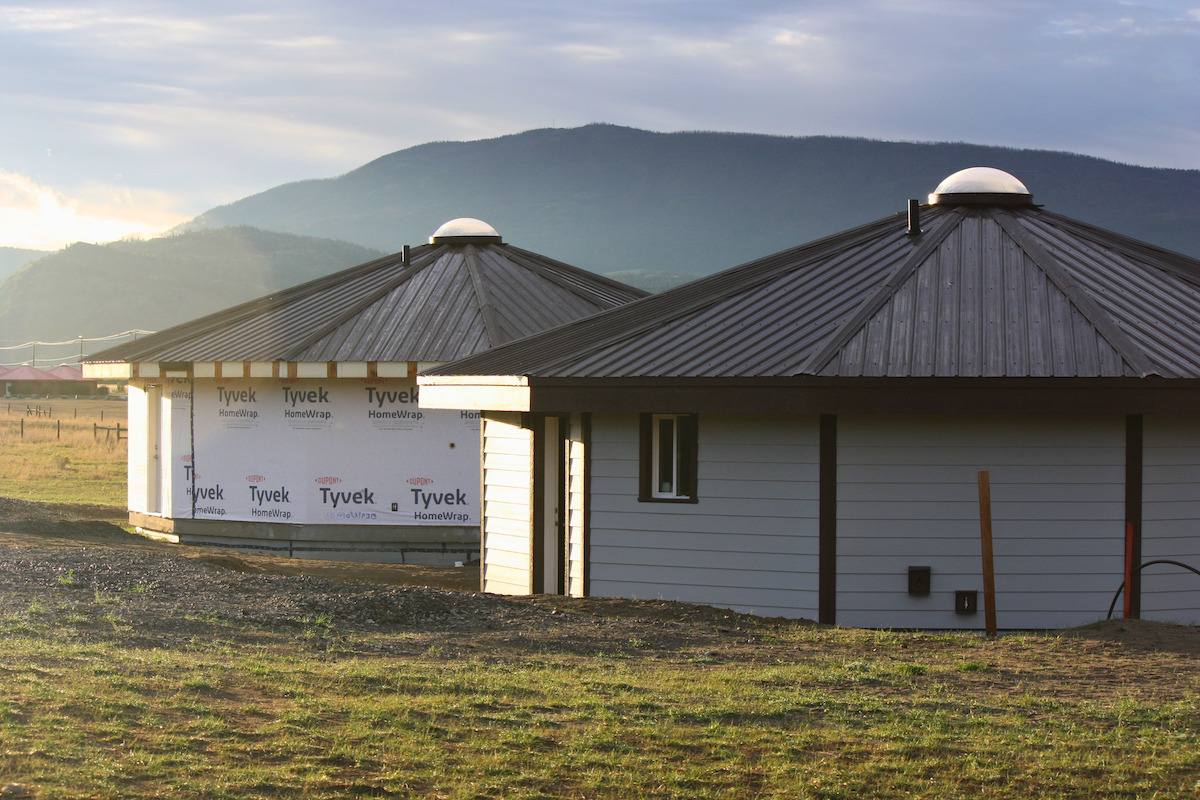
The company has built around 25 units over the past three years. There’s a handful on the Skeetchestn reserve, including a show home. They’ve also sold homes to Logan Lake, Enderby, and recently established a partnership with the Kanaka Bar Indian Band that will provide about a half-dozen modular units for a housing project.
The 12-sided design is based on a traditional Secwépemc pithouse, or kekuli. There are three different sizes currently available: 600, 1,040 and 1,490 square feet. The homes are completely customizable and can include basements or multiple storeys. Structures may also be built in clusters.
The ready-to-make homes are sold as kits and include a Douglas fir timber frame, structurally insulated panels (SIPs), walls and ceiling, metal roofing, up to six windows, a door, a skylight, steel fasteners, conceptual design drawings, assembly instructions and, in true 21st Century DIY fashion, links to supporting videos on YouTube. The kits retail for $100 per square foot. The company also sells turn-key ready structures for $300 to $400 per square foot, depending on the unit.
The first prototypes used wood damaged by pine beetles. Now the homes are made up of Douglas fir, which is sustainably harvested on Skeetchestn traditional territory and then processed into usable timber at the local mill. With the timber for Dodeca-Homes, the band is creating what’s known in forestry circles as a value-added product. It’s been a focus for the B.C. forestry industry of late, and means that the timber that’s harvested in the province is altered into something of higher value (like housing products, flooring or even artwork) than raw logs before it leaves B.C.
“I've always grown trees, but I've always been monkeying around with how do we put them to use, how do we make a value-added product out of them. And this is a truly value-added product,” he says.
Using local sustainable materials is important to Anderson. The one material he would like to find an alternative for is the SIPs — a petroleum product — but he hasn’t found a decent solution yet.
The power of the circle
There’s a pressing need for Indigenous housing options in Canada. Overcrowding, deteriorating infrastructure, mould and other poor living conditions are too common. By 2041, the Indigenous population in Canada is set to reach 1.8 million. The Assembly of First Nations estimates that 157,453 new homes are needed to address the Indigenous housing shortage in Canada.
Dodeca-Home units are designed so that they can be assembled quickly in remote locations, says Jada Britton, marketing and sales director. They are also made for Canadian climates and can handle wind, fire and snow. Britton adds that there’s also a version that works with screw piles, which allows you to build in a floodplain or a swamp — areas where Indigenous communities have been typically forced to live.
“It’s not like the best land was ever given to people on reserves,” she says.
A Skeetchestn member, Britton first got involved in the project 20 years ago, when she helped digitize the design concept, showing how the units could be connected. She recently joined the company to help with promotion and sales.
The concept doesn’t reinvent the wheel. Build-Your-Own-Home kits have been around for a long time — Sears, for example, started shipping supplies and blueprints to build your own home either on your own, or with the help of a contractor, back in the early 1900s.
But now modular homes are gaining in popularity. Prefabricated homes make up about five per cent of new houses made in B.C. per year, and Premier David Eby has previously suggested he would “fast-track” the homes to address the province’s housing crisis.
It’s a major reversal, considering it wasn’t that long ago that their reputation was mixed. Modular homes are often compared to mobile homes, which don’t hold their value. However, once a modular home is attached to the foundation, it looks an awful lot like a traditionally built home. They’re also cheaper to build up front.
Dodeca-Homes claims their homes can be sealed up in around two weeks, depending on the crew, so they’re great for the shorter building seasons that exist in many parts of Canada.
The business has been able to scale with the help of grants. A few years ago, Dodeca-Homes qualified for funding through the Canada Mortgage and Housing Corporation (CMHC) Housing Supply Challenge as a shortlisted applicant. With the money, they were able to train crews from across Canada — Haida Gwaii to Nova Scotia — who are now qualified to build the units in their own areas.
To Anderson, it was a callback to his collaboration with Skeetchestn youth on the powwow arbour. The business isn’t just about creating housing solutions, it’s also about empowering Indigenous people by giving them the skills and confidence to build.
His team isn’t alone. Other nations in Canada have projects that are offering housing solutions to Indigenous communities, including right in Secwepemcul’ecw. Splatsin Homes, owned by Splatsin First Nation, recently unveiled a show home and plan to sell pre-fabricated homes produced at a warehouse in Vernon, B.C.
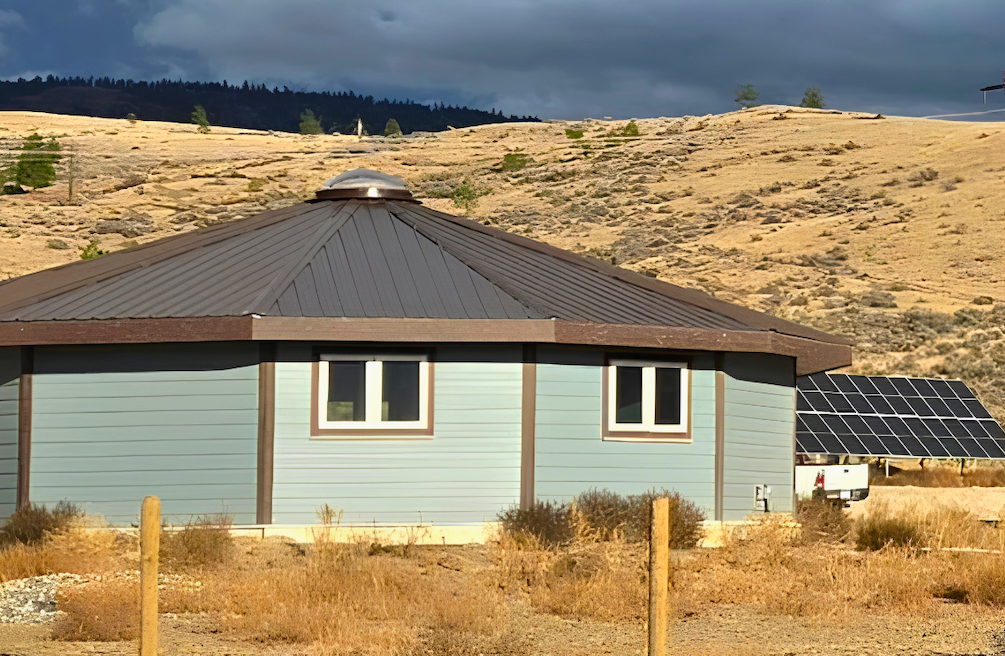
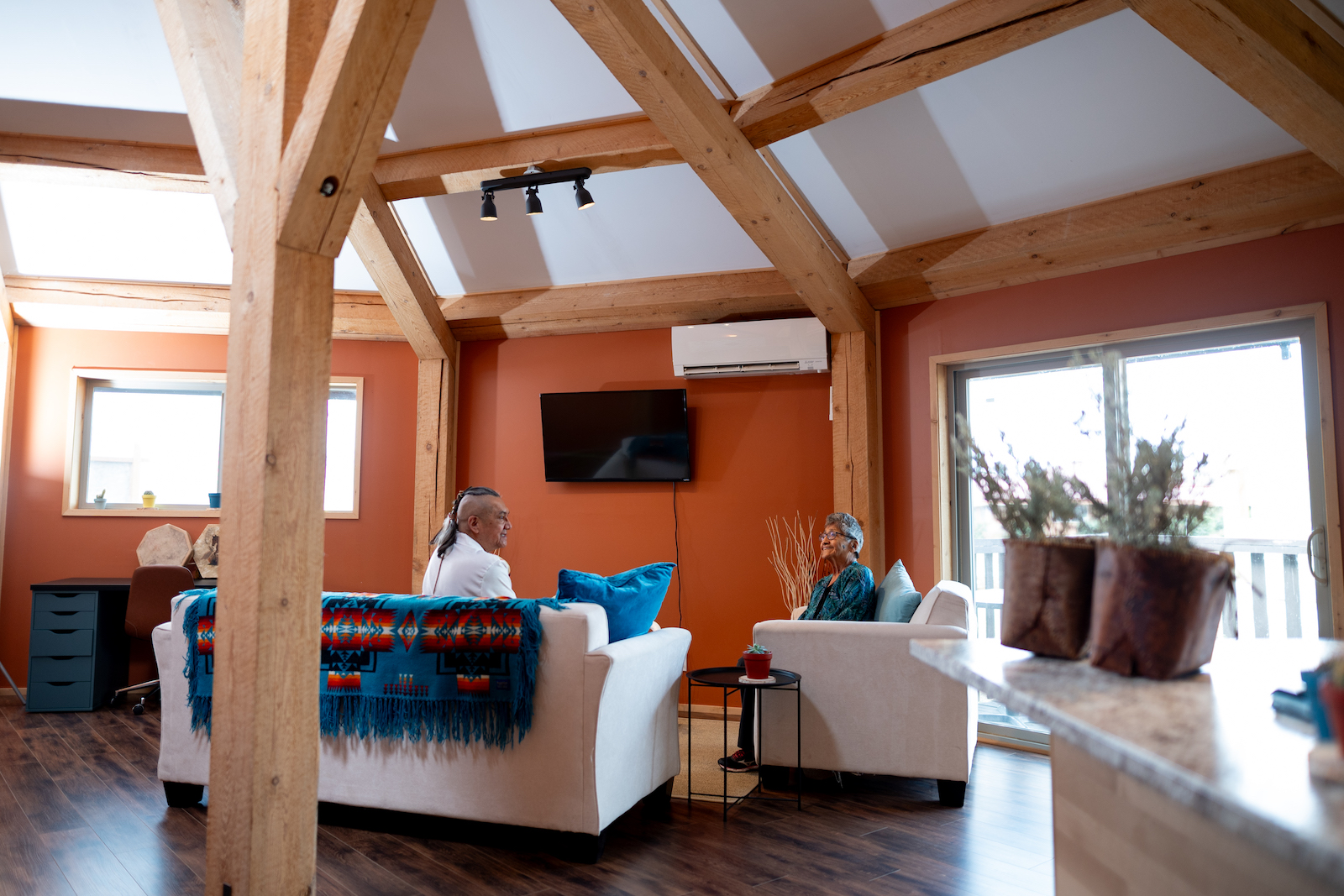
Dodeca-Homes are 12-sided structure, a decision based on Skeetchestn cultural tradition, says Britton. “The house is very warm and the energy in it is really amazing. I love the idea that it’s based on a traditional house, which just kind of brings back that more open family living. Although there’s a separation of the private bedrooms, there’s also this amazing open space for family together.”
Circles are also common within Indigenous cultures and are frequently used as buildings, according to Anderson.
“All the Interior tribes of B.C. lived in round buildings. All the people in the prairie lived in teepees, which is again, a round building. The people up north live in igloos, which again, is a round building. The people in the Navajo lived in Hogans, which again, is a round building. So there’s probably more Aboriginal tribes that have lived in round structures than square structures,” says Anderson. “In some ways, it’s going back to roots.”
The shape also makes the buildings energy-efficient. Since there’s approximately 25 per cent less wall to floor area than a square structure, they’re easier to heat and cool. Even when the mercury reaches 46 C, Dodeca homes stay a comfortable 22 C inside, says Anderson.
They’re also net-zero ready, meaning they can be hooked up to solar arrays easily, a bonus for rural builds that may not be connected to an electrical grid.
An eye to franchising
As Dodeca-Homes settled into its partnership with Kanaka Bar Indian Band, business remains “a slow burn,” according to Britton. The company has advertised to every band across Canada; however, they are not yet breaking even. If they do, any proceeds will go to Skeetchestn Indian Band.
For now, the work isn’t enough to sustain Britton or Anderson full-time. They say selling 20 units per year would keep them both busy. Down the road, the hope is to franchise the concept to other First Nations.
“We provide the intellectual property, the knowledge, the guidance and here, you guys put the kit together and pay us a royalty,” he says. “That would be the ideal scenario.”
The ultimate goal is at least 100 units per year. Anderson says there’s more than enough resources from Skeetchestn territory to accomplish that mark with responsibly harvested lumber.
In the meantime, he’s eyeing retirement, and possibly a move into a Dodeca-Home himself in the not-so-far future. The powwow arbour that started this journey is still standing. And Anderson is confident that similarly designed structures could help so many Indigenous communities across the country.
This article runs in a section of The Tyee called ‘What Works: The Business of a Healthy Bioregion,’ where you’ll find profiles of people creating the low-carbon, regenerative economy we need from Alaska to central California. Find out more about this project and its funders, Magic Canoe and the Salmon Nation Trust. ![[Tyee]](/design-article.thetyee.ca/ui/img/yellowblob.png)
Read more: Indigenous, Housing








Tyee Commenting Guidelines
Please note that email notifications for replies are not currently working due to a software issue which may be resolved in a future update.
Comments that violate guidelines risk being deleted, and violations may result in a temporary or permanent user ban. Maintain the spirit of good conversation to stay in the discussion and be patient with moderators. Comments are reviewed regularly but not in real time.
Do:
Do not: