

 SHARE:
“If a person has a favourite large, old tree, how much confidence should they have that it will still be standing for years to come?”
I asked this of Sara Barron, an assistant professor specializing in urban forestry at the University of British Columbia, because Vancouver is rapidly changing, yet remains the kind of place where a lot of people have a favourite tree or tree-lined street or grove.
Responding to my question, her voice was firm.
“I’m going to be frank,” she said. “Maybe not a lot of confidence.”
This is the story of one much-loved tree in Vancouver — important to me and, it turns out, a lot of other people. It’s a story about how we lose big trees, not only here but around the world, and what’s lost when we do. It’s a story about how trees can be stories.
It begins at the ending. The pandemic was finally over, and a friend and I realized that we hadn’t seen our favourite tree for a long time. We had the feeling, I think, that seeing the tree would stitch time back together. Big, old trees offer a sense of continuity. They’ve been around for a long time; they’ll be around for a long while yet.
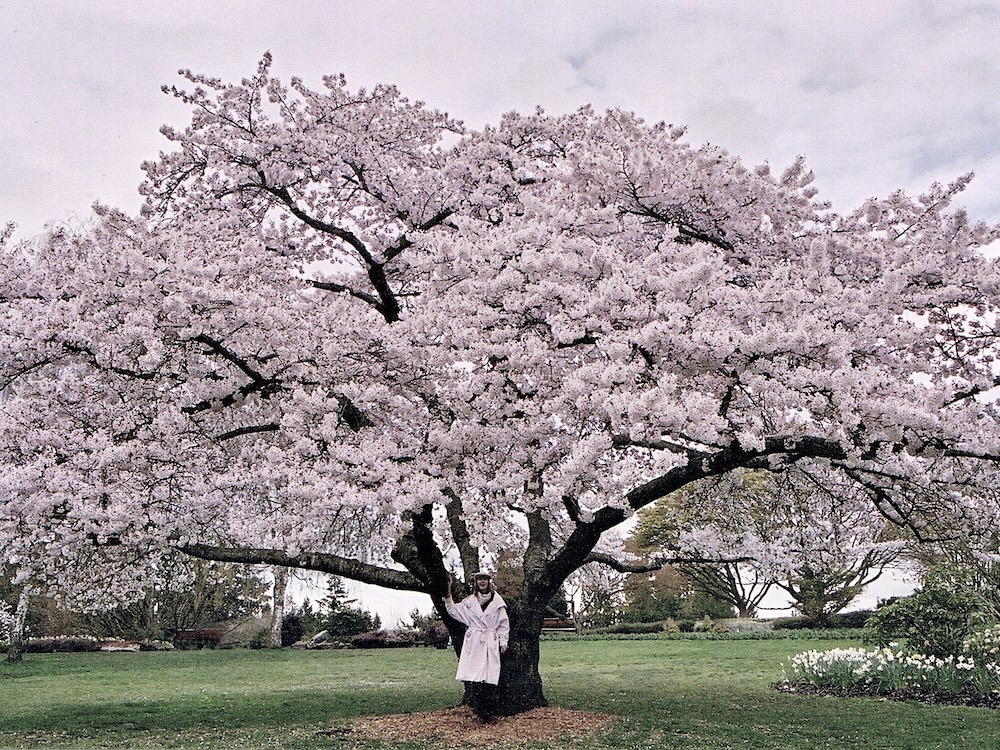
The tree we went to visit was a cherry that stood alone near the top of the southwest-facing slope overlooking Queen Elizabeth Park’s 33rd Avenue entrance. In spring, it had so many palest-pink blossoms that it resembled a mist just lifting from a meadow at sunrise. The tree’s admirers were nearly as numerous, picnicking or pondering the fleeting nature of life in the season’s brief petal fall. “A tree so attractive in bloom you have to wait in line to take its picture,” wrote David Tracey in his Vancouver Tree Book. At any time of year, though, the cherry’s fairy-tale canopy drew people in.
Entering the clearing, we saw a stump.
“It’s gone,” my friend said, stunned.
“No, it’s a little farther down,” I replied, sure she was wrong. I took a few more strides, then looked around, confused. Where was the tree? My eyes found the stump again.
“It’s gone,” my friend repeated.
I approached what remained of the once-resplendent cherry. The cylinder of wood was as wide as the span from my breastbone to the fingertips of my right hand. I didn’t think to count the rings and learn the tree’s age — a lapse I would later regret. A week later, even the stump was gone.
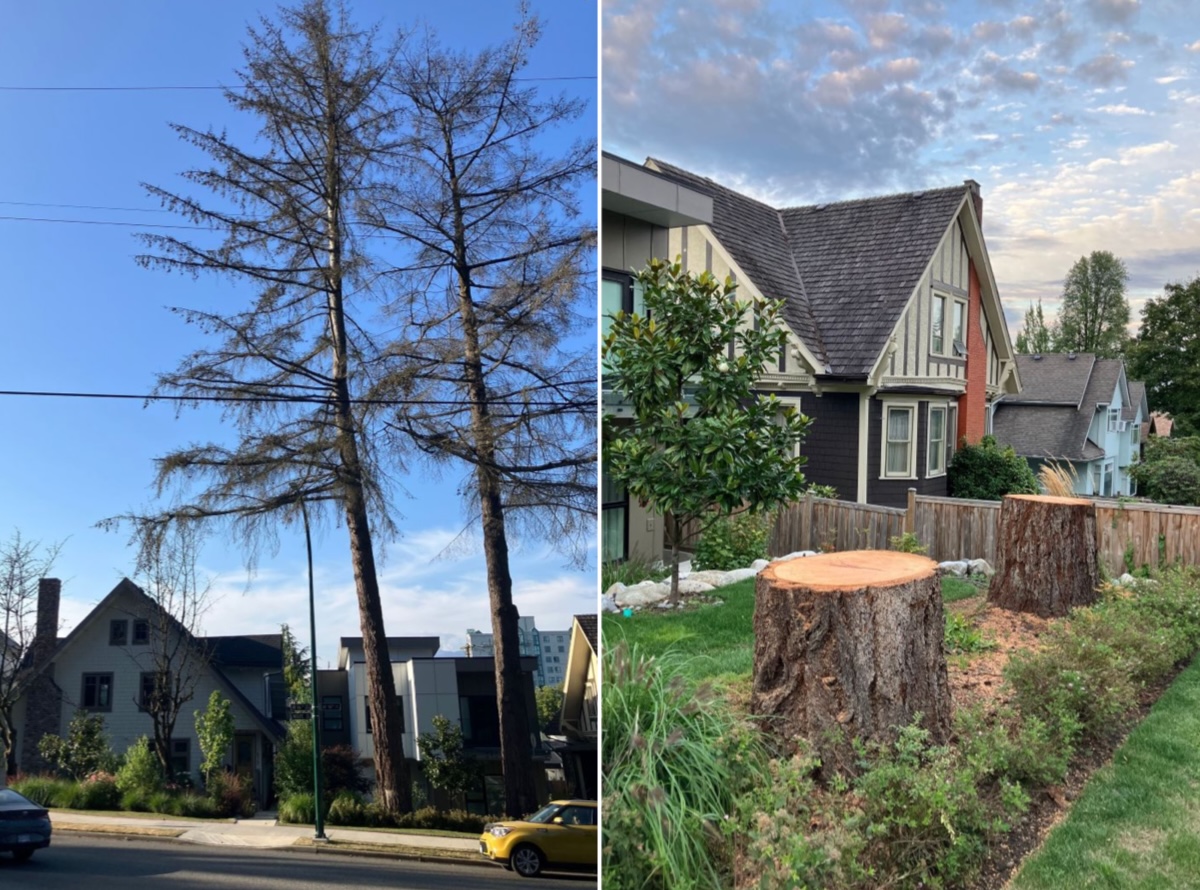
There was nothing to do but accept that the tree was no more. Then I noticed that other large, old trees — trees I’d known for years — seemed to be leaving blank spaces behind. I knew this could be the Baader-Meinhof phenomenon, in which things that have just come to your attention suddenly seem to be everywhere. Yet friends reported the same pattern: huge evergreens turning rusty red, then ashy grey, then being removed; beloved street trees felled by storms or to make way for new development. Was Vancouver losing its giants?
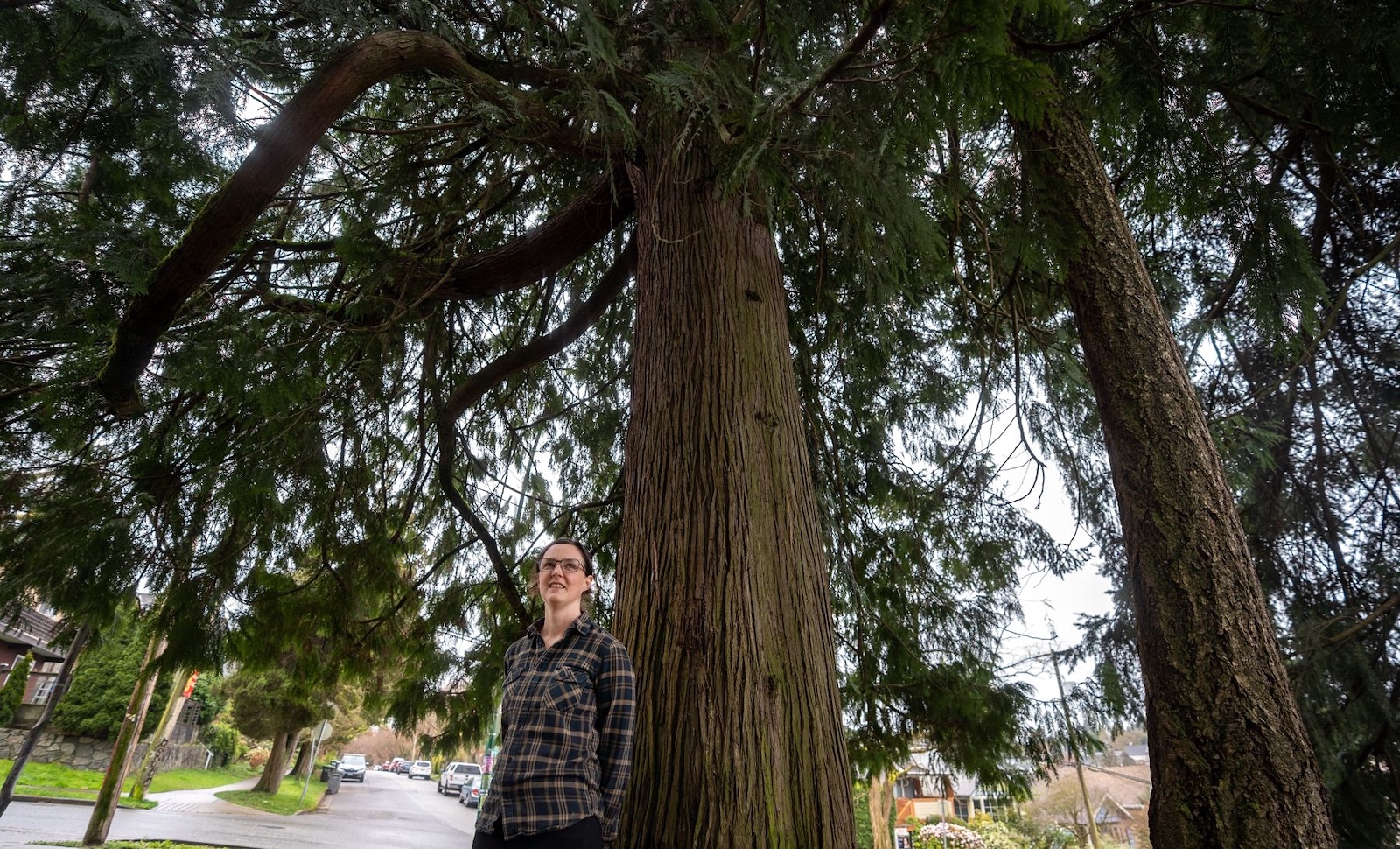
It’s not breaking news, especially in British Columbia, that the world’s old-growth forests are being mowed down. Far fewer people realize that the trend extends beyond woodlands to individual trees, wherever they stand.
“In the vast majority of places, large, old trees are declining quite rapidly,” David Lindenmayer, a forest ecologist with the Australian National University, told me.
The science is surprisingly new. Lindenmayer led the first research paper to review the global state of big, old trees only in 2012. It found they’re being lost as forests fall for timber, industrial agriculture swallows small farms and cities devour the countryside. Environmental scientists now compare the disappearance of large and old trees to the vanishing of elephants, tigers and whales from many parts of the world. At this point, one of the best places to find trees over 1,000 years old is in steep, cold, dry mountains — places where humans struggle to hang around for long.
Two years later, the Australian scientists issued a second paper, focused on the world’s cities and towns. Big trees were losing ground there, as well. Computer modelling their hometown of Canberra, a city that, like Vancouver and Victoria in B.C., is known for its trees, the researchers found that big trees “steadily decline” even in their best-case future scenario. They fall to suburban sprawl and what Lindenmayer calls “urban intensification” (known in Vancouver as “densification”), or never make it into old age to begin with. In Canberra, most trees were being removed after 60 to 100 years to keep people safe from falling trees or branches, even when they could live 500 years or more.
One reasonable response to these findings might be, Who cares? A 100-year-old tree is still old, and in the wilder pockets of a city, like Stanley Park and Pacific Spirit Regional Park in Vancouver, some may still grow to be ancient. The research made another point, though: when it comes to trees, the older, the better.
A large, old tree is a world unto itself. Beneath its canopy, the ground is wetter and cooler — on a hot day, often four to five degrees cooler, enough to protect human health in a heat wave. Animals love big trees. Anyone who has witnessed the rain of nuts and acorns from trees in the fall knows how much food they produce. Birds nest in their branches. Bats doze in one crevice of thick bark while, in the next, a tree frog sings. Squirrels build their leafy dreys in them; racoons wedge in the crooks of limbs to sleep. Big trees are alive with more moths, beetles, spiders, mosses and so on than almost anyone can name. On Vancouver’s streets, aerial gardens of licorice ferns spring from their trunks.
We’re only beginning to appreciate the extraordinary role of old trees in keeping carbon out of the atmosphere. In 2018, James Lutz and Tucker Furniss from Utah State University published blockbuster research showing that the biggest one per cent of trees in a woodland typically store 50 per cent of the carbon. Without these trees, “forests cannot sequester large amounts of aboveground carbon.”
All these beneficial effects are even greater where trees are scattered, as they are in urban areas. Then, the oldest trees might hold remnant species from the original forest that was cleared, or act as life rafts for plants and animals as new development scrapes away habitat. A tree that grows large and old rewilds the city; cutting it down dewilds it.
Young trees can’t replace old trees — not, at least, until they grow old. One of the most remarkable findings about older trees is that the holes that form in their trunks and limbs make them skyscrapers of the animal world. Scientists in Australia found some 300 animal species using tree hollows, without even including insects. Hole-nesting birds — a group that includes local feathered friends like flickers, chickadees and tree swallows — depend on trees that have hollows or wood soft enough for birds to make hollows in. Few trees reach that point until they pass 50 years of age. Douglas fir trees, common in Vancouver, typically don’t form cavities until they’ve lived a century.
Another critical aspect of large, old trees: people like them. Feeling for trees can be extraordinarily strong. After two men illegally cut down a much-loved, much-photographed sycamore in England in 2023, it triggered what one journalist described as “a prolonged nationwide spasm of outrage and what sometimes looked like genuine grief.”
Some of the best places to find great trees are around churchyards, temple grounds, cemeteries — sacred soil. The biologist E.O. Wilson once said, “To see most clearly the manifestations of human instinct, it is useful to start with the rich.” The wealthy have the power and privilege to surround themselves with trees, and they do, as anyone flying over Vancouver’s neighbourhoods can see.
Wherever they’re found, old trees provide a sense of place, offer connections to the past, become markers in our life stories. In one classic study, researchers asked residents in Charleston, South Carolina, to describe the most meaningful losses to their communities after Hurricane Hugo blew through in 1989. Trees, parks and gardens scored highest, with only churches coming anywhere close. Ruined trees, specifically, were mentioned more often than ruined homes. Embedded in these findings is what we might call Joni Mitchell’s Rule: We often don’t know what we’ve got till it’s gone.
I contacted the Vancouver Park Board, the body responsible for the city’s public trees, to ask what happened to my favourite cherry tree in Queen Elizabeth Park. No one seemed to know. They oversee about 1.2 million trees, including 150,000 street trees and 35,000 in manicured parks and golf courses, so maybe the one I liked best didn’t stand out as much as I thought it did. Then I tried my luck with the city’s biggest cherry-tree fans.
Linda Poole wrote back right away. “This was the tree that so inspired me to start the Vancouver Cherry Blossom Festival,” she said. In her circles, it had a name: the Grandpapa Tree.
I met Poole, who wore a cherry-blossom-print blouse, at Queen Elizabeth Park on a clear morning last summer. “Aww,” she said, as we stared down at a few broken-off roots — all that remained of the tree.
Originally from Alberta, Poole had moved to Vancouver decades ago and quickly fallen for the way the city’s cherry blossoms signal spring’s arrival. “It’s just uplifting,” she said.
She and her husband were in Canada’s foreign service and lived for a time in Port-au-Prince, Haiti’s capital city. There, the Japanese chargé d’affaires introduced her to his country’s veneration of sakura, the cherry blossoms, and hanami, or watching the falling petals. She began to think about starting a similar tradition in Vancouver. When she got home, the sight of the Grandpapa Tree prompted her to follow through. The first festival was held in 2006.
For years, the festivities centred on the tree. In 2022, the nucleus shifted to David Lam Park in Yaletown, with its 100 bright young cherries. “I’m wondering,” said Poole, “if that’s when Grandpapa started looking so sad.”
The tree had been aging, she said, but she expected a long, graceful decline. In the fall of 2023, she realized that she hadn’t been to see the Grandpapa in a while. “I came up and, oh my God, he looked so sad and so dry. So I called the park board and I told them, ‘This tree needs help.’” On her next visit, Grandpapa was a stump. Like me, Poole didn’t think to count the stump’s age rings.
“Maybe we should have had a funeral,” she said. “I certainly cried. But I guess we were lucky to have had him. Gosh, he was magnificent.”
As we turned to leave, Poole took a last look at the trees surrounding the space we were in: a mighty cedar of Lebanon, a giant sequoia, a Nootka cypress, other aging cherries. I followed her gaze and saw drooping limbs, withered leaves. “Does somebody keep an eye on these things?” she said. “How are we going to care for them?”
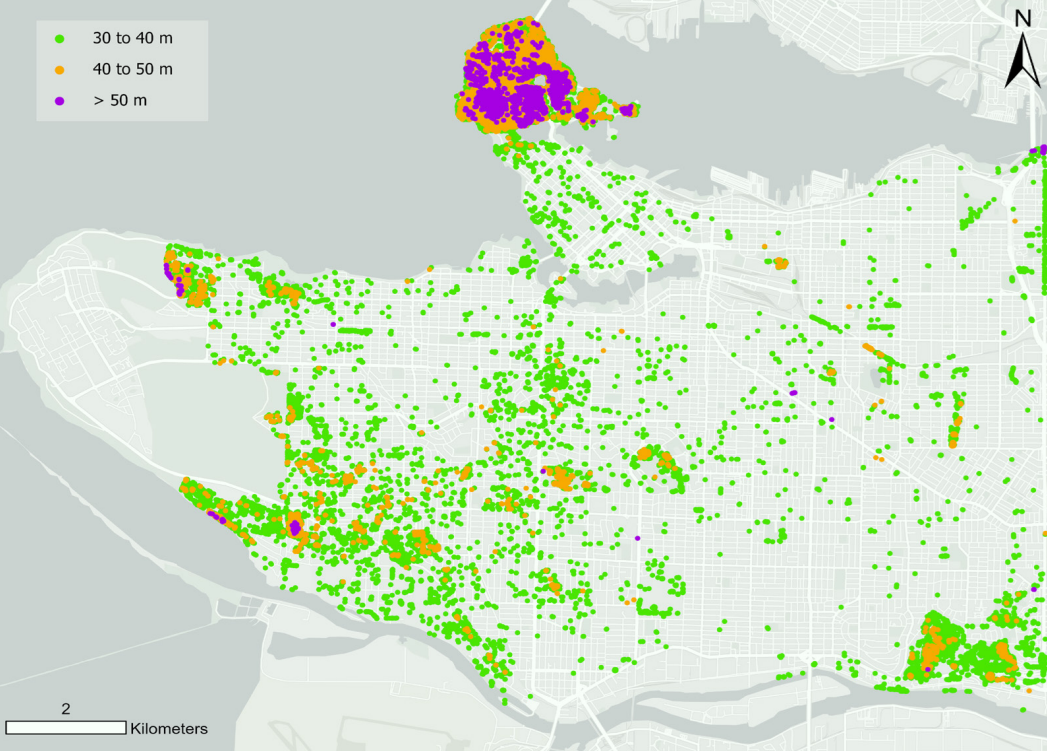
In Metro Vancouver, the tree canopy — the amount of land shaded by trees — has shrunk to 31 per cent as fields and forests make way for homes and industry. The development patterns of the past would predict that the urban forest will keep shrinking as the metropolis grows. Instead, the region’s goal is to increase tree cover to 40 per cent by 2050.
That number has the unlikely ambition of, say, a carbon emissions reduction target in the hands of a world leader. To grow the canopy that much, we’d need to find 9,900 hectares of land for trees in a region that is steadily building over its undeveloped land and replacing houses that have yards with towers and ticky-tacky boxes. For comparison, Stanley Park is 400 hectares in size; Pacific Spirit Regional Park is 860 hectares. Still, Metro Vancouver staff reported in 2024 that it might just be possible to cover 9,900 more hectares with trees by tucking them into every vacant nook visible in aerial surveys. They encouraged municipal workers to put on their boots and “ground-truth” whether the dream could become reality.
In the city of Vancouver itself, the canopy may be growing. The most recent survey, in 2022, found that tree cover had expanded by two per cent since 2018, to a modest 25 per cent. There’s a catch: the canopy surveys tell us little about changes to the size, age or overall fabulousness of the city’s trees. In other words, we can’t see the trees for the forest — and many people who know Vancouver’s urban woods say there are good reasons to believe that the giants are falling in ever-greater numbers.
Development is the most obvious reason. It’s difficult to densify Canada’s most population-dense city without toppling a few trunks. A map showing where Vancouver lost tree cover in the five years leading up to the 2022 canopy survey is a chart of major commercial and residential projects. The hardest-hit areas, some of which lost 70 per cent or more of their urban forest, include Oakridge Park, the Broadway corridor, downtown and some Port of Vancouver lands. “It is often not possible to replace the canopy area lost on a development site,” reads the survey report. Even when trees are replanted after construction is complete, it’s hardly the same. What’s lost are big, old trees.
Another threat is climate change. “It’s change in weather regime, change in drought, change in heat, but it’s also a change in biotic disturbance — insects and pests that can come in with different changes in climate,” says UBC’s Sara Barron.
A clear example is Vancouver’s western red cedars, the species that is both the official provincial tree and “tree of life” to coastal Indigenous Peoples. Cedars can handle drought up to a point, but in soil that is shallow, is low in nutrients or drains easily, the dry periods have become lethal. “What is a marginal soil now didn’t used to be a marginal soil,” said Douglas Justice, associate director of horticulture and collections at the UBC Botanical Garden. Cedars and other trees are prematurely dying in more and more places.
Left alone, trees age and die much like we do. They weaken, their limbs sag, they may no longer meet conventional standards of beauty, they cost more to maintain. Unlike us, they become more dangerous. A falling limb or tree pushed over by a storm — and storms are increasingly severe — can tear down power lines, impale parked cars, smash through walls or kill. According to Joe McLeod, associate director of urban forestry for the City of Vancouver, any tree cut down on public land that isn’t making way for development is almost certainly being removed as a hazard. Cities, meanwhile, face rising pressure from their insurers and lawyers to identify and chop down potentially risky trees.
So, is Vancouver losing its great trees, or not? For the moment, they certainly have little in the way of protection. In 2024, a city council amendment removed a provisional list of trees — as well as streetscapes, parks and landscapes — from the Vancouver Heritage Register. According to the park board, staff are currently drafting a revised Protection of Trees bylaw that will include a “significant tree” designation.
If council approves the bylaw update in 2027, at least some former heritage trees will be declared significant, but which other trees could be included, how, and what protection they will receive remains to be seen. The non-profit group Heritage Vancouver used to follow the fates of remarkable trees in the city but no longer does so.
It isn’t even clear whether the park board knows if the number of trees being cut down overall is increasing. I asked the board for multi-year data on the numbers of trees removed annually by city staff and permits issued for tree removal on private property. (Private land is home to more than a third of Vancouver’s tree cover and is where the most canopy loss is taking place.) The park board declined my request on the grounds it was “too broad in nature.”
In the end, I did some ground-truthing. I made a list of 52 trees that appeared on the most recent Vancouver Heritage Register and Heritage Vancouver lists, plus a roster of “treasured trees” from David Tracey’s 2016 Vancouver Tree Book (it included the Grandpapa Tree). It was an imperfect but substantial sample. Then, jumping on my trusty bicycle, I attempted to visit each tree.
This was, I discovered, one of the most pleasant things you can do in this city, with stops for such wonders as the heavy-limbed red oak that overlooks English Bay from Alexandra Park; the stooped, 101-year-old ‘Ojochin’ cherry at the Japanese Canadian War Memorial in Stanley Park; and a secreted European beech in Point Grey with a trunk like a marble column.
Still, at 18 sites, trees were missing. A third of some of Vancouver’s most remarkable trees. It’s hard to know how many were lost to climate change, risk assessment or simply old age, but in most cases, I saw a smoking gun: new builds or fresh pavement.
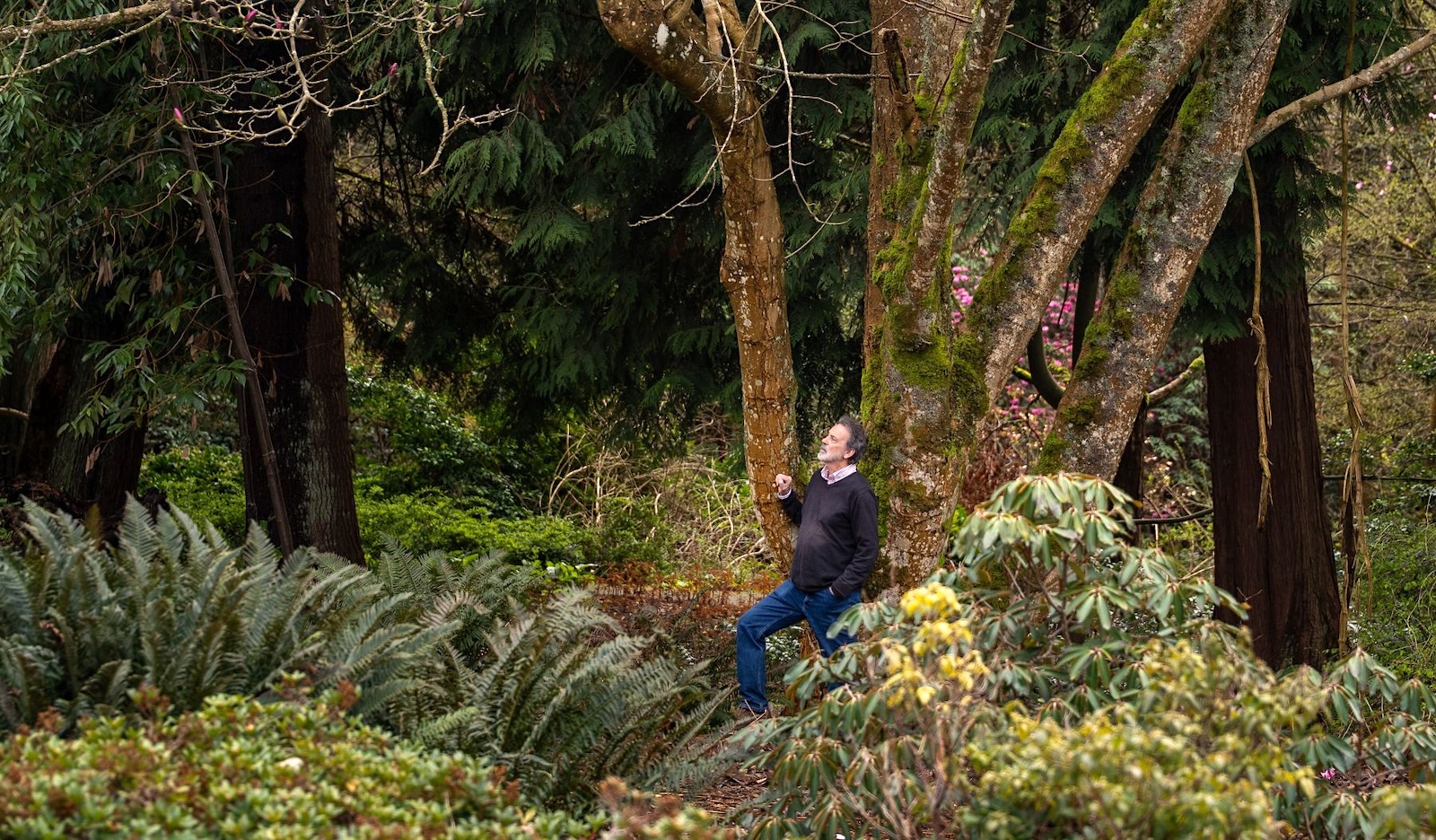
Douglas Justice of the UBC Botanical Garden pays close attention to Vancouver’s trees, and the Grandpapa was one his favourites. “I took it totally for granted,” he said.
It wasn’t the tree itself that he first noticed changing, but rather its surroundings. He gradually realized that his memories of the lush, green hill that the Grandpapa and other cherry trees stood on in Queen E. Park no longer fit with reality. In summer and fall now, the meadows are often straw gold and dusty. “The legacy of cherries in Vancouver is a testament to just how much moisture was retained in the soil because the temperatures were cooler.”
Being inside a park, the trees weren’t threatened by new highrises but still experienced “urban intensification.” As Vancouver’s growing population sought respite in the city’s green spaces, they found the Grandpapa, which became a popular site for picnics, weddings, endless selfies. Drought probably wasn’t enough to kill the tree, Justice said, and neither was the compacting of its soil by so many feet, but the combination might have pushed it over the edge.
“They should have watered those trees, and they should have made a big mulch circle to protect the roots, and that would have saved the tree,” Justice said. “But, you know, they would have had to have done that 12 years ago, 15 years ago.”
As it happens, Alex Downie first noticed signs of decline in the Grandpapa Tree about that long ago. Downie, who was a supervisor in Queen E. Park for two decades, said that trees and people are similar: under stress, or as they get older, they are more likely to catch an illness.
The tree was a favourite of his, and Downie remembers finding oozing cracks in the bark. He and his colleagues took samples from the core wood of the tree and found that some branches were essentially hollow. The Grandpapa had a disease called heart rot.
In 2021, the tree remained striking, its winding limbs looking sparer than in its heyday but still holding aloft an impressive umbrella of blossoms. You could say it was aging beautifully.
“It hung on there for four or five years in decent shape,” said Downie, but then began a more rapid decline. “It got to the point where a whole half of it kind of went dead.”
Downie retired in 2022 but continued to visit the park. The last time he saw the Grandpapa Tree standing, it was just a trunk with two nubs of limbs jutting out of it. Just take it out of its misery, he recalled thinking. “It’s an insult to the dignity of the tree, in my opinion, to prune it like that.”
The next time he passed, the tree was no more. Others who had worked for years at Queen E., like Bill Stephen, a longtime city arborist, were stunned to learn it was gone. “It died?” said Stephen, from his current home on Vancouver Island. “It was very, very special,” he added later. “I thought it was going to live quite a bit longer.”
The final stewards of the tree didn’t have the same attachment. The park board has been under stress itself in recent years, in large part because of Mayor Ken Sim’s push to abolish it, but also due to turnover. I spoke with a handful of people who held positions at Queen E. around the time the tree was removed, but none knew exactly when it happened or who did the job. When I met Joe McLeod of the urban forestry department and Scott Peter, the current city arborist, at the spot where the tree once stood, Peter reported that it had left no paper trail. I asked if they had been familiar with the tree. “To be completely honest, no,” said McLeod.
He speculated, based on the Grandpapa’s size, that once the tree had been felled, it was sawed into rounds and sent to a city yard at Rupert Street and 1st Avenue. From there, it would have gone for industrial chipping.
That was the end of the Grandpapa Tree, but not the ending of the story. For that, I had to find the tree’s beginning.
Queen Elizabeth Park began its colonial-era history as a clearcut quarry, then a reservoir and popular picnic site. By the 1920s it was being eyed as a potential park, and it got its name in 1940, after a visit to Vancouver by King George VI and Queen Elizabeth. It became what historian Mike Steele called a “sculpted park” in the 1950s.
Most people I spoke to surmised that the Grandpapa Tree was planted at around that time, possibly in 1948, when the north and west sides were manicured. The history made sense, but the tree itself did not: it was distinctly different from nearby cherries, larger and more elaborate in its spreading limbs. Knowing the tree’s age would have helped, but it seemed no one had counted its rings.
Then one former longtime park board employee told me that she remembered hearing about some cherry trees planted in Stanley Park and Queen E. in 1937, a fact confirmed in The First 100 Years, Steele’s history of the Vancouver Park Board. There were, at the time, plenty of saplings available: the Uyeda trees.
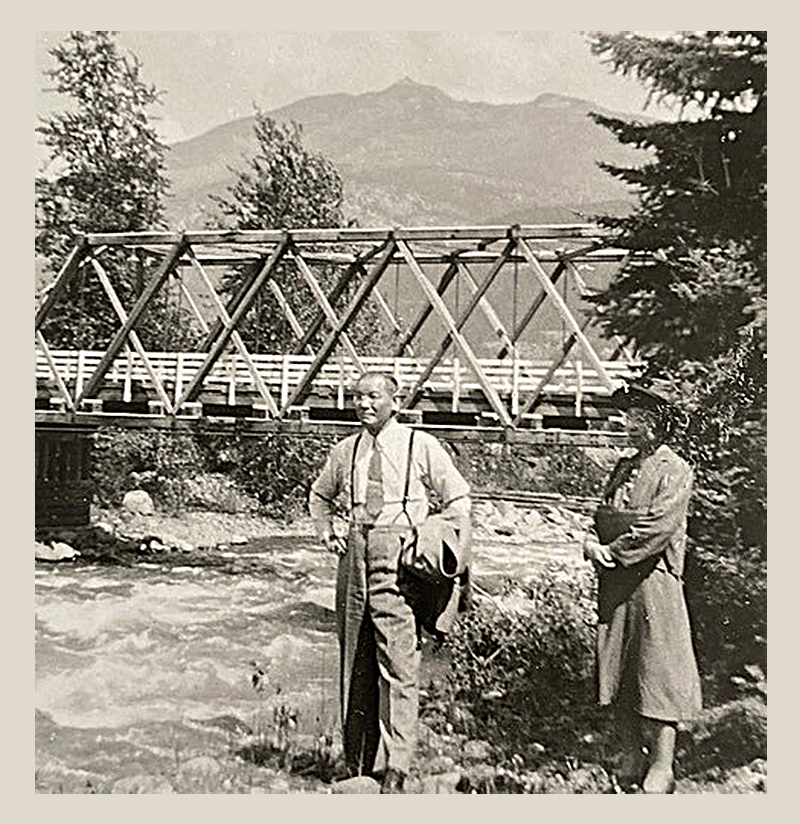
In 1935, Bunjiro and Kimi Uyeda, Japanese immigrants who owned a house in Dunbar and a shop, Yamato Silks, on Granville Street downtown, donated 1,000 cherry trees to the city in anticipation of Vancouver’s golden jubilee in 1936. Because of the Depression, planting was delayed. Some were planted in 1937, but most had to wait until the 1940s.
By then, the park board was calling them “Chinese cherry trees,” because, after Japan attacked Pearl Harbor in 1942, Prime Minister William Lyon MacKenzie King declared anyone of Japanese ancestry persona non grata on the west coast. In the end, the federal government forcibly relocated 22,000 people of Japanese descent, more than half of them born in Canada, to towns and internment camps mainly in the B.C. Interior. The Uyedas and their children — Yutaka, Mariko and Lily — ended up in Kaslo, in the West Kootenay region, where they found a house. Three months after their displacement, the remaining 700 trees they had donated were planted.
The Uyedas’ home still stands on Carnarvon Street, but they never moved back to Vancouver, instead going east to Montreal after the war. As the writer Fiona Tinwei Lam says in “Gift,” a poem about the family,
you would never see Vancouver
blossom with your thousand trees.
Lam began searching for any remaining Uyeda cherry trees in 2023, soon enlisting Douglas Justice and Nina Shoroplova, author of a book about Stanley Park, Legacy of Trees. I read the description of what they went looking for: cherry trees of the ‘Somei-yoshino’ cultivar that, unlike most cherries in the city, had not been grafted. In 2024, Shoroplova found four — possibly five — likely candidates, all in Stanley Park. Justice confirmed they were the right age and type.
Justice, though, had told me that the Grandpapa Tree was also a ‘Somei-yoshino’ cherry. The arborist Bill Stephen had said that one of the tree’s special traits was that it had no grafting scar and instead was most likely grown from a root cutting taken from a parent tree. Before long, Poole, Lam, Shoroplova and I, along with Leslie Uyeda, a Vancouver composer and musician who is the daughter of Yutaka Uyeda and granddaughter of Bunjiro and Kimi, were in an email chain. For a moment the idea seemed impossible: a photo of the tree showed blossoms too pink for a ‘Somei-yoshino.’ Then Justice weighed in. The pink was the camera’s fault, he said. The natural colour of the flowers was nearly white. “The trees on this side of QE park could easily have been Uyeda-donated ‘Somei-yoshino,’” he wrote. If so, the Grandpapa Tree was cut down at nearly 90 years of age.
“I live near Queen Elizabeth Park and have walked with our dog through those cherry trees many times, not realizing that they may be part of Grandma and Grandpa’s legacy,” Leslie Uyeda wrote. Then she asked, “Why was that one tree removed?”
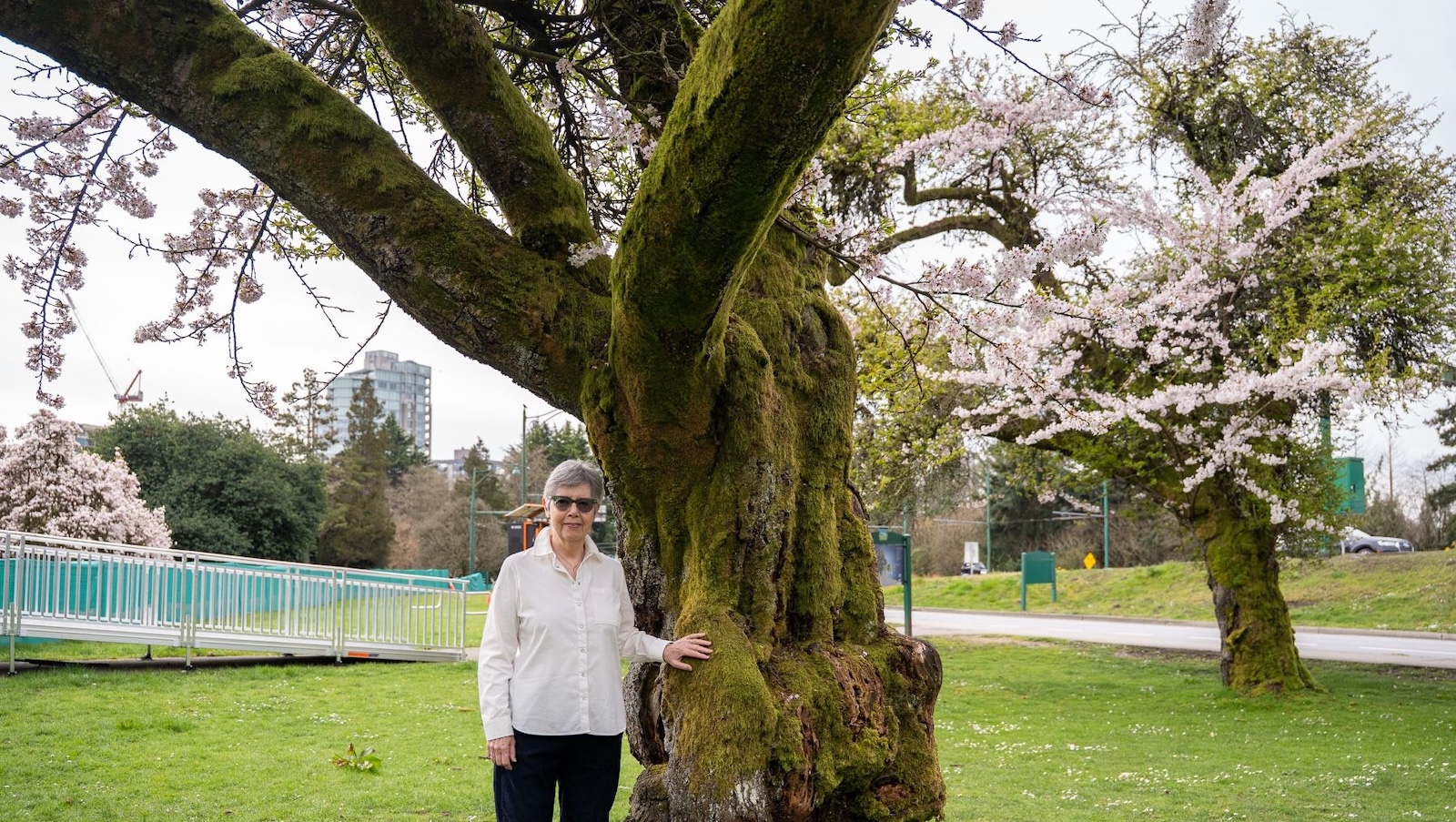
The cause of the Grandpapa’s decline was probably a combination of age, climate change, disease and perhaps the tramping feet of its many fans. The causes of its removal are different, and they explain the loss of many of Vancouver’s great trees: we don’t know which ones are beloved and, even if we did, may not be ready to live alongside them for their entire lifespans.
Some other cities are doing more. In 2013, Melbourne, Australia, launched an online map that allows citizens to look up the type and rough age of any public tree in the city; each tree was assigned an email address so that people could report any problems. Instead, Melburnians wrote letters to the trees themselves. They thanked them for supporting life on Earth, for their beauty, for being the only bright spots on dreary commutes, for acting as “a reminder of what is good and real,” as one letter put it.
Melbourne inspired a smaller art project in Vancouver in 2018, in which signs on 30 trees in Jericho Beach Park invited people to send personal messages. “Do you ever feel trapped, unable to move freely and explore what lies outside the meadow?” wrote one person to a weeping willow. “I often feel trapped myself.”
Vancouver has a comprehensive website featuring all of the city’s park and street trees — more than 185,000 arboreal neighbours. The trees don’t have email addresses, but the site seems to be just a little coding away from being a place where residents could tell officialdom which trees matter most to them, and why.
In Vancouver right now, according to McLeod, the determination of whether a tree is especially important to the public is left to urban forestry department staff: “We’ve been doing this long enough that we know what trees will likely be controversial if they’re removed.” McLeod said this, though, while standing where city staff removed a tree that they apparently did not know had been named, had launched a festival and held a story about Japanese immigrants’ faith in their new home and the betrayal of that faith by their fellow Canadians.
With that kind of knowledge, we could take steps to prolong the lives of those city trees that are most important to its residents. Watering is an obvious choice.
“This is my big controversial statement: We need to prioritize water for trees,” said Justice. “In a time of drought, do you want the trees to die, when they are the only things that are actually keeping the city cool? And the citizens who can’t afford air conditioning — we don’t want to have trees on the street? I think we need to understand how important it is to keep trees alive.”
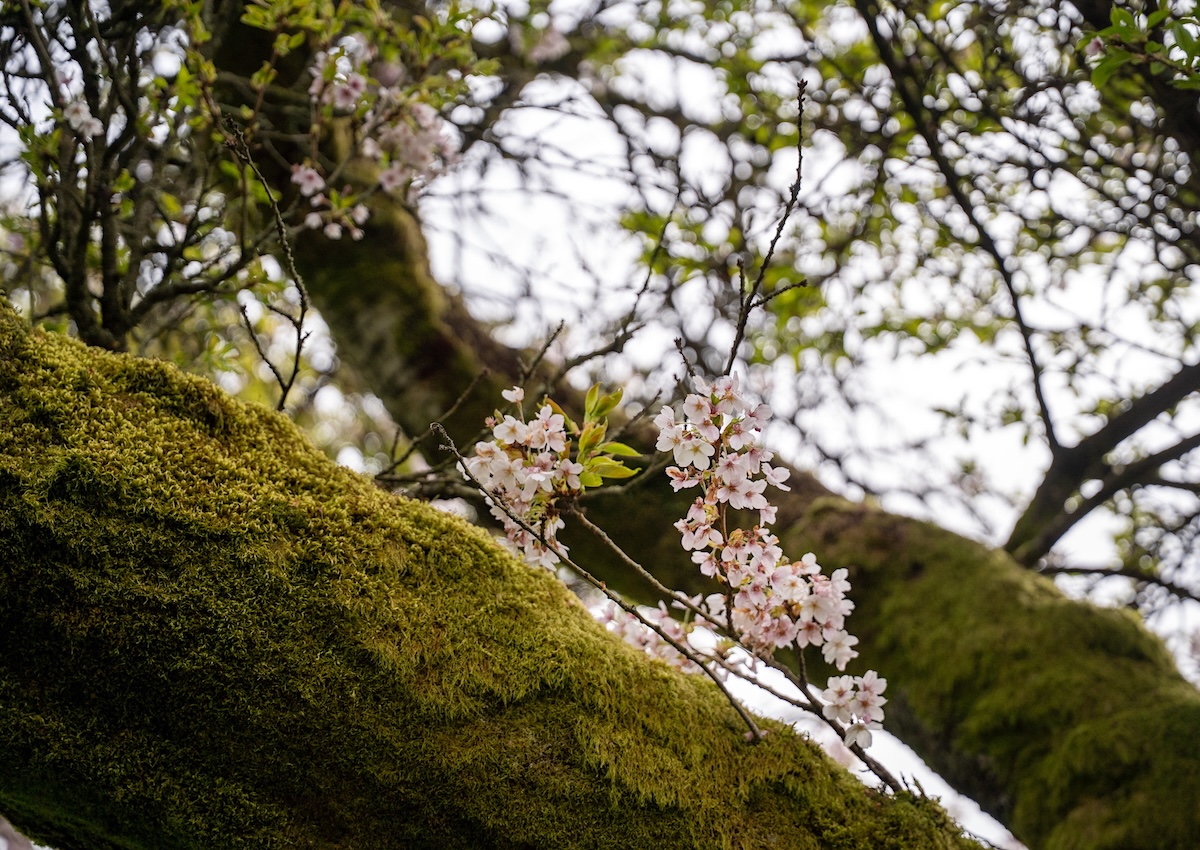
Many challenges facing individual trees can be overcome. After admirers of Japan’s oldest cherry tree, estimated at about 2,000 years of age, nearly loved it to death by trampling its soil in the early 2000s, a Buddhist priest led a project to dig up the hardpack, replace it with fertile soil and fence off the base of the tree. It lives on, and still blooms in spring. Even development doesn’t have to be the end. UBC’s Sara Barron pointed to a large seniors housing project on East 12th Avenue that was built around a big maple tree, rather than clearing it away.
“We could do more to safeguard large, old trees,” said Barron. “The want to protect by the local community often happens when the last tree is standing on the block, and then everyone rallies around that tree and puts up a protest. We see that happen in cities across the world. But what we need to do is put protections in place as much as we can.”
A deeper change is needed, too. Melburnians may send emails to their trees, wrote Australian architects Stanislav Roudavski and Ashley Davis in 2020, but many members of the public don’t like the look of trees as they approach death — the broken-off limbs, litter of bark and twigs on the ground, tufts of leaves ratioed by deadwood. This may be especially true on private land.
Accepting trees in their last stages of life, Roudavski and Davis said, will require “substantial shifts in accepted thinking and practices” and “some form of compromise” with the real risk of harm that aging trees present. Here in B.C., at least, we have experience coexisting with potentially hazardous animals, such as coyotes and bears. Why not trees? As Alex Downie put it, “A no-risk tree doesn’t really exist. That’s called a lamp standard.”
There’s a model for caring for special trees all the way to the end, and it’s found in the traditions of Japanese gardening. Evan Cordes, a gardener with the Portland Japanese Garden in Oregon, said that not every tree there is eased into long old age, but especially prominent, beautiful or beloved trees will be. Limbs may still be removed, but others are propped up with crutches topped by pillows and tied in place with soft jute rope. (Some trees hold themselves up as they age; ancient oaks are known to lower branches to the ground that then bolster their hollowing trunks.) Japan’s 2,000-year-old cherry tree is supported by a small forest of supporting poles and cables. ‘Somei-yoshino’ cherries never live to be truly ancient, but some in Japan are approaching 150 years old.
A key philosophy behind hanging on to old trees, Cordes said, is wabi-sabi, a Zen concept that defies definition other than as an aesthetic that values everything the dominant modern culture does not. It mistrusts novelty, celebrates the long-lasting, embraces aging, admires decline and weathering. An old and failing tree is archetypal wabi-sabi. “There’s a story in that look, like a face with lots of furrows in it,” said Cordes. Trees still do get removed at the Portland garden, he added. When that happens, they do a simple ritual, offering sake and salt. In other words, yes, a funeral.
Perhaps it’s never too late for ceremony. Linda Poole recently approached the park board about planting a new ‘Somei-yoshino’ at the site where the old one stood. That idea is under review, but meanwhile, three new cherries — ‘Shirotae’ variety — were added to the hillside. Poole wishes them a long, long life.
In a companion piece, author J.B. MacKinnon offers a tour of his 12 favourite stately trees in Vancouver, complete with digital map. And we invite Tyee readers to add to the list with their own. ![[Tyee]](/design-article.thetyee.ca/ui/img/yellowblob.png)
Read more: Environment


Tyee Commenting Guidelines
Please note that email notifications for replies are not currently working due to a software issue which may be resolved in a future update.
Comments that violate guidelines risk being deleted, and violations may result in a temporary or permanent user ban. Maintain the spirit of good conversation to stay in the discussion and be patient with moderators. Comments are reviewed regularly but not in real time.
Do:
Do not: