


 SHARE:

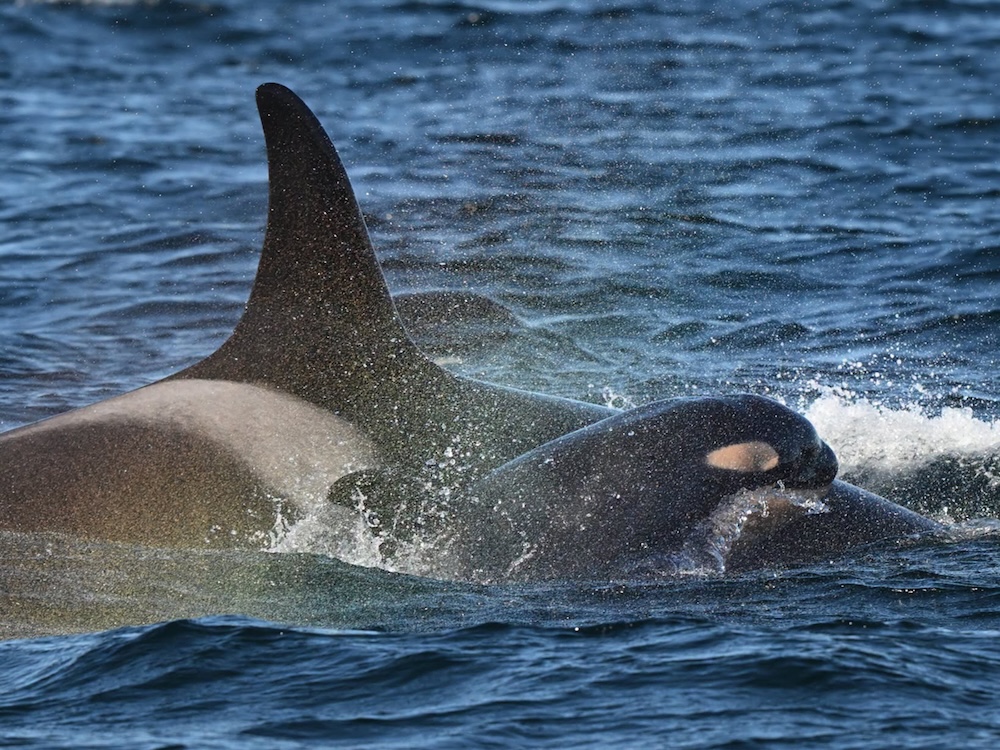
The southern resident orca whale population is so endangered that the birth of every new calf, shiny black and peachy orange, makes headlines.
Last week, researchers with the U.S.-based Center for Whale Research spotted a newborn male swimming beside its mother, Tahlequah, who stole hearts all over the world in 2018 when she carried a dead female calf for 17 days in a “tour of grief” before letting her go.
Life is hard for the 77 southern residents, who are poisoned with toxic chemicals, hampered by underwater noise from ships, and face a severe shortage of chinook salmon, their main food.
New industrial projects planned or under way in southwest B.C. will make survival even more of a challenge for the whales. A federal assessment panel determined that the Roberts Bank Terminal 2 port expansion project will have “significant” impacts on the struggling population. Shipping traffic from new and expanded LNG projects in Squamish and Delta will add to underwater noise, reducing the amount of undisturbed time the whales can feed. And the recently announced Pacific Link pipeline and terminal at Roberts Bank will send oil supertankers into whale habitat in the Salish Sea for the first time, increasing the risk of ship strikes and compounding existing disturbances and pollution.
“The extinction of the southern resident orcas could now have a name and a price tag: ‘Pacific Link’ for $44 billion of mostly taxpayer money,” Wilderness Committee’s conservation and policy campaigner Lucero Gonzalez said in a statement.
Canada heads to COP 17
This decade was meant to be a turning point for what UN Secretary General António Guterres calls humanity’s “war on nature.”
Four years ago in Montreal, Canada and 195 other countries signed an historic agreement aimed at preventing species extinctions and biodiversity loss. This week in Yerevan, the capital of Armenia, the world’s environment ministers are meeting at COP 17 — widely called the nature COP — to assess progress. COP refers to the Conference of Parties to the Convention on Biological Diversity, an international treaty signed at the 1992 Rio Earth Summit.
Julie Dabrusin, Canada’s minister of environment, climate change and nature, told The Tyee that she’s excited to attend the Armenia summit after Canada hosted COP 15 in 2022.
“Now we get to get together with countries from all over the world and take stock on progress, and push for more,” Dabrusin said, adding that the meeting gives Canada a chance to highlight the work it’s doing at home.
She pointed to Canada’s Strategy to Protect Nature and commitment to protect 30 per cent of its lands and waters by 2030, a pledge also made by other countries that signed the Montreal agreement. The commitment comes as the World Economic Forum lists biodiversity loss and ecosystem collapse as the second-biggest risk the world faces in the next 10 years.
Newly announced Canadian protections include the Our Land for the Future project in the Northwest Territories, Dabrusin said.
“That's two per cent of Canada, which is an unbelievably large size, that is being protected in partnership with 23 Indigenous nations, and that's just one of the projects that, if we look back over the past short while, we've managed to enter into,” she said.
Earlier this month, in Toronto, the federal and Ontario governments also announced the conservation of taiga forests and peatlands, with a $13-million investment from Ottawa.
“That’s 81,000 hectares of boreal forest,” Dabrusin pointed out. “So domestically, there's a lot that's happening.”
It’s unclear if B.C. will embrace Canada’s conservation targets following the election of the BC Conservatives on Saturday.
Former BC Conservative leader John Rustad said his party didn’t support the creation of new protected areas, calling them “nonsense.” The Conservative’s 2026 election platform didn’t mention the 2030 conservation targets. Plans for five new Indigenous-led protected areas, and to expand a sixth, are well-advanced in B.C., but they were not completed before former premier David Eby called the wildly unpopular snap election that saw his party suffer a crushing defeat.
Dabrusin said that sometimes people lose sight of the global importance of Canada’s work.
“We’re the second largest country in the world, with the longest coastline in the world. That’s something that we get to own and be proud of, and to continue working on these protections.”
Despite some progress, however, the global agreement, known as the Kunming-Montreal Global Biodiversity Framework, is widely considered to be at risk.
Among other key commitments, Canada and other countries said they would stop the human-induced extinctions of at-risk species, restore degraded ecosystems, and eliminate or reform subsidies and other incentives that harm biodiversity — all by 2030.
Yet, halfway to the deadline, not one of 23 targets has been met.
As COP 17 meetings got under way in Armenia, Guterres, the head of the United Nations, warned that more than a million species around the globe are at risk of extinction, “edging us closer to an uninhabitable world.”
“Every day, humankind saws another branch off the tree of life,” Guterres said, adding, “It doesn’t have to be this way.”
He called the Yerevan summit “our moment of accountability,” noting the world is halfway to its 2030 commitments.
“It’s time to ask ourselves: Are we doing enough?” he asked.
Dabrusin said Canada will be advocating nature financing — one of the three pillars of its nature strategy — at the Yerevan summit. Nature financing, a key part of the Montreal agreement, recognizes that protecting ecosystems and biodiversity will require more money than governments alone can provide. The aim is to encourage more private and philanthropic commitments to protect nature, Dabrusin said, adding, “We’ll be working on that while we’re there.”
She said Canada’s work with Indigenous partners “on protecting lands and waters and ice” will also be highlighted at summit events.
“Having hosted COP 15, I think Canada is well-placed to have an important role on the global review,” she said.
Canada values scientists’ opinions, Dabrusin says
But scientists, scholars and environmental groups say Canada has fallen short — and has even moved backwards — on other nature commitments.
The Mark Carney Liberal government cut funding for the Committee on the Status of Endangered Wildlife in Canada. The committee is now struggling to do its job.
The government also recently committed billions of dollars to industrial projects that will harm nature, including B.C.’s North Coast Transmission Line and the Roberts Bank port expansion.
Last week, 56 scientific experts on the environment and biodiversity signed an open letter to the Carney government saying the omnibus Bill C-39, the Building Canada Strong Act, which aims to speed up project assessments, risks “costly and potentially irreversible harm” to nature.
The bill, which the government aims to pass by the end of the year, permits the federal cabinet to exempt projects it designates to be in the “national interest” from laws that protect biodiversity, including the Species at Risk Act, the Fisheries Act and the Impact Assessment Act.
The scientists and scholars, members of the Royal Society of Canada, said that while they support streamlining project assessments, strong environmental protections must be maintained. They’re calling for amendments before the bill becomes law.
Among other requests, they’re asking the government to remove a clause allowing work on projects to begin prior to an environmental assessment or permits, saying that would side-step environmental protections that were put in place to avoid irreparable harm to species, ecosystems, natural resources and human wellbeing and health.
They also said a proposed Fisheries Act amendment allowing companies to pay a fee for harming fish and fish habitat would be “a dramatic weakening” of current protections, while environmental safeguards would be further weakened by a clause allowing project conditions to be removed if they are deemed “too costly.”
Dabrusin told The Tyee she values the opinions of scientists and others. She noted that a proposed change to the Species at Risk Act, which would have by-passed the “jeopardy” clause — prohibiting projects or actions that would harm species and their critical habitats if it would jeopardize their survival — wasn’t made following feedback from a public consultation.
Bill C-39 is now before a committee, where people “get to put forward how it could be improved,” she said.
“That’s how the process works, and I believe it’s very important that people do share their opinions, so that we can make sure we get it right. Our intention is to get it right and build well.”
The letter from royal society members follows an open letter to Carney and Dabrusin in early October from 32 environmental organizations across Canada, who said Ottawa is “weakening and dismantling” the legal protections and institutional capacity essential for meeting its global biodiversity commitments.
The organizations said they are concerned that Canada has “lost credibility.”
“At a time when biodiversity is declining at an unprecedented rate in human history, now isn’t the time to override environmental protections for short-term economic gain,” Diane Girard, a spokesperson for Seniors for Climate Action! said in a statement.
The Professional Institute of the Public Service of Canada, Evidence for Democracy and three environmental groups also recently issued a joint media statement saying Bill C-39, coupled with federal cuts to scientific capacity at Fisheries and Oceans Canada and the federal environment ministry, will weaken protections for species at risk.
“These are the scientists, biologists and other professionals who assess threats, identify critical habitat, monitor populations and develop recovery strategies,” the groups said in a statement.
“Their work gives the government the evidence they need to understand when a project could cause irreversible harm.” 
Read more: Environment











Tyee Commenting Guidelines
Please note that email notifications for replies are not currently working due to a software issue which may be resolved in a future update.
Comments that violate guidelines risk being deleted, and violations may result in a temporary or permanent user ban. Maintain the spirit of good conversation to stay in the discussion and be patient with moderators. Comments are reviewed regularly but not in real time.
Do:
Do not: