
 SHARE:
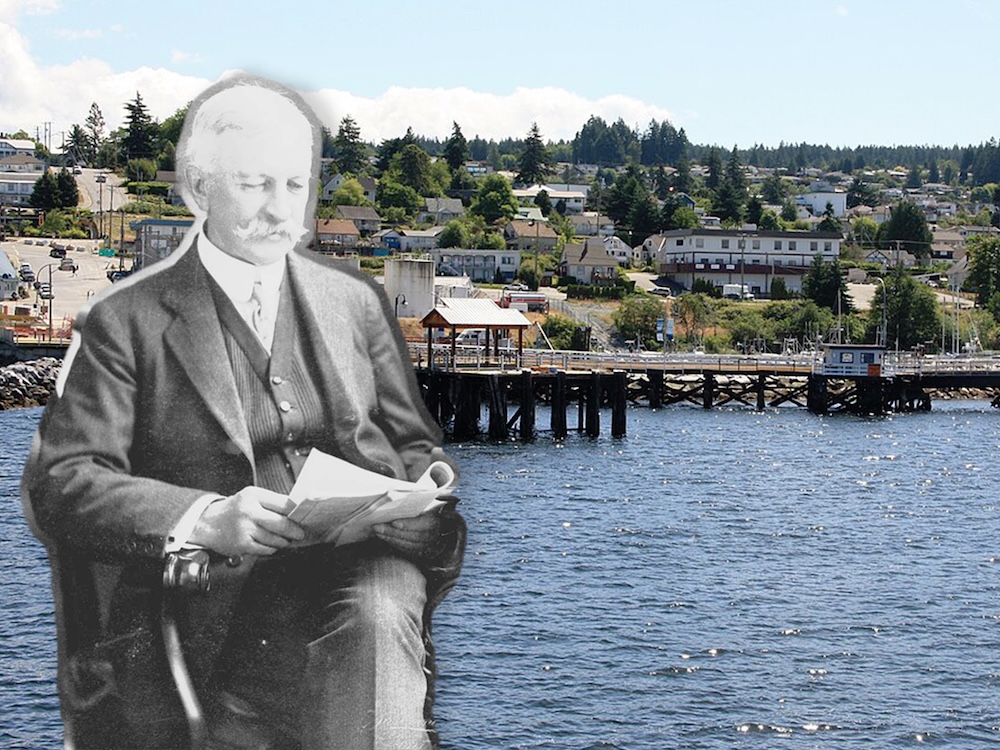
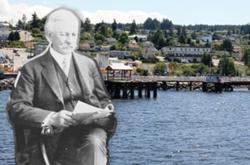
Seven people related to Israel Wood Powell, B.C.’s first superintendent of Indian affairs, have written to Powell River city council in support of the city’s possible name change.
Powell was an early architect of the residential school system. He was critical of potlatches and instrumental in the creation of the legislation that banned them. He also supported the illegal 1878 sale of Lot 450 to land speculator and politician R.P. Rithet. Lot 450 encompassed tiskʷat, a significant and inhabited Tla’amin Nation village site.
In 2021, in light of Powell’s legacy, the Tla’amin Nation asked the city to consider changing its name. No new name has yet been proposed.
The letter describes its seven signatories as some of Powell’s closest living relatives. Powell no longer has any living direct descendants. “We are the grandchildren, and great-grandchildren of Helen Marjorie (Powell) Fisher. Helen Marjorie Fisher was the granddaughter of Walker Powell, who was the brother of Israel Wood Powell,” the letter reads.
“We understand that Tla’amin Nation has requested the town of Powell River change its name, out of respect for the harms done to their people by Israel Powell’s policies.
“We are supportive of changing the name of Powell River.”
In 2021, after the name change request was made, the city and the nation established a joint working group to help guide and inform the name change conversation. The joint working group came up with a list of 11 recommendations for council on how to move the process forward. The 10th recommendation involves identifying options for a new name for the city, based on community engagement and the desire to choose a name that reflects its shared history.
But the process soon hit a hurdle as a group referring to itself as the Concerned Citizens of Powell River began to advocate against the name change. Things got further heated as the group invited Frances Widdowson to town to discuss the name change. Widdowson is a contributor to the book Grave Error: How the Media Misled Us, a collection of essays the Union of British Columbia Indian Chiefs has denounced, as the book claims “genocide did not occur at residential schools.”
Based on testimony from thousands of survivors and witnesses, as well as millions of government and church records, the Truth and Reconciliation Commission of Canada definitively established that through residential schools, Canada had engaged in “a systematic, government-sponsored attempt to destroy Aboriginal cultures and languages and to assimilate Aboriginal peoples so that they no longer existed as distinct peoples.” In other words: “cultural genocide.” Thousands of children died at residential schools. Most were not sent to their home communities to be buried.
Widdowson is often in the news for protesting on campuses, for example in front of the University of British Columbia’s Indian Residential School History and Dialogue Centre, and during a University of Victoria Orange Shirt Day event. Widdowson has been arrested several times over the course of these protests.
Powell River’s current city council, elected in 2022, has not made much progress on the joint working group recommendations. At a recent all-candidates meeting in Powell River, incumbent Coun. Cindy Elliott said the city has, so far, implemented two of the 11 recommendations.
In a post to Facebook about the letter, the Tla’amin Nation wrote: “Reading this letter ahead of Truth and Reconciliation Day is emotional and uplifting.
“We raise our hands in thanks to the family for stepping forward to share their message of reflection and support.”
Relatives speak out
Elise Durante, the great-granddaughter of Helen Marjorie Fisher, spoke to The Tyee about why her family had decided to send the letter to council.
Durante told The Tyee that she and her mother first sent separate letters in support of the name change in 2022.
“At that point, and this is from afar because I live on the island, it seemed like things were going well, there was a process underway, and there were conversations,” Durante said.
In the last year or so, Durante said, she’d noticed some tension.
“Mostly, we wanted to share as a family that’s tied to this name, that we’re in support of you all having this open conversation,” Durante said. “I think when someone says this name is causing harm, it’s really important to understand why.”
Durante added that she’d recently been made aware that people in Powell River had been advancing the idea that the city was named not after Israel Wood Powell, but after a cartographer who shared the same last name.
A Geographic Board of Canada document from 1919 records Powell Lake, and Powell River, as having been named after Israel Wood Powell in 1880. The city has long understood and celebrated the connection of its origins with Powell. In 1966, B.C. honoured his contributions to Confederation with a plaque erected in Powell River.
Part of sending the recent letter, Durante said, was to “dispel that myth.”
Durante, who grew up in the United States, said she was raised knowing she was related to Israel Wood Powell, including knowing that he was a prominent politician and the city of Powell River was named after him.
She added that she’d learned only within the last 10 years that he’d been superintendent of Indian affairs.
“I remember the emotional, physiological response,” she said, adding that she felt a sense of responsibility.
Durante, who is a registered social worker and has a small private practice as a therapist, meets with clients whose therapy is covered by the First Nations Health Authority.
“I think it's part of what informed me, and also made me feel like I needed to do something,” she said.
Durante said that as an outsider she waited to see if there was a desire in Powell River to change the city’s name, given Powell’s legacy.
Durante approached the nation this year, when it seemed as if the city had reached an impasse over the name change, to ask what would be helpful for her to contribute. She asked for permission to wade into the conversation and for guidance. She received feedback that the nation thought it might be helpful to ask other family members related to Powell if they would also consider signing a similar letter.
A recent post to Facebook made by the same researcher who believes Powell River was named after a cartographer alleges that it was the Tla’amin Nation who approached Powell’s relatives to make this ask.
After checking her email records, Durante said she understood how that miscommunication could have occurred. But she told The Tyee that characterization was inaccurate.
She also told The Tyee that, in addition to the seven signatories, many other family members who wished to remain private supported the letter.
Durante said the family had not written a similar letter to, say, the City of Vancouver, about Powell Street, because First Nations in and around Vancouver had not made a request for that name to be changed.
Council candidates’ positions
The Tyee wrote to the four mayoral candidates and 21 city council candidates currently running for office in Powell River. Seven out of 25 responded. The Tyee asked if the recent letter from Israel Wood Powell’s relatives had affected their position on the city’s possible name change.
George Doubt, a city councillor now running for mayor, told The Tyee that in his opinion, the letter was “a significant piece of information in deciding how we proceed.”
“The letter gives us insight on how a change of name might affect those personally involved,” Doubt said.
Rob Southcott, also a city councillor now running for mayor, described the letter as “a vessel of warmth, offered without prejudice in generosity of spirit.” Southcott said the letter’s spirit would “carry our community back to who we truly are.”
“I anticipate a richly rewarding process as we take up this question again,” Southcott added.
Jordie Yow, running for council, said the letter hadn’t changed his position but had added an extra talking point. Yow, running as a progressive, said he believes the city should “move ahead with the name change” and embrace the “huge opportunity for our community to pick a new name that best suits everyone who lives here.”
Council candidate Darryl Jackson said: “I appreciate Israel Powell’s relatives acknowledging this painful part of our history and publicly supporting Tla’amin Nation’s request.” Jackson added that the discussion around the name change deserved careful consideration. But he said the next council needed to focus on more immediate priorities for the time being, including public safety, essential infrastructure and rebuilding the local economy following the closure of the local pulp and paper mill.
Diana Collicutt, running for council, said she respected the viewpoints of Powell’s family. “In order to make an informed decision, I would research discussions that staff have had with all parties to this process,” she said.
Council candidate Henrietta Johnson told The Tyee that building a strong partnership with the Tla’amin Nation needed to be a priority for the city. “At the same time, we must recognize the deep connection thousands of people have to the community and identity of Powell River,” she said.
Earl Almeida, an incumbent running for a second term, said the letter might strengthen the conversation about the name change. “I've often wondered why a community was named after someone who never stepped foot in the community or did anything to build the town,” Almeida said. “The letter indicates the family itself holds no connection to the town being named after a family member either.” ![[Tyee]](/design-article.thetyee.ca/ui/img/yellowblob.png)
Read more: Indigenous, Rights + Justice, Municipal Elections 2026, Municipal Politics







Tyee Commenting Guidelines
Please note that email notifications for replies are not currently working due to a software issue which may be resolved in a future update.
Comments that violate guidelines risk being deleted, and violations may result in a temporary or permanent user ban. Maintain the spirit of good conversation to stay in the discussion and be patient with moderators. Comments are reviewed regularly but not in real time.
Do:
Do not: