


 SHARE:
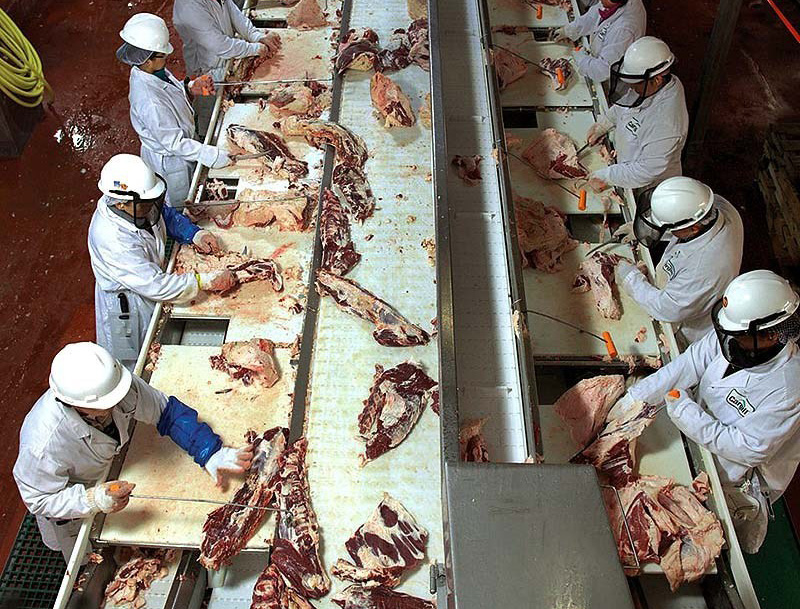
By April 18, 2020, the Cargill meat packing plant in High River, Alberta was still in the weeks’ long grip of the worst COVID-19 outbreak in Canada.
With 659 workers sick — some at death’s door — Cargill officials held a telephone town hall to reassure the mostly immigrant staff that the plant was safe.
The Cargill executives were joined by then Alberta Health Services chief medical officer of health Dr. Deena Hinshaw and UCP labour minister Jason Copping, the government officials who were supposed to be independently regulating the corporation and ensuring the workers’ health.
Another speaker was then agriculture minister Devin Dreeshen, a strident advocate for the cattle and meat-packing industry during the pandemic. The workers’ union was told it could attend but was not allowed to speak.
Hours before the town hall, Hinshaw had sent an email to a government official giving him a heads up. There seemed to have been an infection transmission between two federal meat inspectors in the Cargill plant since protective measures had been instituted.
“This could be an issue on the call today,” Hinshaw wrote. “Not sure how/whether it will come up.”
The infection in the plant never arose and Hinshaw never told the workers about it. To the contrary, she told them that carpooling and household transmission — not conditions in the plant — were responsible for the runaway spread of the virus.
Except Hinshaw had no definitive evidence on which to base that statement.
Dreeshen also had no definitive evidence to support his categorical assurance to workers that the workplace was safe. He went further, warning them not to “get distracted by misleading noise or inflammatory rhetoric” about the plant’s safety.
The following day, April 19, Bui Thi Hiep, a 67-year-old Cargill worker, died in hospital from COVID, only three days after she came home from work feeling sick.
Cargill temporarily closed the plant on April 20, due to what it said was a shortage of workers.
That same morning, Hinshaw sent an email to two health officials in Calgary with an urgent request.
“I need a written summary today of the outbreak plan, including... our current determination (based on recent cases) of where we think transmission is happening, including specifically whether or not you believe there is transmission occurring at the plant, and what extra measures are being put in place.”
The outbreak plan found there had likely been “significant transmission occurring in the plant due to crowded conditions, lack of personal protective equipment, and crowding during lunch and shift changes.”
The revelation that Hinshaw had given unsupported assurances to the workers is contained in a 199-page Parkland Institute report, released today, titled Essential and Expendable; How Alberta’s COVID-19 Response Failed Cargill Workers.
The Tyee has sent requests for comment on the report to Alberta’s government, Alberta Health Services, Occupational Health and Safety, and then Alberta Health Services chief medical officer of health Dr. Deena Hinshaw. This piece will be updated if and when we receive comment.
Produced by University of Regina professor Sean Tucker, the lead author, and Parkland Institute director Jason Foster, the report represents the only thorough investigation and analysis of the largest COVID-19 outbreak in Canada and the largest industrial outbreak in North America.
“The Cargill story is, at its heart, a story of systemic regulatory failure defined by inaction, a lack of preparedness and overconfidence, cultural stereotypes, incompetence and aversion to using available enforcement measures,” the report states.
“This tragedy occurred in a political environment that prioritized economic growth over the health and safety of a vulnerable group of workers. The result was a large-scale, tragic outbreak, the scope of which was preventable.”
‘There is just a lot of secrecy’
The Parkland Institute is a non-partisan research centre at the University of Alberta that studies public policy issues in Alberta and Canada.
Based on an analysis of publicly available documents, interviews, and thousands of pages of internal government documents obtained through freedom of information, the report reveals how and why the Cargill outbreak occurred and makes recommendations to prevent similar tragedies in the future.
In an interview, Tucker, a professor of health and safety, said he undertook two years of research — the last year intensely — in large part because this industrial workplace tragedy had been buried and forgotten.
Promises of a review by former UCP premier Jason Kenney and the labour ministry were never acted on.
A 244-page Alberta Health Services internal review into its management of the pandemic made no mention of Cargill.
“I have found in doing this work that there is just a lot of secrecy, and not many people want to talk about what happened,” Tucker said in an interview.
His co-author’s assessment is more blunt.
“I think it shows that there is a guilty conscience there,” said Foster, an Athabasca University professor of human resources and labour relations.
“They want this to go away because they would have to admit to themselves that they threw these workers under the bus.”
At the time of the outbreak, the Cargill plant, 70 kilometres south of Calgary, had about 2,200 workers, contractors and management staff.
Like most meat-packing plants in Canada, the majority of Cargill workers were refugees and immigrants from countries like Somalia and Mexico, mostly racialized with limited English language skills and varying levels of literacy.
The starting hourly wage was $19.55 for dirty, foul-smelling, loud, crowded and sometimes dangerous jobs on the kill floor and assembly line that too few Canadian workers were willing to do for that wage.
There were also 35 Canadian Food Inspection Agency food inspectors at the plant.
The Cargill workers were represented by the United Food and Commercial Workers, or UFCW, while the Public Service Alliance of Canada represented the food inspectors.
Between April and mid-May 2020, more than 950 Cargill workers tested positive for COVID-19. Half of the plant’s food inspectors and an unknown number of contractors also contracted the virus.
Eighteen Cargill workers were admitted to the hospital. Eight required life-saving intensive care and “an unknown number experienced a complex range of health issues associated with what came to be known as long COVID.”
Two died. The report is dedicated to the memory of Bui Thi Hiep and Benito Quesada, a 51-year-old father of four who emigrated from Mexico and eventually brought his entire family to Canada. He died on May 7 after nearly a month in hospital.
Family members, friends and other close contacts of the infected Cargill workers became ill. Four died and at least 25 were hospitalized. Public health epidemiologists later linked the Cargill cases to at least 22 other outbreaks, mostly in senior’s care homes, although they did not confirm whether Cargill workers infected care home workers or vice versa.
‘We are trying to prevent shutdowns,’ internal email says
Before the main Cargill outbreak, there were early warnings that the government would heed the beef industry’s lobbying to keep the province’s meat-packing plants open during the pandemic.
On March 17, Dreeshen, the agriculture minister, gave assurances that the industry would be formally designated as an “essential service.” Although this designation had no basis in law, it exempted meat-packing plants from any public health restrictions related to gathering sizes, physical distancing and, most importantly, temporary closure orders.
The report notes that while the Cargill plant remained open, Alberta Health Services flexed its regulatory muscle and prosecuted the first restaurant that defied public health orders.
Dreeshen also had no authority over worker safety, but the report found he and his ministry officials played a central role in shaping the response to the Cargill outbreak, including creating designations and processes that Alberta Health Services and the labour ministry’s occupational health and safety officers worked within.
“His ministry’s goal was the industry’s goal: uninterrupted operation of Alberta’s meat-processing plants,” the report states.
“Instead of a mindset centred on preventing worker exposure to the new virus, Dreeshen’s comments suggest that he thought infections were inevitable and that if large numbers of workers became ill with COVID-19, they could be replaced through undefined contingency plans in order to maintain operations.”
Analysis of Alberta Health Services internal emails and the actions of its officials suggested that Alberta Health Services also believed “it was their role to help Cargill continue to operate.”
“In one internal email to Cargill management, an AHS public health official admitted: ‘We are trying to prevent shutdowns.’”
The report shows that the labour minister effectively ceded authority for ensuring worker safety to Alberta Health Services and stayed hands off even as evidence mounted of virus transmission inside the plant. During the April 18 townhall, he did not provide any information regarding basic workers’ rights under Alberta’s Occupational Health and Safety Act.
The report’s authors could not determine why Copping and Alberta Occupational Health and Safety did not carry out their legislated responsibilities.
“Was it due to political pressure, a shortage of trained officers, negligence, incompetence, or a combination of these factors?” the report said. “We do not know. All we can say is that its inaction represents a clear case of regulatory failure.”
UFCW Local 401 union president Thomas Hesse told the report’s authors that he exchanged phone calls and texts with Copping during the outbreak and that he “‘seemed to care’ but this apparent concern ‘didn’t translate into action.’”
“Hesse’s impression was that Copping ‘was torn between what he knew and what his political position was’ and Hesse called it a “‘a failure to show courage. A failure to show leadership.’”
Tucker and Foster found no evidence that either Alberta Health Services or Occupational Health and Safety ever acted to close the Cargill plant, including when the company temporarily closed it on April 20 after the death of a worker. They also found no evidence that anyone from Alberta Health Services or Occupational Health and Safety ever spoke directly with frontline workers.
“These workers,” Foster said in an interview, “were deemed essential in the sense that they had to help get the product out the door. But when it came to their actual existence as people and as men and women, they were irrelevant.”
Alberta Health Services declared the outbreak at Cargill on April 7. Six days later Hinshaw publicly attributed the rapid increase in positive cases, as she did subsequently at the April 18 town hall, on carpooling and household spread.
No epidemiological analysis had been done, yet her speculation was treated as fact and persisted despite evidence from workers, infections among food inspectors and multiple internal emails that confirmed transmission within the plant.
This systemic cultural stereotyping, the report states, further stigmatized the racialized Cargill workers and fuelled racism toward the workers and their families.
Foster told The Tyee that because the workers were racialized immigrants with limited English-language skills, “it was just so easy for everybody at every level to just not consider them in their decision-making processes.”
The reliance of Alberta Health Services officials and, to a lesser extent, Occupational Health and Safety, on cultural stereotypes “shifted responsibility from the employer to workers and their families” and “these stereotypes led to a disproportionate impact on migrant/immigrant and racialized workers.
“This leads us to conclude that systemic discrimination played a significant role in the response to the Cargill outbreak and the blame directed towards its workers. We strongly believe that a different approach would have been taken by Alberta Health Services and Occupational Health and Safety had Cargill’s hourly workers been predominantly white, English- speaking, Canadian citizens.”
The report contains disturbing examples of not only a failure to act but also an incomprehensible double standard applied by officials to the health and safety of workers.
Amidst sickness, attendance bonuses implemented
As workers fell ill, Cargill increasingly had trouble staffing the plant. The corporation responded on March 23 by implementing a $500 attendance bonus and a $2 hourly wage increase — except for workers who were off sick.
Internal documents show Alberta Health Services knew that workers were incentivized to work when they were sick yet they never asked Cargill to stop the practice.
The family of Benito Quesada, the worker who died on May 7, told a local media outlet that “while he isolated at home as a precaution and told family members to stay away from him, he continued to go to work, motivated by the $500 that would have made a big difference for the family of six.”
Five days before Cargill temporarily closed the plant, an Occupational Health and Safety officer was assigned to “remotely” inspect it using video shot by a Cargill safety manager.
The Occupational Health and Safety officer said he conducted a virtual, instead of an in-person, inspection “due to the circumstances of the pandemic” and to “'mitigate risk of exposure to all parties involved due to the pandemic.”
So, while workers could be potentially exposed to infection in the plant, Occupational Health and Safety ensured its inspector, who was deemed an essential worker, was not.
Internal documents show that after the plant’s closure, Occupational Health and Safety seems to have concluded that the virus was spread through air, and not just on surfaces, which meant better quality respirator masks, commonly referred to as N95s, or their equivalent, were required to stop the virus’ spread. Copping issued a ministerial order on May 3.
During an in-person inspection of the plant on May 4, the same day it reopened, Occupational Health and Safety officers wore N95 masks and face shields to protect themselves from potentially being infected.
Informed of this in an email, Hinshaw, the Alberta Health Services chief medical officer of health, replied: “Why will the Labour (ministry) reps be wearing N95 masks?”
While Occupational Health and Safety apparently had determined the virus was spread through aerosol, which became an accepted scientific fact, Hinshaw still had not.
The Occupational Health and Safety officers who conducted the inspection noted in their report that workers were still being issued basic surgical masks and yet Occupational Health and Safety did nothing about it.
“After half of the workforce being ill, 18 going to hospital, several in ICU, and a death, they still did not enforce the regulation related to masking when there is a biological hazard present,” Tucker said in an interview.
“Can you make sense of that for me? Because I can't make sense of how you could be protecting yourself as a regulator, and the code says these workers should be protected because there is a hazard present, and yet they do nothing about masks being handed out that are not compliant.”
The report’s recommendations
The report makes 36 recommendations related to the need for increased accountability, transparency and independence of regulatory enforcement, as well as the protection of vulnerable workers.
A main, obvious recommendation is that Alberta’s health agencies and Occupational Health and Safety must err on the side of caution — on the side of workers’ health — when responding to new respiratory illnesses.
“It should require employers to provide the strongest possible safeguards for employee health until there is greater certainty about the transmission of a new respiratory virus,” the report states.
The report also recommends that Occupational Health and Safety should be clearly responsible for worker safety in similar outbreaks and it calls for Alberta’s auditor general to undertake a review of Occupational Health and Safety internal processes, policies and practices “to determine what contributed to the regulatory failure before and during the Cargill outbreak.”
Most importantly perhaps for the Cargill workers, the report calls on Occupational Health and Safety, Alberta Health Services and the government to acknowledge they failed to protect them and they should apologize to them, and their families.
The report quotes Ariana Quesada, the daughter of Benito Quesada.
“These people who passed away are real people who loved their families and their families loved them,” she said.
“They are not just statistics. They are not just numbers. They were loved people.”
If you have any information for this story, or information for another story, please contact Charles Rusnell in confidence via email. ![[Tyee]](/design-article.thetyee.ca/ui/img/yellowblob.png)
Read more: Alberta









Tyee Commenting Guidelines
Please note that email notifications for replies are not currently working due to a software issue which may be resolved in a future update.
Comments that violate guidelines risk being deleted, and violations may result in a temporary or permanent user ban. Maintain the spirit of good conversation to stay in the discussion and be patient with moderators. Comments are reviewed regularly but not in real time.
Do:
Do not: