

 SHARE:
[Editor’s note: Political scientist Max Cameron has authored a new book tracing the evolution of polarization in Canada. He considers how it has intensified recently, and how the Trump administration in the United States has reshaped Canada’s political landscape. ‘Divided We Fall: How We Can Resist Polarizing Pressures and Strengthen Our Identity as Citizens’ is out now through James Lorimer & Company Ltd.
In the following book excerpt, Cameron argues that Alberta’s referendum on sovereignty is an extension of the “Freedom Convoy.” At a time when Canadians need to be united in defense of our sovereignty, he writes, separatists in Alberta are seeking to divide us so the United States can dominate us.]
The majority of Albertans are politically moderate. Those aligned with far-right or ultra-conservative views remain a minority, even within Alberta’s broader conservative spectrum. But they are clearly taking their cues from their counterparts in the United States.
Albertan extremists have used social media — X, YouTube, Rumble — to propagate the idea that Canada is a “tyrannical hell hole.”
Echoing conspiracy theories about the “great replacement,” they have argued that Alberta may be a “last chance for Western civilization,” or, alternatively, a “new America.”
A thinly veiled and occasionally overt racism is noticeable in these forums.
Increasingly, pro-sovereignty Albertans are expressing opposition to immigration, support for a program of deportations, and discriminating between naturalized and “natural born” citizens — claiming that the latter know how to drive in Canadian snow and ice.
David Parker, the founder of the separatist “Take Back Alberta” organization, put it this way: “If Canada continues to bring in the number of people that they are at the rate that they are, it will be a failed state … It’s being used to dilute the population. They’re degrading our quality of life, our medical system, our health care, our education system. It’s all falling apart because of mass immigration.”
A home-grown movement
Similarities between the far right in Canada and the United States suggest a certain amount of contagion across the border, but Alberta separatism is a home-grown movement. It is a movement that has been radicalized by the Freedom Convoy protest and occupation of Ottawa.
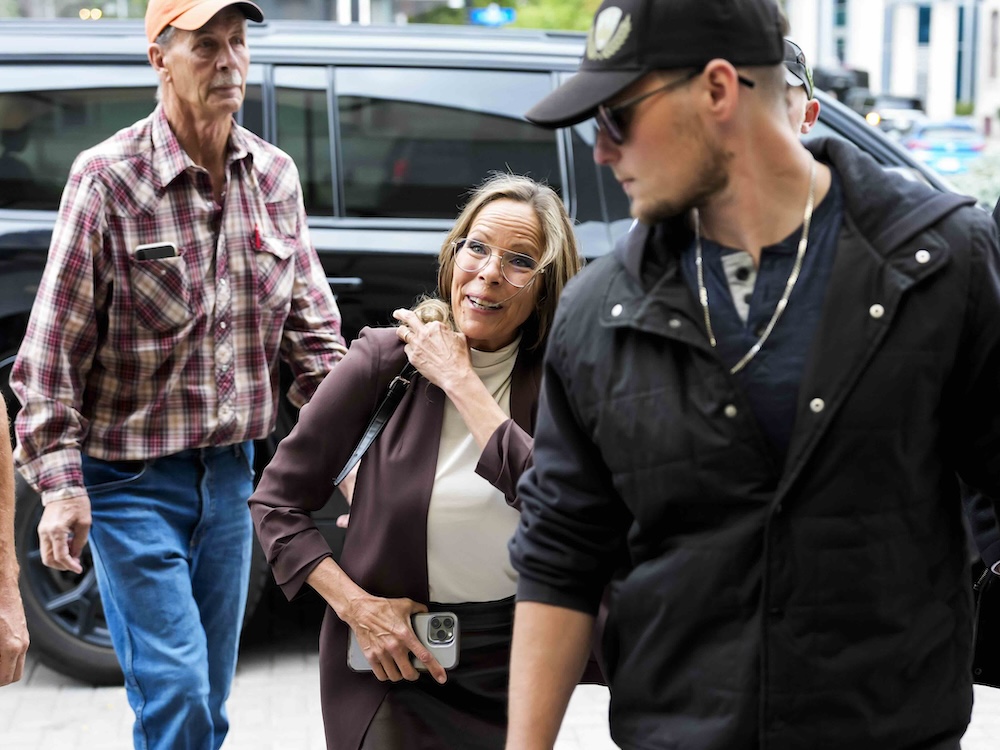
A key leader of the Freedom Convoy protest movement, Yellow Vest activist Tamara Lich, was a leader of the seccessionist “Wexit” movement, which morphed into the Wildrose Independence Party of Alberta. Her arrest and trial in Ottawa became a flashpoint for right-wing anger and radicalization.
For the far right, but also Conservative party leader Pierre Poilievre, the trial of Lich and another protest leader, Chris Barber, who were accused of mischief in relation to the Ottawa occupation, was an outrage.
The Alberta-based Justice Centre for Constitutional Freedoms, or JCCF, founded by John Carpay, who previously ran for the Reform party federally and the Wildrose party provincially, supported the criminal defence for Lich, Barber, and others charged for participating in the convoy protest.
He argued that Alberta can separate from Canada without the approval of the courts. The courts saw the matter differently, finding that a separatist plebiscite could result in the violation of Charter or treaty rights.
The JCCF is one of several Canadian partners in the libertarian Atlas Network, a right-wing organization based in Washington, DC, that has been accused of interference through social media in democracies in Latin America.
It has also played a key role in efforts to obstruct climate action in recent decades, producing thousands of climate-related pieces in the media, and networking think tanks, firms, foundations, universities, and the fossil-fuel industry. Many of these are based in Alberta.
Jeffrey Rath, the co-founder of the Alberta Prosperity Project, a leading proponent of separation, put it this way: “I have to say, it really came to a head for me when [Canadian Prime Minister] Justin Trudeau unnecessarily declared the War Measures Act [sic] against my fellow Albertans who simply went to Ottawa to peacefully protest.”
He went on to call the Act “an anti-Canadian unconstitutional violation of our rights. . . . You know, we need to take our dirty, smelly diesel trucks and our dirty, smelly oil and go home, or face 10 years in an Ontario prison.”
The Trudeau factor
Rath’s mention of the War Measures Act was telling. That statute was repealed and replaced by the Emergencies Act in 1988. The War Measures Act had been invoked by Justin Trudeau’s father, Pierre Elliott Trudeau, during the FLQ crisis.
Albertan opposition to Justin Trudeau can, in part, be traced to his father’s tenure in office.
For many Albertans, Pierre Elliott Trudeau’s National Energy Program became a defining symbol of Western alienation and resentment toward Ottawa — an interpretation that continues to shape political attitudes today, albeit largely along partisan lines. But today’s Alberta separatists go far beyond Western alienation as we have known it in the past.
Just as the Trucker’s Freedom Convoy protest flirted with the idea of overthrowing Trudeau’s government, sovereigntists speak of embracing “political revolution” as a moral imperative, as Bruce Pardy, a professor of law from Queen’s University, put it.
The problem is not Alberta, but Canada, in this view, and Albertans are in a position analogous to “pre-revolutionary America under British rule — subject to remote control, overtaxation, and illegitimate political representation.”
This view is beyond hyperbole. It doesn’t represent the views of most Albertans. It doesn’t represent most Albertan conservatives.
Alberta separatism is provocative, divisive, disloyal to Canada, and a threat to our democracy. It is nothing less than a radicalized movement that undermines our capacity to protect ourselves against the threat of domination by the United States.
It is time to call it out.
Excerpt from ‘Divided We Fall: How We Can Resist Polarizing Pressures and Strengthen Our Identity as Citizens’ by Max Cameron, 2026, published with permission from James Lorimer & Company Ltd.
Join Max Cameron at a Vancouver Institute lecture, ‘Divided We Fall: Why Canada Needs to Be Strong and United Against Trump,’ at the University of British Columbia’s Point Grey campus on Sept. 26. Find event details online. ![[Tyee]](/design-article.thetyee.ca/ui/img/yellowblob.png)





Tyee Commenting Guidelines
Please note that email notifications for replies are not currently working due to a software issue which may be resolved in a future update.
Comments that violate guidelines risk being deleted, and violations may result in a temporary or permanent user ban. Maintain the spirit of good conversation to stay in the discussion and be patient with moderators. Comments are reviewed regularly but not in real time.
Do:
Do not: