


 SHARE:
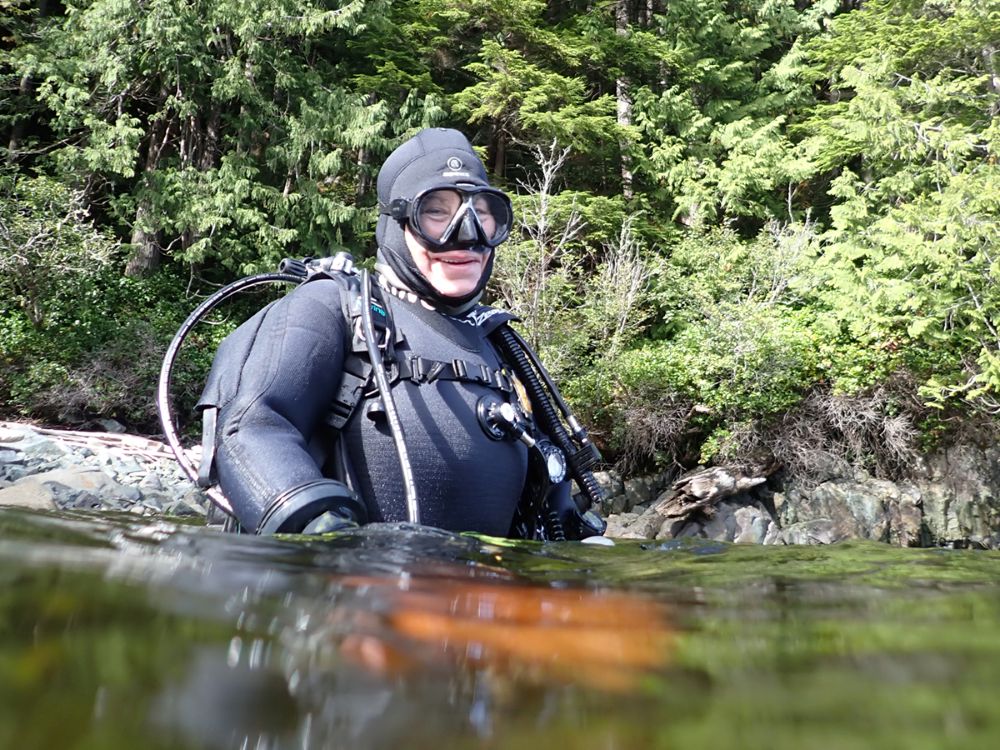
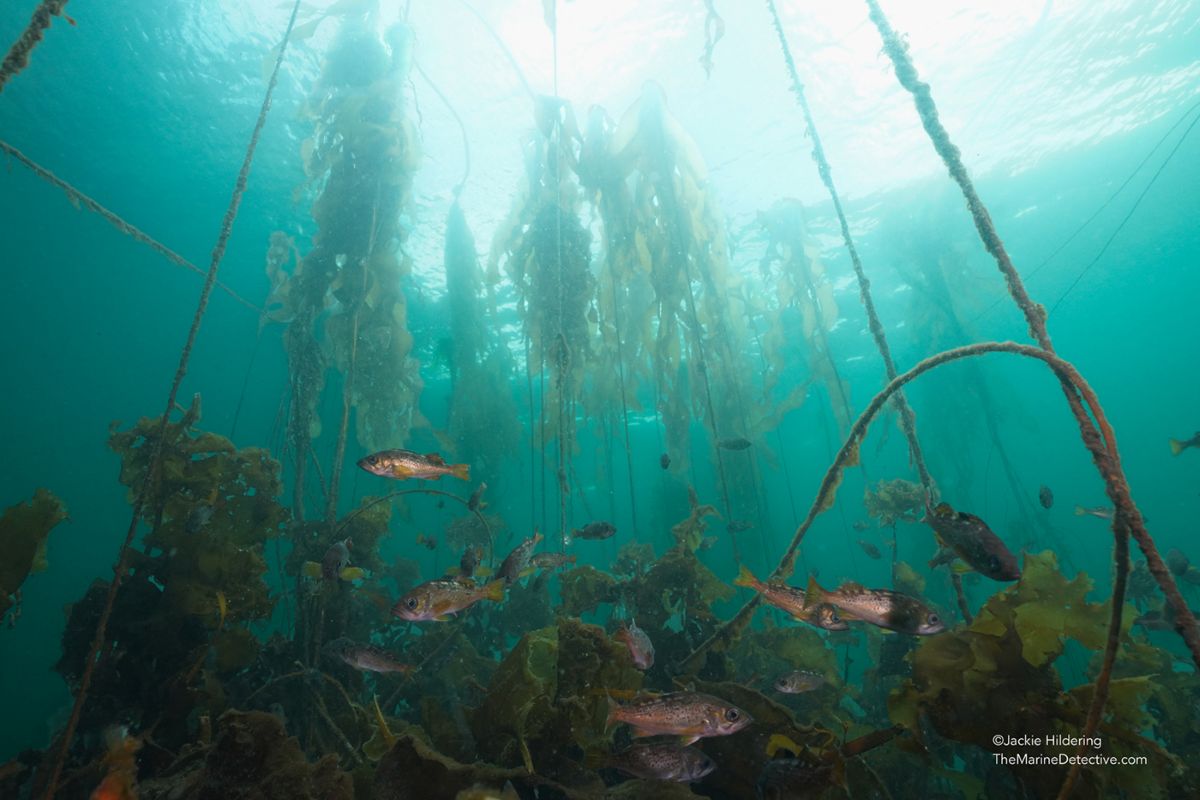
Fourteen metres below the ocean’s surface, Jackie Hildering hoists her underwater camera and snaps a picture. The camera’s flash temporarily introduces the full light spectrum to the blue-tinged world, making the red and gold scales of a yellowtail rockfish sparkle.
She’s diving in the plankton-rich waters of the Kwak̕wala-speaking peoples just outside of Port McNeill on northeastern Vancouver Island.
The water is just below 12 C today — balmy by local standards — and late summer sun streams through the canopy of the bull kelp forest.
Down here, the only sound audible to human ears is the steady stream of bubbles as Hildering exhales.
Today marks her 1,557th dive, which means she’s spent roughly 1,167 hours under these local waves since she discovered diving in her mid-30s.
“I wanted to know one place and be a conduit for that one place,” she says.
Hildering is a cold-water diver, underwater photographer, humpback whale researcher and biology educator. She teaches people about the incredible underwater world she explores with her blog the Marine Detective, and she helped co-found the Marine Education and Research Society, which studies marine mammals and works to educate boaters on how to be safe around whales.
Last year, Hildering was honoured by the King Charles III Coronation Medal, which is awarded to people who make a significant contribution to Canada.
She felt “deeply honoured” to be recognized but felt a bit awkward to wear a medal with the king’s face on it, so she balanced out the evening by draping herself in copper jewelry made by the local Indigenous artist łlilawikw, who makes jewelry for her shop Sea Wisdom Design.
This approach — gently working towards positive change — also shows up in Hildering’s blog and on her social media channels, where she sends a message of joy, curiosity and empathy.
When you spend enough time studying how perfectly marine life fits together, it’s easier to see how “we weirdo humans are much more similar to one another than we realize,” she said.
But people get distracted by societal pressures, where happiness gets equated to consumerism, excessive affluence and the debilitating pressures of beauty norms, she told The Tyee.
People are further isolated by algorithms and a media world that is designed to cause overwhelm, despair, inaction and disconnection — something she refuses to feed into.
So she pushes back by introducing people to the wonder and beauty of the world beneath the waves.
This submerged world has taught her that happiness lies in knowing your place — that is, “the beauty of knowing your place within it all, within time, within your fellow humans and certainly within your place in the world.”
Part of her goal is to help us understand that many of us can gain more from using less.
“Less fossil fuels, less dangerous chemicals, less rampant consumerism,” she explained.
“I really do believe there are common solutions for most societal and environmental problems, and it’s around connection and the use of less.”
This wisdom comes from a lifetime of chasing her own happiness.
The making of a Marine Detective
Hildering was born in B.C., moved to the Netherlands to become a vet and ended up working as a teacher. During a visit home her world was turned upside down when a friend took her on a whale-watching tour off northern Vancouver Island.
Hildering quit her job and moved back to Canada to work for the tour company.
In 1999 she discovered diving as a way to “disappear” underwater. She was hesitant to bring a camera with her until she discovered the impact that underwater pictures could have on students when the picture was taken in their backyard.
She realized how few people knew about the incredible world just below the surface, despite living so close to the ocean.
That’s the “curse” of dark water, she says. While people are drawn to the clear water of the tropics, the cold water here is rich in nutrients, which allows plankton to thrive.
This “soup of life” makes the water dark but also forms the base of an incredible food web that grows giant halibut, salmon, the world’s biggest sea lion, biggest chiton, biggest barnacle and even giants such as humpbacks, fin, sei and blue whales.
Cold, plankton-rich water also produces the most oxygen and absorbs the most carbon dioxide from the atmosphere.
Hildering hopes that by introducing people to the vibrant life hiding beneath these dark waters, they will want to be advocates for the ocean themselves — no cold-water diving required.
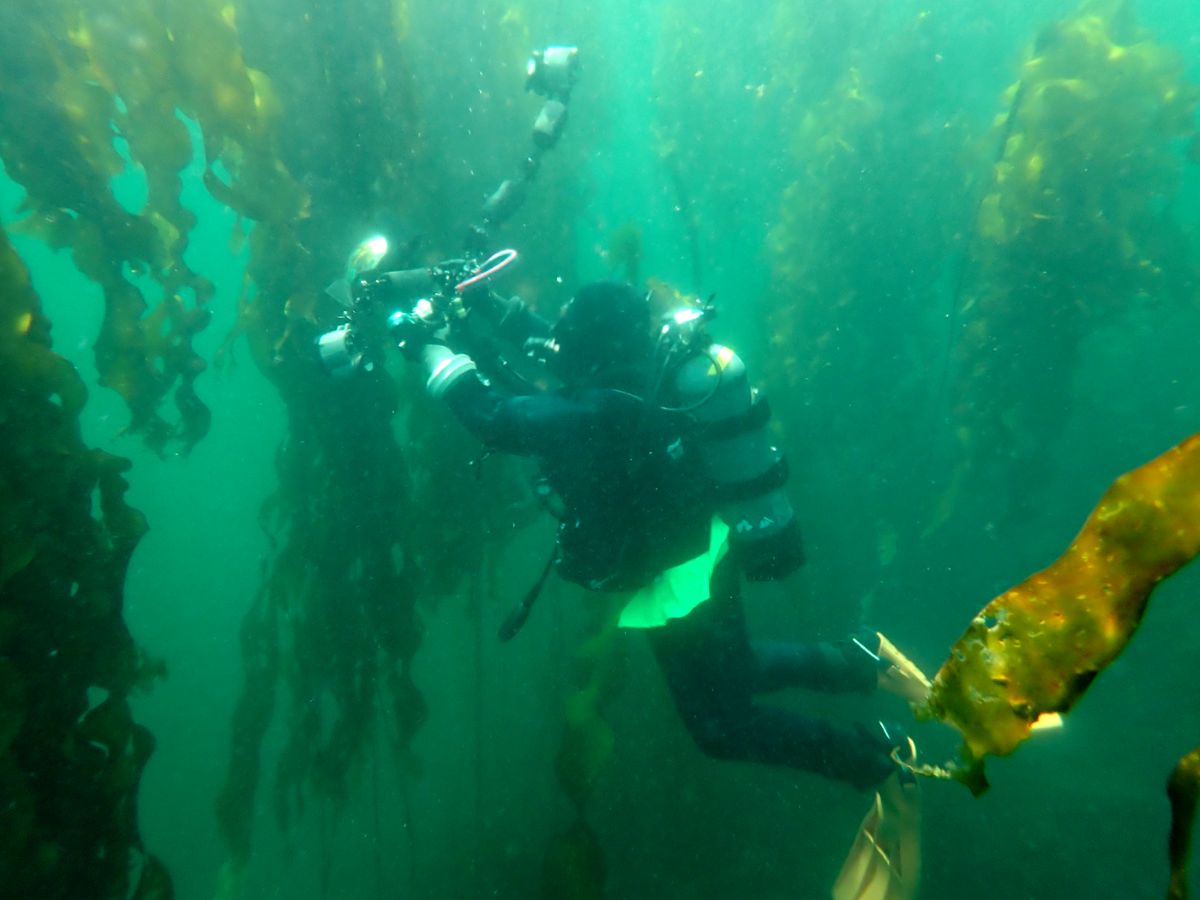
During the dive that The Tyee witnessed, Hildering had to haul more than 50 pounds of gear over rain-soaked logs and a rocky, seaweed-strewn beach.
She wears a dry suit, which means she has to wear warm, dry clothes underneath. The clothes can get a bit sweaty when pulling on wool layers under the September sun.
Once underwater, the gear restricts the movement of her head.
On a recent dive, she was busy photographing a small, rare jellyfish and only noticed later that a sea lion had come to say hello — she was checking out her pictures and noticed its whiskers in the frame.
In the warm tropics, a diver can do six dives a day, but in these cold, high-current waters the limit is more like two. Divers aim to be in the water for slack tide, when the tide switches directions and there is a brief window of low current.
‘See a Blow? Go slow!’
B.C. allowed whaling until 1967 and by the early 1990s humpbacks were still missing from local waters. Then, shortly after Hildering had returned to Canada, the whales also started to come back.
“I remember crying the first time I saw three humpbacks together,” she said.
Hildering and her co-workers at the whale-watching company wanted to do more than observe the whales, so they founded the Marine Education and Research Society, formerly registering as a not-for-profit in 2015.
In 2003, there were seven humpbacks around northeastern Vancouver Island.
Now, there are regularly over 100, according to counts done by the Marine Education and Research Society. This has created an “incredible, manic scramble” to educate boaters about whales.
While most boaters think “orca” when they hear “whale,” the risk of boat strikes for orcas is low, Hildering said.
Toothed whales, such as orcas, have biosonar, which allows them to detect the location of boats. Toothed whales are also relatively easy for boaters to spot because they have large fins, live in pods, stay relatively close to the surface and move in predictable patterns.
By comparison, baleen whales, such as humpbacks, are solitary, don’t have large fins, rest just below the surface, and surface unexpectedly.
The society created the “See a Blow? Go slow!” signs that are posted around marinas. It also runs a government sanctioned whale-safe boating course for motorized and non-motorized vessels, and hosts a four-day workshop to train government employees about marine mammal conservation.
The team also works to raise awareness about whale entanglement in fishing gear.
Hildering says a soon-to-be-published study found that nearly half of all local whales have injuries that suggest they’ve been entangled in fishing gear at least once.
That 50 per cent is likely an underestimate because it includes only whales that survived and lived long enough to be photographed and excludes whales already killed, Hildering said.
This loss and suffering help fuel her drive for education. After all, humans can only learn to be better neighbours when they know their neighbours exist, she said.
What humans can learn from whales
Hildering is active on Facebook and on Instagram, where she posts and interacts with her nearly 43,000 followers.
She shares posts by the Marine Education and Research Society celebrating their young female biologists and doles out praise for the cold-water diving experts she regularly dives with, who are often older women.
As a 63-year-old on social media, Hildering says she has been bombarded with societal messaging negatively focused on ageing, such as the loss of youth and the loss of collagen.
Hildering says “killer women” can draw on lessons learned from killer whales, another mammal that experiences menopause and lives past their reproductive years. If nature designed this process, then it’s clear older females benefit their communities, she said.
“The natural world is perfection,” she said. “The weirdest adaptations, from a human perspective, fulfil a role. There is no ugly in nature.”
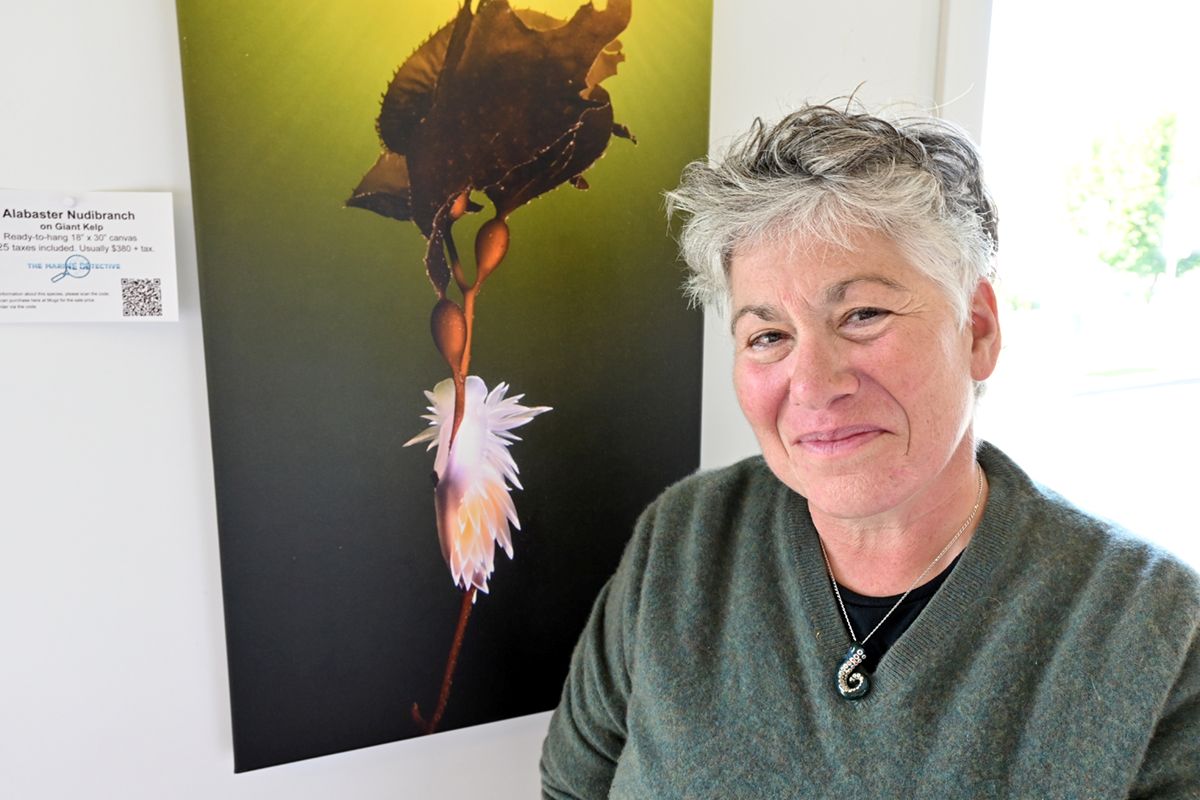
Hildering also posts about not being partnered and still being a happy, whole person, and about never having children, despite living in a society that emphasizes nuclear families.
She wants people to understand that this kind of life is a valid option.
“I’m going to represent something different that is valuable for people to hear and see,” she said. “And it’s that this life, this outcome, is a beautiful thing.”
Hildering is grateful she’s been strong enough to live her life authentically.
The “fabulous” eight-year-old version of herself, who is intensely curious, loud, plays in the surf and runs around pointing out how amazing things are, is alive and well within her.
“That is who I am,” she says.
Sea star wasting disease
Working in her field still comes with its challenges, Hildering said. It can be heartbreaking to identify dead and entangled whales, hoping a whale’s death can mean something, she said.
Most heartbreaking of all — it had her sobbing into her regulator while diving — was documenting sea star wasting disease, which killed billions of starfish along the west coast of North America.
Hildering photographed the weekly progression of the disease in sunflower stars, which can have 24 arms, grow up to 130 centimetres in diameter, and can be red, purple, orange or brown.
Initially the sunflower star would look contorted, then its arms would have crawled away from its body, then all parts would be decayed, then it would just be a mound of mush, she said. The wasting disease is caused by an infectious bacterium.
Mass die offs like this have enormous ripple effects in an ecosystem where everything is so interconnected and cyclical. In B.C., research appears to show that the die off of sunflower stars has allowed sea urchin populations to boom; those more numerous sea urchins are in turn mowing down kelp forests.
But even this story gets a small nudge towards hope. On a recent dive, Hildering says she found refugees from the devastation — 13 adult sunflower stars under a dock on northeastern Vancouver Island.
Building a better world
We can all work together to aim for a better future, which depends on a healthy ocean, Hildering said.
We don’t have to be perfect when trying to build a better world. Telling people they have to be perfect is a strategy used to make people believe they can’t make a difference, she said.
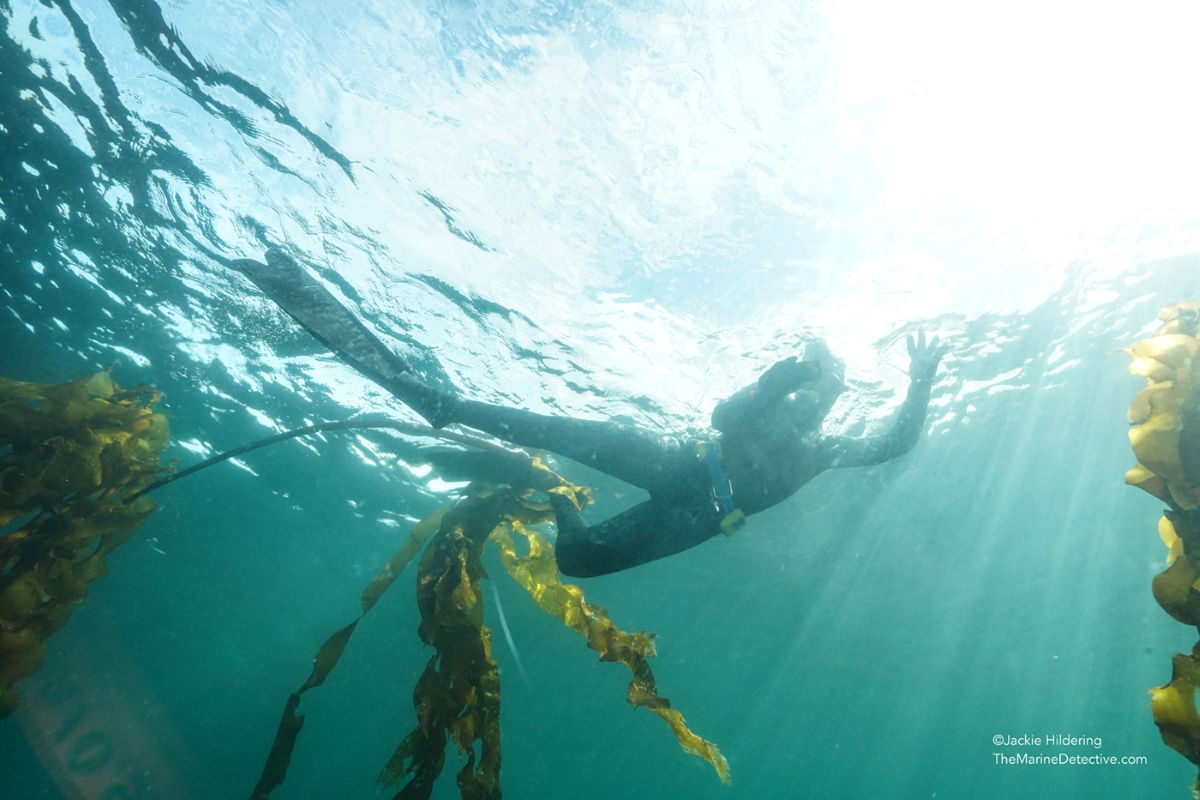
Instead, we need to empower kids to explore their natural world, understand their connection to the ocean wherever they are and experience all the wonder and joy that comes with that.
Fourteen metres below the surface, the yellowtail rockfish watch Hildering with curiosity, drifting between golden blades of kelp.
It’s beautiful down here, but the time for appreciation is fleeting. As humans we are visitors here and will always have to return to land.
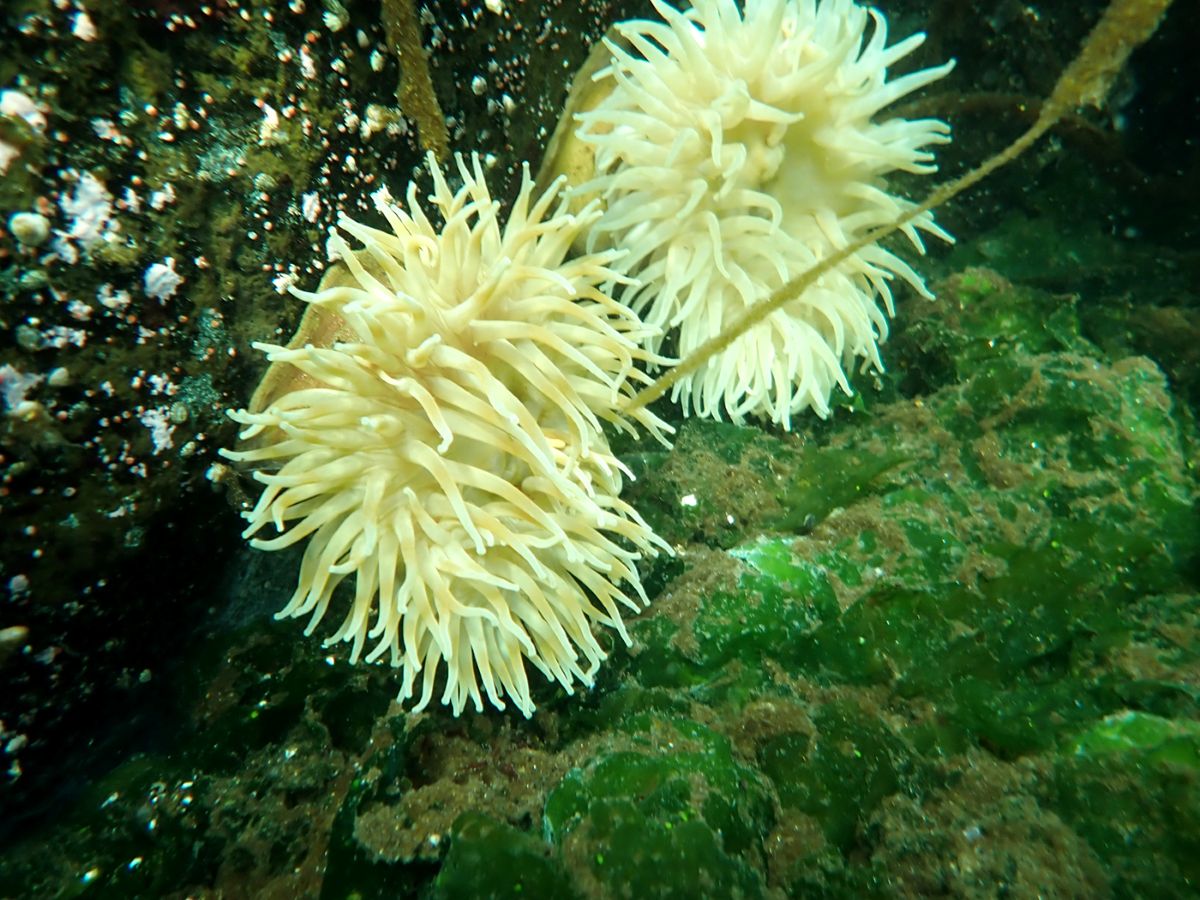
Along the steep rocky slope we admire northern opalescent and hooded nudibranchs, ochre sea stars, gunnels twisted amongst the seaweed and a fish-eating anemone.
I’m freediving, which means I’m darting back and forth from the surface to Hildering, who is scuba diving and hanging out deep beneath the waves.
Ever the teacher, she beckons to me, telling me to come and see. She has found another thing to marvel at, another creature to learn from. ![[Tyee]](/design-article.thetyee.ca/ui/img/yellowblob.png)
Read more: Environment










Tyee Commenting Guidelines
Please note that email notifications for replies are not currently working due to a software issue which may be resolved in a future update.
Comments that violate guidelines risk being deleted, and violations may result in a temporary or permanent user ban. Maintain the spirit of good conversation to stay in the discussion and be patient with moderators. Comments are reviewed regularly but not in real time.
Do:
Do not: