
 SHARE:

Former MLA Ravi Kahlon says his feelings about the BC NDP’s big loss in Saturday’s election have been flipping between sad and angry.
“I’m not one of those people that’s going to play armchair quarterback and try to analyze everything,” Kahlon said. “The premier made a decision. It didn’t work out, clearly, and part of being a leader is making tough decisions and living by them when they work and dealing with the consequences when they don’t, and that’s unfortunate for him in this situation.”
Kahlon, the MLA for Delta North since 2017, was a key cabinet minister in David Eby’s government. In August, after several years in charge of jobs and economic growth and previously being responsible for housing and municipal affairs, Eby made him the health minister.
But when Eby called the snap election in September, Kahlon surprised many by choosing not to run again, saying he wanted to be more available for his family.
Kahlon didn’t participate in the election, other than to support the NDP candidate in Delta North, firefighter Todd Schierling.
When the preliminary results came in, voters had replaced the NDP’s slim majority with a Conservative government that will hold about two-thirds of the seats in the legislature.
“What I hear from people is we would have loved to have the additional two years of a government to be able to do some important things, and I think that’s what people are frustrated by,” Kahlon said this week.
Asked if he was among those frustrated, Kahlon said he “would have loved to continue to have been the minister of health.”
“I quite frankly in the short time fell in love with the file and saw a lot of opportunities and things I think we could have done better.
“But it’s not to be.”
Eby has taken full responsibility for the decision to call the election early and the subsequent election defeat. But some observers have noted he appeared to be isolated, lacking people who could give him the straight advice he needed to make good decisions.
At the time of the election call, his chief of staff was Andrew Mercier, a labour lawyer and former MLA who ran in Langley-Willowbrook and lost to Conservative Jody Toor.
Mercier had taken over as Eby’s chief of staff in July from Cheryl Oates, who had done the job on an interim basis since January while Eby’s permanent chief of staff, Jim Rutkowski, was on medical leave.
Oates, who had previously been the chief communications adviser for former Alberta NDP premier Rachel Notley, served out the commitment she’d made but chose not to continue when Rutkowski’s medical leave was extended.
Eby picked Oates to be the campaign director for the snap election.
While Eby may have been short on trusted advisers, others have argued it’s simplistic to blame everything on one person and that the caucus and party could have done more to assert themselves.
Geoff Meggs, who was former premier John Horgan’s chief of staff and co-authored a book on Dave Barrett’s premiership, offered his views on Substack: “While some New Democrats will be tempted to blame everything on Eby, the larger question is how a government with a two-seat majority allowed what looks in retrospect to be an act of collective suicide, triggered by the decisions of a single man.”
Or as Andrea Reimer, a former Vancouver city councillor, wrote on Facebook: “Eby wielded an enormous amount of power over people and institutions and the people who had the power to hold him more accountable didn’t appear to have the willingness to use that power to hold him accountable.”
Many people inside the party had opportunities to ask harder questions about Eby’s approach to leadership and press for better, but mostly failed to do so, she wrote.
“If the party treats this as one person’s loss rather than a structural issue owned by cabinet, caucus, and party leadership both macro and micro, the NDP will be living with the fallout of this election implicitly for a long time,” Reimer said. “This was not about an aberration but a series of non-actions by many people that created an inevitability.”
Kahlon declined to talk in detail about the process ahead of the election call.
“I think it’s fair to say definitely cautions were expressed, but in the end decisions have to be made and decisions were made,” he told The Tyee. “That’s as far as I can say.”
Niki Sharma, the MLA for Vancouver-Hastings and former attorney general, said Eby spoke in a meeting of outgoing MLAs Wednesday.
“He apologized to caucus as he did in public and took full responsibility,” she said.
Ravi Parmar, the MLA for Langford-Highlands and former forests minister, said, “To say I’m disappointed by the result of the election would be an understatement.”
Like Sharma, he declined to say whether caucus members opposed the election call.
“The premier made a decision,” he said. “We all stood by him.”
The election timing clearly was not good for Aman Singh, the president of the BC NDP. He and his wife had a baby at the end of August, and he figures he got less than two hours of sleep a night throughout the campaign.
Singh, who became president leading a slate that pledged to strengthen the party membership’s role, is also former MLA for Richmond-Queensborough and ran unsuccessfully in this election in Vancouver-Fraserview.
The party was not involved in the decision to call the election, he said, noting that by law it is up to the premier to go to the lieutenant-governor and ask for an election to be held.
“The party apparatus, the organizational apparatus on the outside of caucus, really has nothing to do with that,” he said, adding Eby would have heard advice from people around him. “This is a leader’s decision. We as a party, our primary responsibility is to fundraise and run an election, which is what we did.”
Singh said he’s of course disappointed by the result that ended nine years of NDP government.
“British Columbians clearly made a choice and we absolutely respect it,” he said.
“I’m proud of the work that I did, that we’ve accomplished since electing John Horgan, but there was a clear message,” Singh said. “People are hurting. The economy’s not in the best place. We have an affordability crisis. We didn’t expect our closest trading ally and partner to be attacking us for the last year and a half.”
Despite the challenges, the government opened schools, hospitals and urgent and primary care centres, as well as getting the situation at ICBC under control and keeping vehicle insurance rates low, he said.
“There’s a real strong legacy of things we’ve done. I just think we weren’t able to communicate that to people and make people understand this is what can be achieved,” said Singh.
“That squarely falls on us, and we’ll be looking at how we change that and how we really get back to the grassroots and commune with our people and other British Columbians and communicate to them the legacy that we have, the things we’ve done and the things we still need to do.”
Many factors contributed to the defeat, and the party will take the time to do an in-depth review of what happened, as it does after every election, Singh said.
“We will take a really, really long and strong look at the lessons that we’ve learned, and hopefully come out of it stronger.”
Mike McKinnon, a consultant who worked in Horgan’s premier’s office, was part of the BC NDP’s war room for the first half of the campaign, but not one of its senior officials. He said he doesn’t want to second-guess decisions.
“The early election call obviously became a much bigger issue than I think anyone expected,” he said.
While some blowback was anticipated, past precedents suggested people would move on pretty quickly.
“This time David was still having to defend that decision up until the very last day, and that took a lot of time and attention away from what the NDP wanted to talk about,” said McKinnon.
The party had an ambitious platform aimed at lowering the cost of living, improving health care and continuing to build a more fair world for working people, he said.
“A lot of that was crowded out continually about debate over why the election was being held in the first place,” he added.
“It’s really hard to make the case for the big swings you want to take when you’re still explaining why we’re all here in the first place.”
The party will need to take an objective look at what happened and try to understand why some 250,000 fewer people voted for its candidates than did two years ago, he said. It would be reasonable as part of that, he added, to consider whether the party drifted from its values as it tried to appeal to a broad number of voters.
Big-tent parties, especially when they are governing, have to make hard choices that some supporters may disagree with, he said.
“You are bringing people together who are passionate about a particular value set,” he said. “There are going to be a ton of different views that fall under that, but what is uniting about them? In the BC NDP, that is a belief in strong public services, a belief in fairness and good jobs and giving working people a more fair shake.”
While the core values would always be uniting for the party, he said, “we clearly need to connect that with more British Columbians.”
With the final count to be completed by Nov. 18, the NDP will have about 28 seats in the legislature.
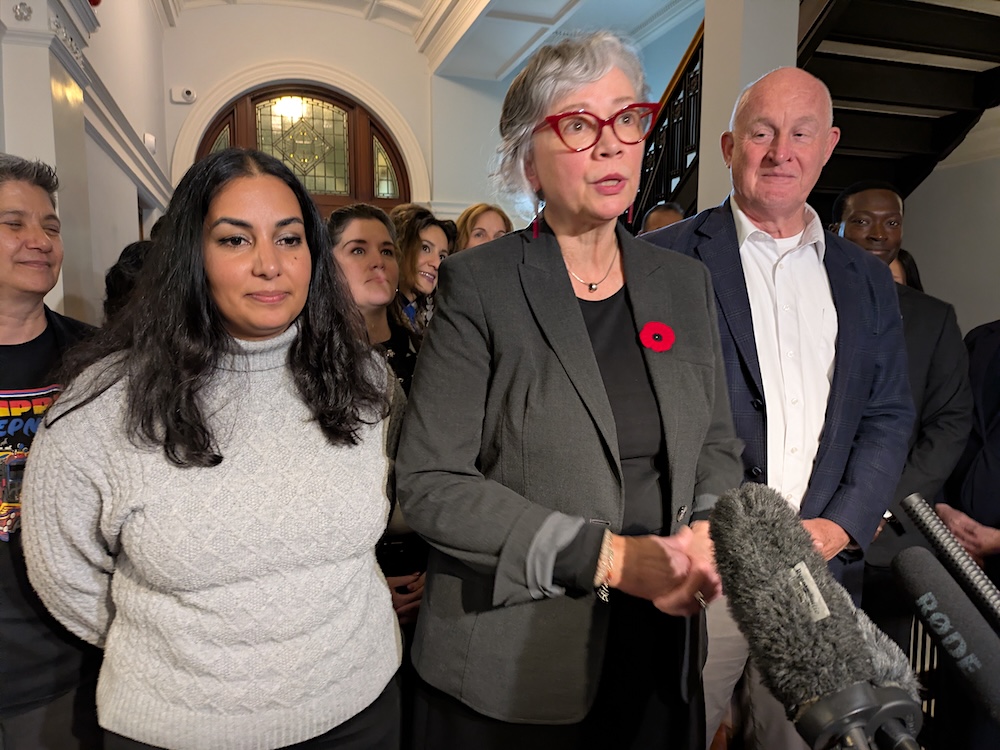
On Thursday the caucus decided to recommend Jennifer Whiteside, MLA for New Westminster-Coquitlam, as interim leader to the party’s provincial council. Longtime Port Coquitlam MLA Mike Farnworth will be the house leader, and Sharma will be caucus chair.
Whiteside is a former manager with the Hospital Employees’ Union. She was first elected in 2020 and has been labour minister, education minister and minister of mental health and addictions.
Whiteside said British Columbians have asked the NDP to sit as the official Opposition.
“We will take on that work with determination, with thoughtfulness, always putting people at the centre of everything that we do,” she said.
Singh said the party executive will set the timing and rules for a leadership contest after the election review is complete.
“It won’t be any time soon,” he said. “My intention is to make this leadership contest really robust and a real contest.”
The last time the party had a process like that was 2011 when Adrian Dix became leader. His replacement, John Horgan, was acclaimed when nobody else entered the race, and David Eby was acclaimed after the party disqualified his only challenger.
Kahlon said his “phone is blowing up” with people asking if he’ll seek the leadership, but his immediate focus is on his family, and questions about what’s next are for the future.
“As far as leaders go, we have no shortage of leaders in our progressive movement,” he said, naming several colleagues who were re-elected. “I’m not sure what that future will hold, but I can guarantee you we’ll have a strong leader in place and we’ll be up to the fight in the next election.”
Neither Sharma nor Parmar ruled out seeking the party leadership, but they said it was too soon to make a decision. Several others may be interested: Josie Osborne, MLA for Mid Island-Pacific Rim, and Brad West, the mayor of Port Coquitlam, are on many people’s short list.
Bowinn Ma, the MLA for North Vancouver-Lonsdale and former infrastructure minister, has said she will not seek the permanent job.
The first step is a full review of what went wrong and why the party failed to connect better with voters, Kahlon said.
“The question for us is ‘How do we take bold ideas in our vision, but meet people where they’re at and meet them in that moment?’” he said, adding that what’s considered “bold” and what people want varies significantly in different parts of the province.
“My worry is, if the question is ‘Did we just not do a couple of policy issues and it would have been different?’ I think that’s missing something much bigger. I think we need to listen more and be less preachy to people.”
Meanwhile there’s a Conservative government to hold to account, Kahlon said.
“They’re going to dust the Gordon Campbell playbook off,” he said, pointing out that premier-designate Lorne Doerkson is already laying the groundwork to claim the economy is bad and the province’s finances are worse than expected.
“They are going to make cuts to health care. They are going to gut housing-related changes, make it harder for renters. We know that.”
Many policies that made life easier and more affordable for people will be reversed, Kahlon warned.
“It’s sad to see that those things will be rolled back, but it definitely will be on the top of the agenda, not to mention the rights of Indigenous people.”
Parmar said he got into politics to defend the interests of people and plans to continue doing that in opposition.
“We let people down by calling this election, and there are a lot of people out there who are scared about what’s to come.” 
Read more: BC Election 2026, BC Politics



Tyee Commenting Guidelines
Please note that email notifications for replies are not currently working due to a software issue which may be resolved in a future update.
Comments that violate guidelines risk being deleted, and violations may result in a temporary or permanent user ban. Maintain the spirit of good conversation to stay in the discussion and be patient with moderators. Comments are reviewed regularly but not in real time.
Do:
Do not: