



 SHARE:
When my son Louis was little, I had a hard time convincing him that Richard Nixon was a real person. To be fair, his only knowledge of Nixon came from old episodes of Futurama, wherein the former U.S. president was presented as a head in a jar.
Auteur filmmaker Matthew Rankin had a not-dissimilar experience with the late former Canadian prime minister Brian Mulroney. On the phone from his home in Montreal, Rankin explains that as a child of the 1980s, his first glimpses of Mulroney came from television. Wee Rankin thought of the former Progressive Conservative party leader as a TV character.
Turns out, he was kind of right.
Television was the medium for Mulroney’s message. Part Irish blarney, part not-so-naked ambition, the man cemented it all with a rumbling purr of voice, a slick hairstyle, cool suits and a massive jawline. Try fitting all that in a jar.
Fresh from its People’s Choice Midnight Madness Award at the Toronto International Film Festival last month, Rankin’s documentary fantasia Ladies and Gentleman, Brian Mulroney is the film we need right this moment.
That’s not overselling it.
Oh, the Canadiana!
In the heat of election season, with two of the damn things in B.C. this month and the Americans going bananas over the November 2026 midterm elections, Rankin’s celebratory evisceration of electoral politics and shenanigans is not only a reminder of how different Canada is from our southern neighbours, but also how truly critical that difference is.
Watching it alone in my apartment, I laughed like a loon. But this is a film that needs to be seen with an audience. Luckily for Vancouver folks, the film is screening at the Vancouver International Film Festival this week and next.
Before we get into the meat of the thing, a word about director Matthew Rankin, who is strangely emblematic of the best of Canadian identity for me.
Born and raised in Winnipeg, Rankin’s early films depicted the glorious weirdness of his hometown, from singer Burton Cummings getting bashed in the head with a beer bottle in a North End 7-Eleven to the banal beauty of Winnipeg apartment buildings.
Born of deep affection, poignancy and gonzo humour, Rankin not only captures the idiosyncrasies of this country, but he makes them beloved.
The apotheosis of this melancholic hilarity came in the form of Rankin’s 2024 feature film Universal Language. Shortlisted for the Academy Awards, it was a prismatic reimagining of Winnipeg through an elaborate embroidery of intermingling tales. Delicate as a poem and nutty as a fruitcake. It was a truly visionary work.
Ladies and Gentlemen, Brian Mulroney is not the filmmaker’s first kick at a former prime minister.
Rankin’s 2019 feature The Twentieth Century charted the rise of William Lyon Mackenzie King.
Described by its maker as “one-part Canadian Heritage Minute and one-part ayahuasca death trip,” the film rose to the challenge of capturing King in all his weirdness.
Mulroney does something similar by summoning the spirit of the man himself, as well as the atmosphere of the time, in all its particularity and detail.
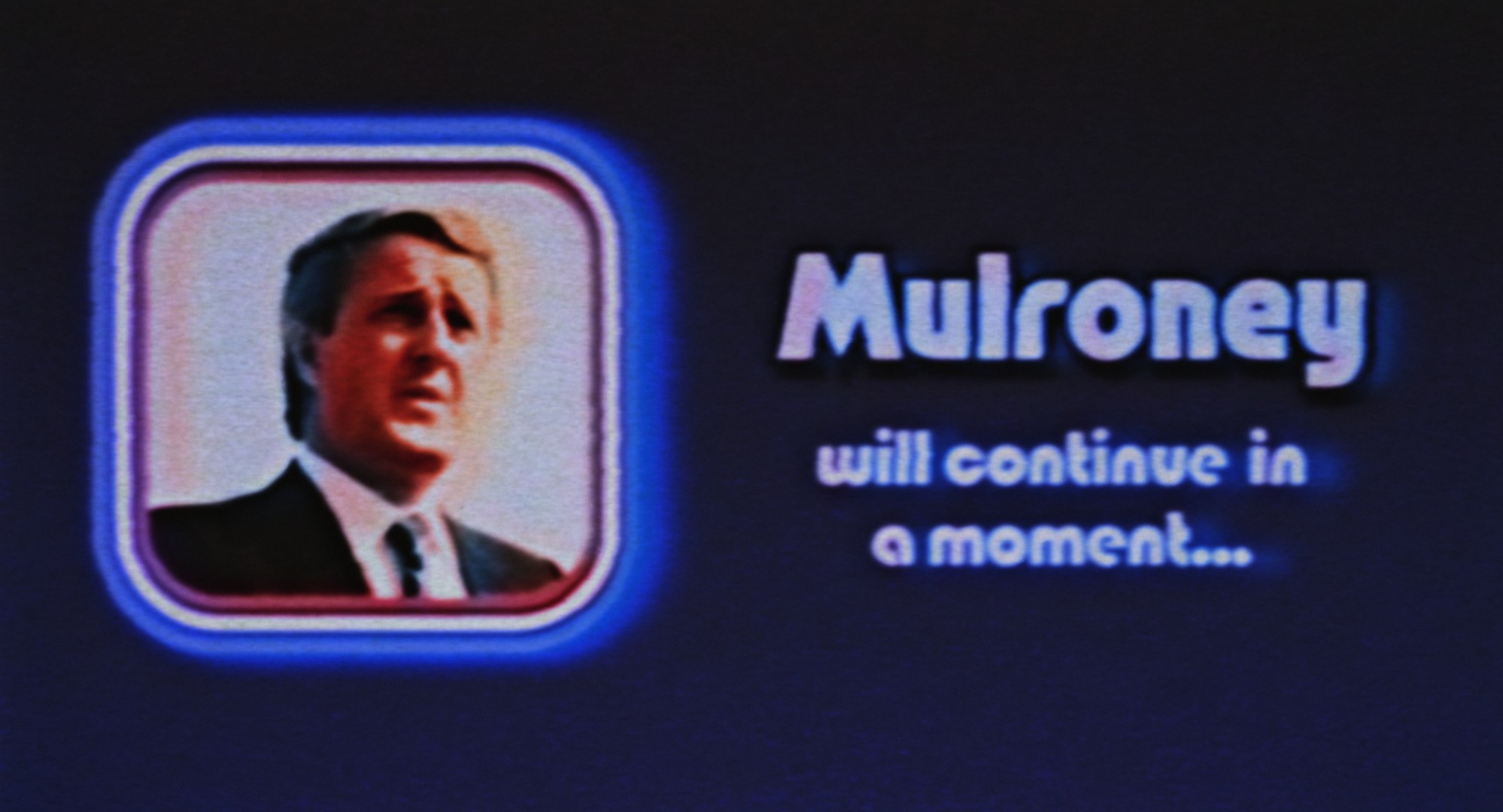
Composed of Canadian ephemera, the flotsam and jetsam of CBC television, NFB films, campaign footage and archival pleasures aplenty, the film borrows the language of episodic television.
With station breaks, commercials and cutaways, Rankin creates a flavour fueled in part by sweetish nostalgia but shot through with tougher stuff. Call it the bitter gruel of history.
Progressive Conservatism: an oxymoron?
Before we get to the end, let’s begin at the beginning, fittingly enough with an old-timey station sign-on.
As “Oh, Canada” warbles in the background, a carousel slide of images pours forth: shining mountain vistas, joyful children, buckets of writhing lobsters and former prime minister Joe Clark in a turtleneck.
The visual jokes come so fast and furious that their arrival is akin to the deluge of a high-pressure firehose. Let them soak in as you cast your mind back to an earlier era in Canadian politics.
Apart from the titular character, the other players in the film are extraordinary. In addition to Mulroney’s contemporaries such as Clark, Pierre Elliott Trudeau and John Turner, there is the right honourable John George Diefenbaker, who was the 13th prime minister of Canada. And, as the film puts it, there is also “a supporting cast of hundreds of white dudes in clean shirts.”
The women in the story — Clark’s wife Maureen McTeer and Mulroney’s wife Mila Mulroney — are equally fascinating.
McTeer was a particularly complex character, Rankin notes. “She was a feminist and a radical, and at the time there was room for that in the Progressive Conservative Party.”
Progressive Conservatism may sound like an oxymoron in this more cynical age. But that’s another reminder of how much things have changed.
At its height, the PC party was something of a contradiction.
It attempted to enshrine cultural diversity, social programs, the rights of women and the environment while maintaining that the function of government was to make life better for ordinary Canadians.
Its emphasis on the welfare of the nation seems almost quaint in the current day’s political snake pit.
Weirder and more powerful than charisma
While watching the film, I kept thinking about definitive Canadian civic programs like Katimavik, Canada World Youth and even Participaction. There was something about Brian Mulroney’s evocation of a more earnest era that lingers in heart and mind.
But back to man at hand. From its opening, the film poses cogent questions about Mulroney’s cult of personality enshrined in the first chapter entitled “Mr. Showmanship.”
After giving Welcome Back, Kotter the boot, CBC television cut to the civic centre in Ottawa, where the 1976 Progressive Conservative leadership convention was off to a running start.
The departure of former leader Robert Stanfield had opened a void and paved the way for the rise of a new power paradigm. Or so it was thought.
After losing five straight elections, the Progressive Conservatives were hungry for a different kind of vision, as well as someone who might be able to “save Canada from Pierre Trudeau.”
They were also eager to challenge the accepted notion of conservatives as “cheap, angry, sexually frustrated bigots.” Although not much has been gained on those grounds, onwards to Clark!
With his terrible French language skills, cracking voice and distinct lack of charisma, Clark wasn’t a very impressive candidate. Diefenbaker apparently slept through much of his speech, while Clark’s mother is seen in the audience, dragging deeply on a cigarette, and looking a mite bored.
After Clark’s dispiriting display, a new figure emerged on scene. Boy howdy, did he ever!
The film takes some creative license in a wildly experimental sequence. Suited up in a sequinned Liberace jumpsuit and a flying DeLorean car, our man Mulroney makes his appearance.

Something strange happens with Mulroney’s introduction.
First, there is the voice so familiar it feels like having your hair brushed by a Grade 7 girl. The purring velvet tone has an ASMR quality that soothes the spirit, even as the stuff he’s saying makes not an ounce of sense. Then there is Mulroney’s confidence. He’s big, bold and brash as he intones, “There’s something wrong with this country.”
You may not care for the dude. But one has to admit he had something. Call it charisma, but it’s weirder than that.
Rankin likens Mulroney to a Cadillac, big, sleek and possessed of a powerful drive.
Despite his bravura entrance, Mulroney “blew it” in the opinion of the media pundits watching the convention.
Mulroney’s role in the previous 1966 leadership fight, when Dalton Camp deposed Diefenbaker as party president, had left deep wounds.
As Deif glowered and growled, “I’m still here,” he enacted his revenge, decrying Mulroney’s lack of government experience and ending his candidacy for party leader.
Then it was all over except for the crying.

The complicated business of bringing the country together
Mulroney mythmaking began long before the man took to the political stage, with stories of growing up in Baie-Comeau, his father working two jobs to put food on the table and wee Brian singing for the rich owner of the paper mill to win $50. It’s compelling stuff, even if it smacks of well-practiced routine.
By the time he began his ascent to power, the pieces were all in place. He had a pretty tradwife in the form of Mila, a couple of cute kids and an easy way with the camera. Wagons ho for the top job.
Unfortunately for Mulroney, Clark’s star was also on the rise at the time. Time for a lite night of the long knives, Canadian-style.
Even as Clark was setting his sights on the job of prime minister, Mulroney maintained that no one but himself could help the Progressive Conservative party become a contender on the national stage.
To be fair, it was something of a complicated business to bring the country together.
Despite a cool robot theme song for Clark’s election ’79 campaign, the doomsday scenario of Clark being supported in English Canada left a path for the separatist Quebec to break the country in two.
An up-and-comer with spouse McTeer at his side, Clark attempted to convince Canadian voters that he was the most capable candidate and the man to beat Trudeau, then portrayed as a Svengali ghoulie who had ruled the roost for decades.
The film depicts Trudeau as a Max Headroom visage, complete with glowing eyeballs and a lizard-like demeanour, floating over the action.
As Trudeau and Clark squared off in the leadership debates, the ongoing joke in the film was Ed Broadbent never getting a word in edgewise. Poor old Broadbent.
Some of the cultural references in the film are very familiar, while others, like a talking pineapple puppet from the TV show Téléfrançais! require a little bit of digging. Other supporting characters like entrepreneur Peter Pocklington, pundit Allan Fotheringham and B.C.’s own irascible Jack Webster, whose capacity to disembowel politicians with slashes of words remains unsurpassed, also come in for some loving time and attention.
The film is so deeply entrenched in the particularities of Canadian history that it will be interesting to see how it plays in other countries. Rankin points out, however, that some of the most insightful reviews of Mulroney have come from U.S. critics.
Stuffed like a Christmas turkey with wonderful material, Rankin’s latest is worth watching multiple times, if only to get all the jokes that are crammed in sideways. Much of its stratified richness is down to the director’s approach.
“I started out to be an academic historian, but then realized I was not a scientist,” he told me. It’s through the prism of art that the even the most mundane stuff, housed in vaults and archives, comes gloriously alive.
As Mulroney found his political footing, polishing his jokes about then-prime minister Turner until they shone like a mirror, the end — or depending on how you view it, the beginning — comes into view.
The rise of Mulroney was an inflection point in Canadian history, ushering in many of the current issues that we continue to contend with in the political realm, including populism and separatism.
One thing that most leaps out from talking to Rankin is the role of culture, particularly Canadian culture, the things that make us feel Canadian in the marrow of our bones.
That this collective experience is insanely hilarious is just the chef’s kiss. In this, Rankin takes his rightful place as a chronicler of all things wonderfully Canadian. He stands alongside comedic giants such as Second City Television, CODCO, Kids in the Hall and The Frantics in his genius ability to mix history and critique into a form of zany poetry.
The film ends before Mulroney assumes the mantle of the 18th prime minister of Canada in 1984.
When I asked Rankin if he wants to return, as a filmmaker, to Mulroney’s years in power when so much happened, the director has this to say: “I view this as a trilogy.”
I cannot wait.
‘Ladies and Gentlemen, Brian Mulroney’ screens at the Vancouver International Film Festival Oct. 4, 6 and 11. ![[Tyee]](/design-article.thetyee.ca/ui/img/yellowblob.png)
Read more: Federal Politics, Film












Tyee Commenting Guidelines
Please note that email notifications for replies are not currently working due to a software issue which may be resolved in a future update.
Comments that violate guidelines risk being deleted, and violations may result in a temporary or permanent user ban. Maintain the spirit of good conversation to stay in the discussion and be patient with moderators. Comments are reviewed regularly but not in real time.
Do:
Do not: