


 SHARE:

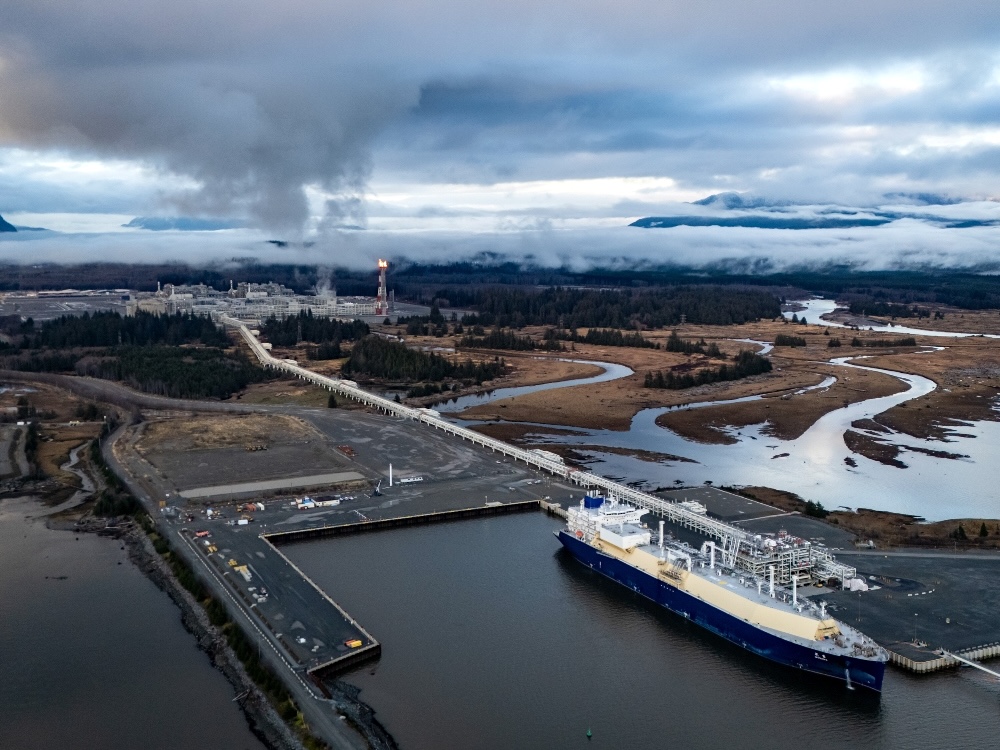
Once Kitimat’s LNG facility is expanded, gas liquefied at the site and shipped to other countries will produce more greenhouse gases than all other emissions produced by the province of B.C. each year.
In September, LNG Canada’s joint partners made their final investment decision to double the plant’s capacity.
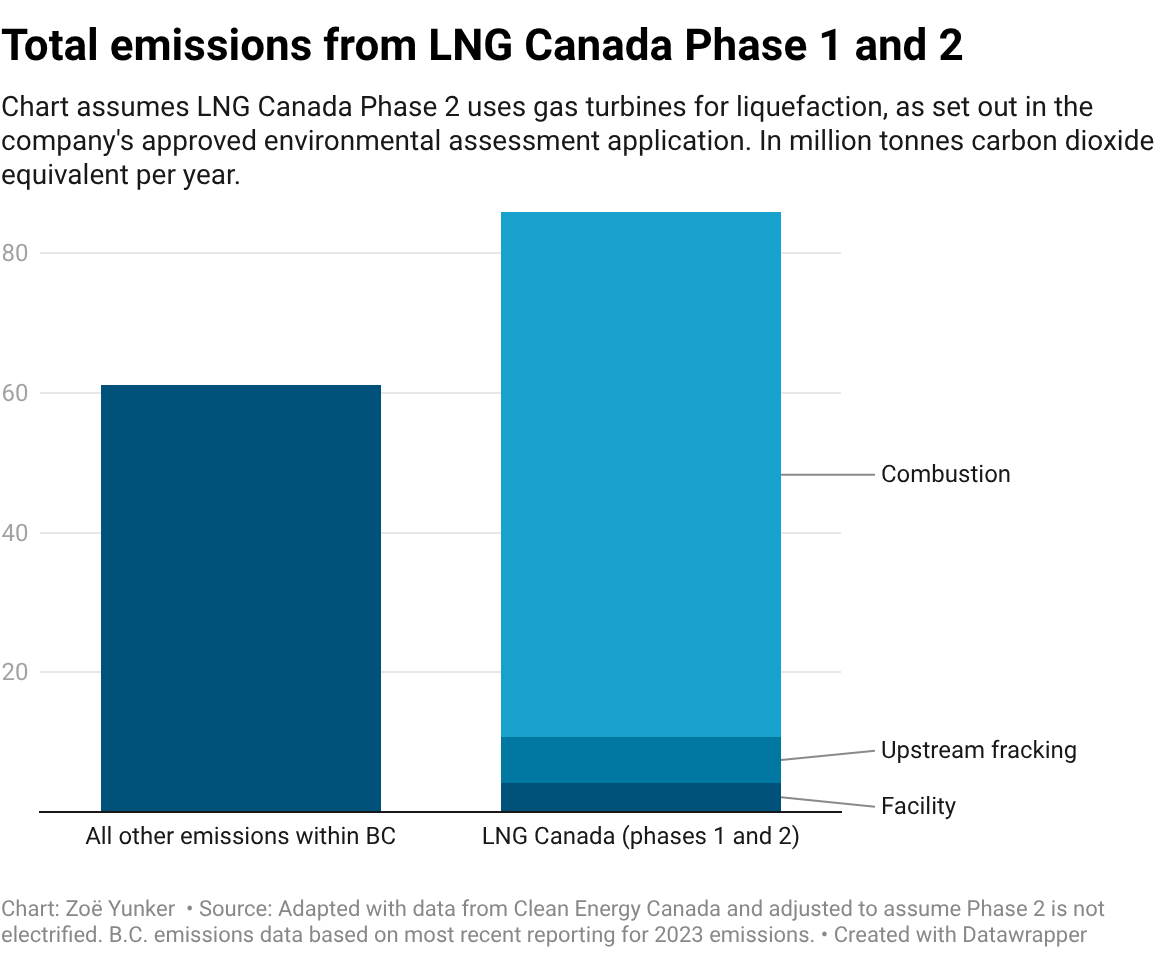
LNG emissions projections from Clean Energy Canada suggest that once the expansion is complete, emissions from extracting LNG Canada’s gas will be roughly equal to those produced by all the light-duty trucks driving in B.C. each year. The LNG facility itself will produce emissions equivalent to all of B.C.’s residential buildings.
But the biggest segment of its emissions by far will occur outside of B.C., when the fuel is burned elsewhere.
Those out-of-country pollutants aren’t counted in B.C.’s or Canada’s emissions inventory. Instead, Canada follows the United Nations’ standard method for tallying emissions produced within domestic borders. This is a methodologically tidy approach: it doesn’t require countries to unpack the relative impacts of their exported fuels, compared with other options a government might choose.
But the approach can obscure the overall climate weight of fossil fuel projects such as LNG Canada, where more than three-quarters of its emissions are released outside of Canada’s borders.
“We can’t simply ignore the downstream emissions that occur when the gas is burned abroad,” said Steven Haig, a policy adviser for the International Institute for Sustainable Development.
“That still needs to be factored in to how we understand the total climate impact of these projects.
“The fact remains that LNG is still a polluting fuel.”
Canada’s federal government and B.C.’s outgoing NDP and newly elected Conservative governments have used the life-cycle approach to arrive at a different conclusion: they say liquefied natural gas, and projects like LNG Canada, can reduce global emissions. B.C.’s new Conservative government campaigned on a plan to work with the federal government to establish emissions “credits” for LNG sales for reducing the use of coal.
How LNG Canada will ultimately affect global emissions remains murky, says Dale Beugin, executive vice-president of the Canadian Climate Institute. Besides the emissions produced within B.C.’s borders, it means analyzing what happens when LNG hits the global energy market.
“What's being replaced, and what is the alternative?” Beugin said. “Those are really hard questions to answer definitively.”
What we know about LNG Canada’s emissions
Projects like LNG Canada produce emissions throughout their entire supply, production and consumption processes, including fracking, liquefying and burning the gas at its final destination.
LNG Canada’s emissions within B.C.’s borders mostly come from the so-called “upstream” activities to extract the gas. That includes fracking, a process that injects high-pressure water, chemicals and sand underground to blast open pathways within the rock for gas to escape. Fracking is powered by gas, and fracking wells often leak methane — a super-potent greenhouse gas. Clean Energy Canada estimates that upstream emissions stemming from LNG Canada’s gas extraction will represent roughly eight per cent of the project’s overall life-cycle emissions inside and outside the country, totalling about 6.5 megatonnes each year.
LNG Canada’s Kitimat facility is also emissions-intensive. It burns gas to make its fuel liquefaction-ready and to power its turbines, and while flaring it to relieve pressure buildups in the plant. An unknown amount of unburned gas likely escapes the plant as methane.
Facility-level emissions will represent three to five per cent of LNG Canada’s total life-cycle emissions, depending on whether the second phase electrifies its production, according to data from Clean Energy Canada. Assuming the project will power its liquefaction with gas, as is approved in its environmental assessment, the second-phase expansion would double its facility emissions to roughly four megatonnes each year.
Combined, fracking and liquefaction at the facility would increase B.C.’s current emissions by 20 per cent, putting the province’s climate targets far out of reach, says Nancy Olewiler, an economist and professor emeritus at Simon Fraser University.
“It means you and I are going to have to walk everywhere we go to reduce emissions enough in other sectors,” Olewiler said, adding that unless there’s massive investment in carbon capture technology or the imposition of policy measures that would cause major economic devastation, there is no path to meet the target.
“It’s just not possible,” she said.
Outside B.C.’s borders, LNG Canada will also produce “downstream” emissions when its gas is burned elsewhere.
According to Clean Energy Canada, combusting the gas from phases 1 and 2 of LNG Canada will emit 23 per cent more greenhouse gases than the entire emissions produced by the province of B.C. each year.
Is LNG Canada’s product ‘low-carbon’?
Canada’s federal government, B.C.’s NDP and its new Conservative government say the project’s potential climate benefits rely on its downstream effects.
Their argument is built on a few assumptions. One is a fact: at the point of combustion, LNG produces fewer emissions than coal.
But point-of-combustion emissions are only one part of LNG Canada’s climate impact. Extracting the gas it uses, liquefying it and shipping it to an export destination add to the fuel’s overall carbon intensity, often through emissions that vent or leak during the process, most notably methane. Experts have made different assumptions about LNG’s average methane production, leading to vastly different conclusions about the fuel’s advantage over coal.
The governments of B.C. and Canada say LNG Canada has a lower relative emissions profile that makes it stand out from competitors.
They note that LNG Canada gets much of its gas from the Montney shale fields in northeastern B.C., which has stronger methane regulations than some other regions, such as the Permian Basin in Texas and New Mexico.
They also argue that LNG Canada’s facility will produce fewer emissions than other plants like it, citing design choices LNG Canada made to reduce emissions, including selecting high-efficiency turbines and using hydro power to fuel some of its activities.
“Greenhouse gas emissions from LNG Canada’s Kitimat operation are expected to be lower than those of any facility of a similar size operating in the world today,” the federal government said in a statement about the final investment decision for the Phase 2 expansion.
Many observers say LNG Canada’s claimed emissions advantage warrants scrutiny.
They argue that although B.C. has improved its methane regulations recently, the facility will also source gas from fracking fields in Alberta, where methane regulations haven’t yet caught up to those in B.C.
“It depends on which side of the mountain the gas is,” said Sven Biggs, campaign director for Stand.earth.
Even if LNG Canada’s fracked gas may involve fewer methane leaks than that of some competitors, this doesn’t account for the fact that fracking remains an emissions-intensive way to extract gas, Haig said.
“It's important to recognize that even if Canada, for example, may have relatively stronger environmental regulations of its oil and gas industry than other competitors, the process itself is inherently emissions-intensive,” Haig said.
Qatar, a major LNG producer, sources much of its gas from conventional gas fields, making its upstream emissions significantly lower.
Others have questioned whether LNG Canada’s claims about its facilities' emissions hold up against the reality of its operations since it started regular operations last summer. LNG Canada did not return The Tyee’s request for comment by deadline.
As reported in The Tyee, leaking valves and frequent power outages have caused the facility to flare much more gas than anticipated. LNG Canada recently applied to the regulator to routinely flare 10 times more gas than its permit currently allows.
This year, the World Bank Group estimated that LNG Canada had the second-highest flaring volumes out of 146 LNG plants worldwide.
These supply chain emissions matter in conversations about the relative emissions benefits of LNG over coal.
Depending on the supply chain methane intensity assumed, researchers have come to vastly different conclusions: Cornell University researcher Robert Howarth, for example, has argued that factoring in methane emissions means LNG from the United States is 33 per cent more emissions-intensive than coal. The International Energy Agency, meanwhile, estimates that LNG’s global average makes it 25 per cent less polluting than coal. Others have argued the LNG benefit is closer to 50 or even 60 per cent, depending on the country importing it.
Global impacts
Assuming that LNG Canada’s product is less emissions-intensive than coal, could it reduce emissions overall by replacing coal use elsewhere?
Some have taken a particularly optimistic view, including the authors of a 2025 report from the Canadian Chamber of Commerce and the modelling group Navius Research, which claimed that Canadian LNG as a whole would decrease global emissions by between 40 and 70 megatonnes. That analysis, though, expected life-cycle emissions from the projects included in the model would exceed Canadian LNG-related benefits, indicating a net increase to global emissions overall.
Even those conclusions depend on a changing landscape of complex factors, said Olewiler. “A simple message is not appropriate in my view,” she said. “We don't know.”
How LNG shapes global energy systems depends on a variety of factors; cost is among the most critical.
Currently, Haig noted, LNG is too expensive to compete with coal.
“LNG is so inherently expensive to produce that it's unlikely that the market price would drop significantly enough to displace coal,” he said.
As the cost of developing renewable energy projects continues to fall, Biggs noted, LNG’s role as a “bridge fuel” between coal and renewables may be redundant.
“I think we've seen that in a lot of places; people are skipping that step and going straight to solar and wind and battery storage,” he said.
Complicating the picture is a coming LNG supply boom as myriad new facilities under construction enter production this decade. If LNG prices fall dramatically, that could displace some coal power or renewables, depending on a variety of factors. Or it could trigger more energy demand — failing to displace anything at all. Whether or not the Strait of Hormuz reopens following the U.S.-Israel war on Iran will shape that picture, and LNG prices in the future.
Either way, Biggs added, the promised lifespan of LNG facilities puts them at odds with their claimed role as a climate solution.
“If we are still operating the LNG at this scale by 2056 or whatever, there will not be much climate left to save.” 
Read more: Energy, Environment











Tyee Commenting Guidelines
Please note that email notifications for replies are not currently working due to a software issue which may be resolved in a future update.
Comments that violate guidelines risk being deleted, and violations may result in a temporary or permanent user ban. Maintain the spirit of good conversation to stay in the discussion and be patient with moderators. Comments are reviewed regularly but not in real time.
Do:
Do not: