


 SHARE:
Why do we make things?
If you’re an artist like Cameron Kerr, you don’t have much choice. “This is what I do, every day of the week,” the sculptor explains from his East Vancouver studio.
The amount of work on Kerr’s studio walls is, in a word, staggering. Outside in a covered area, larger-scale sculptural pieces in different stages of completion reside.
Kerr’s work, like the man himself, is big and possessed of considerable presence. But it is also curiously fluid, moving in unexpected fashion to incorporate a dizzying array of ideas, images and manifestations.
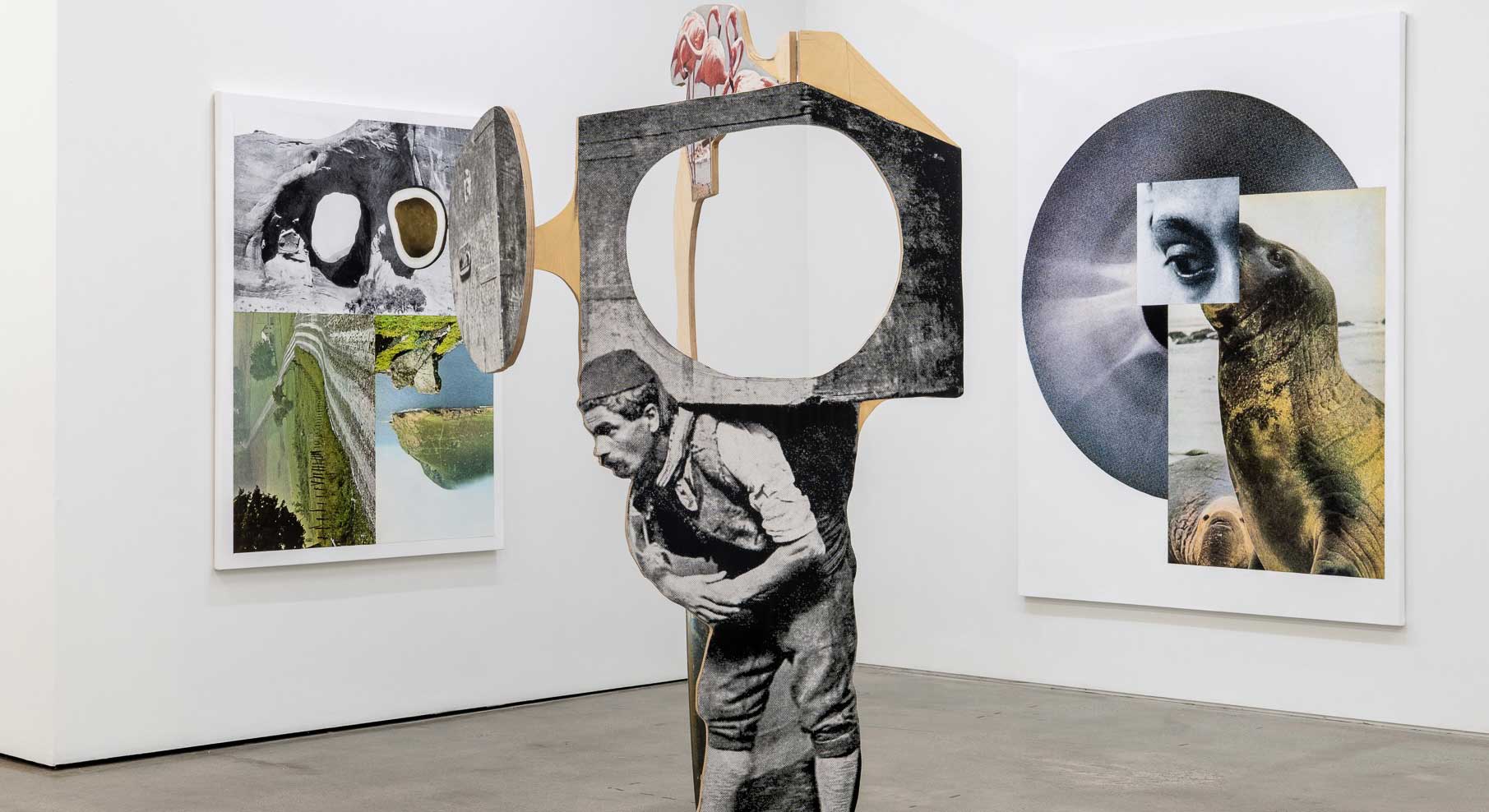
Cameron Kerr: Collecting the Unconscious, a solo exhibition of the artist’s work at Griffin Art Projects in North Vancouver, runs until mid-August. Curated by the Trapp Projects’s Patrik Andersson, Collecting is a deeply curious compendium of the familiar and the wildly idiosyncratic.
This range shouldn’t come as a surprise. In my hours spent to talking to Kerr, the conversation roamed from Canadian rural accents to the home studio of the famed French sculptor Auguste Rodin.
Curiously enough, Brion Gysin, creator of the Dreamachine, an interactive work designed to bring on a hypnagogic state, also popped up. Which is fitting, given that many of the pieces in Collecting the Unconscious are doing exactly that. The collection surfaces the interstitial place between sleep and wakefulness, where the conscious mind takes one last gasp before the body slips under the dark water of sleep.
Born in Campbell River, Kerr came to art because, as he describes it, he was one of those kids who wouldn’t stop drawing. At age 20, he moved to Italy to study marble at the Accademia di Belle Arti di Carrara with American sculptor Manuel Neri. Over the course of his education, Kerr studied with artists including Liz Magor, Antony Gormley, Marian Penner Bancroft and William Tucker, while Gareth James served as his MFA advisor at UBC. Those experiences informed his approach to materials including photography, found objects and wood.
Although he is primarily a sculptor, Kerr’s collection of new work in the Griffin incorporates photographic images drawn from diverse sources, including old print magazines like National Geographic. His search for interesting images is expansive in extremis.
Eyes, whether in a human, fish or bird, figure large. So, too, are shapes that appear in nature, whether a stone arch sculpted over centuries, or the opening of a halved coconut that the artist purchased in Vancouver’s Chinatown. This shared architecture, echoed in natural forms, is revealed and remade, placed onto carved wooden shapes that undulate and snake around the images themselves.
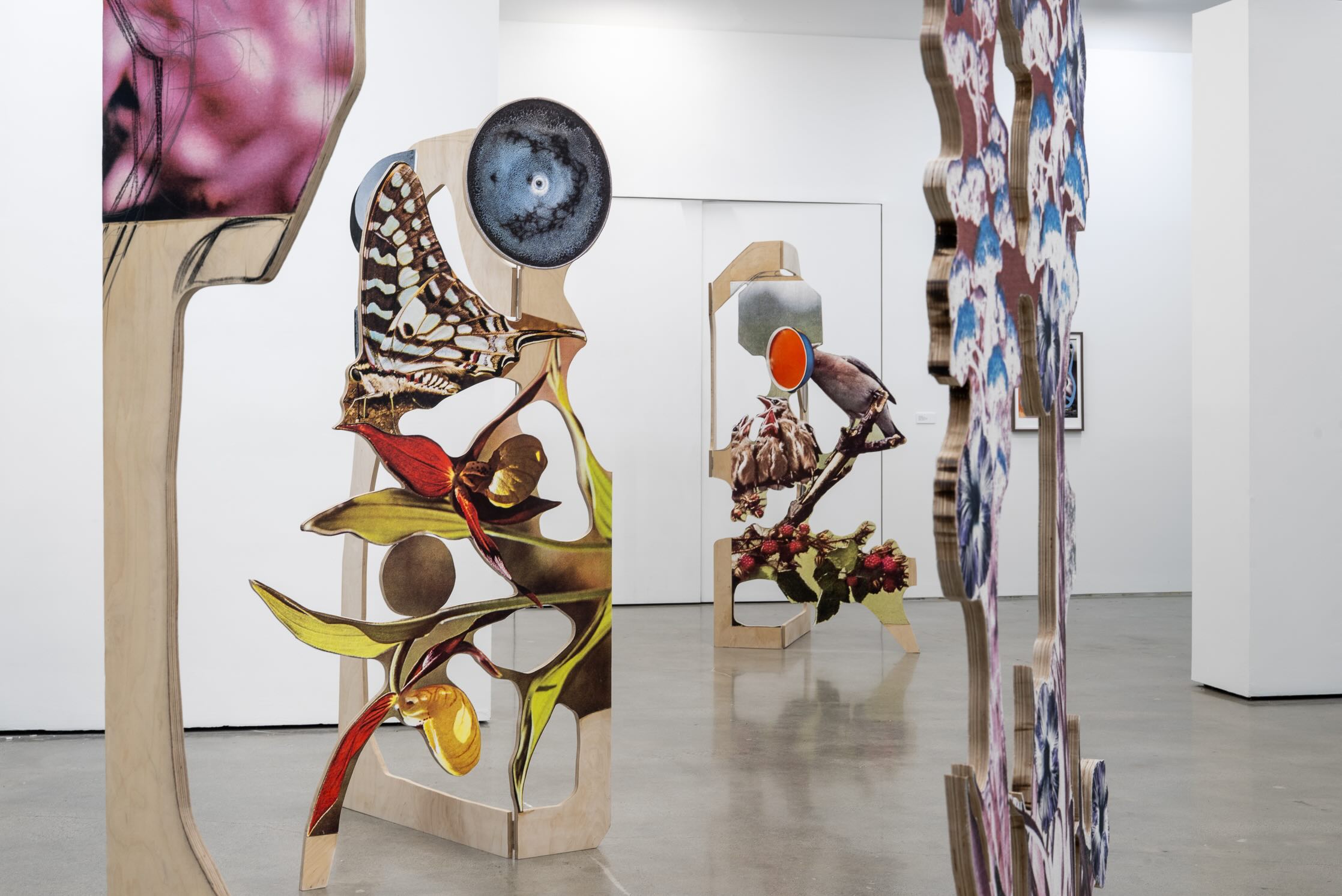
There is a curious choreography at work. Not just a call and response, but an arc, akin to an electric current leaping between ideas. The connections between things give rise to their own form of found poetry, highlighting the frisson that occurs in the process of juxtaposition. Put two disparate objects beside each other, and in the space between them, something entirely unexpected springs up.
The press material describes these recurring motifs as “vernacular image systems, memory and canonical forms in a variety of mediums.”
But anyone who grew up flipping through old copies of National Geographic in their grandparent’s basement will be familiar not only with the images themselves, but also the Ben Day printing process that uses small dots of colour to create a fully realized image.
Curator Andersson, who founded Trapp Projects in 1997 to present and promote the work of local and international artists, met Kerr at Emily Carr University of Art + Design, when the young artist took a survey course on 20th century art that Andersson taught.
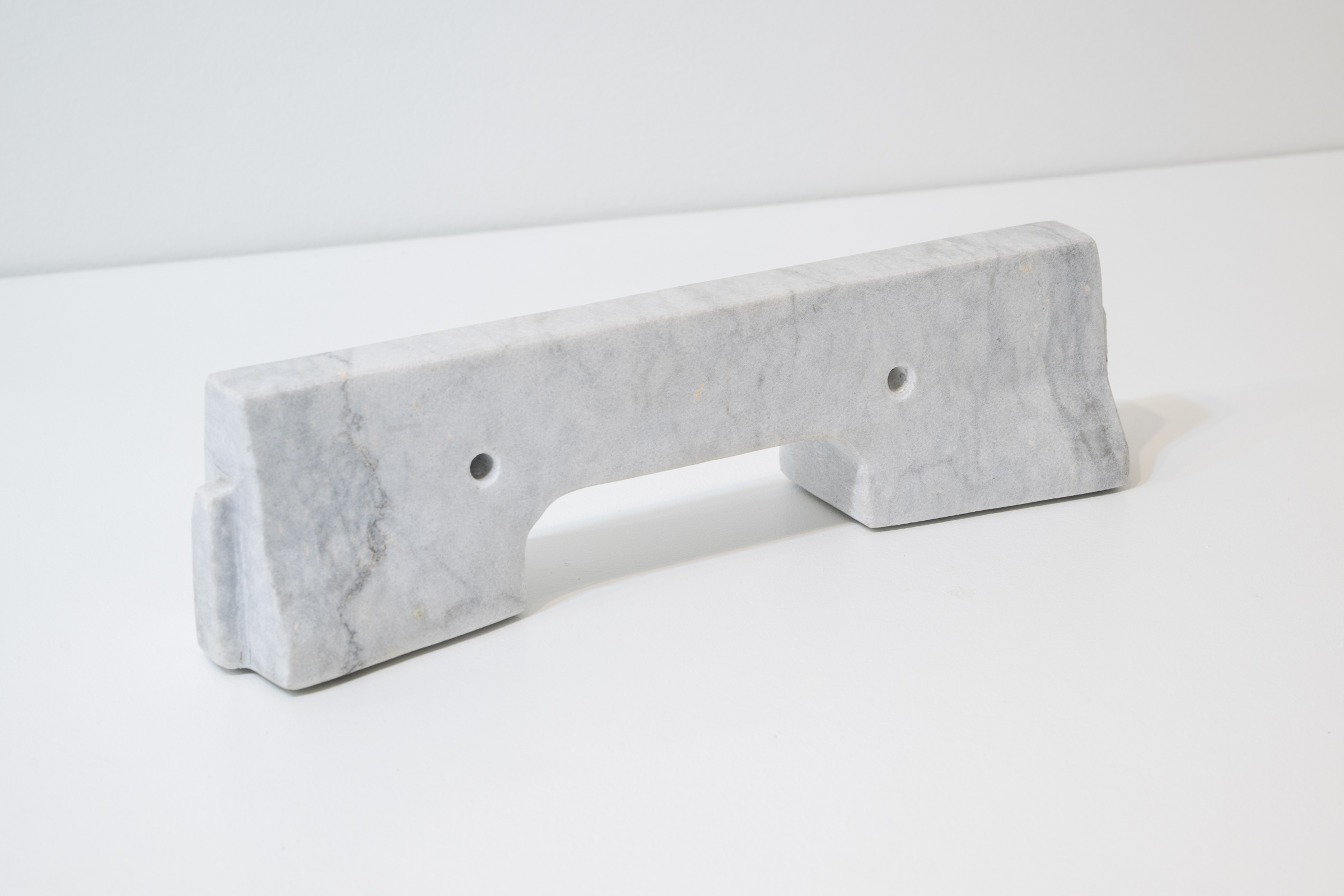
The two have collaborated in previous exhibitions, including a public art installation undertaken with Barbara Cole and Other Sights for Artists’ Projects “where we installed road barriers that [Kerr] had carved out of marble outside Vancouver’s Public Art Gallery and Queen Elizabeth Theatre,” as Andersson describes it.
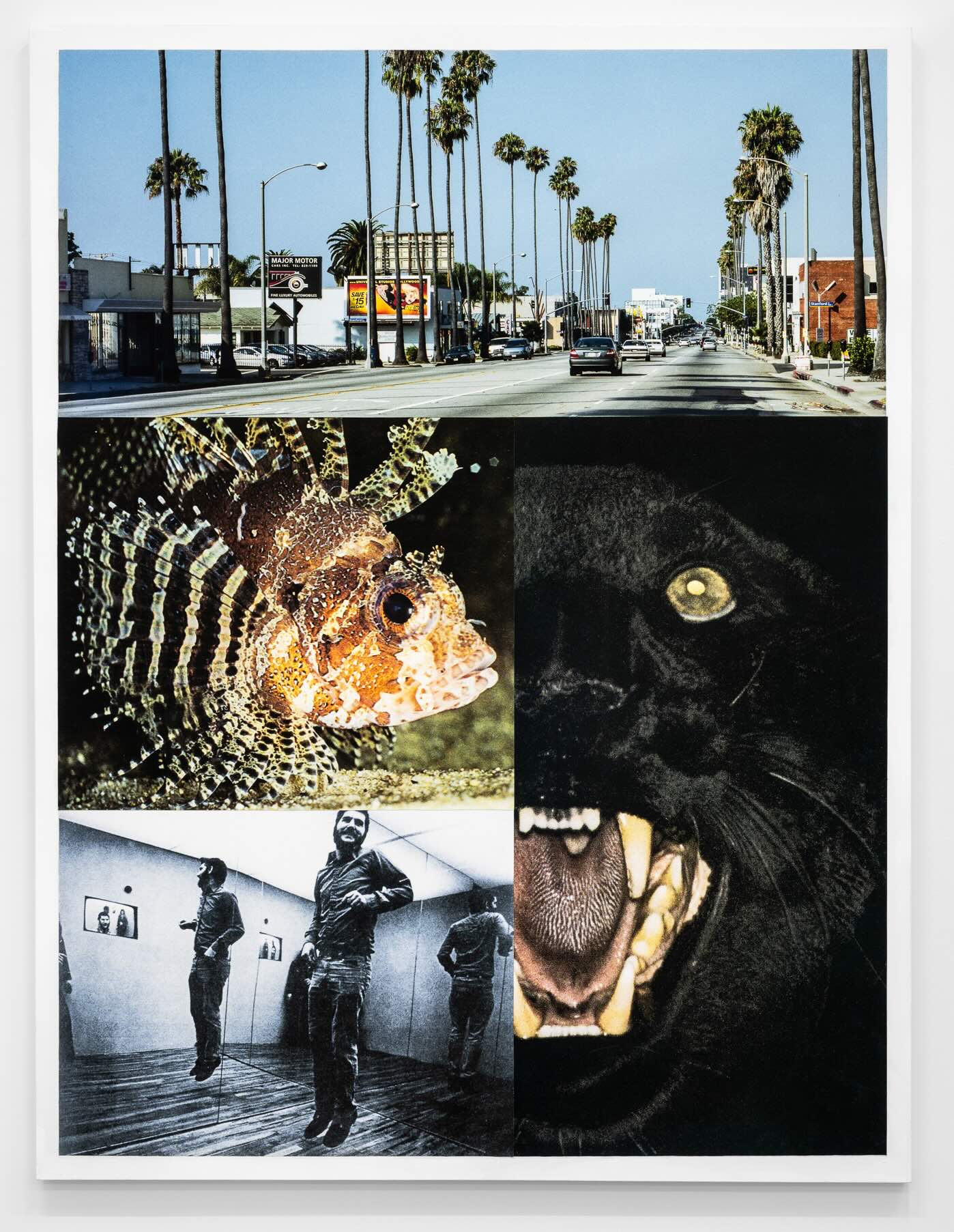
The work in the Griffin is something of a departure from Kerr’s previous sculptural work, scaling up smaller collage-based work, as well as paintings and drawings.
“Anyone who has visited Cameron’s studio knows, not only is it filled with sculptures and maquettes in various materials (wood, marble, granite, plastic),” said Andersson. “But his walls and tables are covered in photographs he has scanned and printed from magazines and books on most subjects. I see them as functioning as a picture atlas akin to Gerhard Richter’s Atlas or Aby Warburg’s Mnemosyne.”
From this wild wealth of material springs all manner of connections, folded into moveable hinged sculptures that open in unexpected fashion, offering peepholes into the conversations that emerge between images.
“Unlike a lot of sculpture, they don’t block views but allow us to peek through and walk around them in a way that activates a dialogue between the space, other viewers and the works on the wall,” Andersson said.
The curator added there is no hierarchy in Kerr’s visual vocabulary. “I am personally really interested in how Cameron’s work manages to employ technology but maintain an analogue sense of making,” he said. “There is always that human trace (pencil marks, cuts and gestures) that provides a punctum of sorts when exploring his work.”
‘Where science and imagination find an anchor of sorts’
Known as an “artist’s artist,” Kerr’s work that exists outside of gallery spaces and private collections is represented in large-scale photographs of chainsaw carvings done in remote rural locations. He explains he visits these pieces every few years to see how they’re evolving as time and weather take effect. It’s an interesting thought experiment to think of random hikers coming across carved cedar behemoths that resemble an Easter Island Moai.
Unlike artists like Andy Goldsworthy whose outdoor works are meant to be ephemeral and fleeting, Kerr’s work looks like it was meant to endure, to tough out the storms and ravages of the natural world and simply continue. Implacable and yet oddly gentle.
The dream logic of image pairings in Kerr’s work is only one aspect of the work, Andersson explained. In his writing about a previous exhibition, he summed up Kerr’s use of repetition as a means of accessing the anatomical infrastructure of the eyes, the brain and the connections therein.
“What fascinates Kerr about abstraction (organic or geometric) is that it can function as a node for the disparate experiences around him. This, he has realized, is because his thought forms are connected to the very architecture of the visual cortex. Here is where science and imagination find an anchor of sorts.”
The coupling of the subconscious and artmaking has found a home in many different artist movements, from the French surrealists to the work of Indigenous artists. That the French surrealists were fascinated by Haida sculptures and masks brings up an entirely other conversational tangent in speaking with Kerr.
The plumbing of the unconscious is certainly a key element, but to me, there is an inherent musicality in much of Kerr’s work. A wavy, almost tidal motion, winnowing in, then back out again. Ease and pleasure with the slippery stuff of the world is also amply evident. Whether fish, flowers or the iris of the human eye, all are buoyed by the curvature of the wood that contains and uplifts them.
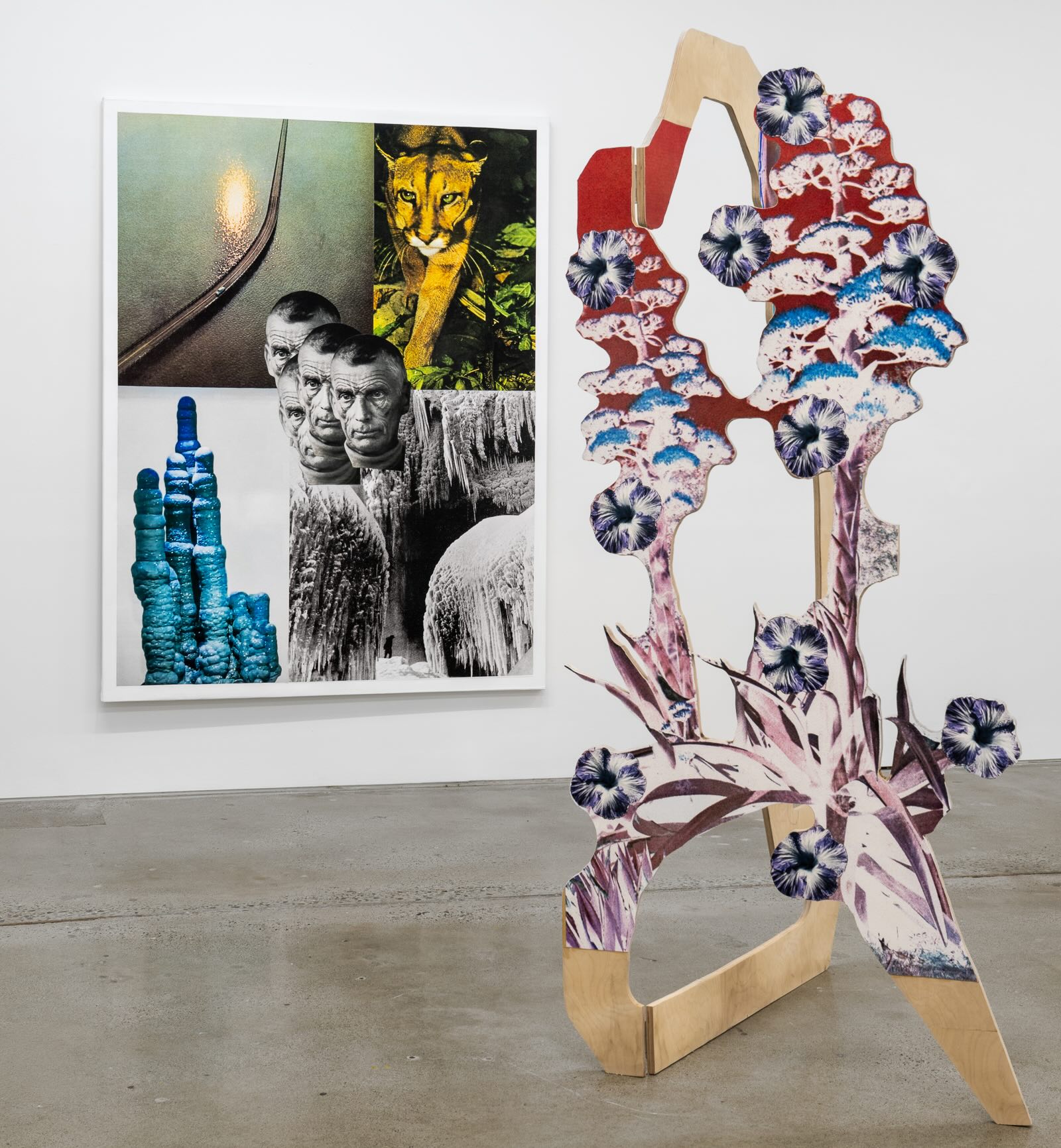
A piece that features four identical Beckett heads is only one example. What does the famed Irish playwright have to do with stalagmites, a prowling cougar and a stretch of highway spanning a section of open water? In all frankness, I’m not exactly sure, but it is strangely compelling.
The brain immediately looks for patterns, aiming to construct an internal logic, a narrative or otherwise derive meaning. But maybe that’s the wrong way to go about it.
Maybe it’s enough to let the image play against each other inside your head, butting up against the linear and controlling habits of the waking mind, offering something freewheeling and strange.
At the end of the afternoon with Kerr, I felt dizzy from talking so much. But also strangely thrilled.
Art is a kick in the psyche sometimes. What a glorious kick it is.
‘Cameron Kerr: Collecting the Unconscious’ is on view at Griffin Art Projects in North Vancouver until Aug. 23. ![[Tyee]](/design-article.thetyee.ca/ui/img/yellowblob.png)
Read more: Art









Tyee Commenting Guidelines
Please note that email notifications for replies are not currently working due to a software issue which may be resolved in a future update.
Comments that violate guidelines risk being deleted, and violations may result in a temporary or permanent user ban. Maintain the spirit of good conversation to stay in the discussion and be patient with moderators. Comments are reviewed regularly but not in real time.
Do:
Do not: