


 SHARE:
What really happens in the drainage tunnels and waterways beneath a major urban centre like Tokyo?
If you answered skateboarding, congratulations. You are one cool human.
For the rest of us who are not so dialled in, I recommend taking in SIDE CORE: under city, part of a dual exhibition at the Richmond Art Gallery. Side Core is a Japanese collective comprised of three members — principally Takasu Sakie, Matsushita Tohru and Nishihiro Taishi — as well as Side Core video director Harimoto Kazunori.
While Side Core was founded in 2012, the group is relatively new on the international scene. Their first solo exhibition took place at the Watari Museum of Contemporary Art in 2024. Since then, they have entered the art world with a bang.
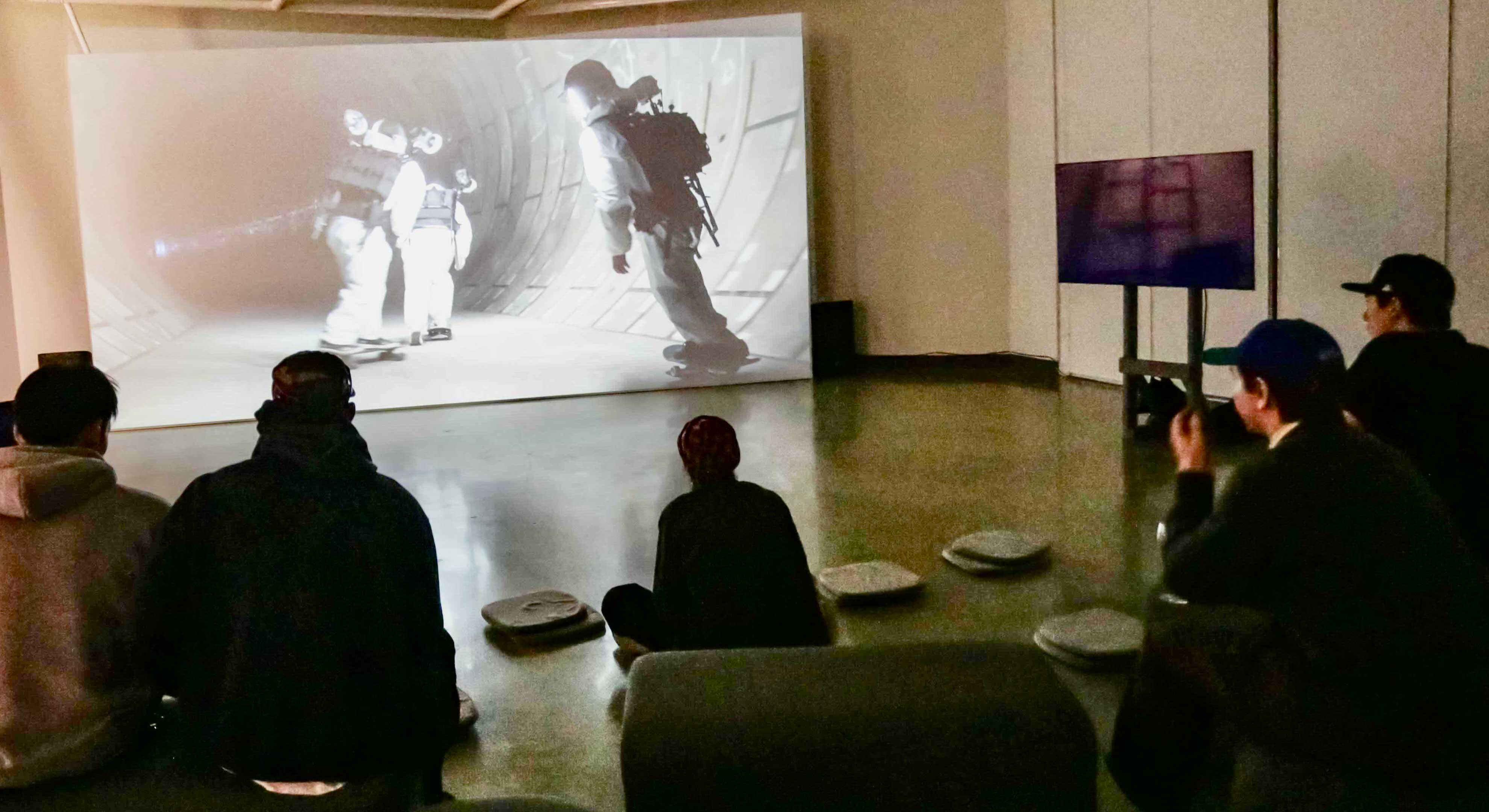
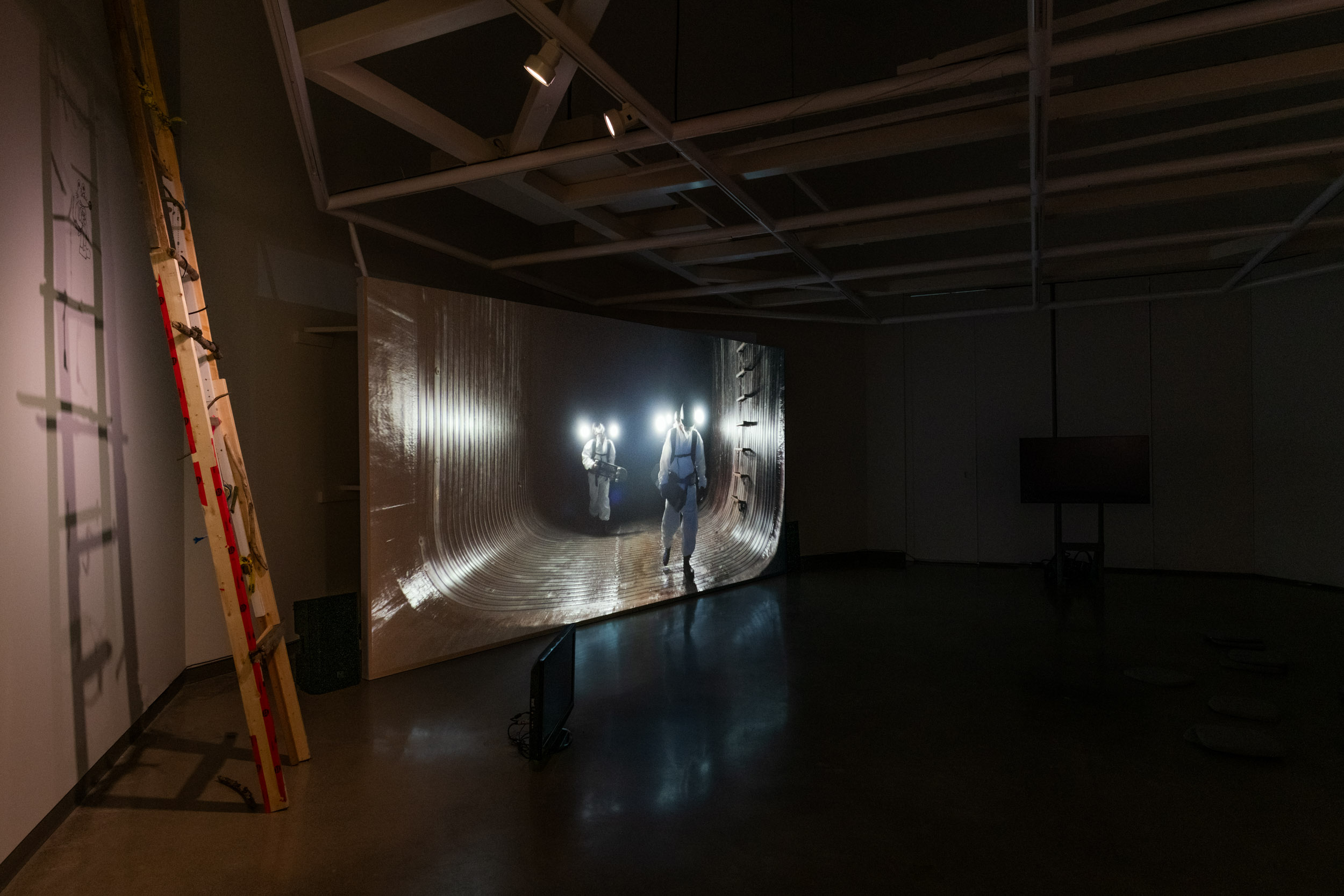
The multi-channel video installation rode work ver. under city, created in 2023, is housed in one the Richmond Art Gallery’s larger spaces. In addition to a main screen, the work makes use of the gallery’s vaulted ceiling to situate another screen that flares to life during the work’s 17-minute run time.
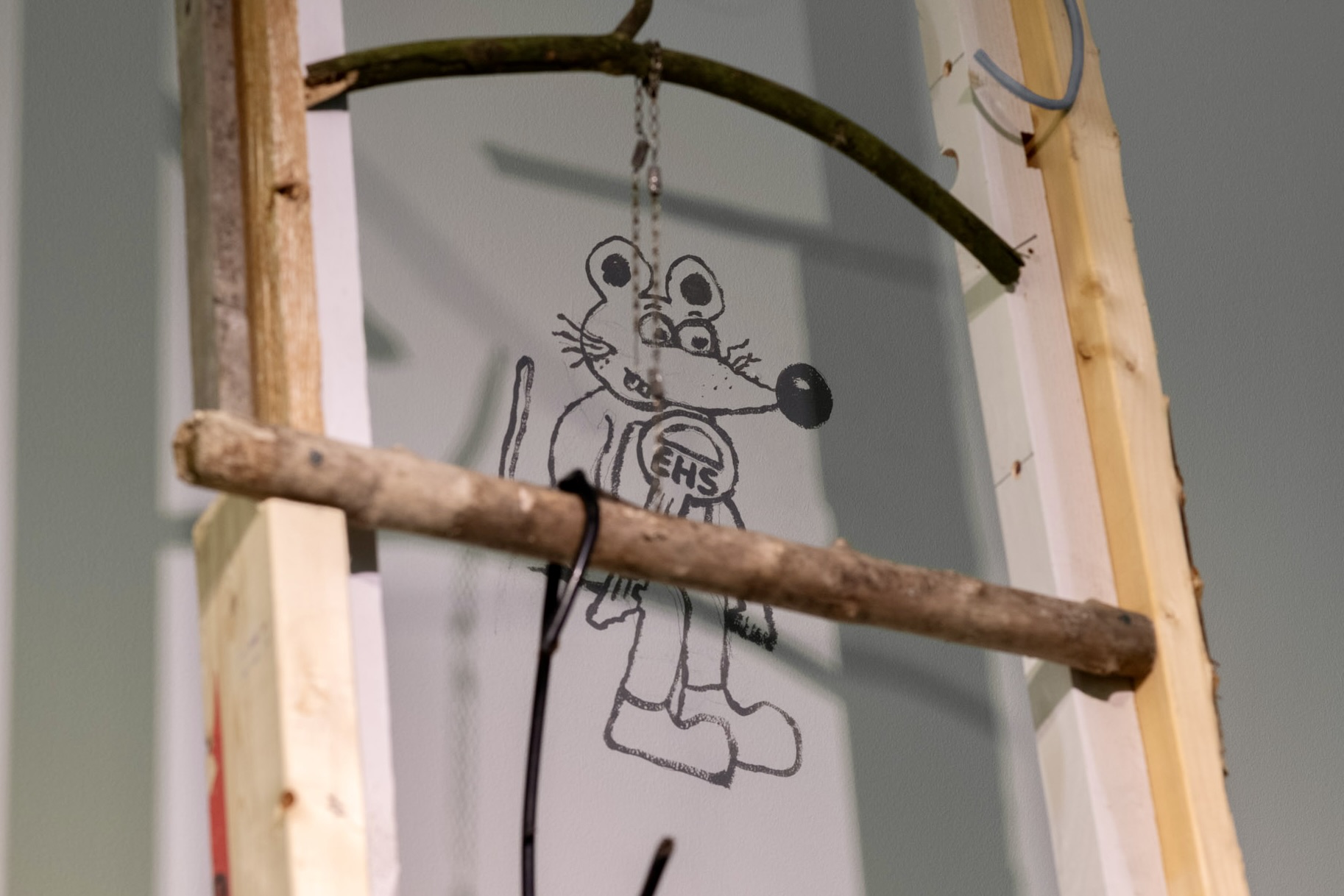
There are several ancillary objects that speak to the underground nature of the installation, including a ladder fashioned from sticks that were found onsite in Richmond, a large sculpture of a blind mole character and graffiti of a rat with a key.
While some of these elements are clear in their function, others are more obscure.
What does that rat need with a house key?
A project born against the backdrop of gentrification
On the surface, rode work documents the progress of three skateboarders making their way through the massive labyrinth of tunnels that make up the underside of downtown Tokyo. The city’s underground flood protection system is a feat of engineering. I feel like another word is necessary to summon the true scale of the infrastructure designed to protect the city from catastrophic flooding from storm surges, typhoons and other extreme weather events.
Completed in 2006, the underground tunnel project took more than 14 years to build and cost $2 billion. It is truly something to behold. The flood fortress, referred to colloquially as the Underground Temple and formally known as the Metropolitan Underground Discharge Channel, resembles something out of The Lord of the Rings, such is its size and magnificence.
The space has a legion of tunnels, underground vaults and service elevators. If you’re a skateboarder, your first inclination might be to explore it on wheels, and that’s pretty much exactly what happens.
Working with the Far East Skate Network, Side Core has fashioned a deeply resonant work that calls up a multitude of references from The Lord of the Rings to Bladerunner. And even Teenage Mutant Ninja Turtles.
Dressed in hazmat suits and facemasks, the three skateboarders make their way deeper and deeper into the bowels of the city. The space unfurls before your eyes, a ribbony series of maintenance tunnels and vaulted chambers, some still dripping with water.
The eeriness of the experience is only one aspect; even more compelling is the desire to see more of this mysterious space, to go further and deeper in search of some subterranean epiphany. What does one find at the very bottom? The shortest answer is water.
Richmond shares some commonalities with the city of Tokyo, notes Richmond Art Gallery curator Shaun Dacey. Both centres were built on a floodplain, and both share the threat of flooding and seismic instability.
Like Metro Vancouver and Richmond, Tokyo also invested enormously in megaprojects, ostensibly tidying up the city in advance of the 2021 Olympics. This had the effect of pushing underground culture, well, underground.
“This project was born against the backdrop of Tokyo’s gentrification triggered by the 2021 Olympics,” notes Side Core member Tohru in the press materials for the show.
“While skateboarding became an official Olympic sport and athletes became national heroes, the accompanying ‘urban cleanup’ led to stricter crackdowns on street skating.”
Hounded and harried from public spaces (think of the ongoing struggles between skaters and the Vancouver Art Gallery), Tokyo’s skateboarders found a home for themselves in the empty, cavernous spaces that limn the city’s underground limits.
Implicit in the work is a sense of liberation, of being set free and allowed to move unencumbered in spaces that lend themselves so well to moving on four wheels. All that smooth polished concrete must be something of a skateboarder’s dream come true.
Epic, cinematic, human
The choreography of the work is epic and cinematic, yet human in scale. As the three figures loop in and out, gliding in seamless rhythms, it’s hard not to see the installation as akin to a ballet. Like dance, narrative is part of the work, but it’s also not the most compelling aspect.
Movement for its own sake is fascinating enough, but the larger picture flickers in and out of focus. When the camera zooms in to observe details such as the desiccated remains of sea creatures washed into the storm drains and left to slowly die in solitude and darkness, the larger picture emerges.
There’s impermanence, yes, but also the hubris of what we humans have wrought, Ozymandias-style.
In a statement about their work, Side Core sketches out the larger intent of their explorations.
“When one spends time underground, in tunnels, in construction sites, on streets in the middle of the night, and in other dark areas of the city, one perceives the shape of the city through one's internal/physical senses, and the city as defined on a map becomes distorted.
“This visualization of loophole-like spaces/situations in the landscapes that we normally see in our daily lives spurs us to take action that deviates from the norms of our daily behavior. However, this is not the result of our own imagination alone, but rather an act of inheriting a vision of the city that someone once saw and passing it on.
“It is a reaction like the butterfly effect, a phenomenon in which a small game born somewhere in the world is incorporated into the urban systems of countries around the world through the actions of people from diverse backgrounds.”
The case for the poetic city
It’s interesting to think about the Richmond exhibition in light of a February 2026 debate about the future of Granville Island in Vancouver, which tackled the incipient changes that are well on their way.
One commentator in the audience that night made the point that planning, at least from a political standpoint, doesn’t really go beyond four-year periods.
How Tokyo has contended with the issue stands in marked contrast to Vancouver, which seems to largely approach things to the tune of, “Let’s talk a lot, but do very little.”
The repercussions of rising sea levels on major urban centres are manifold and profound. Although Side Core’s work doesn’t seek solutions, it offers something else that is perhaps even more impactful. Namely the inextricable connections between humans, their built environments and the infinitely greater forces of the planet itself.
In summoning these deep-seated connections, a certain poetry is necessary. A passage from Side Core’s statement about the work, moving from the micro to the macro and back again, is particularly evocative in tying together what’s present in a city, but isn’t always noticeable.
“Someone said, ‘In the basement of a certain building in the city, you can hear the murmur of a culverted river late at night.’ When we actually visited there, we found that during the daytime we could not hear it because it was blocked by the hustle and bustle of the city, but when the city quieted down at night, we did indeed hear a sound like flowing water.”
It is fitting that Side Core’s installation ends not with the engineering marvel of massive culverts built to withstand the volatility of the natural world, but rather the humble reality of a fish moving in shallow water, doing its utmost to simply survive and continue.
One day, we might feel like that fish trying to navigate a rapidly changing world.
‘SIDE CORE: under city’ runs until July 5 at the Richmond Art Gallery. ![[Tyee]](/design-article.thetyee.ca/ui/img/yellowblob.png)
Read more: Art, Urban Planning






Tyee Commenting Guidelines
Please note that email notifications for replies are not currently working due to a software issue which may be resolved in a future update.
Comments that violate guidelines risk being deleted, and violations may result in a temporary or permanent user ban. Maintain the spirit of good conversation to stay in the discussion and be patient with moderators. Comments are reviewed regularly but not in real time.
Do:
Do not: