

 SHARE:
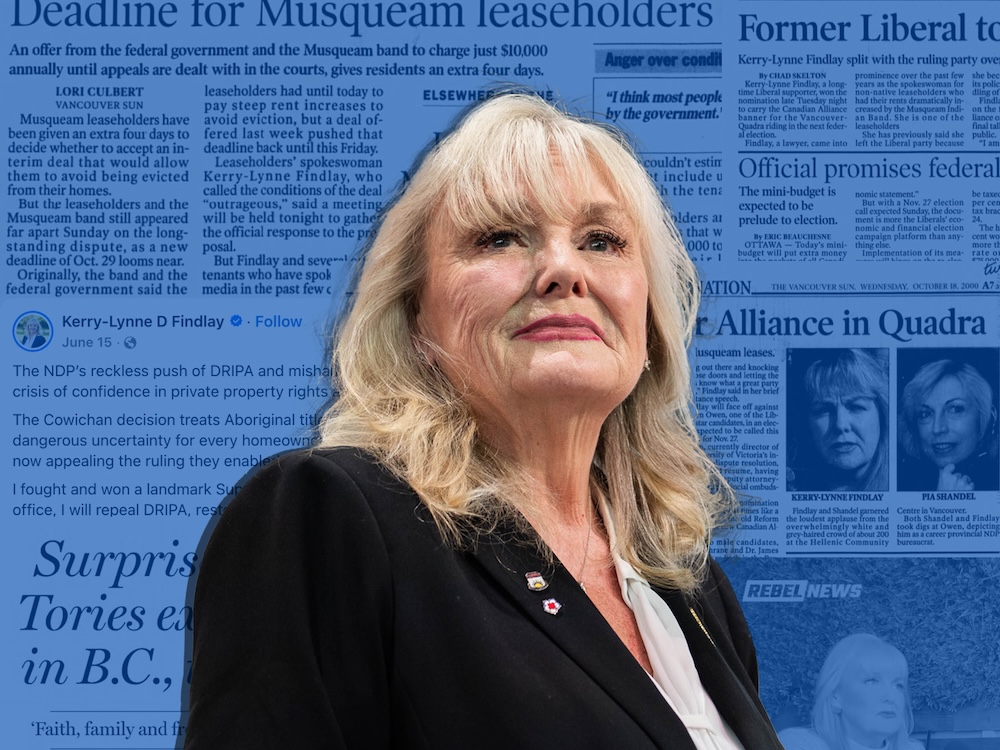
It was November 2000, and victory had just been declared in a legal case that had been making headlines for years. The high-profile court battle had pitted the Musqueam band against leaseholders challenging huge rate increases. A Supreme Court decision had severely curtailed the amount the Musqueam could charge. One of the leaseholders, a former Ladysmith resident with a law degree from UBC, had helped lead the legal fight.
“This decision means that this has now become a community where it is possible to live,” said Kerry-Lynne Findlay. “It's now possible to survive economically.”
The Musqueam leaseholders’ case marked the introduction of Findlay to the public sphere. She would eventually go on to win a seat in Parliament for Delta-Richmond East and serve in the cabinet of Prime Minister Stephen Harper. After an up-and-down career in federal politics, Findlay re-emerged in 2026 as the leader of the resurgent Conservative Party of BC.
Now she is running to claim the provincial riding of Abbotsford-Mission, hoping to lead her party from inside the B.C. legislature. As the B.C. Conservatives churn with dissent and defections, Findlay has held to a hard-line agenda that separates the pragmatic from the true believers. The Sept. 26 byelection is shaping up as a referendum on a leadership tenure in danger of foundering almost as abruptly as it began.
The Tyee asked the Conservative Party of BC for an interview with Findlay or another representative, but did not receive a response.
Findlay was born in January 1955, one of seven children. Her older brother Greg had a long CFL career as a BC Lions linebacker, and Findlay's father Stephen, an electrician, previously played for the Hamilton Tigers (before the team merged with the Hamilton Wildcats to become the Hamilton Tiger-Cats). According to a 1997 article in the Vancouver Bar Association’s magazine, The Advocate, she graduated from the prestigious Crofton House School in Kerrisdale and proceeded to study at UBC, first earning degrees in history and political science before adding a law degree in 1978. Findlay went on to a distinguished legal career, culminating in her appointment as Queen's Counsel in 1999. She later served as a member of the Canadian Human Rights Tribunal.
Politically, Findlay started out as a Liberal. She was active in the federal party, serving as a convention delegate and an executive in the Vancouver Centre riding association. Her first husband, Arthur Boyd Ferris, was a prominent Vancouver lawyer who had been a top Liberal strategist in Ottawa — in 1968, Ferris chaired Pierre Elliot Trudeau's campaign committee when he captured the Liberal leadership.
He and Findlay had two children before Ferris died suddenly of a heart attack in 1989. Findlay later spoke of being “suddenly widowed, with two young children,” and moving to a house on Musqueam territory in southwest Vancouver. She subsequently met Brent Chapman, an actor in TV commercials whose career would eventually include horror movie sequels like Halloween: Resurrection and Freddy vs. Jason. They were married in 1993 and Findlay had two more children.
Findlay's political orientation seems to have changed drastically by 2000. Her first foray into elected politics was as the unsuccessful Vancouver Quadra candidate of the Canadian Alliance, the successor to the right-wing Reform Party. By the time of her candidacy, Findlay had gained considerable media attention as the public face of the Musqueam leaseholders in their legal fight against the band.
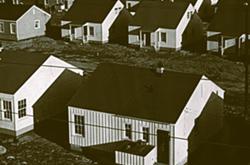
In the 1960s, the Musqueam First Nation had leased lots on its reserve land in southwest Vancouver to non-Indigenous families. Homeowners owned their houses but paid rent to the band for the land. The rents had been quite low, ranging around $400 annually. But in 1995 the Musqueam announced they would be upping the rent to $36,000 per year for each lot.
The homeowners sued. They claimed that because they did not own the land, it did not carry the same value as fee-simple property.
“What had been a peaceful neighbourhood changed dramatically when taxes tripled and the Musqueam First Nation sued 150 families, including mine, over a dispute about the annual lease payments,” Findlay later wrote. “We made a fair offer. They refused to meet with us and took us to court instead.”
Her second husband was prominent in the legal fight as well. “Nothing in the contract says we would be subject to native law or taxation by the Musqueam Indian band,” Chapman told a Vancouver Sun reporter in 1999.
In 2000, the Supreme Court ruled the rent increases would be capped at $10,000 — still a significant increase, but nowhere near the proposed 9,000 per cent rise the band had been seeking.
Although the leaseholders won their fight at the Supreme Court, Findlay would suffer serious financial consequences. The legal battle and its conclusion severely impacted the value of homes on the Musqueam territory. Banks would not issue loans on the properties. Findlay found herself in deep difficulty, with assets of $175,000 against debts of $557,000.
“It isn't as if they took my title away,” she said later. “But they sucked all the equity out.”
Findlay declared bankruptcy.
This would eventually lead to one of the oddest political incidents of the Stephen Harper era. In 2011, Findlay was seeking the Conservative nomination in the federal riding of Delta-Richmond East. Her bid was unsuccessful, as Dale Saip clinched the nomination. But it then emerged that Saip had a dark secret: bankruptcies. Saip had declared bankruptcy three separate times, in 1993, 2004, and 2005. Saip bowed to pressure and resigned his candidacy. His replacement, naturally, was the runner-up. After all, Findlay had only gone bankrupt once.
According to a March 2011 story in the Vancouver Sun, a Conservative Party representative who questioned Findlay about her bankruptcy said that “Findlay explained that her bankruptcy was in part because of the costs of waging the court fight, several deaths in the family, and ‘someone left her a lot of debt.’”
Findlay won her seat in the May 2011 general election. In a final twist, Findlay became Harper's Minister of National Revenue in 2013. Years after suffering bankruptcy, Findlay was put in charge of a $4.3 billion budget.
A tumultuous time for federal Conservatives
In 2015, Findlay's federal career subsequently ran into serious headwinds when she lost the Delta riding to the Liberals. Two years later she contested the South Surrey-White Rock riding, but lost to Liberal Gordie Hogg. A rematch was held in 2019, and this time Findlay came out on top. She was back in Parliament, albeit this time on the Opposition benches. The Findlay-Hogg rubber match was held in the 2021 election, with Findlay winning again.
In August 2020, Findlay reposted and commented on a 2009 interview then-Finance Minister Chrystia Freeland had done with billionaire George Soros; Findlay’s post warned about the apparent closeness between Freeland and Soros shown in the video clip. Soros, who is Jewish, is a frequent focus of anti-Semitic conspiracies on the far right.
Findlay quickly deleted the post and apologized: "I thoughtlessly shared content from what I am now learning is a source that promotes hateful conspiracy theories. I have removed the tweets and apologize," she wrote.
It was a tumultuous time for the federal Conservatives — leader Erin O'Toole was ousted in February 2022. An interim leader was needed and Findlay threw her hat in the ring, but Candice Bergen was chosen instead. Still, things were looking up for Findlay after Pierre Poilievre won the leadership: in September 2023, she was named Chief Opposition Whip.
Meanwhile Chapman followed his wife into politics, running for the riding of Surrey South with the Conservative Party of BC in the 2024 provincial election.
During the campaign, Chapman’s past record of making extreme social media statements came to light. In 2015, Chapman made a Facebook post that called for a boycott of Air Canada to protest the airline's role in bringing Syrian war refugees to Canada. That same year he declared on social media that co-existence with Muslims was impossible, and referred to Palestinians as “inbred, walking, talking, breathing time bombs.” He also questioned the reality of mass shootings, including a 2017 shooting at a Quebec mosque. His comments were described as unacceptable by many people including, eventually, Chapman himself.
In an interview with CKNW host Jas Johal, Chapman insisted that the remarks no longer reflected his opinion or character. He later said he had received legal advice not to further discuss his earlier social media statements. In the months leading up to the 2024 provincial election, Chapman cited alleged sinister conspiracies by the United Nations and the World Health Organization, and said allegations of unmarked grave sites at residential schools were a “massive fraud.”
The political effect of Chapman's statements is debatable. They certainly didn't hurt Chapman himself—he was elected to the BC Legislature with almost 59 percent of the vote. Did the controversy affect his wife? Findlay would lose her federal seat in 2025, a setback that may have had more to do with a national Liberal wave in response to threats from President Donald Trump.
Shifting to provincial politics
After losing her federal seat, Findlay dabbled in Surrey municipal politics while preparing for her next move, becoming an advisor with the municipal Conservative Electors Association.
She also fended off reports of an Elections Canada investigation related to her most recent federal campaign. Reporter Rob Shaw wrote that the allegations involved the use of foreign canvassers, as well as alleged money and services obtained from a corporation in exchange for promises of federal contacts.
“The allegations are completely false and untrue,” Findlay told reporters before leaving without taking questions. It would not be the last time Findlay would be accused of engineering a political quid pro quo.
In 2026, Findlay shifted to provincial politics, declaring her candidacy to lead the suddenly prominent BC Conservatives. Despite having led his party to a stunning political rise in 2024, coming from nowhere to the brink of government, BC Conservative leader John Rustad faced widespread dissension from his caucus. The party suffered defections, while Rustad expelled others. Eventually, the dissent led Rustad to step down.
It was clear by this time that Findlay was no liberal, capital “L” or otherwise. She has described SOGI (Sexual Orientation and Gender Identity) programs as “radical gender ideology” and “indoctrination,” and has promised to repeal DRIPA (the Declaration of the Rights of Indigenous Peoples Act).
What caused Findlay's transformation from Liberal Party activist to hardline social conservative?
“As people get older they tend to get more conservative in a small 'c' sense of the word, more cautious,” says Hamish Telford, associate professor of political science at the University of the Fraser Valley.
“Whereas Ms. Findlay has not only become politically more conservative, she has… become radicalized,” Telford said. “But why that trajectory took place, I can't say.”
Was it simply a function of a new marriage creating a new social circle? Was it just the gradual emergence of views Findlay had privately held all along? Was it Findlay's central role in the bitter Musqueam lease dispute?
She has cited the Musqueam dispute as a central aspect of her political career.
“I fought and won a landmark Supreme Court of Canada case defending property rights,” Findlay said in a June social media post. “In office, I will repeal DRIPA, restore legal certainty, and put British Columbians’ property rights first.”
“We should have a conservative as the leader of the BC Conservatives,” Findlay told the crowd at the April 8 Juno News leadership debate. “That should not be an amazing concept.” She condemned candidates Caroline Elliott and Kamloops Centre MLA Peter Milobar for previously supporting SOGI, DRIPA, the carbon tax, and for criticizing the Freedom Convoy, a stance that Findlay said was “not conservative.”
The May 9 Global News debate would prove more controversial. During one exchange, Findlay suggested Milobar had a conflict of interest on Indigenous issues because he was married to an Indigenous woman. Milobar called the charge “ridiculous.” Kamloops-Thompson-Cariboo Conservative MP Frank Caputo later called Findlay's remarks “atrocious,” and Cariboo-Prince George Conservative MP Todd Doherty called the comments “abhorrent.”
The race ultimately came down to five candidates, including Elliott and Milobar. Polls appeared to show Elliott in the lead. At the May 30 party convention, the fourth ballot featured a showdown between Elliott and Findlay. The final margin was 51 to 49 percent. Findlay was the new BC Conservative leader, and immediately promised to heal the divisions made evident by the vote split.
She also indicated the party would be headed in a much more overtly socially conservative direction when she said in her acceptance speech that the party would be focused on “faith, family and freedom.”
Almost immediately, Findlay put her own stamp on the party. She promoted Heather Maahs, the Conservative MLA for Chilliwack North, to be interim leader of the Opposition. Maahs had previously invited an organization called the Association for Reformed Political Action to the B.C. Legislature. ARPA opposes abortion and same-sex marriage and believes that “Jesus Christ is sovereign over all, including all civil governments.”
In response to Maah’s new position, Elenore Sturko, a former BC Conservative MLA who opposed Maah’s invitation to ARPA, called Findlay’s stance “quite a Christian nationalist and biblical governance position,” according to a report by CBC.
According to an April article published on the Church for Vancouver’s website, Findlay herself is an “active member” of All Saints Community Church in Surrey. The All Saints congregation is part of the Anglican Mission in Canada, a breakaway church formed in the early 2000s by religious leaders who did not agree with the Anglican Church’s decision to allow blessings of same-sex unions.
According to the Church for Vancouver, Findlay said at an April talk to congregants that she believes “we need to unite and fight because I don’t think it’s an exaggeration to say we’re in a contest of good and evil.”
“I am running for the leader of the Conservative Party of BC. Why am I doing that? Because, first of all, we need to change the government of this province. And the Conservative Party of BC, at least for now, is the only vehicle through which that might happen,” she said.
“I have faith that it’s possible because I believe God wouldn’t have asked me to embark on this journey in his name if he didn’t know how I’d get there.”
Nine MLAs quit the B.C. Conservative after Findlay takes over
While Findlay promised her apparently divinely sanctioned Conservative Party of BC would be a “big tent party,” it hasn't worked out that way. Since her victory, a parade of nine MLAs has quit the caucus, including Milobar and Richmond-Bridgeport MLA Teresa Wat, who Findlay had once accused of belonging to the Chinese Communist Party.
Chilliwack-Cultus Lake MLA Áʼa:líya Warbus, a member of the Stó:lō Nation, told The Tyee's Tyler Olsen that she disliked the party's us-vs.-them philosophy on Indigenous issues. “I just felt like the approach was not working,” she said, explaining why she made the decision to leave the party.
While the caucus defections are the most obvious signs of dissension, there has been considerable turmoil elsewhere. Chief of staff Chris Delaney resigned, and Apollo Chung, the party’s director of operations and stakeholder relations, who had previously worked with Alberta separatists, was fired from his position after the release of an audio tape which seemed to record his desire to personally profit from party fundraising. Chung has since claimed the tape was “doctored,” and accused departing Delaney of racial bias.
Another leaked tape seemed to show Findlay promising a senior advisor position to any caucus member who would resign their seat for her. Departed MLA Ian Paton, who previously said he had been offered a job if he would resign his seat, says he has been interviewed by the RCMP about the tape, which might be evidence of illegal office selling. Findlay calls the claim “baseless.”
Abbotsford-Mission MLA Reann Gaspar resigned from caucus on Aug. 22, clearing the way for the Sept. 26 by election that will allow Findlay to run for a seat. Gaspar was then appointed Findlay's chief of staff, replacing Delaney.
Many of the departing MLAs have cited Findlay's divisive style as a key reason for their decisions to leave the BC Conservatives. Findlay's current political approach might have been best encapsulated in a BC Conservative video posted to Facebook in August. It begins with a manipulated image of Premier David Eby in what appears to be a Soviet general's uniform. While Russian military music plays, the video accuses Eby of starting a “culture war,” then goes on to imply that the NDP shrugged off 2021 arson attacks on First Nations churches, encourages small children to become gender fluid, and pressures institutions to “view people through the lens of race, identity, and historical guilt.” It is Eby, the video insists, who engages in culture wars.
Kamloops-North Thompson Conservative MLA Ward Stamer did not seem to endorse the video. “People are having a hard time putting food on their table, and we’re having a hard time keeping everybody working,” Stamer told a reporter. “That’s what’s on my mind right now. I’m not thinking about culture wars.”
Telford says the political right has fractured.
“The old formula that united the right in B.C., going back 80 years, no longer exists. That formula was to focus on economic and fiscal matters. They put their social differences aside. That was how a pro-choice liberal like Christy Clark could have Rich Coleman, a pro-life social conservative, as deputy premier,” he said.
“Nowadays, populist conservatives are animated by these very divisive social issues, and they're not going to stop. They don't care about deficits, marginal tax rates, corporate tax rates, and so on. So there is no basis for unity anymore. As long as people like Kerry Lynne Findlay tap into those populist concerns, there is no uniting the right.”
Donald Trump has been described as a cult leader. Telford believes the tag could be applied to Findlay as well.
“It's just a smaller cult,” he says. “The U.S. cult is big enough to deliver victory for Trump. It's big enough in Alberta to deliver victory for Danielle Smith. In B.C., it's just not big enough to deliver victory for Findlay. It's big enough for her to disrupt the system, big enough for the B.C. Conservatives to take 15 or 20 seats. But they're not going to get 50 seats to form a government. It also means any other party that forms on the centre-right is going have a ceiling of about 30 seats.”
Several of the departed Conservative MLAs have announced plans to form a new party caucus in the legislature. With more caucus departures rumoured, Findlay faces a competitive race in Abbotsford-Mission against NDP candidate Pam Alexis. Others running include CentreBC candidate Lakhwinder Jhaj, BC Green Party candidate Stephen Fowler, and Libertarian candidate Jeff Monds. A Findlay victory could give the B.C. Conservative leader some much-needed breathing room, along with a chance to face the government in question period. Any more losses will make it difficult for Findlay to shift the focus away from her own struggles. By-elections are typically seen as referendums on the government. This one will almost certainly provide a crucial judgement on the Leader of the Opposition.
But Telford believes Findlay will hang on regardless of the outcome on Sept. 26.
“The most intense pressure would have come from people who have already left the party,” he says. “Her base supports her. They want her to do this stuff. She has reorganized the party apparatus to have supporters in place. I've been reminded of Margaret Thatcher saying about herself, 'The lady's not for turning.' Kerry-Lynne Findlay doesn't seem for turning.”
Despite ongoing pressure from outside critics and inside her own caucus, Findlay said as much following her speech last Thursday to delegates at the Union of BC Municipalities convention. The evening before the speech, she had reportedly been asked to step down by two of her MLAs; another MLA, Claire Ratée, wrote a Substack post pleading with the leader to do a better job of communicating with her caucus.
Late Thursday, CHEK News broke the story that the Conservative Party of BC had hired a private investigator to examine not only former Conservative MLAs and staffers, but its own political columnist, Rob Shaw.
Amid it all, Findlay held firm.
“I'm not going anywhere, as I said in my speech just now,” Findlay told reporters. “We have a young party — it's still in its growing pains.” ![[Tyee]](/design-article.thetyee.ca/ui/img/yellowblob.png)
Read more: Politics, BC Politics



Tyee Commenting Guidelines
Please note that email notifications for replies are not currently working due to a software issue which may be resolved in a future update.
Comments that violate guidelines risk being deleted, and violations may result in a temporary or permanent user ban. Maintain the spirit of good conversation to stay in the discussion and be patient with moderators. Comments are reviewed regularly but not in real time.
Do:
Do not: