


 SHARE:
What does it mean to be Canadian at a moment of geopolitical uncertainty? Can deeply polarized democracies find their way back to common ground? What will artificial intelligence do to work — and how will humans learn to work alongside robots? What can Indigenous art teach us about land and knowledge? Why does medicine still struggle to understand pain? And why, amid all the troubles of the world, do we take such pleasure in a good murder mystery?
These are among the questions that will bring audiences to the University of British Columbia this fall for the 111th year of the Vancouver Institute’s free public lectures.
For more than a century, the Vancouver Institute has created a meeting place between the university and the wider community. Its premise is simple: important ideas should be discussed in public. Scholars, writers, scientists, artists and public figures are invited to share their work with audiences from across Vancouver and beyond. The lectures are free and, with one exception this fall, take place on Saturdays at 7:15 p.m. in Lecture Hall No. 2 of UBC’s P.A. Woodward Instructional Resources Centre.
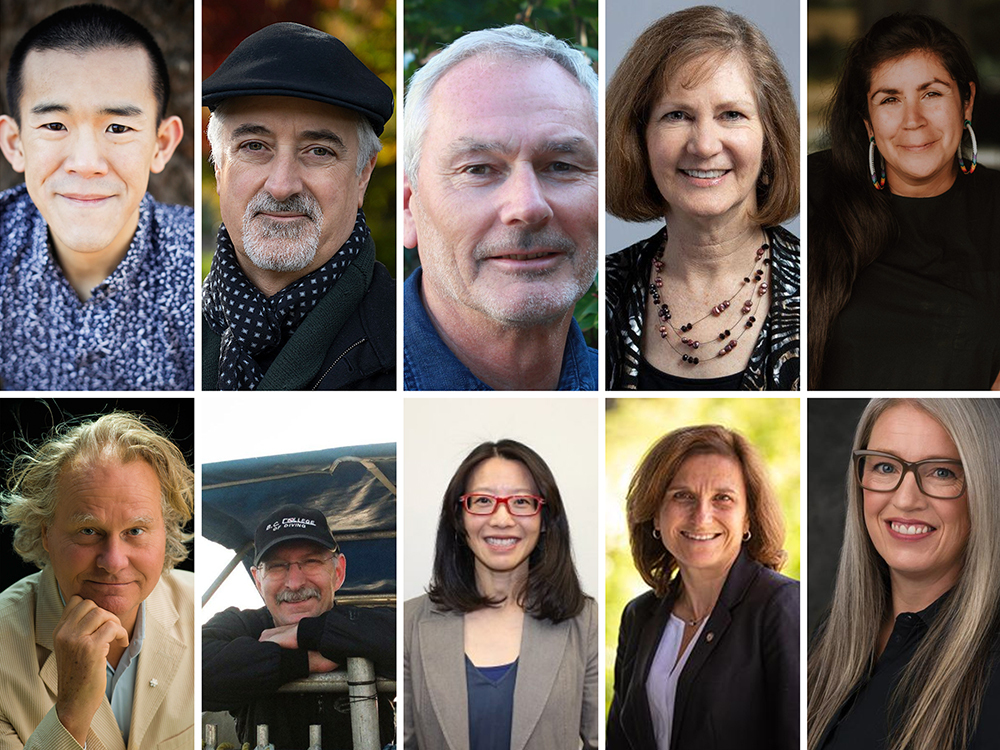
The fall season opens on Thursday, Sept. 17, with Pulitzer Prize-winning science writer Ed Yong, in a special Dal Grauer memorial lecture presented with Green College. In “Telling Stories of Nature in Times of Darkness,” Yong will consider the importance of writing about nature at a time when environmental and political anxieties can make it difficult to look at the natural world with wonder. Yong, whose reporting on COVID-19 won the Pulitzer Prize, is also the author of An Immense World, an exploration of the extraordinary sensory worlds inhabited by other animals. This special opening lecture will be held at the UBC Old Auditorium at 5:15 p.m. and requires registration with Green College.
On Sept. 26, UBC political scientist Maxwell A. Cameron turns to Canada’s relationship with its increasingly unpredictable neighbour. “Divided We Fall: Why Canadians Need to Be Strong and United Against Trump” asks what Canadians can do to defend their sovereignty, democratic institutions and capacity for collective action at a time when the international order is under strain. The lecture considers not only the challenge posed by Donald Trump, but a question closer to home: whether Canadians can overcome their own political divisions when circumstances demand it.
Technology presents a different kind of challenge. On Oct. 3, Cardiff University sociologist Phillip Brown examines “The Future of Work in an Age of AI.” Predictions about artificial intelligence range from unprecedented gains in productivity to the disappearance of entire categories of employment. Brown, whose research has influenced governments and international organizations around the world, asks what the AI revolution will actually mean for jobs, skills, education and inequality — and who is likely to benefit from the transformation.
The health of democracy itself comes into focus on Oct. 17. Political scientist Jennifer McCoy, one of the leading international scholars of political polarization, asks “How to Depolarize Democracies.” McCoy coined the influential idea of “pernicious polarization” to describe situations in which political differences harden into opposing camps and begin to threaten democratic institutions themselves. Drawing on research and practical experience with democratic conflict around the world, she examines a difficult but increasingly urgent question: Once societies become deeply divided, how can they find a way out?
On Oct. 24, Secwépemc artist, curator and writer Tania Willard, winner of the 2025 Sobey Art Award and director of UBC’s Morris and Helen Belkin Art Gallery, approaches questions of knowledge from a very different direction. “Transformations: Indigenous Art and Land as Knowledge” explores relationships among artistic practice, land, community and environmental stewardship. Willard’s work challenges audiences to think about art not simply as representation, but as a way of knowing and sustaining relationships with place.
A week later, on Oct. 31, anthropologist and bestselling author Wade Davis turns his attention to Canada itself. In “North Star: Reflections on Canada and Being Canadian,” Davis brings the perspective of a lifetime spent travelling, writing and thinking about cultures around the world to the question of Canadian identity. At a time when Canadians are once again debating what distinguishes their country and what holds it together, Davis asks what Canada has been, what it might become and what it means to call it home.
The series moves beneath the surface — literally — on Nov. 14. Jacques Frederick Marc of the Underwater Archaeological Society of British Columbia marks half a century of underwater archeology in the province with “Dive into History.” Historic shipwrecks scattered along the B.C. coast are not simply relics or diving destinations: they are records of migration, commerce, disaster and the communities that have shaped the province. Marc draws on more than four decades spent documenting and protecting this submerged cultural heritage.
On Nov. 21, UBC legal scholar Joel Bakan turns to the Canadian Charter of Rights and Freedoms at a moment of mounting political and social strain. In Just Rights: The Canadian Charter in Troubled Times, Bakan examines the Charter’s promise, its limitations and the challenges it faces in troubled times. A Rhodes Scholar and former law clerk to Supreme Court of Canada Chief Justice Brian Dickson, Bakan is a Distinguished University Scholar at UBC’s Peter A. Allard School of Law and the internationally bestselling author of The Corporation: The Pathological Pursuit of Profit and Power. His newest book, Just Rights: The Canadian Charter in Troubled Times, is forthcoming in November 2026.
Artificial intelligence returns on Nov. 28, but this time in physical form. Roboticist Elizabeth Croft, vice-president academic and provost at the University of Victoria, asks how humans and robots can learn to work together. Her lecture, “More Than Words,” draws on decades of research into human-robot interaction. As robots move from isolated industrial machines toward collaborative systems designed to work alongside people, the challenge is no longer simply making robots more capable. It is making human-machine interaction safe, predictable and genuinely useful.
The season concludes on Dec. 5 on a rather more murderous note. Award-winning novelist Susan Juby, author of Mindful of Murder and A Meditation on Murder, explores “The Pleasures of Mayhem: The Appeal of the Murder Mystery.” Why do readers find comfort and enjoyment in stories built around acts that would horrify us in real life? Juby, known for combining mystery with humour and sharply observed characters, considers the enduring appeal of a genre in which disorder, suspicion and death can somehow become a source of enormous reading pleasure.
From democracy and Canadian identity to artificial intelligence, Indigenous art, medicine, maritime history and murder mysteries, the Vancouver Institute’s fall program ranges widely. What connects the lectures is less a single theme than a commitment to curiosity: bringing people together to hear from those who have spent their lives thinking deeply about subjects that matter — and giving the public a place to join the conversation.
Except for the opening Ed Yong lecture, Vancouver Institute lectures take place on Saturdays at 7:15 p.m. in Lecture Hall No. 2 of the P.A. Woodward Instructional Resources Centre at UBC. Lectures are free and open to the public. ![[Tyee]](/design-article.thetyee.ca/ui/img/yellowblob.png)
Read more: Education
This article is part of a Tyee Presents initiative. Tyee Presents is the special sponsored content section within The Tyee where we highlight contests, events and other initiatives that are put on either by us or by our select partners. The Tyee does not and cannot vouch for or endorse products advertised on The Tyee. We choose our partners carefully and consciously, to fit with The Tyee’s reputation as B.C.’s Home for News, Culture and Solutions. Learn more about Tyee Presents.








Tyee Commenting Guidelines
Please note that email notifications for replies are not currently working due to a software issue which may be resolved in a future update.
Comments that violate guidelines risk being deleted, and violations may result in a temporary or permanent user ban. Maintain the spirit of good conversation to stay in the discussion and be patient with moderators. Comments are reviewed regularly but not in real time.
Do:
Do not: