


 SHARE:
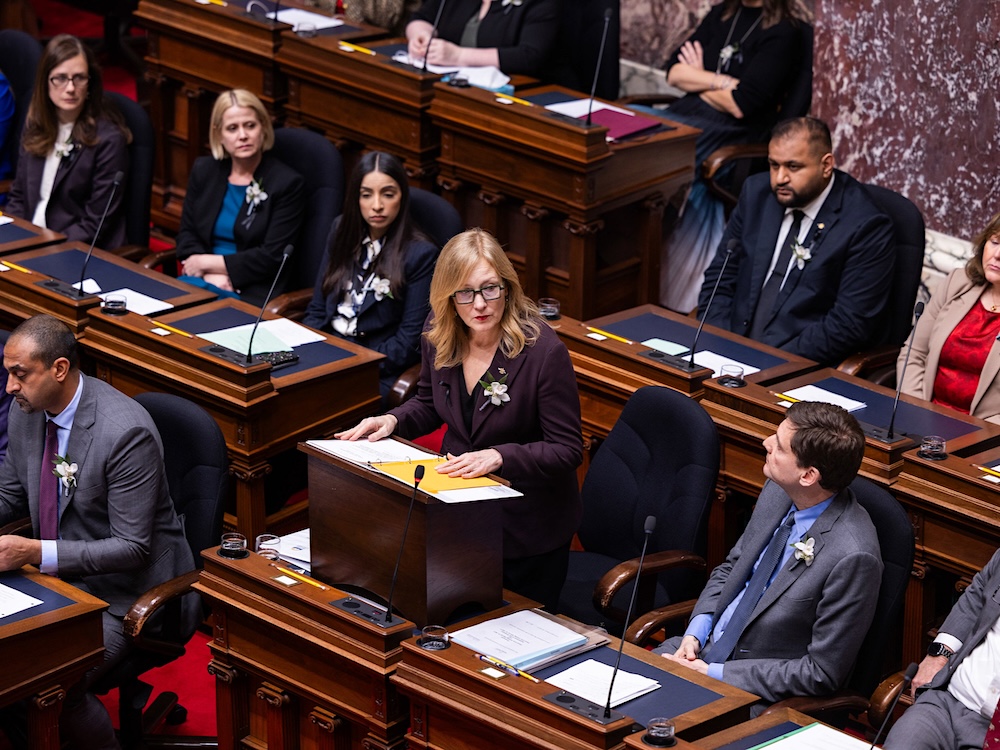
Despite Finance Minister Brenda Bailey’s efforts to put a positive spin on the government’s financial performance last year, things are bleak.
Bailey said the public accounts released this week showed the deficit for the fiscal year ending March 31 was $7.7 billion, well below the $11 billion forecast in the budget six months ago.
The spin worked, with first-day headlines such as “Tighter Spending, More Revenue Brings B.C. Deficit Down to $7.7B, Minister Says.”
But in fact the financial situation is grim, the reduced deficit an illusion and the government apparently adrift.
The reduced deficit came because of a $2.6-billion payment from tobacco companies as part of a national settlement over government lawsuits seeking to recover health costs from the industry. The payment will be made over 18 years, but the government counted all the revenue in the 2024-25 fiscal year.
That help won’t be available in future years.
When David Eby became premier, he inherited a small surplus from the John Horgan government.
His first budget called for a $4.2-billion deficit. The numbers have been steadily climbing, with no plans to make serious reductions. The forecast for this year is a $13.3-billion deficit, with another $23.6 billion in deficits over the next two years.
Deficits aren’t inherently bad. In a recession, government spending can help keep the economy running and provide jobs. Investing in improvements in education and supports for families can save money in the future.
It’s much like the family budget. It can be worth spending borrowed money to retrain for a new line of work, for example, if it will bring increased income in future years.
But simply spending money you don’t have without a plan to repay it is a problem for both governments and families.
Which is where the Eby government finds itself.
The public will also accept increasing deficits, for a time, if the spending is producing obvious improvements in services.
The legislature’s all-party, but NDP-dominated, finance committee presented its report on public consultations for the February budget. It quoted a participant who “expressed concern that public spending growth has not translated into improved service delivery, especially in health care.”
The public accounts show broad health sector spending has increased by about 33 per cent in Eby’s three years as premier — from $30.3 billion in 2022-23 to $40.2 billion last year.
But the public is not seeing significant improvements in care. Emergency rooms are jammed — or closed. The crisis in primary care that has left 1.3 million people without a family doctor or nurse practitioner has worsened. Waits for tests and surgeries remain horrendous.
Bailey also pointed to the government’s efforts in reducing spending. It had set a goal of $300 million for the last fiscal year, and exceeded it with $467 million in savings “through reduced discretionary spending, including travel, office and business expenses, conferences and events, as well as staffing adjustments, voluntary retirements and hiring restrictions.”
But with $80 billion in expenses, the savings are insignificant, the equivalent of a debt-ridden family with $80,000 in income boasting they had cut spending by $467.
And while the government maintains it has taken measures to curb staffing growth, about 11 per cent more people — or full-time equivalents, to use the government’s phrase — are working for the province this year.
The province can, at this point, manage its debt.
But the deficits are already adding to costs. Three credit agencies downgraded the province’s rating this year. Downgrades cast doubt on the province’s ability to manage its debt and can result in higher interest rates for borrowing.
And interest costs rose to $4.9 billion last year, up from $2.7 billion when Eby became premier.
The government has dug itself into a hole, and has no apparent plan to find a way out. ![[Tyee]](/design-article.thetyee.ca/ui/img/yellowblob.png)
Read more: BC Politics









Tyee Commenting Guidelines
Please note that email notifications for replies are not currently working due to a software issue which may be resolved in a future update.
Comments that violate guidelines risk being deleted, and violations may result in a temporary or permanent user ban. Maintain the spirit of good conversation to stay in the discussion and be patient with moderators. Comments are reviewed regularly but not in real time.
Do:
Do not: