


 SHARE:
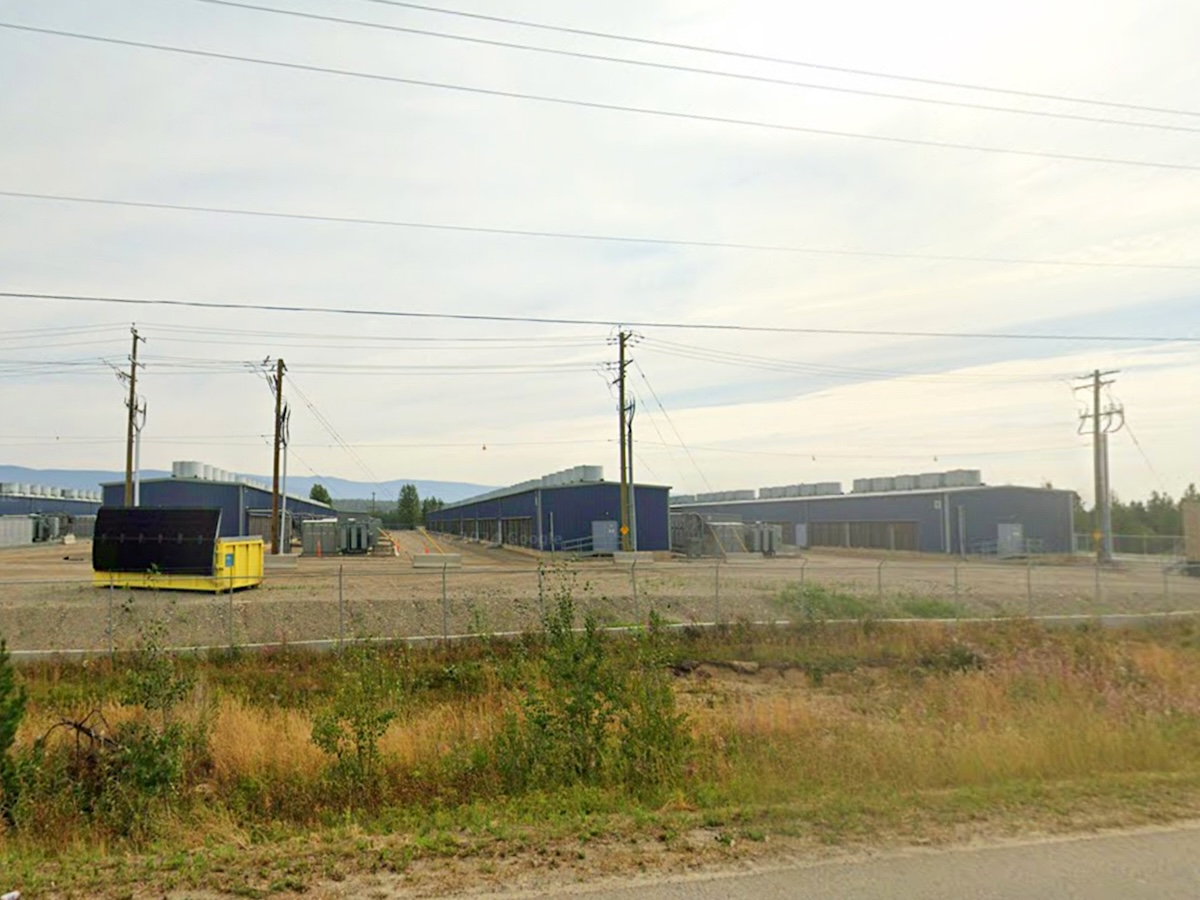
For Mayor Joan Atkinson, the local hyperscale artificial intelligence data centre is a welcome addition to the district of Mackenzie.
About 165 kilometres north of Prince George, Mackenzie was purpose-built around sawmills, a paper plant and other trappings of the forestry industry. And like many small towns across B.C., Mackenzie has been hit hard by a decades-long series of layoffs and mill closures.
For example, Atkinson said the back-to-back closures of a sawmill in 2019 and a pulp mill the year after cost the community about 425 jobs. Not to mention tax revenue. So when Australian tech company Iren approached the local government asking to set up in town, Atkinson said an opportunity presented itself.
“From the get-go, we knew there weren't going to be lots of jobs,” Atkinson said. “But any jobs are better than no jobs.”
The 4.5-hectare facility was initially built for cryptocurrency operations. But Iren has since pivoted the site into an 80-megawatt-capacity data centre that will offer storage space and computing power needed to train and run AI models.
It employs about 60 people in permanent jobs maintaining the centre’s constantly running processing units and servers. It has not affected residents’ electricity rates, and according to Atkinson, it hasn’t majorly disrupted life in Mackenzie.
Still, there’s one major issue: the facility pays property taxes at the same rate a local coffee shop would. Atkinson and the local government are advocating for the province to tax data centres as light industry — which in Mackenzie would approximately triple the town’s tax revenue from the centre.
“Data processing is a pretty new industry in the province and in the country, and it's growing fast,” Atkinson said. “So I think the government is just working to catch up.”
Benefiting from the boom
The property tax proposal is one of the ways municipal governments are trying to ensure their communities can benefit from the boom in data centre development — and not just suffer the externalities.
The types of data centres needed to facilitate artificial intelligence draw significant amounts of power, use large amounts of water as coolant and may generate excess noise and heat.
As Canada scrambles to adopt and control AI, dozens of data centre projects have been proposed across the country — especially in small and rural areas. Now, some B.C. municipal politicians are calling for tax reform, reviewing zoning policies and, in some cases, asking for more time to figure it all out.
There are already dozens of data centres in British Columbia. The vast majority are called “co-location” data centres, which rent out their servers and space to other businesses that need computing hardware and data storage.
These co-location centres require less power than the types of data centres needed to facilitate artificial intelligence, and are thus smaller. Small-to-medium-sized data centres consume anywhere from one to 20 megawatts of power, according to the Canadian Centre for Policy Alternatives.
However, AI companies require vast amounts of physical computing capacity to train and run their models. Developers are starting to build “hyperscale” data centres to enable the use and continued improvement of AI. These are larger facilities that consume about 100 megawatts of power — equivalent to powering up to 75,000 homes at once — or more.
So far, Canada has five hyperscale data centres, two of which are in British Columbia. And dozens more are planned for the province as the federal government looks to build AI infrastructure in Canada.
For example, Telus plans to expand its existing Kamloops data centre and build a hyperscale data centre next to BC Place in downtown Vancouver. Bell Canada has plans to build a six-data-centre “supercluster” in B.C. that will draw more than 500 megawatts of hydroelectric power. And Iren is building out two AI data centres, one each in Mackenzie and Prince George.
Zoning, permitting, wastewater and electricity
The rapid influx of hyperscale data centre projects is forcing municipal governments to react on the fly, said former Saskatoon city councillor Mairin Loewen. She said many municipal governments in Canada don’t have zoning laws that consider the energy use and external impacts of hyperscale data centres.
“This is such a new land use,” Loewen said. “And there's almost an inverse relationship between the size of the project and the size of the municipality in which they choose to locate, so it presents a real administrative challenge.”
Loewen, who is now associate director of climate charity MakeWay’s Urban Climate Leadership project, has spent the past months considering how Canadian municipalities manage the impacts of AI data centre construction on communities.
In addition to power, heat, water and noise issues, some AI data centre projects also come with their own power generation facilities. For example, the proposal for a hyperscale data centre near Olds, Alberta, includes a new natural gas plant to meet the centre’s demand for as much electricity as is used by the city of Edmonton.
“If you're approving a data centre, you may also be approving a massive, heavy industrial land use in the form of a new natural gas power plant,” Loewen said.
“The risk is that a regulating municipality may not even have a concept of what each project looks like and the way it might impact neighbours.”
Cities’ power over data centres primarily lies in their decision-making over water and wastewater and electrical connections, Loewen said. She said cities can also consider how they can change zoning and permitting processes to compel development of the most sustainable data centres possible.
The Iren power plant in Mackenzie is mainly powered by local hydroelectricity. While it does generate noise, Atkinson said it’s been built far enough away from residential areas that it doesn’t bother residents.
The company has also helped pay for fibre-optic infrastructure for the district, Atkinson said, and has committed to $250,000 per year in grant funding for things like financial relief programs, local recreational infrastructure and employment training programs for data centre technicians and network specialists.
But none of those promises are guaranteed by a contract. Loewen suggested municipalities try to get robust community benefits agreements signed with data centre companies to ensure that residents see long-term job creation and aren’t left holding the bag on infrastructure costs, environmental impacts and decommissioning the data centres if they become obsolete.
What other BC municipalities are doing
Some B.C. municipalities are already trying to figure out how to ensure these projects benefit their communities.
In July, OneCity Vancouver Coun. Lucy Maloney tried to get city staff to create a regulatory framework for building AI data centres in Vancouver. Her motion was voted down by the A Better City, or ABC, majority.
A similar motion passed in Prince George last month. At a council meeting Aug. 31, Couns. Garth Frizzell and Brian Skakun called for city staff to look into data centre regulations and policies. Their motion passed unanimously.
Both cities are heading into municipal elections next month.
Meanwhile, some municipal politicians are asking for more time to prepare for data centres. In Vancouver, the Coalition of Progressive Electors, also known as COPE, is calling for a pause on data centre development until more regulations are in place to protect residents and the environment.
BC Green Party Leader Emily Lowan has also called for a moratorium on data centre development.
But while Urban Climate Leadership’s Loewen said these moratoriums might buy municipalities some time, policy at a higher level of government might be more effective.
“It's entirely appropriate for municipalities to enact a pause in order to prepare their policies to grapple with these kinds of land uses,” Loewen said. “But what would be ideal is if Canada came with some regulation or incentive that would protect local governments.”
Meanwhile, municipalities are looking to the province for support. During its September convention, the Union of BC Municipalities voted to endorse Mackenzie’s call for tax reform.
BC Assessment currently classifies data centres as businesses, meaning they pay the same property tax rates as stores, dental clinics and law offices.
The Union of BC Municipalities is calling on the province to classify data centres as light industry to help towns pay for the centres’ significant electricity demands and land-use implications.
In an email to The Tyee, a spokesperson for the B.C. Ministry of Finance said the government reviews property classification each year. They made no indication of whether the government would heed the municipalities’ call.
Still, from Mackenzie, Atkinson said she’s hopeful.
“I think everyone realizes the potential there could be to help support municipalities and the province,” she said. ![[Tyee]](/design-article.thetyee.ca/ui/img/yellowblob.png)
Read more: Labour + Industry, Municipal Politics, Science + Tech












Tyee Commenting Guidelines
Please note that email notifications for replies are not currently working due to a software issue which may be resolved in a future update.
Comments that violate guidelines risk being deleted, and violations may result in a temporary or permanent user ban. Maintain the spirit of good conversation to stay in the discussion and be patient with moderators. Comments are reviewed regularly but not in real time.
Do:
Do not: