


 SHARE:

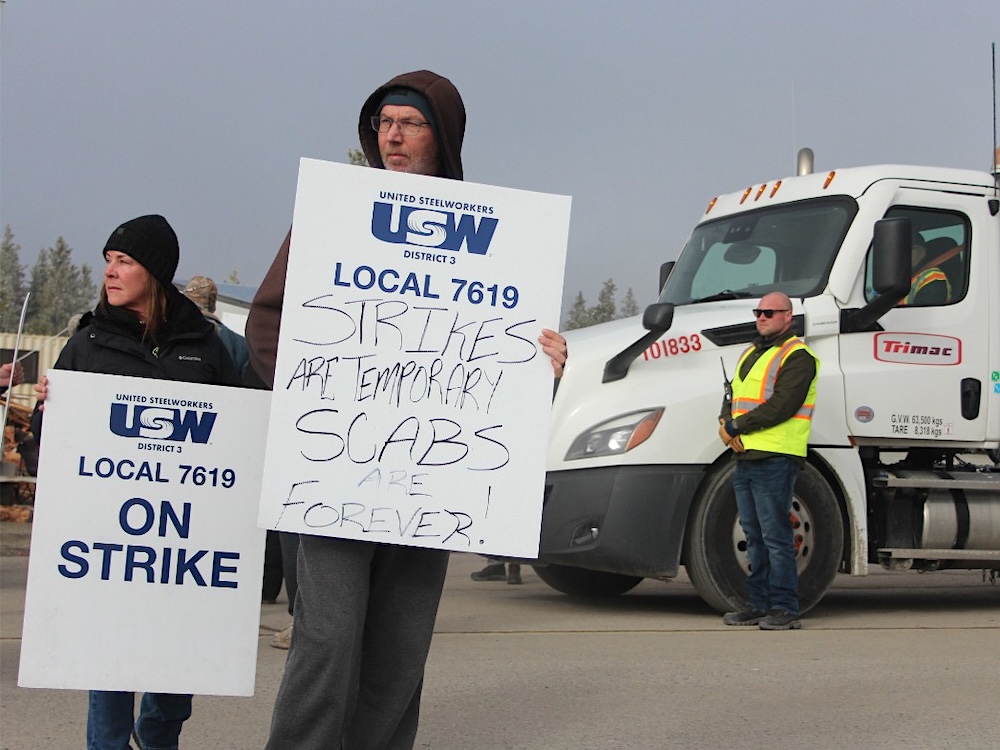
British Columbia’s central labour organization is calling on its affiliate unions, which represent 500,000 workers, not to touch products coming out of the Highland Valley Copper mine while employees are on strike.
The BC Federation of Labour issued the declaration — called a “hot edict” — on Friday, nearly two weeks after more than 1,200 Highland Valley Copper mineworkers walked off the job.
The mineworkers’ union, United Steelworkers Local 7619, said negotiations broke down with the employer over wages, contract work and health and safety issues.
Sarah Payne, a spokesperson for Teck Resources Ltd., said in an email that the Vancouver-based mining company is committed to reaching a fair agreement at the bargaining table.
“Operations are currently continuing at a reduced capacity,” Payne said. “Our focus is on maintaining safe and environmentally responsible operations.”
The BC Federation of Labour, also known as the BCFED, said in a press release Friday the hot edict aims to add more economic pressure on Teck to reach a fair deal.
“A hot edict is an exceptional step to take,” BCFED president Sussanne Skidmore said. “But it’s become clear this employer believes they can wait out their workers and operate around this strike and B.C.’s anti-scab law. And it’s up to all of us to show them how wrong they are.”
The edict calls for affiliated unions and their members not to handle, load, unload, store, transport, ship, process or otherwise deal with affected products. Despite the strike, the Highland Valley Copper mine is continuing to operate at a reduced capacity.
That means managers and supervisors would be operating mining equipment, such as crushers, and putting in long shifts to try to keep the mine running, United Steelworkers Local 7619 president Kyle Wolff told The Tyee Tuesday.
“If they're safe, if they're certified, I have no idea,” he said. “I feel bad for them to some extent. It's not their fault that this is happening. It's the employer.”
The strike is largely over compensation and long-running concerns about health and safety issues, specifically how silica dust is controlled and what workers say is the degrading state of mining equipment.
And while the union did not disclose either side’s exact numbers on wages, Wolff previously told The Tyee the employer asked for a 25 per cent reduction in pensions at the table.
The union’s Western Canada director, Scott Lunny, said in the BCFED’s press release that Teck Resources can afford to pay higher wages.
“They aren’t just failing to pay workers enough to retain them — they’re even asking for concessions,” Lunny said. “No company this profitable should be falling so far short of the wages and pensions they can afford to pay.”
The company is in the middle of a merger with Anglo American, a London, England-based multinational mining company with a market cap of nearly 40 billion British pounds.
According to Teck’s latest quarterly results report, the company made $1.69 billion in gross profit last quarter, up from $660 million the same quarter last year.
Copper production volumes increased across all the company’s copper mines except for one in the Coquimbo region of Chile, and were 11 per cent higher than the same period last year.
“Across our copper business, we increased production, lowered unit costs and delivered strong margin growth,” president and CEO Jonathan Price said in a press release about the report. “These results further demonstrate the strong foundation from which we are advancing toward completion of the planned merger with Anglo American.” 
Read more: Labour + Industry











Tyee Commenting Guidelines
Please note that email notifications for replies are not currently working due to a software issue which may be resolved in a future update.
Comments that violate guidelines risk being deleted, and violations may result in a temporary or permanent user ban. Maintain the spirit of good conversation to stay in the discussion and be patient with moderators. Comments are reviewed regularly but not in real time.
Do:
Do not: