


 SHARE:


The union for striking workers at the Highland Valley Copper mine near Kamloops says safety issues — including silica dust and degrading equipment — are a key factor behind the workers’ 100 per cent strike vote mandate.
United Steelworkers Local 7619 president Kyle Wolff says workers are determined to hold the line.
“This is really about frustration,” he said. “Especially with the people that have been there for a long time, we've just seen the mine slowly degrade to a point where it is unsafe.”
More than 1,200 workers walked off the job on Oct. 24 after negotiations broke down with Teck Resources Ltd., a Vancouver-based mining company. Wolff said negotiations mainly broke down over compensation and health and safety issues.
The union has an unusually strong mandate to strike; all 944 workers who participated in the strike vote supported job action.*
Teck spokesperson Dale Steeves said in an email the company is committed to reaching a fair agreement at the bargaining table and to continuously improving its health and safety standards.
“There is nothing more important than the health and safety of our people and ensuring a respectful workplace,” Steeves said. “We encourage people to speak up if they witness or experience unsafe conduct.”
It’s the first time the copper mine has seen labour action since the turn of the century. But an investigation by the provincial mines regulator shows health and safety has been a source of growing tension between the union and management in recent years.
Now, labour action has become a flashpoint for workers’ concerns, which Wolff says have not been meaningfully addressed. He said workers are ready to stay off the job as long as it takes to get the company to reconsider its position.
“They're willing to do everything they can to ensure that they have a job to come back to that they're proud of and that they're safe at,” Wolff said.
The Highland Valley Copper mine, about 50 kilometres southwest of Kamloops, is one of the largest open-pit mines in Canada. Last year it produced 127,000 tonnes of metal concentrates for $499 million in gross profit.
The mine hasn’t had any job action in decades. The last time workers went on strike was in 1989, and the company briefly suspended operations in 1999 over copper prices.
Scott Lunny, director of United Steelworkers District 3 (which covers Western Canada), said he would not share more details about what’s on the table for compensation. But a chief issue at stake during the strike is health and safety, according to Local 7619’s Wolff.
Over the past 10 years, Wolff said union safety committees have felt pushed out by management.
One of the union’s chief concerns is silica dust — fine particles of silica produced by breaking, drilling and crushing rocks in the mine. According to the Canadian Centre for Occupational Health and Safety, low exposure to the dust over 15 to 20 years can lead to silicosis, an incurable and sometimes deadly lung disease. Wolff said two members have been diagnosed with the disease.
Workers are encouraged to wear dust masks while at the site, but Wolff said that’s not enough to protect them. He said it’s been a struggle to get the company to take measures like installing more dust monitors in the pit and having mandatory water trucks on mining roads to wet dust before a shift starts, keeping it on the ground.
Other concerns include degrading mining equipment. Wolff said some vehicles don’t have working air conditioning, while others have had dust seals degrade on their windows. Wolff said some on site have resorted to duct-taping vehicle windows to keep out the dust.
Teck did not respond to The Tyee’s questions about specific health and safety concerns.
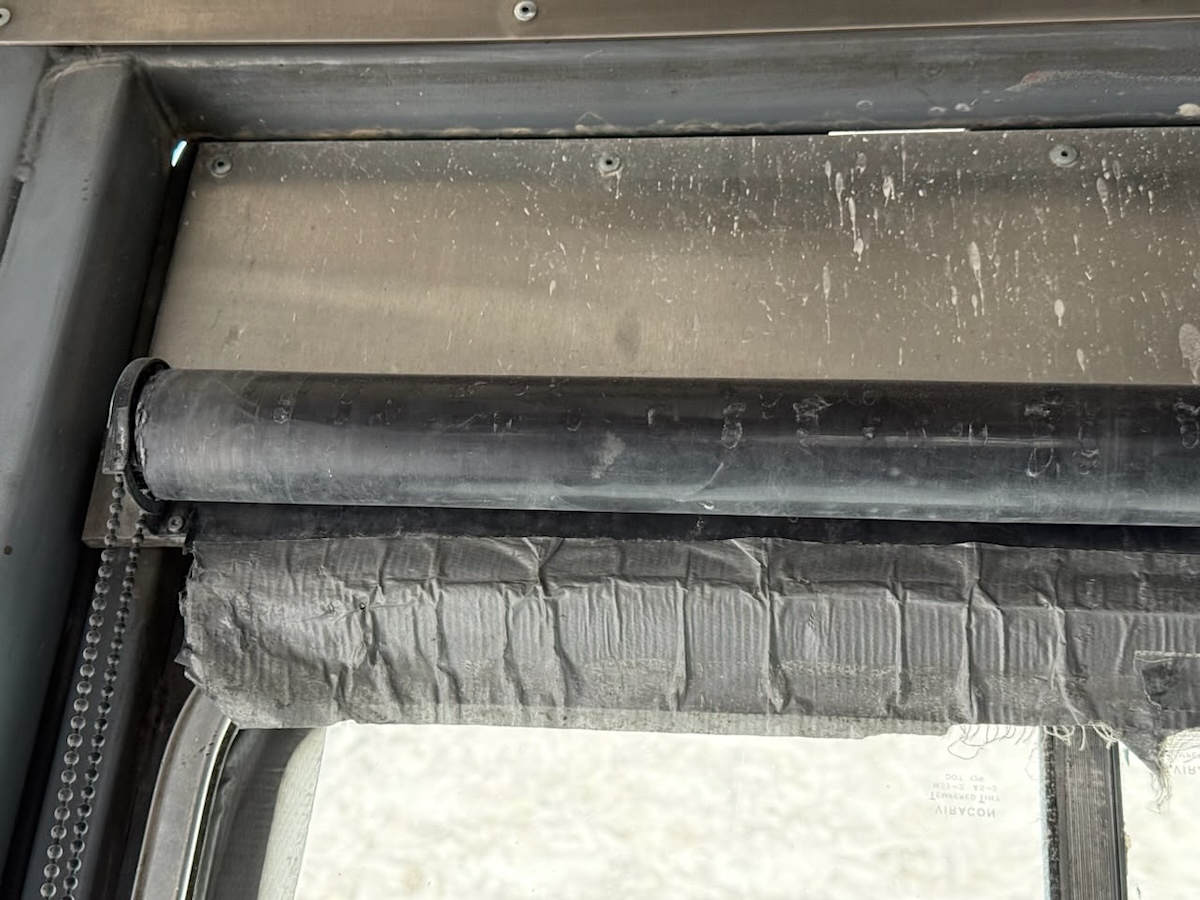
“This is the stuff that we're taking to the bargaining table and showing the employer,” he said. “The response is ‘No, we're not going to negotiate that, we're doing good.’”
The union has been sounding the alarm on the issue for years. Last year, the Office of the Chief Inspector of Mines — the provincial regulator for mines in B.C. — conducted an investigation into safety concerns at Highland Valley Copper.
It mainly consisted of surveys, interviews and document reviews and included anonymized quotes from both workers and management. The investigation turned up reports of dust exposure, persistent running of broken equipment and reports of workers not being given enough breaks.
“If you can’t do it right, do it at night,” was an on-site motto, several hourly workers and a supervisor told the inspector, according to the investigation report.
Meanwhile, management told the inspector they saw the union as obstructive to workplace discipline and that workers disregarded rules meant to keep the site safe.
“This is the most difficult place I’ve ever worked,” one supervisor said in the report. “There is not a close second.”
Another manager took a more nuanced stance and said in the investigation report that they were impressed by the union’s leadership on safety.
“They are genuinely trying to improve safety for the co-workers, and it’s been a pleasure to work with them,” they said. “I have found at times that the union executive makes politics out of safety, and that is very unhelpful.”
The inspector said in the report that tension between the union and management had weakened trust between the two parties.
Meanwhile, a survey included in the report about workplace bullying and harassment underscored the diminished union-management relationship. Of respondents, 56 per cent of workers, 79 per cent of supervisors and 52 per cent of management reported either experiencing or witnessing bullying and harassment on site.
“Improving health and safety at HVC requires all parties to commit to transformative change by proactively and voluntarily challenging existing beliefs, reflecting on roles, and embracing a long-term shift in approach,” the inspector wrote in the investigation. “Collaboration will be critical.”
The inspector recommended that the Highland Valley Copper mine assign “owners” to each high-risk health and safety compliance concern, report progress to regulators and publish a remediation tracker.
Recommendations also included having the mine train supervisors and investigators to overcome their own bias, introduce independent reviews for disciplinary decisions and integrate frontline experience into hazard mitigation.
The Office of the Chief Inspector of Mines would continue to monitor the mine’s progress on actions and follow up on health and safety concerns during future inspections. The office did not respond to requests for comment for this story in time for publication.
But Wolff said workers had not seen meaningful improvements at the mine in the 11 months since the investigation was published. He said that ultimately the breakdown comes to management and the union disagreeing over the best way to keep workers safe. For example, Wolff said, the union has been pushing for the company to require having water trucks around the mine to reduce silica dust exposure.
“We've had two of our safety reps, who are doing really good work, step down from absolute frustration,” he said. “They’re beating their head against the wall every single day trying to improve safety and just not getting anywhere.”
He said Workers’ Compensation Board claims were “going through the roof” in recent years.
It’s why the issue has become such a flashpoint during bargaining. The previous five-year collective agreement ended Sept. 30, and Wolff said it became clear during negotiations that the employer was not willing to bargain on health and safety and higher compensation.
While the union declined to share what wages were on offer, the previous collective agreement shows that by 2025, workers earned between $28.61 and $56.61 per hour, up approximately eight per cent from 2021.
That hasn’t kept up with the cost of living. The B.C. all-items consumer price index rose 16.5 per cent over the same amount of time.
“Certainly Teck is in a position to provide more than fair compensation to their employees and to resolve these things so that we can move forward with a good collective agreement,” United Steelworkers’ Lunny said.
Wolff said workers are ready to strike until Teck is willing to come to the table with a different position. Meanwhile, Teck did not respond to further questions about its safety policies.
On Saturday, about 15 mineworkers sat in camping chairs around a fire. Queens of the Stone Age played from a speaker while the workers talked. Clouds and mist hovered just overhead, obscuring the mine beyond them and the Highland Valley’s three famous Canada-flag-branded domes.
A semi-truck pulled onto the mine access road, across which a metal fence had been erected with an opening to allow vehicles to pass. The workers hoisted placards and began marching back and forth across the road, blocking the truck’s progress.
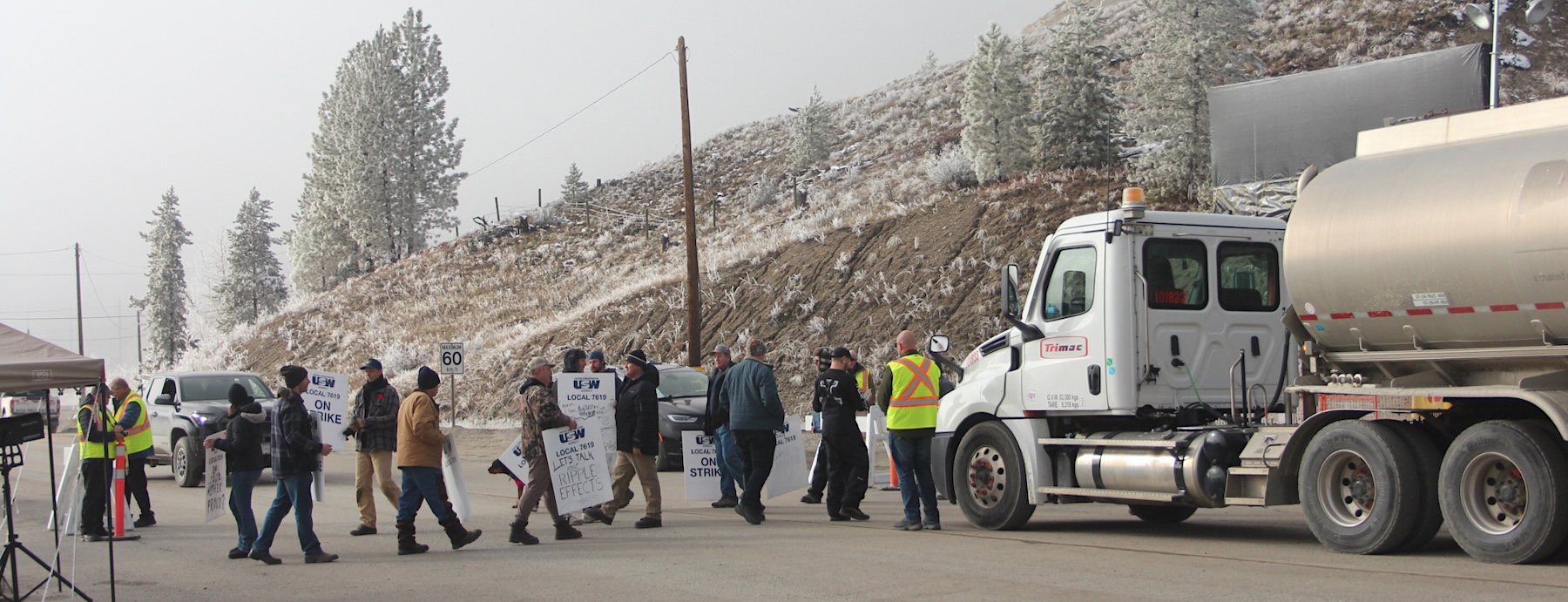
The routine was well established by the time The Tyee arrived; workers would picket for five minutes, a pair of security officers would stand by the truck, then it would be allowed to proceed into the mine.
Placards had slogans deriding scabs, asking for a fair contract and alluding to the mining company’s increasing profits.
DriveBC traffic camera footage shows part of the picket line. After nearly two weeks, picketers have aimed signs at the camera, and pictures show them barbecuing food and keeping warm.
Wolff said the union has set up working lights, heating trailers and heated washrooms on the picket lines. A movie screen has been set up, and the union is working on setting up a TV so that workers can watch hockey from the picket line.
The strike has also become complicated for workers and community members nearby. Teck is expanding the mine, which the company estimates will allow it to produce 132,000 tonnes of copper annually until at least 2046.
Workers outside of United Steelworkers Local 7619, including contractors, have been hired to build the expansion, according to Lunny.
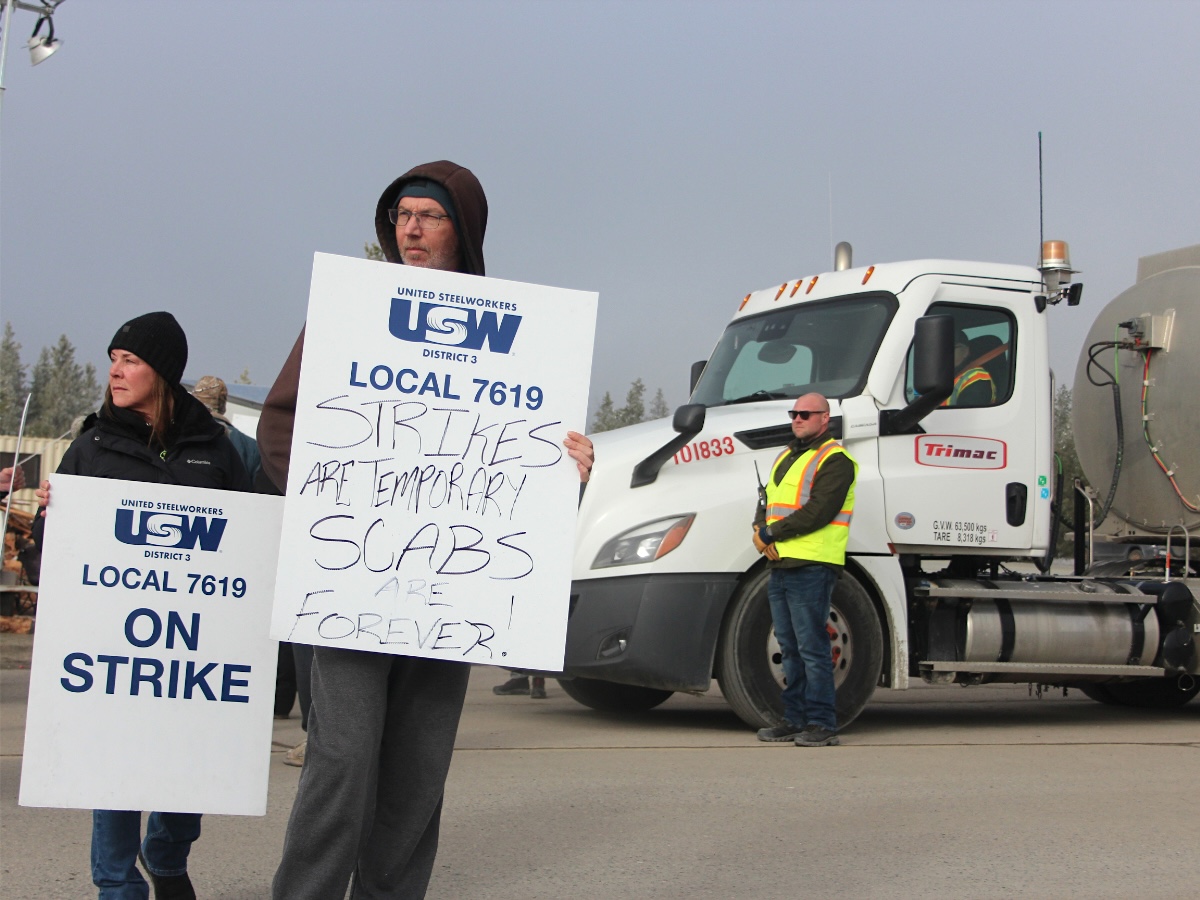
Lunny said some of those workers have expressed concerns working on the site while United Steelworkers pickets the entrance. He said the union is complying with a labour board declaration asking them not to picket the Bethlehem Gate entrance, which is being used to facilitate mine expansion.
Still, Lunny added, it’s part of the union’s job to make sure that those workers aren’t being asked to do striking employees’ jobs.
“They need to be allowed to continue with the project, which is really in everyone's best interest because it extends the life of the mine,” Lunny said. “But obviously, some contractors and some of the unionized contractors are uncomfortable because there's a labour dispute.”
He’s calling on Teck to come back to the table.
With files from Tyler Olsen.
* Story updated on Nov. 8 at 3:33 p.m. to correct the number of workers who participated in the strike vote and supported job action. 
Read more: Health, Labour + Industry









Tyee Commenting Guidelines
Please note that email notifications for replies are not currently working due to a software issue which may be resolved in a future update.
Comments that violate guidelines risk being deleted, and violations may result in a temporary or permanent user ban. Maintain the spirit of good conversation to stay in the discussion and be patient with moderators. Comments are reviewed regularly but not in real time.
Do:
Do not: