


 SHARE:
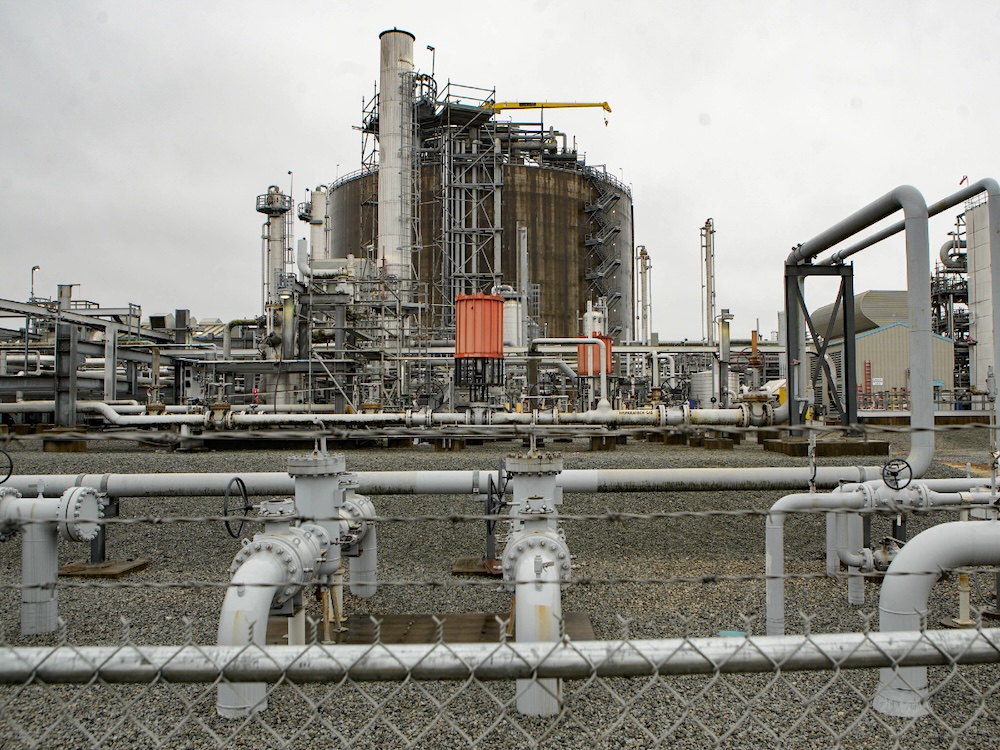
Emissions from the site of a recently approved LNG expansion in Metro Vancouver are projected to exceed Canadian ambient air quality standards for nitrogen dioxide, a harmful pollutant, according to company reports.
Last month, the provincial and federal governments approved FortisBC’s plan to further expand Tilbury, its decades-old LNG facility in North Delta, helping to turn it from a domestically focused, small-scale operation into a large export-oriented facility.
The province described the newly approved expansion as a “clean energy” project.
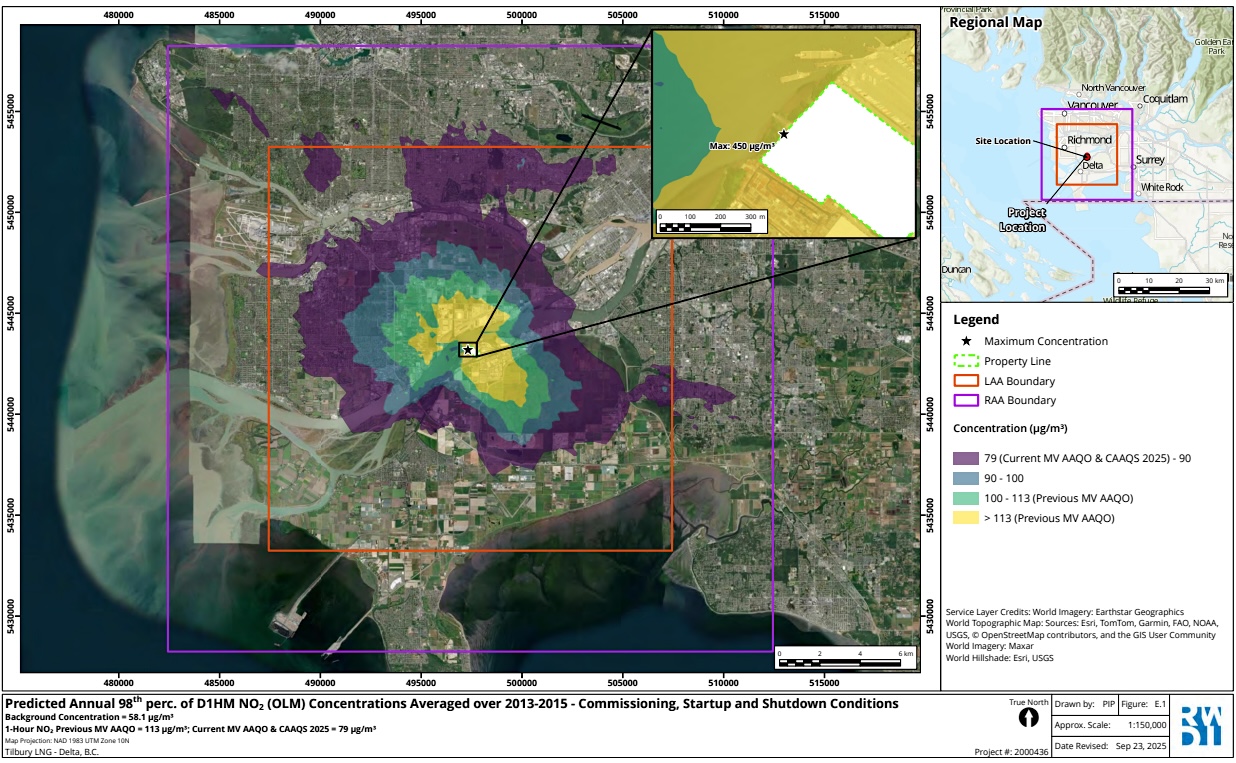
During the commissioning phase and when the facility’s equipment is malfunctioning, nitrogen dioxide levels in parts of Richmond, Delta and Vancouver are projected to be between three and 16 times above Canada’s guidelines for maximum hourly emissions. That estimate doesn’t include the cumulative impacts of emissions from Tilbury’s other, already approved expansions at the site.
During ongoing operations, Fortis predicts the site and associated marine traffic will slightly exceed national standards for average annual nitrogen dioxide levels, indicating the potential for long-term, chronic exposure. Those exceedances are expected to extend across schools, homes and child-care centres in southern Richmond.
Those elevated annual levels are expected even after factoring in significant reductions in the project’s predicted nitrogen dioxide emissions from yet-to-be-determined mitigation efforts Fortis says it will employ. If those mitigation efforts are unsuccessful, Tilbury’s emissions could be even higher.
Vancouver and Richmond already have some of B.C.’s highest average nitrogen dioxide levels.
The company has not yet made its final investment decision to proceed with the project, and some permits are still pending, but the recent approvals signal the federal and provincial governments are willing to allow the expansion to proceed.
The Tilbury expansion “has the potential to deliver significant economic and environmental benefits for B.C., and jobs for British Columbians,” Minister of Energy and Climate Solutions Adrian Dix said in a press release announcing the project’s approval.
But Tilbury’s projected nitrogen dioxide emissions suggest potential health implications from the expanded facility.
According to Canada’s Environment Ministry, long-term nitrogen dioxide exposure can increase susceptibility to respiratory infections, increase risks of developing asthma, affect cardiovascular health, lead to reproductive issues and increase the risk of premature death.
In an emailed statement, FortisBC told the Tyee: “The Tilbury Phase 2 LNG Expansion project will be built and operated in accordance with all municipal, provincial, and federal guidelines.” It added that the project must meet regulatory requirements by various levels of government.
A provincial spokesperson said government communications staff are unable to comment during the ongoing election period.
Emissions are predicted to increase
The Tilbury facility has produced LNG on site since the 1970s, relying on the liquefied fuel’s condensed form to store enough gas near the province’s urban centre to boost the region’s energy supplies during cold snaps. It was a low-profile operation, producing a small amount of LNG per year, mostly to supply local demand.
Just over a decade ago, Fortis began moving its expansion forward in a piecemeal fashion. The company first applied to build a new, bigger storage tank and to increase its liquefaction capacity in a project it called Phase 1A. In 2024, the province also approved the company’s plan to build a marine jetty that would allow export tankers into the river for the first time. This July, the province provided a regulatory exemption to support another expansion of the site’s storage and liquefaction capacity that Fortis has dubbed Phase 1B. The newly approved Phase 2 project will further expand liquefaction at the site, increasing the facility’s total production to 3.5 million tonnes of LNG per year.
LNG facilities like Tilbury use energy-intensive compressors to turn natural gas into a liquid state. Fortis plans to power its compressors with electricity, reducing some emissions during the process. But the company didn’t decide to electrify its hot oil heater, citing uncertainty about energy supply and the cost of power connection upgrades.
In the section of its application discussing its decision to choose gas to power its oil heater, Fortis wrote that “although electrification is seen as a ‘green choice’ and may reduce public opposition to the proposed project, early analysis suggests that there may not be adequate electrical power available to support the proposed project without significant capital upgrades.”
Fortis wrote that the upgrades could compromise the project’s schedule and commercial viability.
Other new components will also produce emissions, including a ground flare stack and acid gas incinerator. Together with the hot oil heater, these parts of the project are expected to produce the bulk of the expansion’s anticipated nitrogen dioxide pollutants.
“Just because you use electric compressors doesn't mean you have zero emissions,” said Tim Takaro, a physician and researcher with Simon Fraser University and a member of the Canadian Association of Physicians for the Environment.
Pollutants from those systems will add to an already compromised airshed, Takaro said, noting that the region has one of the highest concentrations of nitrogen dioxide in the province.
“They're already stretched in terms of air quality,” Takaro said.
Although Fortis describes Tilbury’s ground flare as “totally enclosed,” the facility will include a 200-metre open stack surrounding a low flare, meaning its exhaust will still enter the airshed.
When added to the existing pollution in the airshed, Tilbury’s Phase 1A and 1B expansions are anticipated to push nitrogen dioxide levels in the surrounding area above the federal government’s threshold for acceptable emissions, indicating possible short-term, acute exposures.
The company’s estimated maximum nitrogen dioxide emissions during commissioning and malfunctions are predicted to significantly exceed regulatory limits beyond the project’s immediate vicinity, including areas of Richmond, Delta and Vancouver and other parts of Metro Vancouver up to 11 kilometres from the project.
These kinds of disruptions have been ongoing at Canada’s only major LNG facility, LNG Canada, leading to high rates of flaring and bursts of black smoke — a sign that uncombusted or partially combusted gas is being released into the airshed.
Those unburned pollutants are particularly dangerous because they can include volatile organic compounds such as benzene, a potent carcinogen that has no safe threshold, said Dr. Melissa Lem, a Vancouver family physician and past president of the Canadian Association of Physicians for the Environment.
Fortis’s application said its production of volatile organic compounds in the airshed would be “negligible.”
According to Fortis’s application, it expects to vent unburned gas from the facility during mechanical disruptions and during commissioning, when the company expects it will not yet have its flare system installed.
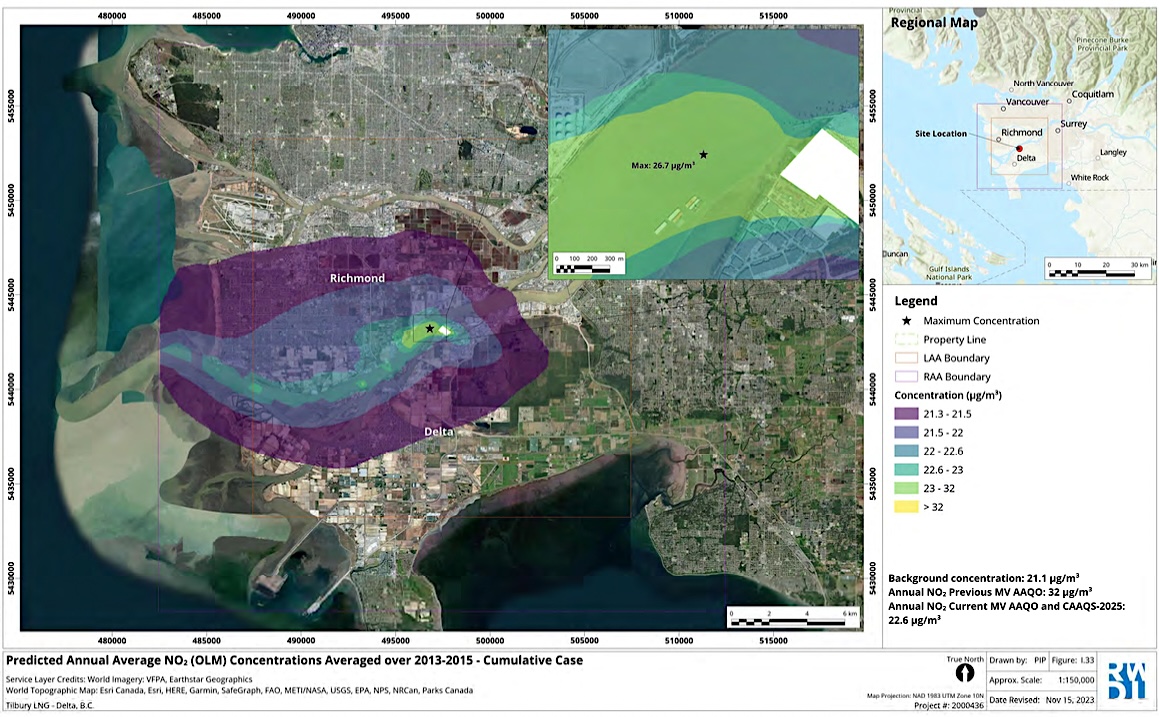
When existing emissions and emissions from Tilbury’s various expansions and associated marine traffic such as LNG tankers are combined, the site is estimated to produce average annual nitrogen dioxide levels slightly exceeding national guidelines, indicating sustained long-term exposure to the pollutant near the facility.
The projections assume potential reductions from a set of mitigation measures for the Phase 2 expansion. According to Fortis, these measures “are not intended to represent final design commitments or regulatory conditions.” Fortis added that it is “exploring an emissions mitigation strategy” to meet air quality standards. The province called for an air quality management plan in its list of conditions for approving Tilbury’s application, including details on how it plans to reduce emissions and the technologies it plans to use.
Climate concerns
Besides local pollution, Lem noted that Tilbury’s forthcoming climate emissions would also have consequences for human health.
Additional emissions from Tilbury’s Phase 2 expansion and its associated upstream gas fracking activity are expected to produce about one million tonnes of carbon dioxide equivalent per year, around 13 per cent of Metro Vancouver’s total target emissions by 2030.
About 800 people die prematurely every year in Vancouver due to air pollution, according to Tyee reporting from 2021. Pollution from wildfire smoke made more likely by climate change is a large part of the city’s air hazards.
“The fossil fuel industry doesn’t have to deal with patients on the frontlines when climate change drives all these harms,” Lem said. “Doctors and nurses, we are on the frontlines when wildfire smoke rolls in and people are having asthma attacks and high risk of anxiety and depression.”
Lem said the federal and provincial governments’ recent Tilbury approval is a mistake.
“If they were adhering to science, they would not be approving new fossil fuel projects like this Tilbury project,” she said.
Safety risks
The project’s location alongside the narrow, heavily trafficked Fraser River has also raised safety concerns among locals, including from Kelly Greene, the NDP’s MLA for Richmond-Steveston, a riding located just downriver from the Tilbury site. Greene, who was also the province’s minister of emergency management and climate readiness, cited her opposition to the project in a statement announcing she would not seek re-election.
“While no industrial activity is without risk, my work in emergency management taught me that low-probability events can still have profound impacts, particularly when they occur in densely populated or environmentally sensitive areas,” she wrote in a statement posted to LinkedIn.
“I remain deeply concerned about risks posed by the Tilbury LNG shipping channel and have advocated for better safety standards for a decade.”
Like Greene, Richmond Coun. Michael Wolfe worries about the safety risks from Tilbury’s riverside locale.
“It's just a remarkably challenging environment for boats,” he told The Tyee.
The Society of International Gas Tanker and Terminal Operators advises that vessels carrying LNG avoid “long, narrow inland waterways... due to greater navigation risk.”
Alhough Tilbury’s operations are long-standing, the expansion project means international LNG carriers will enter the Fraser for the first time. Fortis’s application estimates the tankers will be about 300 metres long — roughly the size of three football fields.
“Turning it around is going to be a bit of a tricky operation,” Wolfe said. Tankers travelling to and from the facility will be required to make a tight 180-degree turn in the midst of the busy river. Fortis plans to dredge part of the riverbank to make added space.
Spills and explosions related to LNG production remain rare, but when they occur, their consequences can be profound. Supercooled and compressed LNG can explode when it comes into contact with water and rapidly changes from liquid to gas.
When it leaks, LNG can remain as heavier-than-air vapour that can travel long distances before it dissipates. Under certain conditions, that vapour can ignite if it contacts an ignition source, as it did at the Freeport LNG facility in Texas in 2022.
Wolfe noted that Tilbury sits adjacent to a jet fuel terminal on the other side of the river. “If one of these sites has a major event, it's going to compromise all the other ones in the area,” he said.
“It's absolutely crazy to think that people will do that and not care about the future generations.” ![[Tyee]](/design-article.thetyee.ca/ui/img/yellowblob.png)
Read more: Energy, Health, Environment






Tyee Commenting Guidelines
Please note that email notifications for replies are not currently working due to a software issue which may be resolved in a future update.
Comments that violate guidelines risk being deleted, and violations may result in a temporary or permanent user ban. Maintain the spirit of good conversation to stay in the discussion and be patient with moderators. Comments are reviewed regularly but not in real time.
Do:
Do not: