


 SHARE:
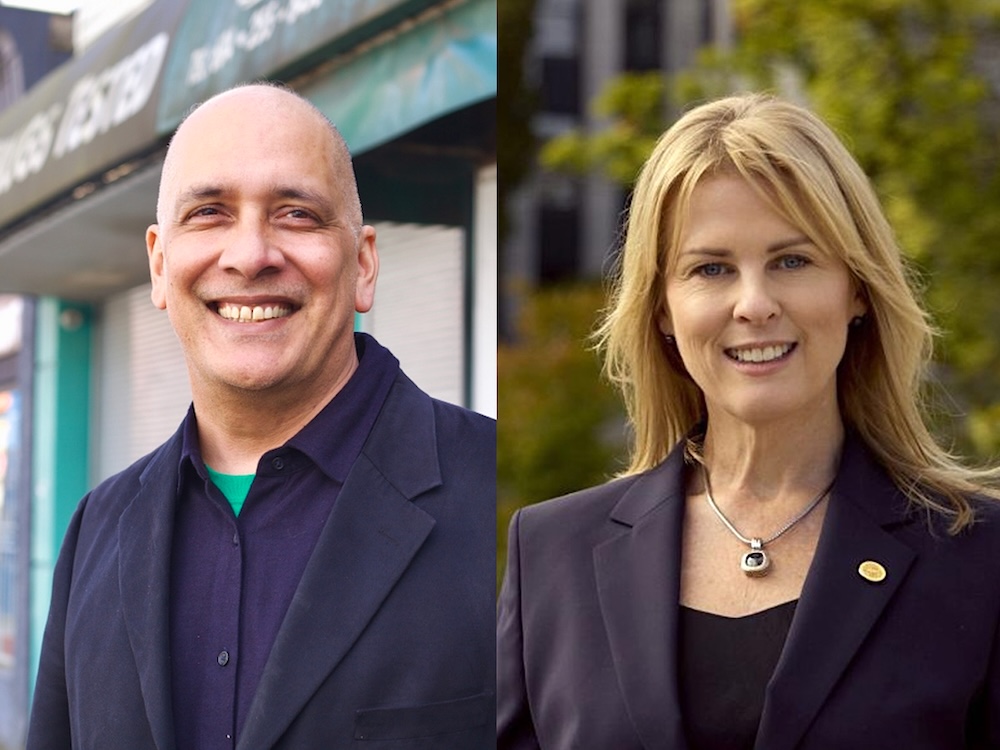
Green Party of Vancouver mayoral hopeful Pete Fry is supposed to be the progressive voter’s candidate of choice this election. After several meetings this summer, two other progressive parties — OneCity and the Coalition of Progressive Electors, or COPE — pulled their mayoral candidates to try to avoid splitting the vote and handing incumbent Mayor Ken Sim another victory.
So why are some prominent former progressive politicians endorsing one of Fry’s opponents?
Last week a public letter endorsing Rebecca Bligh for mayor was signed by Mike Harcourt, former Vancouver mayor and former BC NDP premier; Peter Ladner, former Non-Partisan Association city councillor and Vancouver mayoral candidate; and Geoff Meggs, former Vision Vancouver city councillor and later chief of staff for previous BC NDP premier John Horgan.
Brenda Bailey, a former BC NDP MLA who decided not to run for re-election in the provincial campaign, has also endorsed Bligh, according to a post on Bailey’s Facebook account.
“Vancouver deserves a mayor who listens and hears them, and can work through disagreements and get the job done,” the letter reads. “Rebecca Bligh is that leader.”
The latest two polls for the mayoral race show the race is largely between Sim and Fry. A Leger poll commissioned by the Vancouver Sun shows Pete Fry at 23 per cent support compared with Ken Sim at 19 per cent, with other mayoral candidates Bligh, Kareem Allam and Colleen Hardwick all around 5 to 6 per cent support.
A Canada Pulse Insights poll commissioned by CityNews and Omni puts Fry at 28 per cent support and Sim at 27 per cent. That poll shows 19 per cent support for Allam, 13 per cent support for Hardwick and seven per cent support for Bligh.
The former politicians cited Bligh’s eight years of experience on city council, as well as her two-year stint as president of the Federation of Canadian Municipalities, which ended this past June.
But in both the letter and in interviews with The Tyee, Harcourt, Meggs and Ladner acknowledged Bligh’s gender was also a factor in their decision.
“It’s about time to have a woman mayor in Vancouver after a hundred and some odd years,” said Harcourt.
“And she just happens to be the most qualified to be mayor anyways, with her two terms on council and an excellent, well-regarded stint as the head of the Federation of Canadian Municipalities. I think she’d be a far better mayor than Ken Sim.”
The letter also endorsed a slate of council candidates, including Vote Vancouver’s Rebecca Hasdell, John Boychuk, Steve Jedreicich and Geoff Teoli; OneCity Vancouver’s Iona Bonamis, Frances Bula, Jarrett Hagglund and Lucy Maloney; and the Vancouver Liberals’ Moira Stilwell.
“My interest in this was to shine what I think is a deserving light on people who I think could work well with Rebecca Bligh,” Geoff Meggs said, adding he personally supports OneCity’s Caitlin Stockwell for council but had to reach a compromise with Ladner and Harcourt for the limited council seats.
The letter was organized and distributed via email to news media by David Helliwell, a local tech entrepreneur, who told The Tyee it was part of his year-and-a-half effort to work across partisan politics to “make things work better” in the city.
“I’ve voted for pretty much everybody over the years. I don’t like partisan politics, but I care deeply about the city and government,” Helliwell said.
Asked for comment on the endorsement, Fry told The Tyee via text message that he was focusing on his own campaign and that he did not have relationships with Meggs, Ladner and Harcourt as Bligh did.
Fry has received an endorsement from the Vancouver and District Labour Council, a coveted election-season endorsement for progressive candidates. The VDLC represents 90 unions and their members, including workers employed by the City of Vancouver.
Endorsing a multi-partisan council slate
Both Ladner, who served on council from 2005 until he ran for mayor in 2008, and Bligh had been members of the centre-right, now-defunct Non-Partisan Association municipal party.
Ladner left municipal politics after he lost the mayoral election to Vision Vancouver’s Gregor Robertson. Bligh left the Non-Partisan Association in 2019, a year after she was first elected to council, because of what she saw as the party’s “far-right” turn.
Bligh joined ABC Vancouver for the 2022 election, after Sim also left the Non-Partisan Association to start the new party. But she was kicked out of ABC in 2025 after she voted against a motion to pause hearing new supportive-housing development pitches at council.
“I think she’d be the best mayor of all the people running,” said Ladner, who added he has voted for many different municipal parties since his time on council.
In an interview with The Tyee, Bligh said she met Harcourt early in her time on council when then-mayor Kennedy Stewart invited Harcourt to speak to council about cross-partisan and collaborative governance. They have stayed in touch ever since.
“And Geoff Meggs was somebody that I’ve asked about the viaducts, for example, and the future of the northeast False Creek development,” she said.
The letter acknowledges that outside of their endorsement of Bligh and the council candidates, Ladner, Meggs and Harcourt often disagree on politics. While they did not serve on council together, Meggs and Ladner were members of opposing parties.
But before coming out in support of Bligh, Ladner, Harcourt and Meggs told The Tyee they were supporting OneCity mayoral candidate William Azaroff.
Three progressive municipal parties running a mayoral candidate, OneCity, the Greens and COPE, had previously agreed to run just one mayoral candidate between them in an effort not to split the vote.
A little over a month ago Azaroff and COPE mayoral candidate Stephanie Allen dropped out of the race, leaving Fry as the sole progressive candidate.
“I really would have supported William Azaroff had he not dropped out in what I think was a mistake by OneCity and others that thought that Pete Fry would be able to carry this campaign,” Meggs said, adding the progressive parties should not have coalesced behind one candidate.
“If he is able to, I’d be surprised.”
When it comes to policies, Fry has criticized Bligh for her past support of closing the city’s renter office in 2023. Bligh has responded that at the time, she thought the plan to fund an external renter support organization would provide better service for renters, but she now supports reopening the city’s office because of the redevelopment pressures created by the Broadway Plan.
There are other notable differences in the parties’ platforms.
Vote Vancouver's platform doesn't mention anything about the police budget, accountability or oversight and is in favour of the school liaison officer program. On the campaign trail, Bligh has said that Vancouver pays more for police per resident than other cities and that there has been “complete mismanagement” in what police are prioritizing.
On policing, the Greens have promised to regularly report back to council from the police board on budgets, strategic priorities, community safety outcomes and performance; introduce regular independent public performance reviews of the Vancouver Police Department budget; and review the school liaison officer program or any police partnership with schools using evidence, student safety, community input and the school board's education mandate.
The Greens have also promised to implement a peer-based intervention program for people experiencing mental health or addictions issues instead of calling the police or an ambulance, and an office of community safety to integrate police, fire, licensing, property use and planning departments.
Vote Vancouver is promising a community safety strategy and more co-ordination between police and existing housing and social services, so police aren't answering all the calls related to poverty, mental health, homelessness and addictions.
Why Bligh and not Fry?
Bligh says she is grateful for the “cross-partisan” support shown by Ladner, Meggs and Harcourt’s letter.
“For the issues that the city is dealing with every day, I have always gone and sourced out people who have various opinions and various experiences in dealing with those issues for their input,” she said.
As for them endorsing only four of the six Vote Vancouver council candidates, Bligh said she expected partial slate recommendations to happen during the campaign. (In municipal politics, a “slate” is a political party’s entire group of candidates for council, park board and school board. Vote Vancouver is running six council candidates, three school board trustee candidates and two park board commissioner candidates.)
“We have a great slate. All six council candidates have both worked incredibly hard and earned their place on our slate,” she said. “We continue to support them wholeheartedly.”
Like Bligh, Vancouver Greens mayoral candidate Fry has also been on city council since 2018. Asked why they supported Bligh over Fry, Harcourt, Meggs and Ladner cited Fry’s voting record.
They took issue in particular with the number of times Fry abstained from voting this term, noting a potential mayor should be making a yes or no decision on most council votes.
While councillors may abstain as a protest or to excuse themselves from a conflict of interest, under the Vancouver Charter abstention votes are considered a vote in favour.
In total Fry has abstained from 120 votes since he was initially elected to council in 2018, 80 of which have taken place since the Oct, 15, 2022, election. Bligh has abstained from 78 votes since 2018, and 31 of those abstentions happened over the past four-year term on council.
Fry’s abstentions are part of why an article in Spacing magazine in August found that among four opposition councillors, including Bligh, OneCity’s Maloney and COPE’s Sean Orr, Fry was found to have voted with the majority ABC Vancouver councillors most often at 87 per cent, when the magazine examined 50 significant council votes since the April 2025 byelection.
But Bligh was not far behind, voting with ABC councillors 86 per cent of the time.
“I don’t think he’s got it, got the capacity even close to what Rebecca has to be a good mayor, to bring people together, to work co-operatively with other governments — federal and provincial — on the key issues,” Harcourt said of Fry.
“And I think she’ll be able to have a mixed council and has the personal qualities and the temperament to be able to pull people together to work towards common cause and the key issues for a lot of Vancouverites.” ![[Tyee]](/design-article.thetyee.ca/ui/img/yellowblob.png)
Read more: Municipal Elections 2026, Municipal Politics










Tyee Commenting Guidelines
Please note that email notifications for replies are not currently working due to a software issue which may be resolved in a future update.
Comments that violate guidelines risk being deleted, and violations may result in a temporary or permanent user ban. Maintain the spirit of good conversation to stay in the discussion and be patient with moderators. Comments are reviewed regularly but not in real time.
Do:
Do not: