

 SHARE:
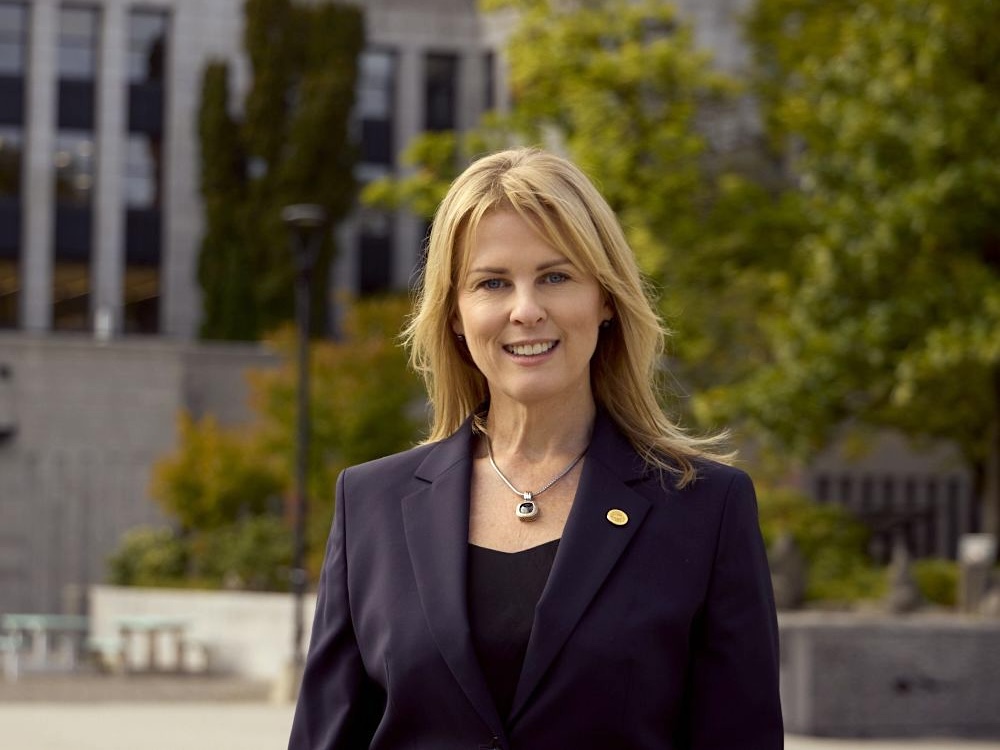
Rebecca Bligh knows something about starting from scratch.
The two-term Vancouver city councillor was just 20 years old when she moved to Vancouver. By 21 she was a new mom, and by her early 30s Bligh was a single mother of two kids, juggling her own career working in small businesses.
Eventually, Bligh worked her way up to opening her own small consultation and leadership business, BLACKPiiN. A feat she achieved, Bligh said, without family money to support her.
"In a time where things feel like the deck is stacked against you, Vancouver can be a city of opportunity that provides pathways to self-determination and one's own ability to create a life here," she said in an interview with The Tyee at Mount Pleasant Vintage & Provisions in late March.
"That's my 30 years’ experience living in this city."
Bligh's experience finding affordable housing and child care and starting her own business inspired her to run for city council, her first political position, in 2018 with the Non-Partisan Association, better known as NPA. Bligh became president of the Federation of Canadian Municipalities the same year, a position she continues to hold.
But a year later, she became the first of eventually four NPA councillors to leave the party, with Bligh citing NPA's emerging “far-right” direction as her reason. She sat as an independent councillor for the rest of the term.
In 2022, Bligh ran for council again, this time with former NPA mayoral candidate Ken Sim's new party, A Better City Vancouver — also known as ABC. The party swept the municipal elections that year, achieving majorities on council, park board and school board. Bligh was also appointed as the city's representative on Metro Vancouver's regional board of directors.
But after a series of controversies, including unsuccessful attempts to abolish the park board and suspend the work of the city's integrity commissioner, ABC began losing members.
After voting against several ABC motions, including a pause on approvals of new supportive-housing projects, Bligh was ejected from the party in 2025 and again sat as an independent.
Her February 2026 motion to revisit that supportive-housing pause became its own controversy when it was derailed by a social media video ABC Coun. Lenny Zhou released that referred to Bligh in Mandarin as an “extremist” who wanted to build “drug housing” in Vancouver.
In the video Zhou also accused unnamed non-ABC councillors of being drug users who distributed drugs in public. This accusation was later traced back to Mayor Ken Sim telling Chinese-language media earlier in February that Coalition of Progressive Electors Coun. Sean Orr distributed drugs in public. Orr, who denies distributing drugs, has since filed a defamation suit against Sim.
Both Zhou and Sim have publicly apologized and retracted their statements. But when Bligh's motion to end the supportive-housing pause finally came before city council in March, just over half of the 26 members of the public who encouraged council to vote against the motion referenced illegal drugs, drug use or addiction. The motion failed, with all present ABC councillors voting against it.
Bligh's passion for supportive housing and growing Vancouver's economy is key to her decision to run for mayor in the October municipal election. She also wants to combat partisan politics at city hall.
"While I've always worked really well with the parties that are in place now," she said, "in order for me to put a mayoral bid forward that I knew was in alignment with my own personal values, non-partisanship was at the core of what I could commit to in how I would govern, should I become mayor."
The following interview has been edited for length and clarity.
The Tyee: Everyone has their own version or idea of what kind of city Vancouver is. What kind of city is Vancouver to you?
Rebecca Bligh: Well, I immediately point back to where my adult life really got jump-started, which was becoming a parent at the spry age of 21 and having my daughter. Who arguably changed the course of my life in every positive way, but was not a plan that I had.
So Vancouver to me, on a personal level, is a city that gave me every possible opportunity to raise my family here. To have the ability to find good work through the small-business sector, to find child care and to find housing. And to be a family that played outside in parks and beaches, seawalls. And so Vancouver, to me, is a place where families can or ought to be able to do that.
Vancouver needs stewarding to be a city where families can thrive, where young people can see themselves get started, where small businesses can get started. Small businesses become big businesses, become global businesses. Vancouver is a very innovative, entrepreneurial city.
And then, of course, Vancouver's physical beauty needs both protecting and also recognizing that we live in a really incredible part of the world. It's got so much potential to be a place where the people of Vancouver can give as much back to the city as the natural beauty gives to us. So how do we do that together?
Why run for mayor this time?
Timing is everything in politics. There's a moment here. Being a two-term city councillor and being chair of the national federation representing municipalities across our country, I have the experience and the knowledge.
I still have a lot of energy to deliver for Vancouverites in terms of leadership that I think the city desperately is looking for and needs.
Why start your own party?
When I looked at the existing landscape of parties that existed in Vancouver, it was clear to me that there's so much partisanship in party politics. It compromises collaboration, which creates great solutions, good decision-making and leadership that is set up to govern, working with multiple parties across party lines, no matter what happens in this election.
Starting my own party, Vote Vancouver, was based on the values that non-partisanship and collaboration are key to providing good governance and good decision-making that is appropriately set at the local level.
Why not continue to be independent, as you have been?
We've seen even recently mayors that were independent and found it incredibly difficult to get anything done. Not that I would not be up to that task. But we're putting forward councillors that also represent the values of collaboration, of listening, of working with others to make sure that this is not a situation of power blocks like we see now.
As mayor, having folks on the council based on a clear platform can help make decisive policy decisions is important, I would say, in order of getting the business done. But we do that in a collaborative way. And having been there for two terms and watched the different dynamics, I'm absolutely certain it's possible.
There are now six candidates for mayor with possibility for more. There’s a concern that this will split the vote and allow Ken Sim to win again. What do you say to people who level that criticism?
I think the current mayor has as much of a contest ahead of him as any of us. Vancouverites typically are quite centrist in how they vote, and overly left or overly right [candidates] split their own votes. What we often find is a pretty centrist platform gets the attention of voters, and that's what we'll be putting forward about Vancouver.
Where would you put Vote Vancouver on the political spectrum in Vancouver?
Right in the middle. [Laughs.] I was very new to politics when I first ran. I ran to bring a unique perspective, a lived experience as a single parent. Working class, not from family money, just really trying to make a go of it in Vancouver, and had an opportunity to provide that perspective when making decisions that affect Vancouver, right?
I did that as somebody who is non-partisan, fiscally responsible and socially progressive, in the sense that any policies we make have a downstream impact on real people. And there has to be an awareness and an appreciation and a sense of responsibility for that.
How does it differ from ABC Vancouver?
I've come to learn that I was probably ABC's progressive candidate. And [I] happily acknowledge that. I remain committed to the centrist voter and the big-tent vote that elected ABC with a significant mandate.
And while maybe not everything was exactly on the mark in the 94-point platform, I stand behind a lot of it as it relates to increasing housing and housing affordability, supporting small business, delivering city services that are both available and affordable for people.
My reflection on the past three and a half years is that ABC left that voter and reprioritized on issues that, quite frankly, were not in the platform and they weren't elected with a mandate to deliver, in my opinion.
What sets you apart from the other candidates that you see so far running for mayor?
At the end of the day, I have unmatched experience. Both as a city councillor that has chaired various local committees, has sat as a director of Metro Vancouver Regional District, and now as chair of Federation of Canadian Municipalities. I've done work to open doors to ensure that Vancouver is well represented in senior-level government conversations about some of our biggest challenges.
And, yeah, I probably bring the most unique experience. Starting out as a 20-year-old that quickly had two kids and was able to build a life here in Vancouver, I think, is a hope and an aspiration that many young people have for themselves.
If you were mayor, how would the city respond to the city's housing crisis?
Recognizing that there's a role for the city government to play in providing land. And also working with provincial and federal governments to build much-needed, deeply affordable housing to create a better outcome for folks who are at risk of homelessness or are unhoused. With an understanding that supports embedded in purpose-built supportive housing are a proven success model.
City-owned land is public land that needs to be for public housing. So until we have really filled the housing gap, we need to leverage every square inch of land we own to build below-market housing people can afford. And I would embed child care in each of those developments.
We are at a point where rental housing is in a surplus. But that creates a really uncertain environment for building new housing. The city needs to respond to the changing economic conditions that are preventing more housing from being built, particularly rental housing.
We also have a mental health and drug crisis. How should the city respond to that?
We have an opportunity right now with the new St Paul's [Hospital]. There's a significant investment going into programs like Road to Recovery. The city plays a key role in advocating for the residents of our city who need access to health-related services that can address the addictions and mental health crisis.
Less bureaucratic types of health-care response to the addictions crisis is what we see works best: mobile health units, embedded health services in supportive housing. Folks don't have to go to an emergency room or a hospital to access the care that they need.
What a lot of people don't realize is that addiction is not necessarily the acute health-care issue that folks are dealing with on a day-to-day. It's related issues — infections, acute wound care — that can really deteriorate somebody's quality of life. That can be dealt with in embedded health-care services.
There's the proactive pieces, recognizing that there are more vulnerable youths that are falling into mental health crises and are at risk of homelessness, of substance use disorder. The unemployment rate for youth is at 14 per cent and climbing, an incredibly high number.
That's concerning for me, because without employment and supports around them, poverty ensues. And then being able to access housing, jobs and training also is compromised. We have to lean into where youth are in society and make sure that we have supports and a network of frontline services to help them become fully independent.
Crime rates are down, and they have been for a while. But you often hear people still feel very unsafe. How would you address residents' safety concerns?
Public safety needs to be a conversation that happens outside of just a police response to the public's perception or reality — both exist — of being and feeling unsafe. Of course, the very real violent attacks that have happened in our city, although rare, have a lasting impact in terms of how people feel. I take it very seriously.
Safety is critically important. We have to recognize that a solely reactive police response needs to be managed as one short-term tool to deal with a situation. But there are more systemic and long-term policy goals that can address the elements that contribute to a perception of a lack of public safety.
Our VPD [Vancouver Police Department] do very good work, and they can only do so much. They're also struggling with the intense load. They, too, are seeing a system that does not have the capacity to respond to the issues that are not criminal: people sleeping in doorways, a level of street disorder, a person having a mental health crisis. The system needs to respond in a much more comprehensive way. We need to look at holistic solutions to address the real crisis.
Speaking of police, their budget is a fifth of the city's budget right now. If you were mayor, how would you respond to what seems like an annual budget increase request from the police board?
We have to recognize right now that no matter how much money has been prioritized to police, people don't feel safer. We need to address that. Police officers in the city of Vancouver have a very tough job. We have very good people that have public safety and the public's interest at heart. Police are part of the equation.
I'll also say that the cost of policing is more expensive in Vancouver by quite a margin, compared to anywhere else in Canada. And that's on a purely per capita expenditure, not on what they like to call cop-to-[population] ratio.
While we see ABC bringing forward a zero per cent property tax rate for average services, the decline in other areas is going to create more reactive policing calls. And so my focus is on the proportional amount of funding that is required to police a city like Vancouver. It's complex, but it's really high.
Are you a homeowner or a renter?
I was a renter for all of my adult life, until two years ago. It took me 23 years to save for a townhouse.
How do you feel about raising property taxes?
I think property taxes need to be raised at a sustainable and predictable rate. Coming back to experience, we can hold property taxes in and around inflation and still deliver city services. Without providing tax breaks to the wealthiest in Vancouver off the backs of people who can least afford it.
Reducing property taxes and raising fees for everyday services that people access in our city, it's not a way to manage a budget. It's more of a smoke-and-mirrors approach that I was very frustrated to see ABC put forward in an election year. It creates chaotic city services, and while there's always opportunities to slim down the bureaucracy, why not repurpose funding into arts and culture grants that have been static for 20 years?
What I hear from small businesses is that they can't deal with a steep increase like 10 or 11 per cent, then a severe drop like zero per cent. [Editor’s note: In their first year in office, ABC raised property taxes by 10.5 per cent.] And worry that next year it'll just mean 12 per cent. For as long as it costs a little bit more each year to run a city, every zero per cent means a massive reduction in the city budget. And eventually that catches up to any city budget.
Austerity seems to be in the air with the city, provincial and federal budgets. What's your hopeful big picture for Vancouver, and how do you afford it?
My commitment as a mayoral candidate for the City of Vancouver is to build the most vibrant economy in the country. We have incredible potential. And yet we limit our capacity for what we can deliver in terms of the innovation and tech economy, the creative economy, arts and culture included in that.
We have so many sectors that are performing and with a distinct focus on growing a very strong economy in Vancouver. What we do is create more, higher-paying jobs. And make sure that people can connect to their own personal ambition and aspiration by accessing and harnessing that opportunity.
You mentioned austerity. But I think it's fiscal management that's happening. It's like a rightsizing that's happening at every level of government. I think we lean into those opportunities. The offset to any rightsizing in fiscally strained times is grow the economy.
Vancouver faces some headwinds when it comes to adaptation around climate, to addressing our homelessness crisis. But again, it can't be on the backs of people that can least afford it. We need strong fiscal management, and part of that is growing a very strong economy in Vancouver so that it can be the city that it's destined to be. And we have a plan and a pathway of how to pay for it.
How would you run your budget process, in comparison to how it was done this past year?
We had a process, and it got kiboshed at the 11th hour. When we inspire the public, when we are representative of the public's interest, we foster really good engagement from the public.
I think our city staff actually do a very good job at getting real and honest feedback from the public who are engaged through our budget process. We would return to our commitment to that.
And make sure that the priorities we set forward, respond to and meet the moment of [are] the priorities of Vancouverites. And that their ability to communicate with us in all languages is provided for.
Going back to growing the economy, are there any industries or businesses that will be a no-go for you? Like, say, oil and gas? Or an AI data centre?
I come at the role of governing as a steward, somebody who has the trust of the public to be able to be pragmatic and also principled in my approach. I don't hold strong ideological views on any one particular sector. But human rights and protecting people is a paramount principled priority for me.
So in doing so, you can figure out what's the business case or the cost-benefit analysis for any interested company or startup that wants to be in Vancouver.
I would rather focus on what we have to infuse more energy, more potential in — like arts and culture, and tech and innovation — than pick fights with sectors we may have different viewpoints on.
Previous councils focused on being the greenest city. This council has overseen cancellation of energy retrofit programs and the sustainability department disassembling. How would you prioritize climate and sustainability if you were mayor?
There's an economic imperative to advance green and sustainable policy when it comes to city building. Whether it's buildings, transportation, adaptation around sea level rise. It's undeniable.
Just today, we approved close to $1.[4] million in grants for cooling and warming retrofits in extreme heat and cold in partnership with the SRO Collaborative. I'm very proud to have worked closely with that organization to lift up the work they're doing.
Green and sustainable building policy leads to deeper affordability over the long run.
How would you approach a relationship with both the urban Indigenous community and the host nations, xʷməθkʷəy̓əm, Sḵwx̱wú7mesh and səlilwətaɬ?
The relationship we have with the xʷməθkʷəy̓əm, Sḵwx̱wú7mesh and səlilwətaɬ has been an ongoing and important priority over various councils. I did serve for some time on the UNDRIP Task Force and got to see the importance of that work in its real form.
The urban Indigenous population in Vancouver are an incredibly important population of our city to be considered in any city building policy that we advance and prioritize. Whether from the urban Indigenous population, the host nations or city of Vancouver, there's a sincere desire to engage and consult with our communities.
There's a lot of room and opportunity for improvement. I know that the Missing and Murdered Indigenous Women and Girls report is an opportunity for us to recognize some of the very vulnerable population [within] the Indigenous community in Vancouver, that the city has a responsibility to.
As a city of reconciliation at the end of the day, that includes reparations for decades’ worth and multi-generational harms that were caused through colonialism. And we need to be realistic about that, and respond in a thoughtful way.
So continuing with UNDRIP [United Nations Declaration on the Rights of Indigenous Peoples], recognizing the opportunities to engage with both groups distinctly from one another. And then also providing a bridge to bring communities together to ensure that all voices are heard, and we can get to clear solutions on the issues we're tackling.
Can you expand on what you mean by reparations?
A recognition that there's an overrepresentation, as an example, of people of Indigenous descent experiencing homelessness in the Downtown Eastside. So reparations, to me, means a relevant and responsive but proportional response to harms caused through the previous decisions that need to be addressed.
It's about negotiating in good faith. And moving at the speed of trust. That there's a different kind of engagement structure that supersedes Robert's Rules of Order. It's about listening, meeting people where they're at. Having an open heart, an open mind and an open ear to feedback. And also what the city can do to continue to advance its mandate as a city of reconciliation.
If you become mayor and Vote Vancouver councillors are also elected, would you whip the vote?
No. Because platforms are what you're asking the voters to endorse by voting for you.
And should a policy come up that is not necessarily contemplated before, we have a slate of candidates seeking the nomination that bring an enormous amount of experience and expertise in the film sector, public health, seniors housing. But also provide a level of analysis, data and pragmatism. That runs very counter to whipped votes.
And to be quite blunt, we're not supposed to whip votes under the Vancouver Charter and the procedure bylaw.
There's a serious park board infrastructure deficit. How would you balance both the everyday needs of filling potholes and updating utilities with more expensive, longer-term projects?
This is exactly where my national role will come in handy. Advocating for infrastructure funding with the federal government has been my sole responsibility as chief lobbyist representing municipalities for the past 18 months.
There's very encouraging announcements that have come in this week in terms of the federal government partnering with municipalities to reduce development charges and inject new housing and infrastructure funding. That includes what you're talking about: roads, bridges, sewers.
It also will create less pressure on municipal budgets to deliver a plan to renew and increase public amenities, like community centres, pools, ice rinks.
There are opportunities in terms of how we can leverage different funding streams. Like municipal bonds, where with a strong financially performing city, we're able to access different types of funding that will allow us to invest in renewal of those facilities now and pay back over the long term.
But it's about committing to delivering on some of the amenities that have been in line for a long time. We've got a really big issue with Britannia. It includes school board, park board and city council. To bring together a trilateral agreement that involves all three levels to commit to what a renewal looks like is a very important opportunity. I'm not supportive of purely private sector commercializing public amenities.
Like the Canucks’ idea of building a practice rink that (according to some reports) would replace the Britannia ice rink?
I'm just generally speaking. If they're helpful proponents, as opposed to lead proponents, there's a bit of nuance there. We have to be realistic about our capacity to fund these solely as a city and be open to innovative proposals. But at the same time protecting public interest over any other interests.
We've got to do an assessment of where things are at. And of course, there'll be a capital plan that will come forward through this term, 2027 and onwards. And so we'll be looking even within this term.
I have noticed over the years that whenever you or Ken Sim are mentioned, some voters bring up Landmark Forums. And I was wondering if you had a response to people who have questions about it.
For me, it was one weekend, somebody paid it forward to me. It was about maybe 15 years ago. I was feeling quite stuck in my life and had just recently experienced some personal things. And it was a bit like, “Oh, go. See if you like it, and take what's good, and leave what's not.”
I didn't know Ken at Landmark. I had no connection to Ken at Landmark, and it was actually a very well-attended course by many people over the years. But for me, it was like a flash-in-the-pan moment that had some good stuff in it. [I] certainly didn't become a zealot. But [I] appreciate it can be polarizing for people. ![[Tyee]](/design-article.thetyee.ca/ui/img/yellowblob.png)
Read more: Municipal Politics

Tyee Commenting Guidelines
Please note that email notifications for replies are not currently working due to a software issue which may be resolved in a future update.
Comments that violate guidelines risk being deleted, and violations may result in a temporary or permanent user ban. Maintain the spirit of good conversation to stay in the discussion and be patient with moderators. Comments are reviewed regularly but not in real time.
Do:
Do not: