


 SHARE:

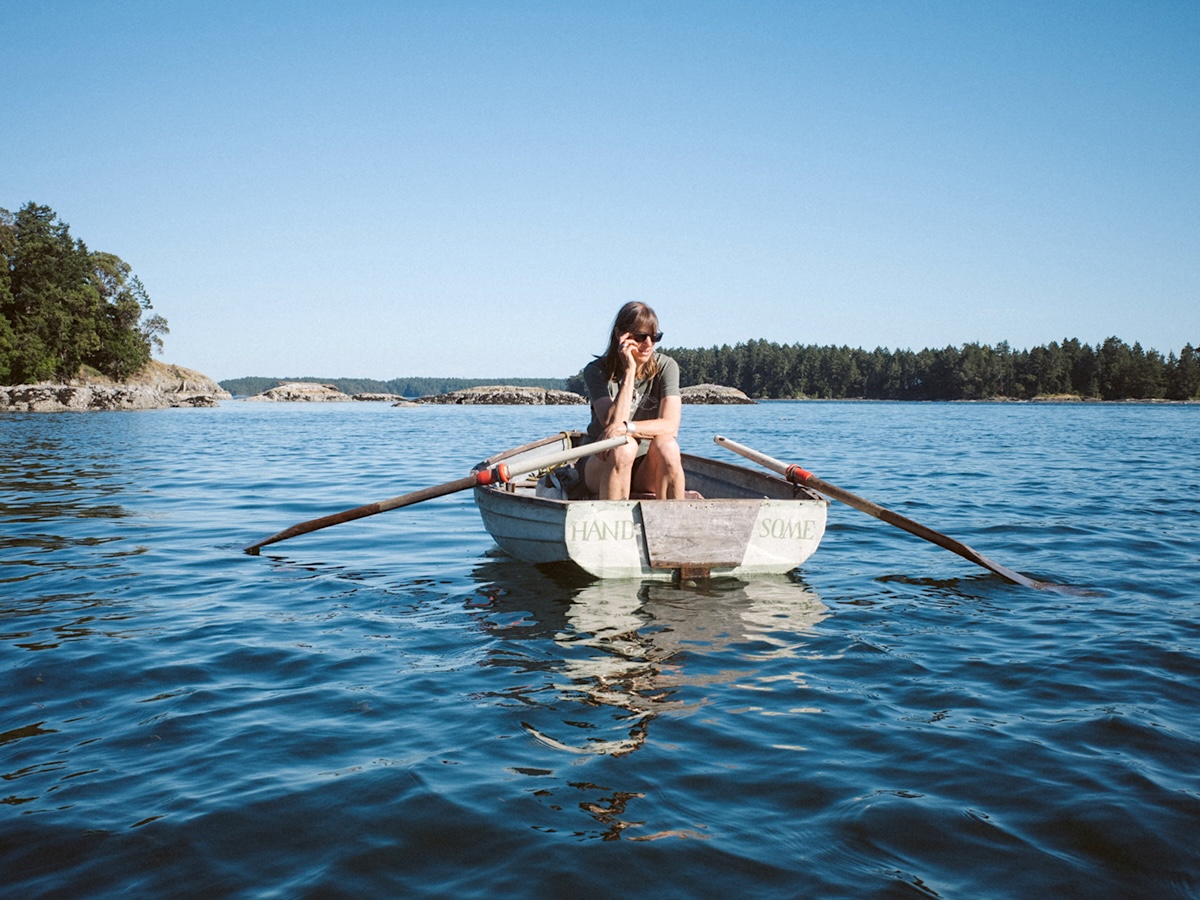
Five years ago, when I was visiting Saltspring Island, author Briony Penn took me to see her favourite islet. We didn’t get there by the usual conveyance of ferry, motorboat, sailboat or kayak. Instead, we rowed.
Penn had two little rowboats tucked up in a cove, and we carried life-jackets and oars down a well-trodden path from her home. I rowed Jetsam; Penn captained Handsome.
The rocky islet was about 500 metres from shore. We yanked the rowboats up a beach of crushed shells and sat on a washed-up log, watching the world. A seal popped its head out of the water, eyes luminous. Tiny fish scampered in the shallows. Penn, a naturalist, could name all the local seabirds: bufflehead, common murre, hooded merganser, short-billed gull, glaucous-winged gull and double-crested cormorant among them. Gulls shrieked, squabbling over the remains of a crab.
Penn was already deep into research for her new book, The Seabird Trials: How a Scientist Took Big Oil to Court and Won. She’d been approached by the family of seabird biologist Harry Carter to ask if she would write Carter’s biography posthumously. Carter was an expert witness in landmark court cases about West Coast oil spills that, Penn writes, “woke up the world to the damages of oil.”
When we went rowing, the Trans Mountain pipeline expansion project was still under construction. Today, about 360 oil tankers a year glide past Saltspring Island, loaded with crude and bitumen from Alberta’s oilsands. That’s a jump from 60 tankers a year.
“I can look out and see the increase,” Penn said when I called to ask her about The Seabird Trials. “They pass right in front of that islet.”
Penn was also deeply concerned about plans to introduce oil supertankers to the Salish Sea as part of the new West Coast pipeline project, now dubbed Pacific Link. Supertankers, which are banned in Washington state and along B.C.’s North Coast, have never before navigated the sharp turns of the Salish Sea’s international shipping lanes. Each supertanker carries two and a half times as much bitumen as the Aframax tankers currently shipping Trans Mountain pipeline oil.
At the centre of The Seabird Trials is the Apex Houston oil spill, which killed 10,000 seabirds off the coast of California in 1986. The ensuing court case, featuring Carter’s testimony, drew international attention because it was one of the first large claims for damages to wildlife from oil spills. It laid the groundwork for subsequent settlements, including from the Exxon Valdez oil spill. It also led to a successful US$5-million seabird restoration project.
That caught the attention of Penn, who says putting more of a price on nature might help prevent future oil disasters.
My conversation with Penn has been edited for length and clarity.
The Tyee: When we think of oil spills, Exxon Valdez springs to mind, and Deepwater Horizon. In BC, we had the devastating Nathan E. Stewart spill in Heiltsuk Nation territory. But not many people have heard of the Apex Houston spill. What was that spill, and why is it important?
It’s January 1986. This big oil barge is tied up in Martinez, north of San Francisco, getting fuel. The dockworker, Daniel Gomez, notices there's a faulty hatch cover. He notifies the company. They take him off the job. They order a second worker at the Martinez refinery to fasten the cover, and the barge goes off and it hits a winter storm. It leaks a large amount of oil all along the coast. Because of the storm and current, it affects a large stretch of that coastline and kills 10,000 seabirds.
Harry Carter knew exactly what was living there — all the seabirds that had been nesting just a few years previously. And so they had really good data about what was there prior to the oil spill. And Harry was also close at hand. He was right there after the oil spill, counting what had died. There was a lot of good evidence about what had been destroyed.
You said you originally intended to write the book like true crime episodes. Why does this story lend itself to the true crime genre?
It was a true crime story. There were 10,000 murder victims. The expert witness, Harry Carter, was put through the same scrutiny as if there were 10,000 human victims he had to identify. He himself had done an autopsy of just about every single bird that had died. He had scoured the beaches and gone to every rehabilitation centre and collected the evidence. It’s one of the reasons he won. No oil company was ever expecting a government scientist to go to the lengths that he did to get evidence of the victims. But he did it. He also had done all the [seabird] inventories prior to the spill.
What inspired you to write ‘The Seabird Trials’?
I was pondering a lot of questions, and I wanted to have an opportunity to answer them. One of them was [about] valuing nature in our legal system. Another question I had was “Why is there this weird relationship between [Christian] fundamentalism and oil?” This court case goes right to the heart of it.
I was interested in a good-news story, because there's a lot of bad news out there. This was a story about restoration. The seabird colony came back completely.
I was also interested in tactics of divide and conquer that are going on everywhere we look. How does it actually work, and how is it so effective? The story revolves between two expert witnesses on each side of the court case, and a divide-and-conquer strategy is used.
And then I really wanted to look at the junction of climate change and biodiversity, because we just don't make the links anymore. Biodiversity has fallen off the radar completely. This is a story where climate change and the protection of biodiversity are completely and utterly intertwined. Seabirds are literally the canaries in the coal mine.
You write that seabirds are critical early warning systems of the impacts of hydrocarbons. Why does it behoove us to pay attention to seabirds?
Seabirds are ultra-sensitive to climate change. The depth that forage fish swim at is related to sea temperature. Up in the north, you’ve got warming sea temperatures driving forage fish down, changing migratory bird behaviour.
Seabird scientists and ornithologists have been spotting the impacts of climate change for over 100 years. They've also been seeing the impacts from oil. In these court cases, the seabirds become a path by which we start understanding what's going on.
The whole [Apex Houston] case was rich with the implications of seabird physiology and natural history. Because seabirds have this canary-in-the-mine role, what does that mean for us, as humans?
Harry Carter's letters to his stepdaughter, about various seabirds like marbled murrelets and horned puffins, figure prominently in the book. Why did you decide to include these letters in their entirety?
I wanted to create a book that would appeal to people that don't normally read science or environmental histories. I wanted to write a book that really celebrated the beauty and the amazing stories of the natural world. Sitting there were all these beautiful stories that Harry had written when he was courting his wife, Emma Carter. He’s writing stories to her daughter, and that was the sort of avenue by which they [Harry and Emma] reunited and restored their relationship. Harry was a meticulous note keeper, and I got access to the family's library.
You can't read about seabirds without being amazed at their diversity, at their adaptability, at how long they've been on this Earth. Despite being on Earth for millions of years, we're putting a lot of them at risk. The ones that really matter a lot in terms of endangered species on the B.C. coast are the marbled murrelets and the common murres and the puffins.
Some people love reading the letters because they've never read natural history before. Because it's in the format of a letter to a child, they're pretty easy to understand.
You tell a good-news story about how a former seabird breeding colony that was decimated by the Apex Houston spill eventually came back to life, but only with intensive efforts, like using dummy birds and sound recordings to bring back common murres. What is the significance of this restoration effort?
It was a seabird colony called Devil’s Slide Rock. Common murres, a member of the puffin family, only nest in colonies. Once the colony gets too small, they stop nesting. The seabird colony will literally die out.
They created all these decoys and landed on this remote seabird colony. It’s dangerous to get there. You have to climb up using climbing gear. They installed all these decoys and they created recordings of the colony.
Over 20 years, this seabird colony went from three nesting pairs — that was all that was left of the population after the oil spill — all the way back to the full breeding colony. It’s a big success story. It’s an important symbolic story. As humans, we can have agency to help restore things in many different ways.
What are the big takeaways for nature from Carter’s work and the Apex Houston case?
Getting animals and wildlife valued in our legal system is one piece of the puzzle to shifting our worldview and putting a value on nature. From the Apex Houston, we learned what it takes to value a species and come up with some scheme of how we're going to restore it — and what that's going to cost and how long that's going to take.
I think its biggest value is that maybe someone thinks twice about not screwing the hatch on the tanker, if they think that they're going to be paying the tab for a 20-year restoration project involving dozens and dozens of scientists. You’re going to think twice if you’ve got to restore an entire endangered pod of southern resident killer whales.
If you put a value on every living thing that is killed, it's going to start acting as a bit of a deterrent. If the cost of destroying them pushes you into a non-competitive place, it changes human behaviour. So, for example, it might have changed the decision of whether the whistleblower was fired or not. They may have said, “You're going to be rewarded. You just saved the company $6 million.”
Did you envision a new West Coast oil pipeline and tanker terminal and oil supertankers in the Salish Sea when you were writing ‘The Seabird Trials’?
When I started writing this book, there was none of this. In a way, the book's good timing, sadly.
People were galvanized by the Santa Barbara oil spill back in the late ’60s. That's what gave rise to the Endangered Species Act in the States, and the Environmental Protection Act in Canada, and a whole proliferation of legislation, which is what led to Harry Carter's moment of glory — when he could actually bring all the momentum from that oil spill in Santa Barbara and do something positive and try and prevent further oil spills.
I feel like we're at that moment again. It might take another oil spill. I can tell you it's really ugly to see a dead puffin washed up on a beach, smothered in viscous crude oil.
You also write about the Nestucca oil spill that Harry Carter had a personal connection to because of its devastating impact on seabirds along the west coast of Vancouver Island. What lessons does this spill hold for the BC and Washington state coasts?
The Nestucca spill was back in the ’80s. The tanker was off Washington when it started spilling. That slick, due to currents and weather, moved north very quickly and covered most of the west coast, right up to Clayoquot Sound and north. People started watching these large pancakes — four- or five-foot-sized pancakes — of oil moving in, in the dead of winter. Cleland Island was a seabird colony. It was [B.C.’s] very first ecological reserve. It's the seabird colony that Harry Carter cut his teeth on.
The Cleland Island seabird colonies have never been the same. Common murres are extirpated from there. There were all sorts of losses. Oil spills are not great for tourism, and that's just one of the many ways that people make their living on the coast.
It's not going to be if there's going to be an oil spill. It's going to be when. The Nestucca is a really good reminder that it’s just round the corner.
Keep an eye out tomorrow, when The Tyee will run an excerpt from ‘The Seabird Trials.’ 
Read more: Books, Environment











Tyee Commenting Guidelines
Please note that email notifications for replies are not currently working due to a software issue which may be resolved in a future update.
Comments that violate guidelines risk being deleted, and violations may result in a temporary or permanent user ban. Maintain the spirit of good conversation to stay in the discussion and be patient with moderators. Comments are reviewed regularly but not in real time.
Do:
Do not: